
Remote-Vent Aeration Controller Market Report 2026
Global Outlook – By Product Type (Automatic, Semi-Automatic, Manual), By Connectivity (Wired, Wireless), By Distribution Channel (Online, Offline), By Application (Agriculture, Aquaculture, Industrial, Residential, Other Applications) – Market Size, Trends, Strategies, and Forecast to 2030
Remote-Vent Aeration Controller Market Overview
• Remote-Vent Aeration Controller market size has reached to $1.27 billion in 2025 • Expected to grow to $2.39 billion in 2030 at a compound annual growth rate (CAGR) of 13.4% • Growth Driver: Surge In Smart Homes And Green Buildings Driving The Growth Of The Market Due To Rising Energy Efficiency Awareness • Market Trend: Technological Innovations In Remote-Vent Aeration Controllers • North America was the largest region in 2025 and Asia-Pacific is the fastest growing region.What Is Covered Under Remote-Vent Aeration Controller Market?
A remote-vent aeration controller is a device that remotely manages and regulates the aeration systems used in environments such as wastewater treatment plants, aquaculture facilities, or industrial processes. Its primary function is to control the flow of air or oxygen into a liquid medium to maintain optimal levels for biological, chemical, or environmental processes. The main types of products in the remote-vent aeration controller are automatic, semi-automatic, and manual. Automatic remote-vent aeration controllers function independently, relying on sensors and programmed logic to detect changes in airflow, humidity, or air quality and activate accordingly. It includes various connectivity types, such as wired and wireless, and is distributed online and offline. It finds applications in agriculture, aquaculture, industrial, residential, and other fields.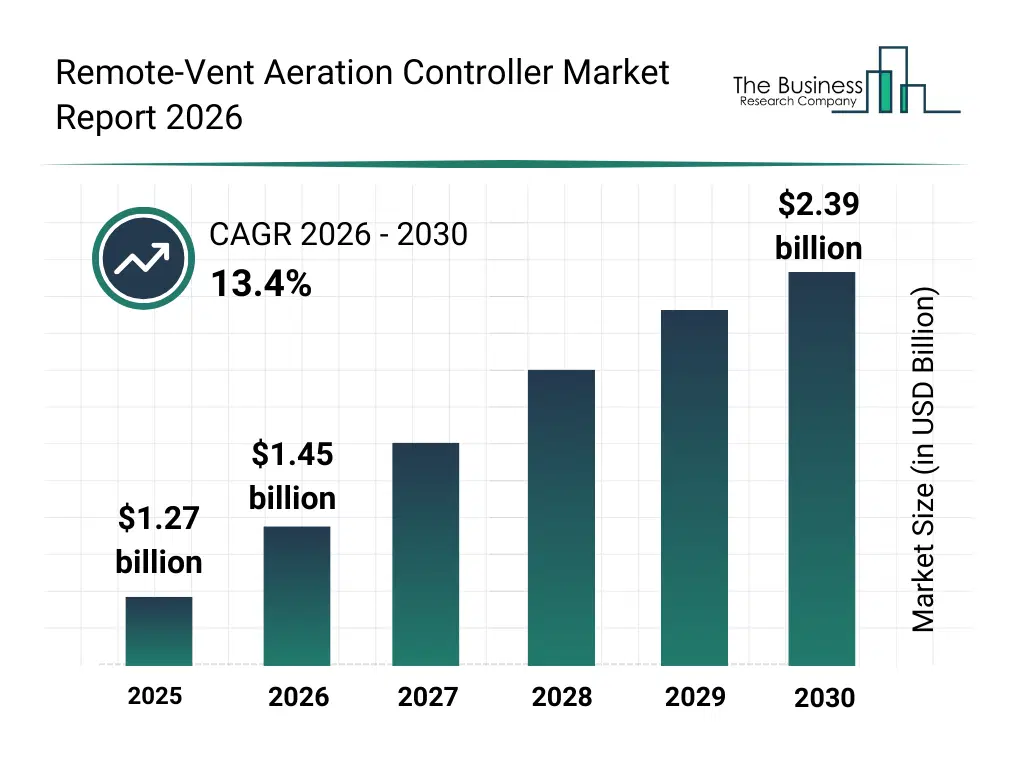
What Is The Remote-Vent Aeration Controller Market Size and Share 2026?
The remote-vent aeration controller market size has grown rapidly in recent years. It will grow from $1.27 billion in 2025 to $1.45 billion in 2026 at a compound annual growth rate (CAGR) of 13.7%. The growth in the historic period can be attributed to growing reliance on traditional aeration controls, increased need for wastewater treatment efficiency, rise in aquaculture production, early adoption of basic remote monitoring, heightened awareness of oxygen management requirements.What Is The Remote-Vent Aeration Controller Market Growth Forecast?
The remote-vent aeration controller market size is expected to see rapid growth in the next few years. It will grow to $2.39 billion in 2030 at a compound annual growth rate (CAGR) of 13.4%. The growth in the forecast period can be attributed to rising demand for automated aeration systems, growth in precision aquaculture, increasing industrial focus on energy-efficient operations, expansion of digital aeration infrastructure, higher adoption of wireless control technologies. Major trends in the forecast period include increasing demand for remote aeration optimization, rising adoption of smart ventilation control in aquaculture, growth of automated wastewater aeration solutions, expansion of energy-efficient aeration management systems, higher integration of sensor-based airflow monitoring.
Global Remote-Vent Aeration Controller Market Segmentation
1) By Product Type: Automatic, Semi-Automatic, Manual 2) By Connectivity: Wired, Wireless 3) By Distribution Channel: Online, Offline 4) By Application: Agriculture, Aquaculture, Industrial, Residential, Other Applications Subsegments: 1) By Automatic: Digital Control System, Programmable Timer System, Sensor-Based Control System 2) By Semi-Automatic: Timer Assisted Control, Manual Override Control, Partial Sensor Control 3) By Manual: Handwheel Operation, Lever Operation, Push-Button OperationWhat Is Driver Of The Remote-Vent Aeration Controller Market?
The increasing popularity of smart homes and green buildings is expected to propel the growth of the remote-vent aeration controller market going forward. Smart homes and green buildings refer to living spaces that integrate advanced technologies and sustainable design practices to enhance comfort, efficiency, and environmental responsibility. The growing popularity of smart homes and green buildings is driven by increasing awareness of energy efficiency, as people seek solutions that reduce utility costs while minimizing environmental impact. The remote-vent aeration controller supports smart homes and green buildings by optimizing indoor air quality and energy efficiency through intelligent ventilation management. For instance, according to the U.S. Green Building Council, a US-based non-profit organization, there were over 46,000 residential projects certified under the LEED green building rating system in 2024, following nearly a 5% rise in new LEED residential project registrations in 2023. Therefore, the increasing popularity of smart homes and green buildings is driving the growth of the remote-vent aeration controller industry.Key Players In The Global Remote-Vent Aeration Controller Market
Major companies operating in the remote-vent aeration controller market are Munters Group AB, Big Dutchman AG, Plasson Industries Ltd., Climatec LLC, Priva Inc., SKOV A/S, Farmer Boy Ag Inc., J&D Manufacturing Inc., Argus Control Systems Ltd., Hotraco Agri B.V., Prism Controls Inc., DACS A/S, Automated Production Systems Inc., Link4 Corporation, Wadsworth Controls Ltd., LUBING Systems, Phason Controls Ltd., Autogrow Limited, Agridry LLC, Fancom B.V., Growlink Inc., Munter Climate Solutions, AgriNomix LLC, Onset HOBO Data Loggers, Sensaphone Remote Monitoring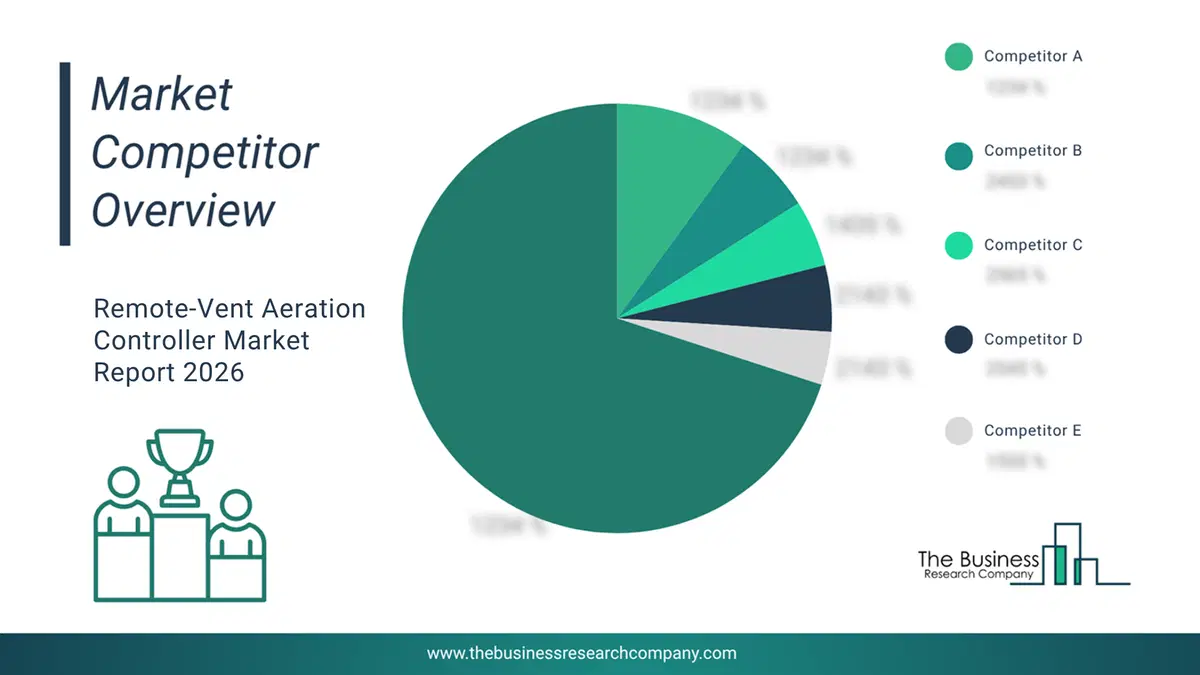
This chart is for illustrative purposes; the full report includes a detailed competitor analysis and comprehensive overview of the top 10 companies in the market.
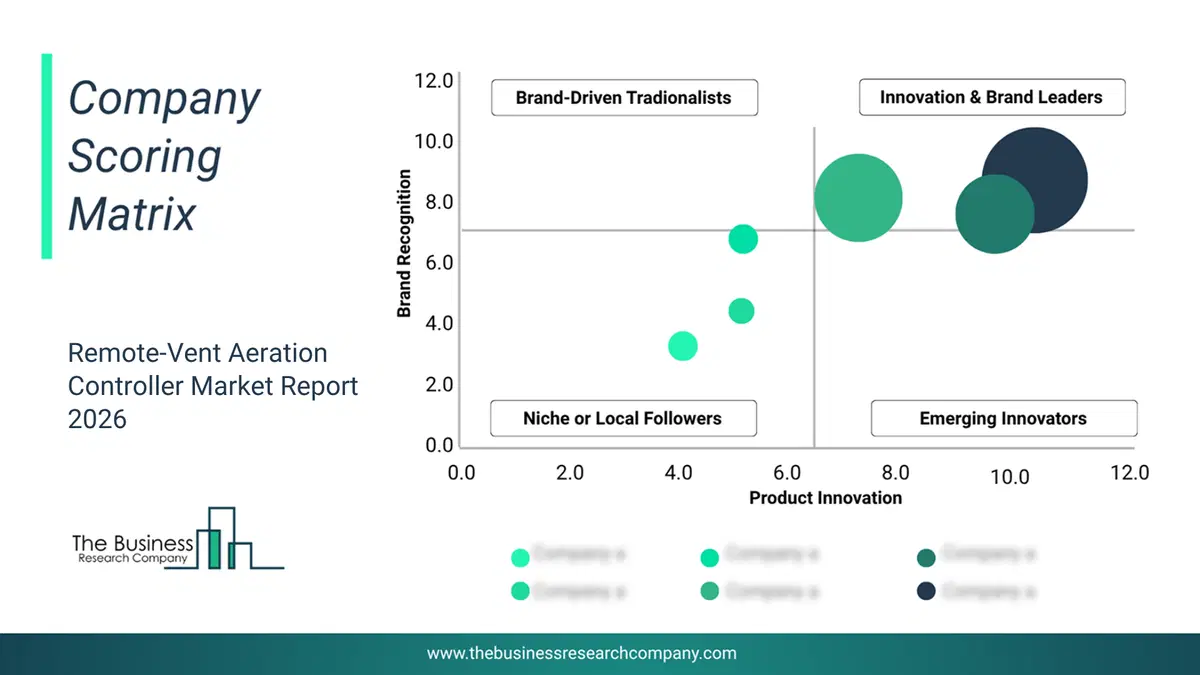
This chart maps companies by product innovation and brand strength, with bubble size indicating relative revenue, helping identify market leaders, challengers, and niche players. This is an illustrative chart; the full report provides a complete and accurate competitive analysis.
Global Remote-Vent Aeration Controller Market Trends and Insights
Major companies operating in the remote-vent aeration controller market are focusing on developing technologically innovative solutions, such as advanced aeration control modules, to enhance operational efficiency and improve environmental compliance across water and wastewater treatment processes. Advanced aeration control modules are sophisticated systems that monitor and adjust oxygen levels, airflow, and water quality in real time to optimize efficiency, reduce energy use, and ensure effective treatment in water and wastewater processes. For instance, in September 2024, iGRAIN, an India-based service provider in agri commodities, launched an advanced Aeration Control Module for grain storage aimed at enhancing the efficiency and safety of stored grain. This fully automatic system uses real-time data from sensors monitoring grain temperature, moisture, CO2 levels, and weather to precisely control aeration fans, optimizing grain conditions and minimizing energy use and spoilage risks. By applying a sophisticated Equilibrium Moisture Concentration (EMC)-based algorithm, the module regulates the grain environment to maintain quality and extend storage life. It integrates with iGRAIN’s digital platforms for easy monitoring and reporting, supporting better decision-making in grain storage management.What Are Latest Mergers And Acquisitions In The Remote-Vent Aeration Controller Market? Grundfos Acquires Newterra To Expand Water Treatment Capabilities And North American Market Presence
In August 2025, Grundfos Holding A/S, a Denmark-based provider of advanced pump solutions and water technologies, acquired Newterra Corporation for an undisclosed amount. With this acquisition, Grundfos aims to significantly strengthen its water and wastewater treatment portfolio by integrating advanced modular and reuse technologies from Newterra, while also expanding its operational footprint, customer reach, and overall market presence across the North American region. Newterra Corporation is a US-based manufacturing company that offers remote-vent aeration controllers.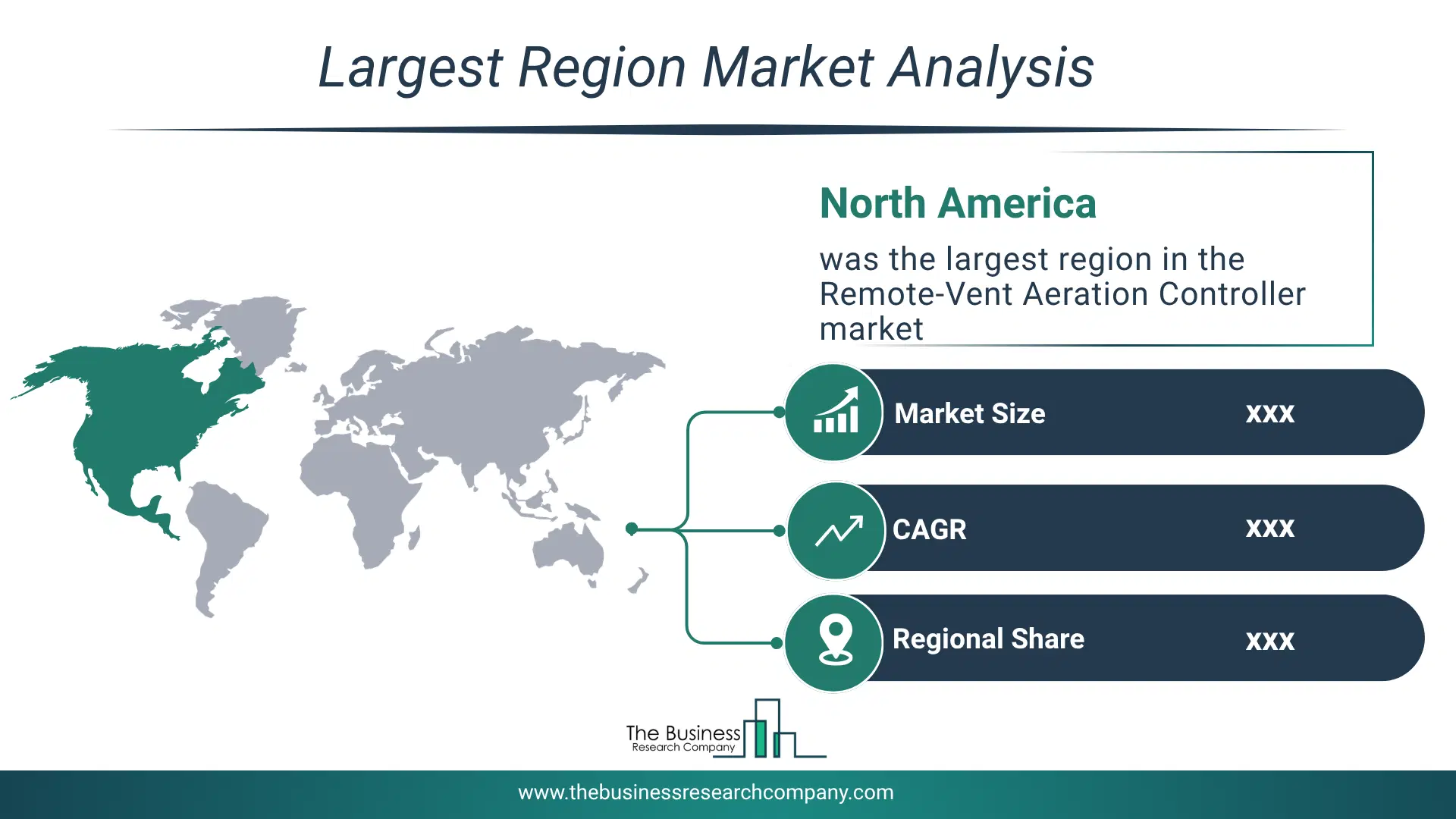
Regional Outlook
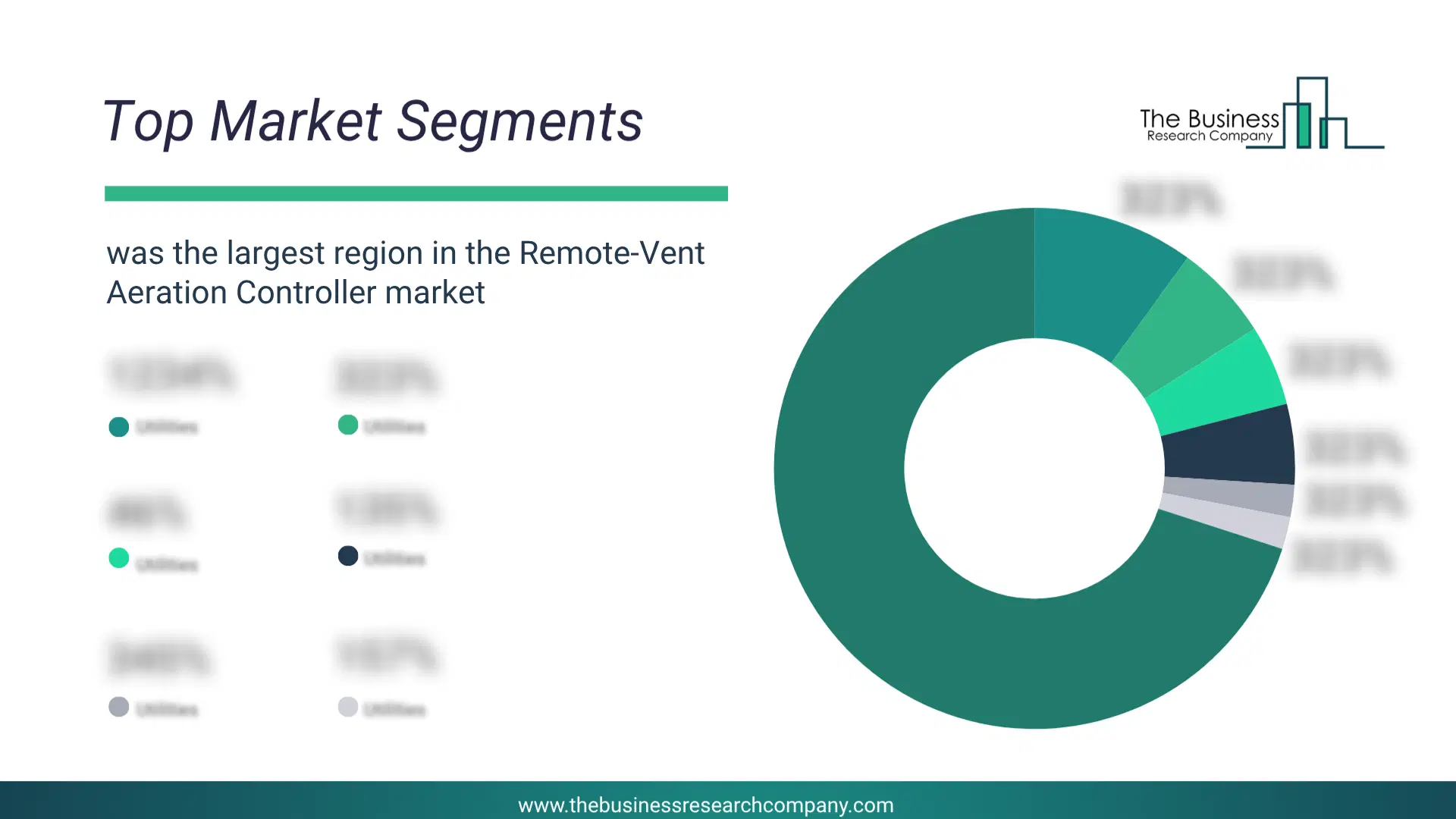
North America was the largest region in the remote-vent aeration controller market in 2025. Asia-Pacific is expected to be the fastest-growing region in the forecast period. The regions covered in this market report are Asia-Pacific, South East Asia, Western Europe, Eastern Europe, North America, South America, Middle East, Africa. The countries covered in this market report are Australia, Brazil, China, France, Germany, India, Indonesia, Japan, Taiwan, Russia, South Korea, UK, USA, Canada, Italy, SpainWhat Defines the Remote-Vent Aeration Controller Market?
The remote-vent aeration controller market consists of sales of ventilation controllers, air quality sensors, motorized dampers, speed controllers, thermostats and timers, and remote control switches. Values in this market are ‘factory gate’ values; that is, the value of goods sold by the manufacturers or creators of the goods, whether to other entities (including downstream manufacturers, wholesalers, distributors, and retailers) or directly to end customers. The value of goods in this market includes related services sold by the creators of the goods.How is Market Value Defined and Measured?
The market value is defined as the revenues that enterprises gain from the sale of goods and/or services within the specified market and geography through sales, grants, or donations in terms of the currency (in USD unless otherwise specified). The revenues for a specified geography are consumption values that are revenues generated by organizations in the specified geography within the market, irrespective of where they are produced. It does not include revenues from resales along the supply chain, either further along the supply chain or as part of other products.
This chart presents market attractiveness based on a quantitative evaluation of growth, competition, strategic alignment, and risk, offering a clear view of opportunity areas for decision-making. This chart is for illustrative purposes; the full report contains the complete analysis.

This chart highlights the Total Addressable Market (TAM) by estimating the maximum revenue opportunity using an assumption-driven approach, supporting strategic planning and opportunity sizing across markets. The chart is illustrative; the full report provides a more comprehensive analysis.
What Key Data and Analysis Are Included in the Remote-Vent Aeration Controller Market Report 2026?
The remote-vent aeration controller market research report is one of a series of new reports from The Business Research Company that provides market statistics, including industry global market size, regional shares, competitors with the market share, detailed market segments, market trends and opportunities, and any further data you may need to thrive in the remote-vent aeration controller industry. The market research report delivers a complete perspective of everything you need, with an in-depth analysis of the current and future state of the industry.Remote-Vent Aeration Controller Market Report Forecast Analysis
| Report Attribute | Details |
|---|---|
| Market Size Value In 2026 | $1.45 billion |
| Revenue Forecast In 2030 | $2.39 billion |
| Growth Rate | CAGR of 13.4% from 2026 to 2030 |
| Base Year For Estimation | 2025 |
| Actual Estimates/Historical Data | 2020-2025 |
| Forecast Period | 2026 - 2030 |
| Market Representation | Revenue in USD Billion and CAGR from 2026 to 2030 |
| Segments Covered | Product Type, Connectivity, Distribution Channel, Application |
| Regional Scope | Asia-Pacific, Western Europe, Eastern Europe, North America, South America, Middle East, Africa |
| Country Scope | The countries covered in the report are Australia, Brazil, China, France, Germany, India, Indonesia, Japan, Taiwan, Russia, South Korea, UK, USA, Canada, Italy, Spain |
| Key Companies Profiled | Munters Group AB, Big Dutchman AG, Plasson Industries Ltd., Climatec LLC, Priva Inc., SKOV A/S, Farmer Boy Ag Inc., J&D Manufacturing Inc., Argus Control Systems Ltd., Hotraco Agri B.V., Prism Controls Inc., DACS A/S, Automated Production Systems Inc., Link4 Corporation, Wadsworth Controls Ltd., LUBING Systems, Phason Controls Ltd., Autogrow Limited, Agridry LLC, Fancom B.V., Growlink Inc., Munter Climate Solutions, AgriNomix LLC, Onset HOBO Data Loggers, Sensaphone Remote Monitoring |
| Customization Scope | Request for Customization |
| Pricing And Purchase Options | Explore Purchase Options |