

Renewable Aviation Fuel Market Report 2026
Global Outlook – By Fuel Type (Biofuel, Hydrogen Fuel, Power To Liquid Fuel, Other Fuel Types), By Feedstock (Vegetable Oils, Animal Fats, Municipal Solid Waste, Other Feedstocks), By Blending Capacity (Below 30 Percent, 30 Percent To 50 Percent, Above 50 Percent), By Distribution Channel (Direct Sales, Distributors, Online Sales), By Application (Commercial Aviation, Military Aviation, Business And General Aviation, Other Applications) – Market Size, Trends, Strategies, and Forecast to 2030
Renewable Aviation Fuel Market Overview
• Renewable Aviation Fuel market size has reached to $2.54 billion in 2025 • Expected to grow to $11.83 billion in 2030 at a compound annual growth rate (CAGR) of 35.9% • Growth Driver: The Rising Crude Oil Price Driving The Growth Of The Market Due To Increasing Geopolitical Tensions • Market Trend: Digital Solutions Drive Verified Emissions Reduction Initiatives • North America was the largest region in 2025 and Asia-Pacific is the fastest growing region.What Is Covered Under Renewable Aviation Fuel Market?
Renewable aviation fuel refers to a sustainable aviation fuel produced from renewable feedstocks such as biomass, waste oils, agricultural residues, and other non-fossil sources. It is designed to serve as a lower-carbon alternative to conventional jet fuel, helping reduce greenhouse gas emissions while maintaining compatibility with existing aircraft engines and aviation infrastructure. The main fuel types of renewable aviation fuel include biofuel, hydrogen fuel, power to liquid fuel, and other fuel types. Biofuel refers to sustainable aviation fuel produced from renewable biological resources that can reduce greenhouse gas emissions compared with conventional jet fuel. These fuels are produced from feedstocks such as vegetable oils, animal fats, municipal solid waste, and other feedstocks and are available in blending capacities including below 30 percent, 30 percent to 50 percent, and above 50 percent. They are distributed through direct sales, distributors, and online sales and find application in commercial aviation, military aviation, business and general aviation, and others.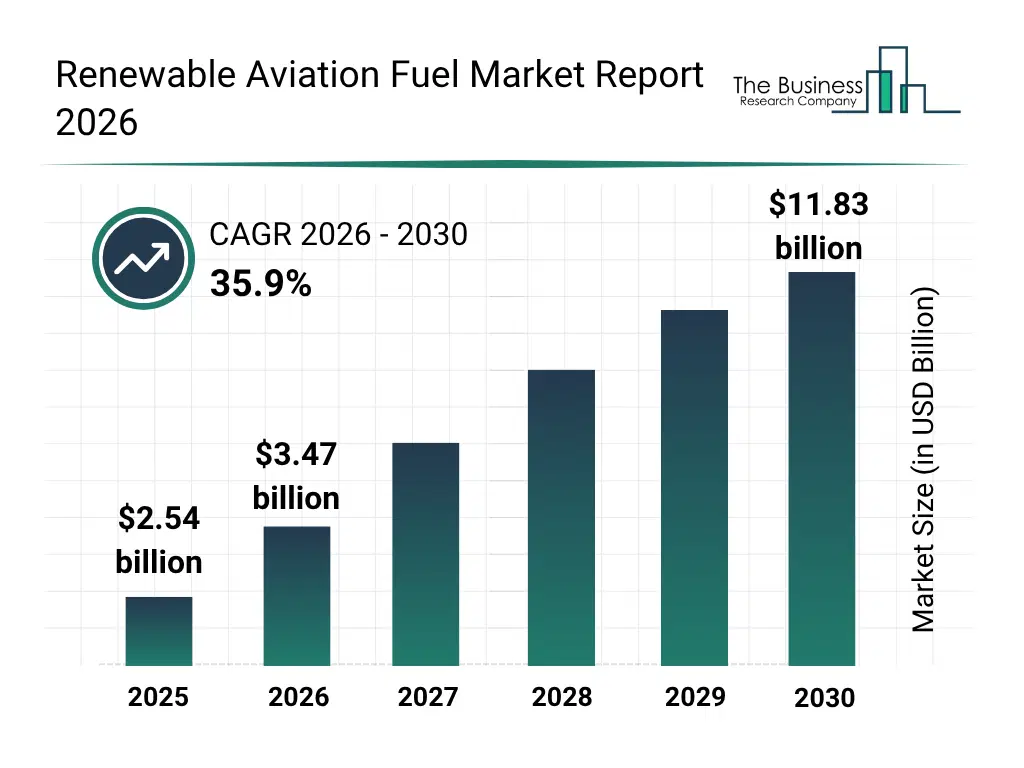
What Is The Renewable Aviation Fuel Market Size and Share 2026?
The renewable aviation fuel market size has grown exponentially in recent years. It will grow from $2.54 billion in 2025 to $3.47 billion in 2026 at a compound annual growth rate (CAGR) of 36.3%. The growth in the historic period can be attributed to increasing aviation fuel consumption, rising greenhouse gas emission concerns, growing government support for low carbon fuels, expanding biofuel production capacity, increasing utilization of waste based feedstocks.What Is The Renewable Aviation Fuel Market Growth Forecast?
The renewable aviation fuel market size is expected to see exponential growth in the next few years. It will grow to $11.83 billion in 2030 at a compound annual growth rate (CAGR) of 35.9%. The growth in the forecast period can be attributed to growing demand for sustainable aviation fuel, rising investments in renewable fuel production plants, increasing adoption of advanced fuel blending technologies, expanding commercial aviation decarbonization initiatives, growing development of hydrogen based aviation fuels. Major trends in the forecast period include increasing development of advanced sustainable aviation fuel pathways, growing adoption of waste based renewable aviation fuel feedstocks, rising expansion of commercial scale renewable aviation fuel production facilities, expanding investments in renewable aviation fuel blending infrastructure, increasing focus on high energy density renewable aviation fuel formulations.
Global Renewable Aviation Fuel Market Segmentation
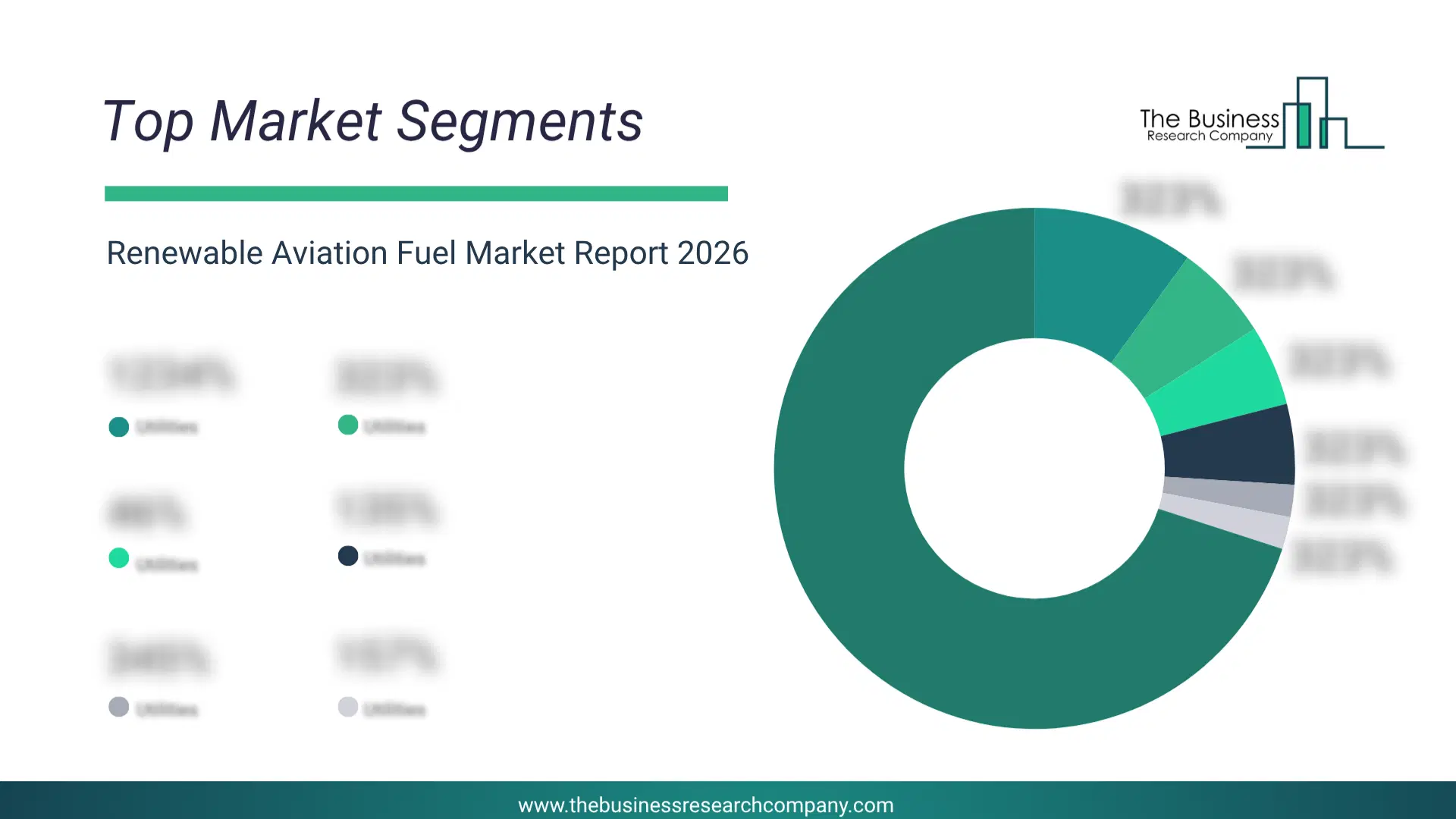
2) By Feedstock: Vegetable Oils, Animal Fats, Municipal Solid Waste, Other Feedstocks 3) By Blending Capacity: Below 30 Percent, 30 Percent To 50 Percent, Above 50 Percent 4) By Distribution Channel: Direct Sales, Distributors, Online Sales 5) By Application: Commercial Aviation, Military Aviation, Business And General Aviation, Other Applications Subsegments: 1) By Biofuel: Hydroprocessed Esters And Fatty Acids Fuel, Fischer Tropsch Fuel, Alcohol To Jet Fuel, Synthesized Iso Paraffinic Fuel, Catalytic Hydrothermolysis Jet Fuel 2) By Hydrogen Fuel: Liquid Hydrogen Fuel, Gaseous Hydrogen Fuel, Green Hydrogen Fuel, Renewable Hydrogen Fuel 3) By Power To Liquid Fuel: Synthetic Kerosene Fuel, Electrofuel Aviation Fuel, Carbon Dioxide Derived Fuel, Renewable Electricity Based Fuel 4) By Other Fuel Types: Biomass Derived Aviation Fuel, Waste Based Aviation Fuel, Renewable Diesel Blend Fuel, Advanced Sustainable Aviation FuelWhat Is The Driver Of The Renewable Aviation Fuel Market?
The rising crude oil price is expected to propel the growth of the renewable aviation fuel market going forward. Crude oil price refers to the value at which crude oil is bought and sold per barrel in global commodities markets. Rising crude oil prices are driven by increasing geopolitical tensions, which disrupt supply chains, create uncertainty in oil-producing regions, and raise concerns about future supply shortages. Renewable aviation fuel reduces dependence on conventional jet fuel derived from crude oil, thereby moderating crude oil demand pressures and contributing to more stable global crude oil prices. For instance, in January 2025, according to the Energy Information Administration, a US-based government agency, Brent crude oil prices increased from a monthly average of $78 per barrel in December 2023 to $89 per barrel in April 2024. Therefore, the rising crude oil price is driving the growth of the renewable aviation fuel industry.Key Players In The Global Renewable Aviation Fuel Market
Major companies operating in the renewable aviation fuel market are China Petrochemical Corporation, Shell plc, BP p.l.c., TotalEnergies SE, Eni S.p.A., OMV Aktiengesellschaft, Honeywell International Inc., Neste Oyj, Sasol Limited, Preem AB, SkyNRG B.V., Aemetis Inc., World Energy LLC, LanzaTech Global Inc., Gevo Inc., DG Fuels LLC, Repsol S.A., Chevron Corporation, Phillips 66, Marathon Petroleum Corporation, ExxonMobil Corporation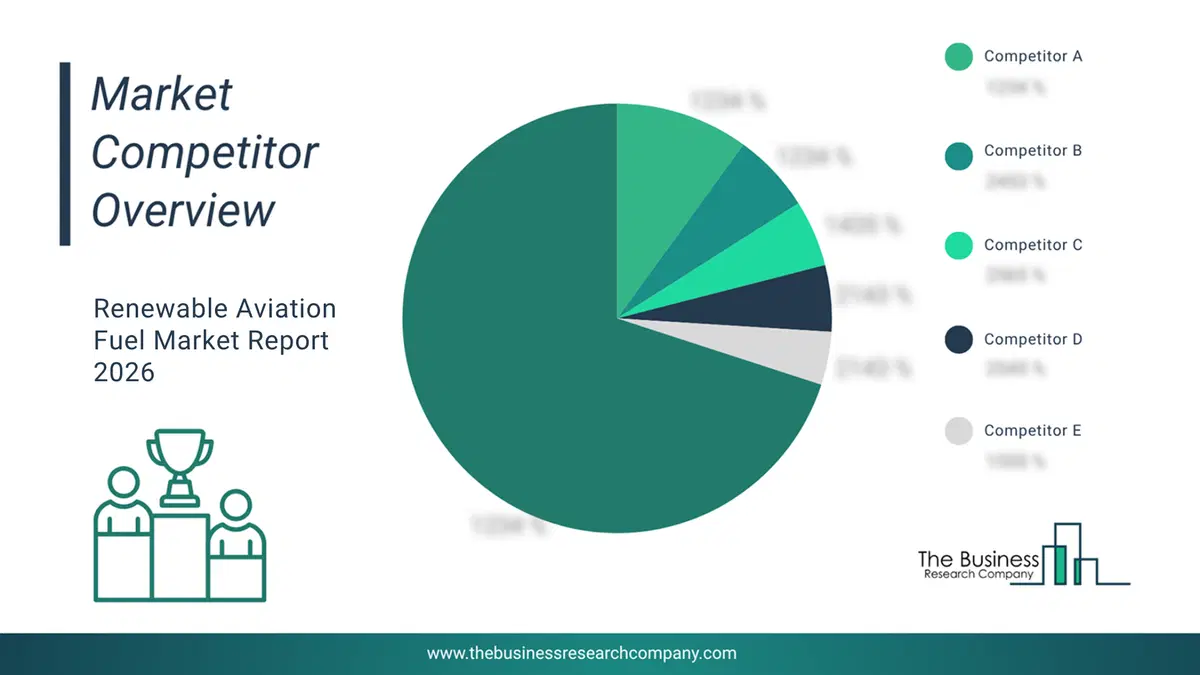
This chart is for illustrative purposes; the full report includes a detailed competitor analysis and comprehensive overview of the top 10 companies in the market.
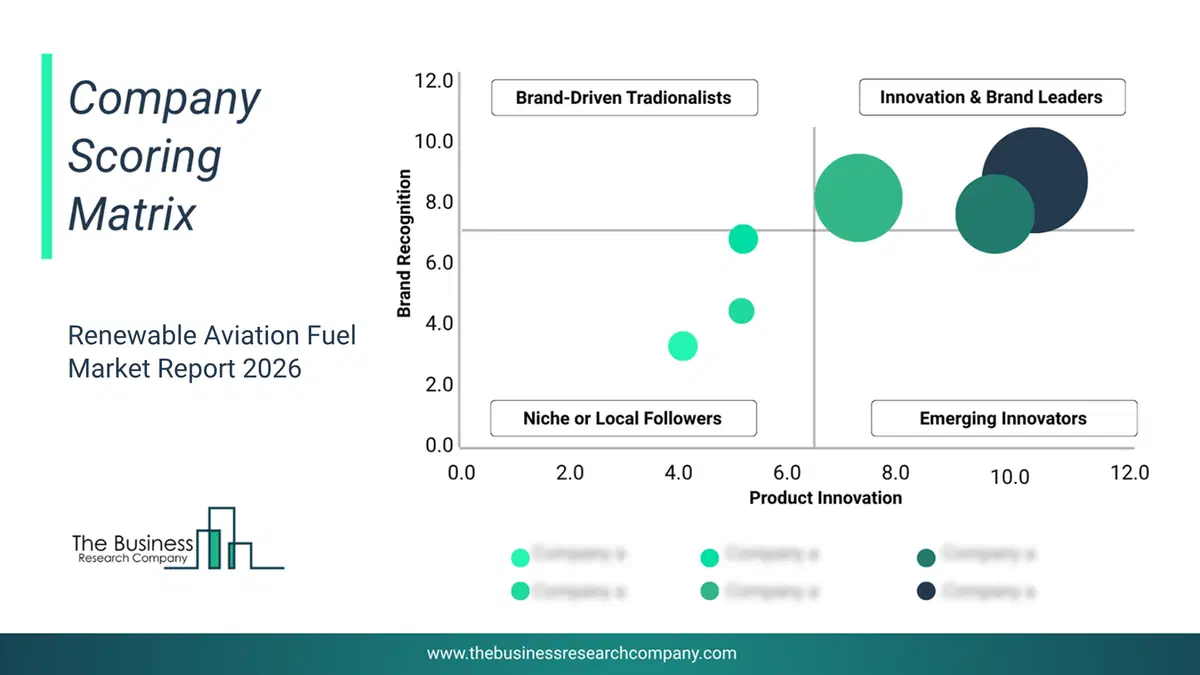
This chart maps companies by product innovation and brand strength, with bubble size indicating relative revenue, helping identify market leaders, challengers, and niche players. This is an illustrative chart; the full report provides a complete and accurate competitive analysis.
Global Renewable Aviation Fuel Market Trends and Insights
Major companies operating in the renewable aviation fuel market are focusing on developing innovative solutions, such as digital emissions-reduction solutions, to enhance carbon footprint transparency, accelerate sustainable fuel adoption, and support corporate decarbonization goals. Digital emissions-reduction solutions are technology-based platforms and tools that track, measure, verify, and manage greenhouse gas emissions, enabling organizations to reduce their environmental impact through data-driven sustainability initiatives. For instance, in November 2025, Spring Global Delivery Solutions, a Netherlands-based cross-border logistics company, launched its Book And Claim solution for Sustainable Aviation Fuel (SAF) and a digital emissions-reduction solution. The solution allows customers to support verified SAF usage and receive certified emissions reduction attributes linked to their air freight activities. Spring GDS secured 170,000 liters of SAF sourced from renewable waste and residue feedstocks, enabling measurable reductions in lifecycle carbon emissions compared with conventional fossil-based jet fuel. The platform provides end-to-end sourcing, allocation, verification, and sustainability reporting services, helping customers document Scope 3 emissions reductions. It incorporates third-party certification under recognized standards, including ISCC, RSB, and CORSIA, ensuring transparency, traceability, and prevention of double counting.What Are Latest Mergers And Acquisitions In The Renewable Aviation Fuel Market?
In February 2026, Montana Renewables LLC, a US-based renewable fuels producer, partnered with World Energy to enhance the efficiency and scalability of Sustainable Aviation Fuel (SAF) deliveries across the aviation fuel supply chain. With this partnership, Montana Renewables and World Energy aim to streamline SAF logistics, improve coordination between production and distribution networks, and accelerate the availability of lower-carbon aviation fuel to airlines, thereby supporting decarbonization efforts in the aviation sector. World Energy Clean Fuels LLC is a US-based producer of renewable fuels, including sustainable aviation fuel derived from low-carbon feedstocks.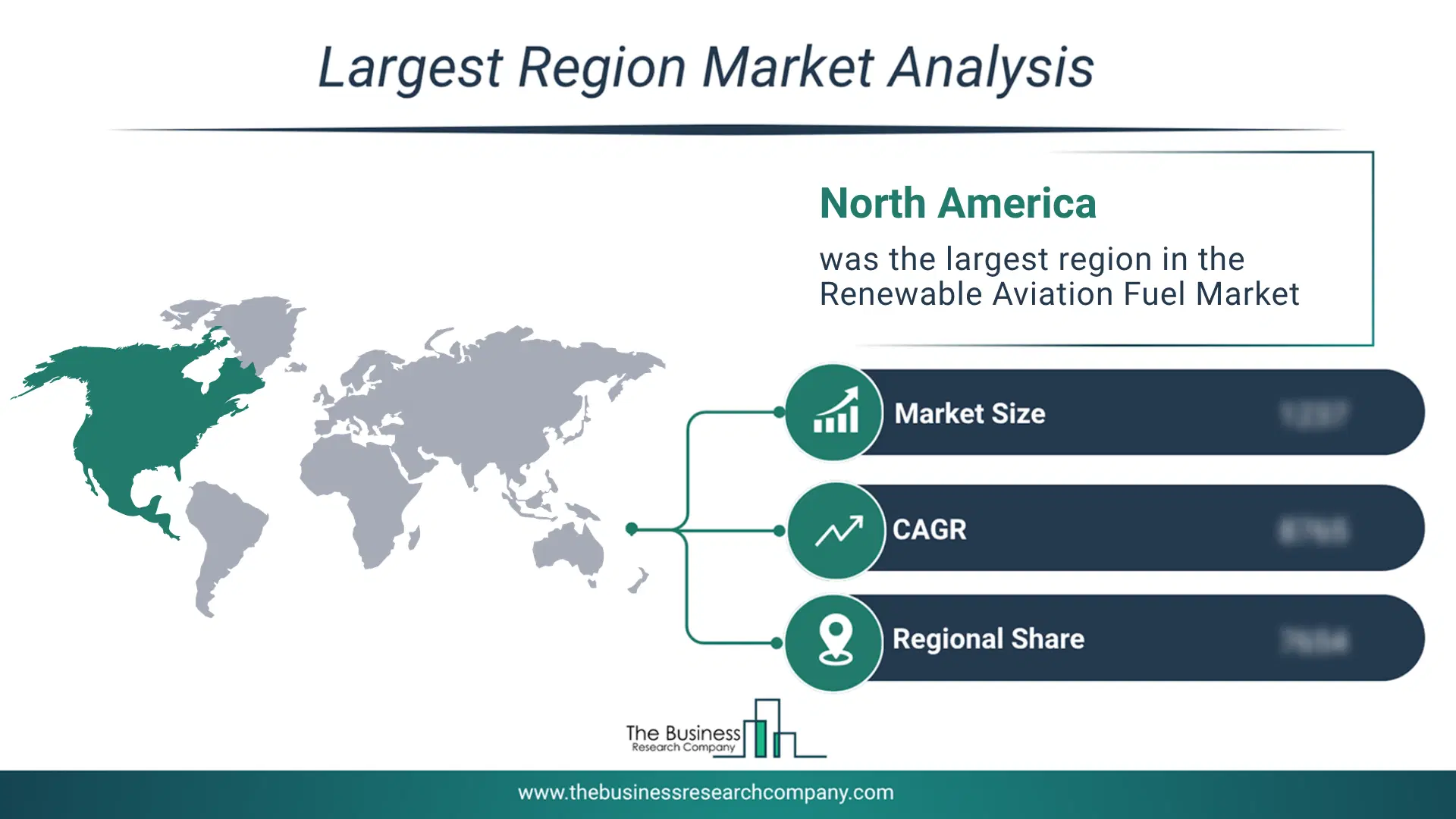
Regional Outlook/Insights
North America was the largest region in the renewable aviation fuel market in 2025. Asia-Pacific is expected to be the fastest-growing region in the forecast period. The regions covered in this market report are Asia-Pacific, South East Asia, Western Europe, Eastern Europe, North America, South America, Middle East, Africa. The countries covered in this market report are Australia, Brazil, China, France, Germany, India, Indonesia, Japan, Taiwan, Russia, South Korea, UK, USA, Canada, Italy, Spain.What Defines the Renewable Aviation Fuel Market?
The renewable aviation fuel market consists of sales of sustainable aviation fuel, fischer-tropsch synthetic paraffinic kerosene, alcohol-to-jet fuel, and synthesized iso-paraffins fuel. Values in this market are ‘factory gate’ values, that is, the value of goods sold by the manufacturers or creators of the goods, whether to other entities (including downstream manufacturers, wholesalers, distributors, and retailers) or directly to end customers. The value of goods in this market includes related services sold by the creators of the goods.How is Market Value Defined and Measured?
The market value is defined as the revenues that enterprises gain from the sale of goods and/or services within the specified market and geography through sales, grants, or donations in terms of the currency (in USD unless otherwise specified). The revenues for a specified geography are consumption values that are revenues generated by organizations in the specified geography within the market, irrespective of where they are produced. It does not include revenues from resales along the supply chain, either further along the supply chain or as part of other products.
This chart presents market attractiveness based on a quantitative evaluation of growth, competition, strategic alignment, and risk, offering a clear view of opportunity areas for decision-making. This chart is for illustrative purposes; the full report contains the complete analysis.

This chart highlights the Total Addressable Market (TAM) by estimating the maximum revenue opportunity using an assumption-driven approach, supporting strategic planning and opportunity sizing across markets. The chart is illustrative; the full report provides a more comprehensive analysis.
What Key Data and Analysis Are Included in the Renewable Aviation Fuel Market Report 2026?
The renewable aviation fuel market research report is one of a series of new reports from The Business Research Company that provides renewable aviation fuel market statistics, including renewable aviation fuel industry global market size, regional shares, competitors with a renewable aviation fuel market share, detailed renewable aviation fuel market segments, market trends and opportunities, and any further data you may need to thrive in the renewable aviation fuel industry. This renewable aviation fuel market research report delivers a complete perspective of everything you need, with an in-depth analysis of the current and future scenario of the industry.Renewable Aviation Fuel Market Report Forecast Analysis
| Report Attribute | Details |
|---|---|
| Market Size Value In 2026 | $3.47 billion |
| Revenue Forecast In 2030 | $11.83 billion |
| Growth Rate | CAGR of 35.9% from 2026 to 2030 |
| Base Year For Estimation | 2025 |
| Actual Estimates/Historical Data | 2020-2025 |
| Forecast Period | 2026 - 2030 |
| Market Representation | Revenue in USD Billion and CAGR from 2026 to 2030 |
| Segments Covered | Fuel Type, Feedstock, Blending Capacity, Distribution Channel, Application |
| Regional Scope | Asia-Pacific, Western Europe, Eastern Europe, North America, South America, Middle East, Africa |
| Country Scope | The countries covered in the report are Australia, Brazil, China, France, Germany, India, Indonesia, Japan, Taiwan, Russia, South Korea, UK, USA, Canada, Italy, Spain. |
| Key Companies Profiled | China Petrochemical Corporation, Shell plc, BP p.l.c., TotalEnergies SE, Eni S.p.A., OMV Aktiengesellschaft, Honeywell International Inc., Neste Oyj, Sasol Limited, Preem AB, SkyNRG B.V., Aemetis Inc., World Energy LLC, LanzaTech Global Inc., Gevo Inc., DG Fuels LLC, Repsol S.A., Chevron Corporation, Phillips 66, Marathon Petroleum Corporation, ExxonMobil Corporation |
| Customization Scope | Request for Customization |
| Pricing And Purchase Options | Explore Purchase Options |