
Renewable Chemicals Market Report 2026
Global Outlook – By Product Type (Ethanol, Ketones, Biopolymers, Platform Chemicals, Other Product Types ), By Feedstocks (Biomass, Corn, Sugarcane, Algae, Other Feedstocks ), By End-Use (Automotive, Medical, Food And Beverages, Petrochemicals, Textiles, Agriculture, Other End-Uses) – Market Size, Trends, Strategies, and Forecast to 2030
Renewable Chemicals Market Overview
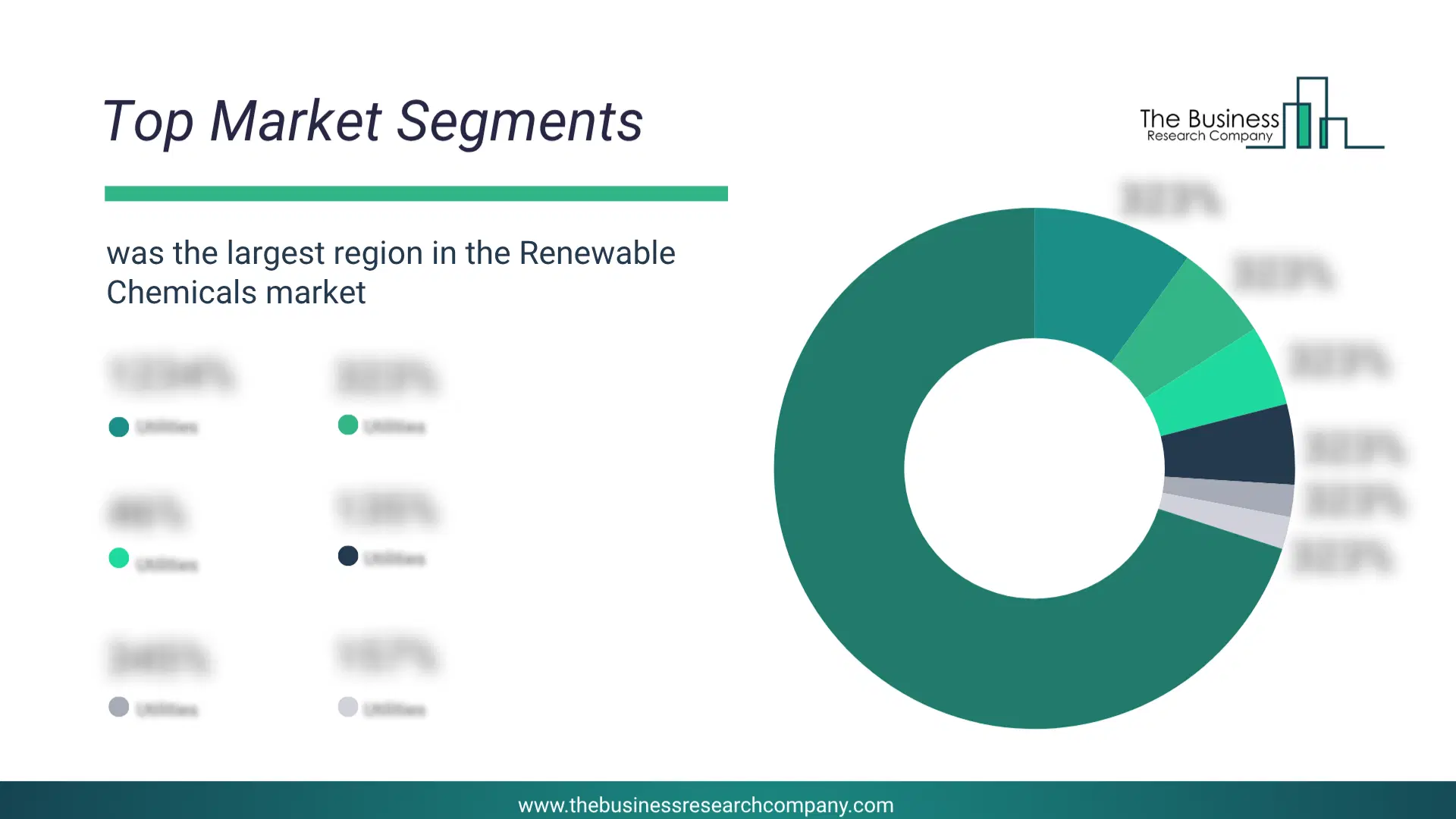
• Renewable Chemicals market size has reached to $130.04 billion in 2025 • Expected to grow to $244.85 billion in 2030 at a compound annual growth rate (CAGR) of 13.4% • Growth Driver: Rapid Growth Of Renewable Feedstock Sources Drives The Renewable Chemicals Market • Market Trend: Bio-Based Surfactants Meets Sustainability Demands In The Renewable Chemical Market • North America was the largest region in 2025 and Asia-Pacific is the fastest growing region.What Is Covered Under Renewable Chemicals Market?
Renewable chemicals are substances derived from renewable resources such as biomass, microorganisms, agricultural waste, agricultural feedstock, and organic waste products. Renewable chemicals are frequently used as direct replacements and have a smaller carbon impact than traditional petro-based compounds. The main types of renewable chemicals are ethanol, ketones, biopolymers, platform chemicals, and other product types. Ethanol is an alternative fuel produced from sugar- and starch-containing raw materials. Ethanol is used as a gasoline additive or motor fuel because it has no detrimental effects on the environment. The feedstocks include biomass, corn, sugarcane, algae, and other feedstocks that are used in the automotive, medical, food and beverage, petrochemical, textile, agriculture, and other sectors.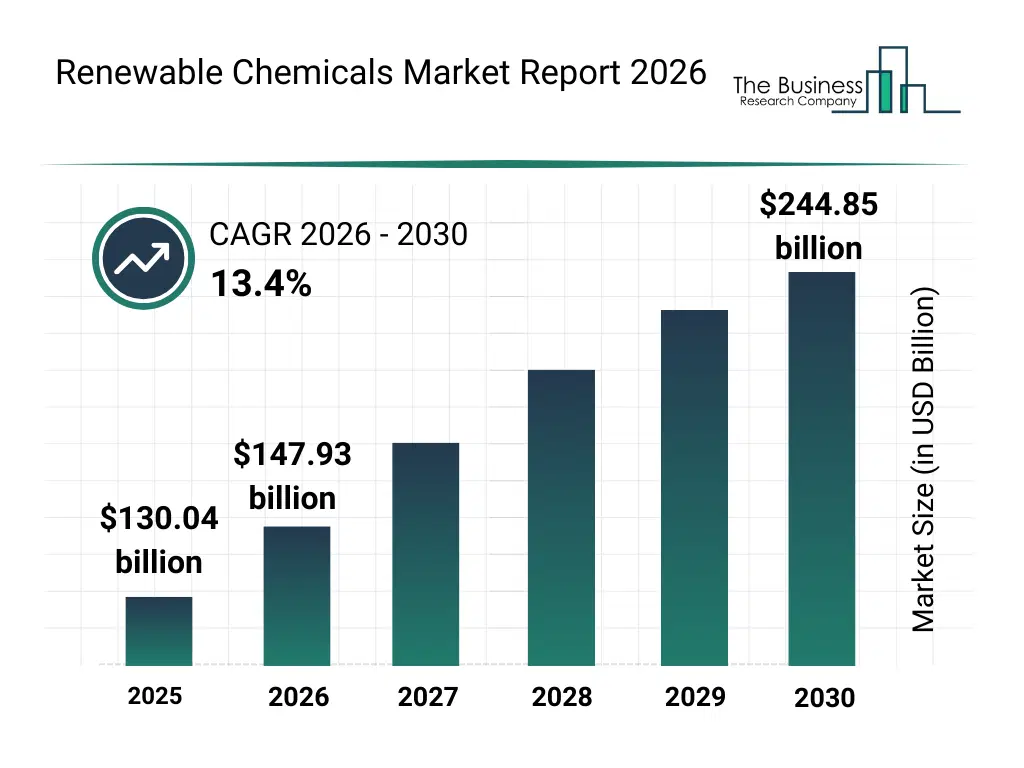
What Is The Renewable Chemicals Market Size and Share 2026?
The renewable chemicals market size has grown rapidly in recent years. It will grow from $130.04 billion in 2025 to $147.93 billion in 2026 at a compound annual growth rate (CAGR) of 13.8%. The growth in the historic period can be attributed to expansion of bioethanol production facilities, availability of agricultural feedstock surplus, increasing adoption of renewable inputs in chemicals, growth of fermentation-based chemical processes, early government incentives for bio-based products.What Is The Renewable Chemicals Market Growth Forecast?
The renewable chemicals market size is expected to see rapid growth in the next few years. It will grow to $244.85 billion in 2030 at a compound annual growth rate (CAGR) of 13.4%. The growth in the forecast period can be attributed to increasing decarbonization targets across industries, rising demand for sustainable polymers, expansion of biorefineries, growing investment in synthetic biology, increasing substitution of petrochemicals with renewable chemicals. Major trends in the forecast period include increasing adoption of bio-based chemical alternatives, rising commercialization of platform chemicals, growing use of renewable feedstocks in industrial applications, expansion of biopolymer production capacities, enhanced focus on low-carbon chemical manufacturing.
Global Renewable Chemicals Market Segmentation
1) By Product Type: Ethanol, Ketones, Biopolymers, Platform Chemicals, Other Product Types 2) By Feedstocks: Biomass, Corn, Sugarcane, Algae, Other Feedstocks 3) By End-Use: Automotive, Medical, Food And Beverages, Petrochemicals, Textiles, Agriculture, Other End-Uses Subsegments: 1) By Ethanol: Bioethanol, Cellulosic Ethanol 2) By Ketones: Acetone, Methyl Ethyl Ketone (MEK), Other Ketones 3) By Biopolymers: Polylactic Acid (PLA), Polyhydroxyalkanoates (PHA), Starch-Based Polymers, Other Biopolymers 4) By Platform Chemicals: Furfural, Levulinic Acid, Succinic Acid, Other Platform Chemicals 5) By Other Product Types: Glycerol, Lactic Acid, Other Renewable ChemicalsWhat Is The Driver Of The Renewable Chemicals Market?
The expansion of renewable feedstock sources is boosting market growth for renewable chemicals. Renewable feedstock sources are sustainable raw materials, typically derived from organic matter such as plants or waste, that can be replenished naturally and are used in the production of renewable products and materials, reducing reliance on finite fossil resources. The expansion of renewable feedstock sources provides a sustainable, environmentally responsible, and economically viable solution for the production of renewable chemicals, which is driving market growth in response to increasing demand and regulatory support for sustainable alternatives. For instance, in November 2024, according to the United Kingdom Government, a UK-based government organization reported that 3,700 million liters equivalent (eq.) of renewable fuel have been supplied, which constitutes 7.5% of total road and non-road mobile machinery fuel for the year in the UK. Therefore, the expansion of renewable feedstock sources will propel the renewable chemicals industry forward.Key Players In The Global Renewable Chemicals Market
Major companies operating in the renewable chemicals market are Braskem,NatureWorks LLC,Cargill Incorporated,Archer Daniels Midland Company,BASF SE,DuPont,Evonik Industries AG,Mitsubishi Chemical Group,Covestro AG,TotalEnergies SE,Neste Oyj,Novamont S.p.A.,Amyris Inc.,Genomatica,Corbion NV,LanzaTech Global,Green Plains Inc.,Gevo Inc.,Clariant AG,Versalis S.p.A.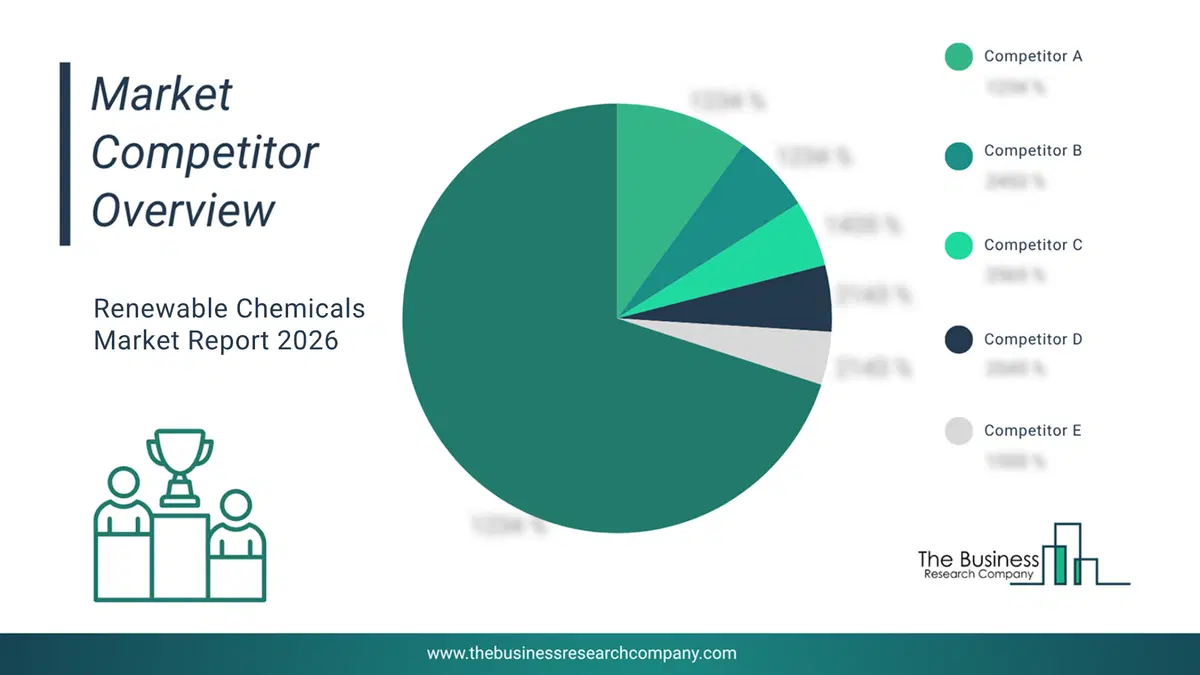
This chart is for illustrative purposes; the full report includes a detailed competitor analysis and comprehensive overview of the top 10 companies in the market.
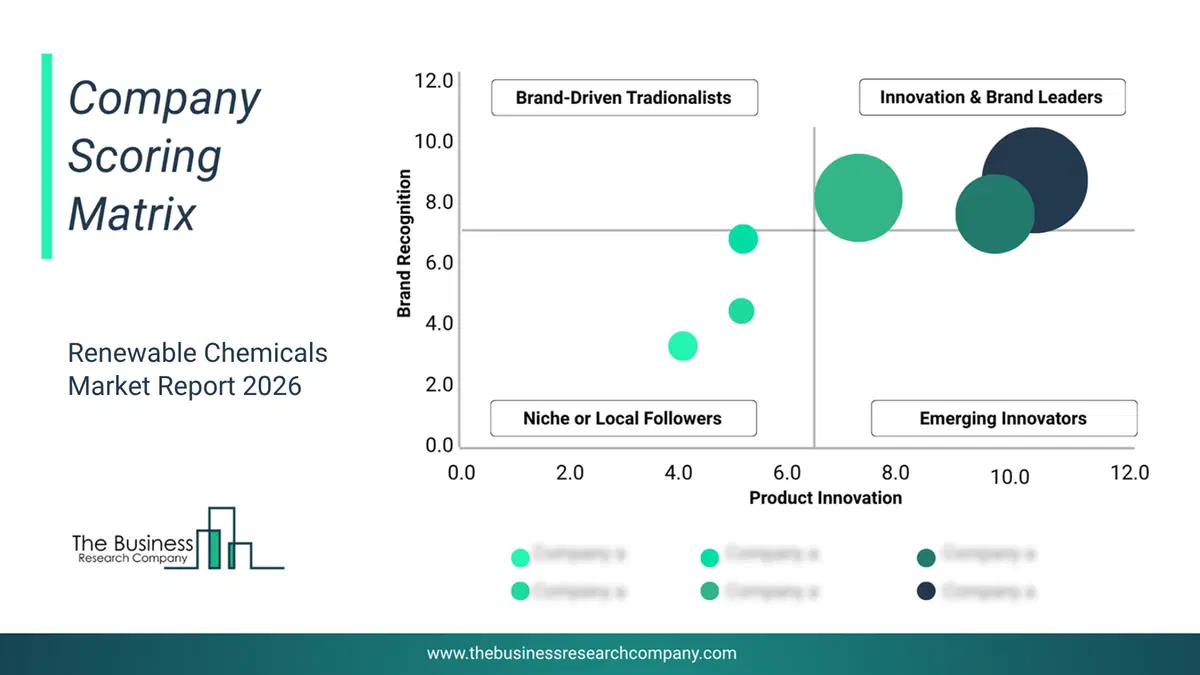
This chart maps companies by product innovation and brand strength, with bubble size indicating relative revenue, helping identify market leaders, challengers, and niche players. This is an illustrative chart; the full report provides a complete and accurate competitive analysis.
Global Renewable Chemicals Market Trends and Insights
Major companies operating in the renewable chemical market are focused on developing products, such as bio-based surfactants, to cater to evolving industry needs and changing consumer preferences. Bio-based surfactants are derived from renewable, biological sources such as plant-based materials and are manufactured using sustainable feedstocks, with the aim of minimizing the environmental impact associated with traditional surfactants typically sourced from fossil fuels. For instance, in September 2024, Evonik Industries AG, a Germany‑based chemical company, introduced a range of 100% bio‑based biosurfactants known as TEGO Wet 570 Terra and TEGO Wet 580 Terra, targeting coatings and inks. These products are entirely derived from renewable plant‑based feedstocks through fermentation, marking a significant step in eliminating fossil carbon from the value chain. They are readily biodegradable, have very low volatile organic compound content, and are credited with significantly reducing environmental impact compared to conventional fossil-based surfactants. The launch is supported by Evonik’s first industrial-scale biosurfactant manufacturing facility, enabling production at commercial volumes and advancing the adoption of sustainable, renewable chemicals in industrial applications.What Are Latest Mergers And Acquisitions In The Renewable Chemicals Market?
In April 2023, Versalis, an Italy-based chemical company, acquired Novamont S.p.A. for an undisclosed amount. Through this acquisition, Versalis aims to expedite its strategic goals by incorporating a distinctive and complementary technological platform. This integration will play a significant role in advancing the decarbonization of Versalis' product portfolio. Novamont S.p.A.is an Italy-based renewable chemicals company.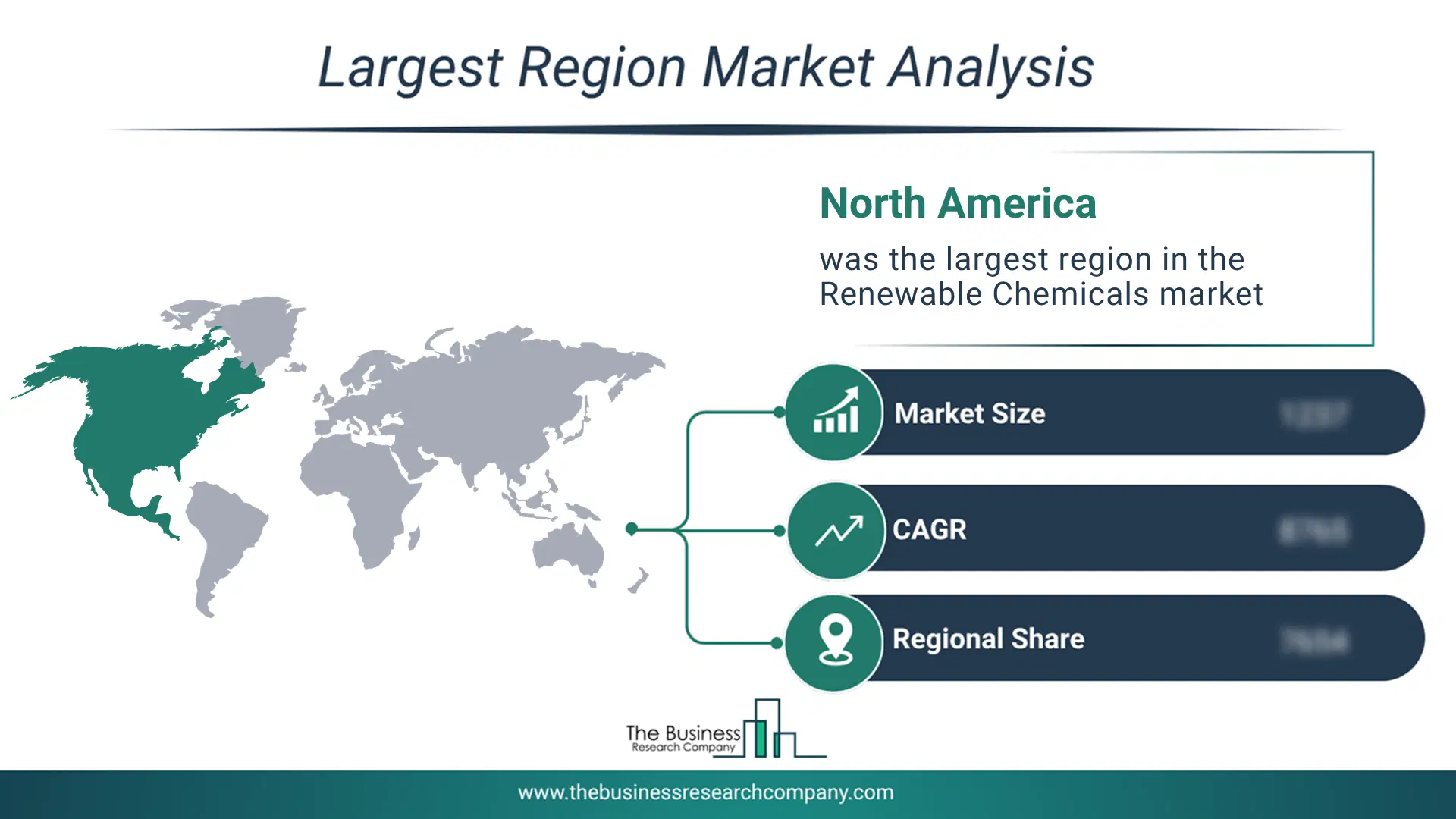
Regional Insights
North America was the largest region in the renewable chemicals market in 2025. Europe is expected to be the fastest-growing region in the renewable chemicals market report during the forecast period. The regions covered in this market report are Asia-Pacific, South East Asia, Western Europe, Eastern Europe, North America, South America, Middle East, Africa The countries covered in this market report are Australia, Brazil, China, France, Germany, India, Indonesia, Japan, Taiwan, Russia, South Korea, UK, USA, Canada, Italy, SpainWhat Defines the Renewable Chemicals Market?
The renewable chemicals market consists of sales of alcohols, organic acids, and biopolymers. Values in this market are ‘factory gate’ values, that is, the value of goods sold by the manufacturers or creators of the goods, whether to other entities (including downstream manufacturers, wholesalers, distributors, and retailers) or directly to end customers. The value of goods in this market includes related services sold by the creators of the goods.How is Market Value Defined and Measured?
The market value is defined as the revenues that enterprises gain from the sale of goods and/or services within the specified market and geography through sales, grants, or donations in terms of the currency (in USD unless otherwise specified). The revenues for a specified geography are consumption values that are revenues generated by organizations in the specified geography within the market, irrespective of where they are produced. It does not include revenues from resales along the supply chain, either further along the supply chain or as part of other products.
This chart presents market attractiveness based on a quantitative evaluation of growth, competition, strategic alignment, and risk, offering a clear view of opportunity areas for decision-making. This chart is for illustrative purposes; the full report contains the complete analysis.

This chart highlights the Total Addressable Market (TAM) by estimating the maximum revenue opportunity using an assumption-driven approach, supporting strategic planning and opportunity sizing across markets. The chart is illustrative; the full report provides a more comprehensive analysis.
What Key Data and Analysis Are Included in the Renewable Chemicals Market Report 2026?
The renewable chemicals market research report is one of a series of new reports from The Business Research Company that provides market statistics, including industry global market size, regional shares, competitors with the market share, detailed market segments, market trends and opportunities, and any further data you may need to thrive in the renewable chemicals industry. The market research report delivers a complete perspective of everything you need, with an in-depth analysis of the current and future state of the industry.Renewable Chemicals Market Report Forecast Analysis
| Report Attribute | Details |
|---|---|
| Market Size Value In 2026 | $147.93 billion |
| Revenue Forecast In 2030 | $244.85 billion |
| Growth Rate | CAGR of 13.8% from 2026 to 2030 |
| Base Year For Estimation | 2025 |
| Actual Estimates/Historical Data | 2020-2025 |
| Forecast Period | 2026 - 2030 |
| Market Representation | Revenue in USD Billion and CAGR from 2026 to 2030 |
| Segments Covered | Product Type, Feedstocks, End-Use |
| Regional Scope | Asia-Pacific, Western Europe, Eastern Europe, North America, South America, Middle East, Africa |
| Country Scope | The countries covered in this market report are Australia, Brazil, China, France, Germany, India, Indonesia, Japan, Taiwan, Russia, South Korea, UK, USA, Canada, Italy, Spain |
| Key Companies Profiled | Braskem,NatureWorks LLC,Cargill Incorporated,Archer Daniels Midland Company,BASF SE,DuPont,Evonik Industries AG,Mitsubishi Chemical Group,Covestro AG,TotalEnergies SE,Neste Oyj,Novamont S.p.A.,Amyris Inc.,Genomatica,Corbion NV,LanzaTech Global,Green Plains Inc.,Gevo Inc.,Clariant AG,Versalis S.p.A. |
| Customization Scope | Request for Customization |
| Pricing And Purchase Options | Explore Purchase Options |