
Renewable Energy Certificates Market Report 2026
Global Outlook – By Energy Type ( Wind Power, Solar Energy, Hydro-Electric Power), By Capacity ( 0-1000 KWh, 1000-5000 KWH, Greater Than 5000 KWH), By End Use ( Compliance, Voluntary) – Market Size, Trends, Strategies, and Forecast to 2030
Renewable Energy Certificates Market Overview
• Renewable Energy Certificates market size has reached to $22.55 billion in 2025 • Expected to grow to $70.56 billion in 2030 at a compound annual growth rate (CAGR) of 24.8% • Growth Driver: Role Of Renewable Energy Certificates In Facilitating Renewable Energy Consumption • Market Trend: Shizen Energy Inc. Introduces Renewable Energy Certificate Service To Support Decarbonization Efforts • North America was the largest region in 2025 and Asia-Pacific is the fastest growing region.Market Gains By 2030 – Top Opportunities By Segment
Market Gain identifies the most promising market opportunities by highlighting the segments or products expected to generate the highest incremental revenue growth over the next five years.
What Is Covered Under Renewable Energy Certificates Market?
Renewable energy certificates (RECs) are tradable certificates demonstrating the environmental characteristics of power produced from renewable energy sources. It is used for several purposes related to promoting renewable energy, lowering greenhouse gas emissions, and verifying the environmental benefits associated with that electricity production. The main energy types included in renewable energy certificates are wind power, solar energy, gas power, and hydroelectric power. Wind power refers to the conversion of wind energy into a useful form of energy, typically electricity, using wind turbines. It includes various types of capacity, such as 0-1000 KWh, 1000-5000 KWH, and greater than 5000 KWH, and is used by several end-users, including compliance and voluntary.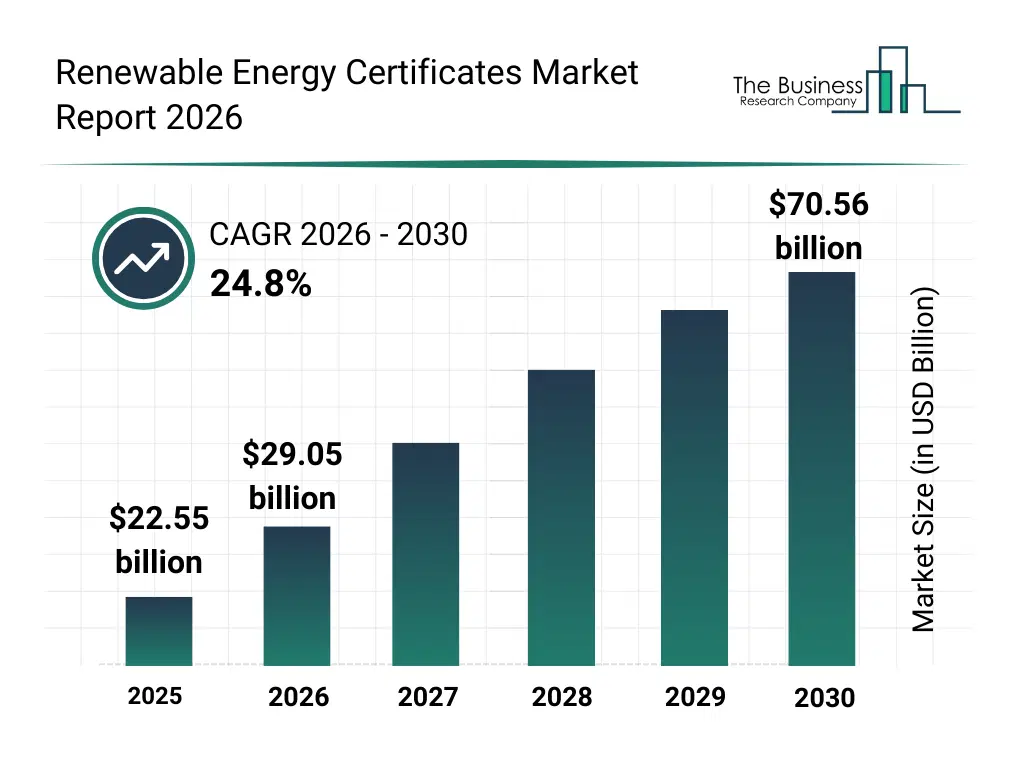
What Is The Renewable Energy Certificates Market Size 2026 And Growth Rate?
The renewable energy certificates market size has grown exponentially in recent years. It will grow from $22.55 billion in 2025 to $29.05 billion in 2026 at a compound annual growth rate (CAGR) of 28.8%. The growth in the historic period can be attributed to initial establishment of renewable portfolio standards, early corporate sustainability commitments, growth of wind and solar capacity additions, introduction of market based emission reduction tools, rise in voluntary green power purchasing.What Is The Renewable Energy Certificates Market Growth Forecast?
The renewable energy certificates market size is expected to see exponential growth in the next few years. It will grow to $70.56 billion in 2030 at a compound annual growth rate (CAGR) of 24.8%. The growth in the forecast period can be attributed to expansion of international renewable certificate markets, increasing regulatory pressure for decarbonization, growth of corporate net zero targets, rising demand for transparent rec tracking platforms, increasing cross border renewable energy procurement. Major trends in the forecast period include increasing corporate demand for renewable energy procurement, growing adoption of market based instruments for emission reduction, rising participation in voluntary renewable energy programs, expansion of cross border renewable certificate trading, advancements in verification and tracking mechanisms for recs.
Global Renewable Energy Certificates Market Segmentation
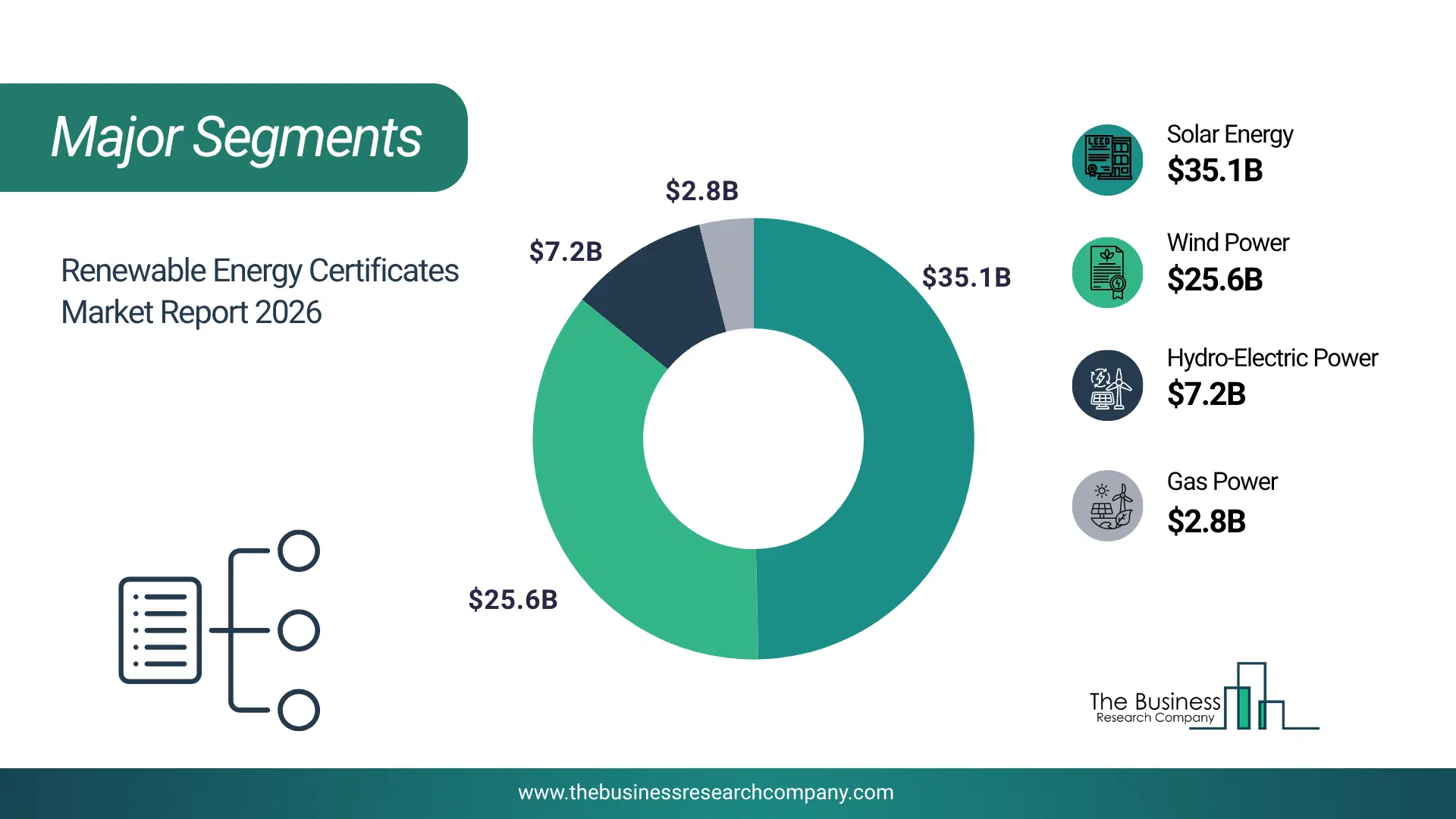
1) By Energy Type: Wind Power, Solar Energy, Hydro-Electric Power 2) By Capacity: 0-1000 KWh, 1000-5000 KWH, Greater Than 5000 KWH 3) By End Use: Compliance, Voluntary Subsegments: 1) By Wind Power: Onshore Wind Energy, Offshore Wind Energy 2) By Solar Energy: Photovoltaic (PV) Solar Power, Concentrated Solar Power (CSP) 3) By Hydro-Electric Power: Large-Scale Hydropower, Small-Scale Hydropower The top segments in the renewable energy certificates market will be: • Solar Energy will reach $35.02 billion by 2030. • Wind Power will reach $25.58 billion by 2030. • Hydro-Electric Power will reach $7.19 billion by 2030. • Gas Power will reach $2.77 billion by 2030.What Is The Driver Of The Renewable Energy Certificates Market?
The increasing consumption of renewable energy sources is expected to propel the growth of the renewable energy certificate market going forward. Renewable energy refers to energy sources that are naturally replenished and come from resources that are constantly available, such as sunlight, wind, water, and organic matter. Renewable energy certificates are used for renewable energy sources to facilitate market transactions, ensure compliance with renewable energy targets, and enable environmental claims related to renewable energy usage. For instance, in April 2025, the International Renewable Energy Agency (IRENA), a UAE-based intergovernmental organization, reported that global renewable power capacity increased by 585 GW in a single year, indicating a record rate of 15.1% annual growth, which surpasses 2023's growth rate of 14.3%. Therefore, the increasing consumption of renewable energy sources is driving the growth of the renewable energy certificate industry.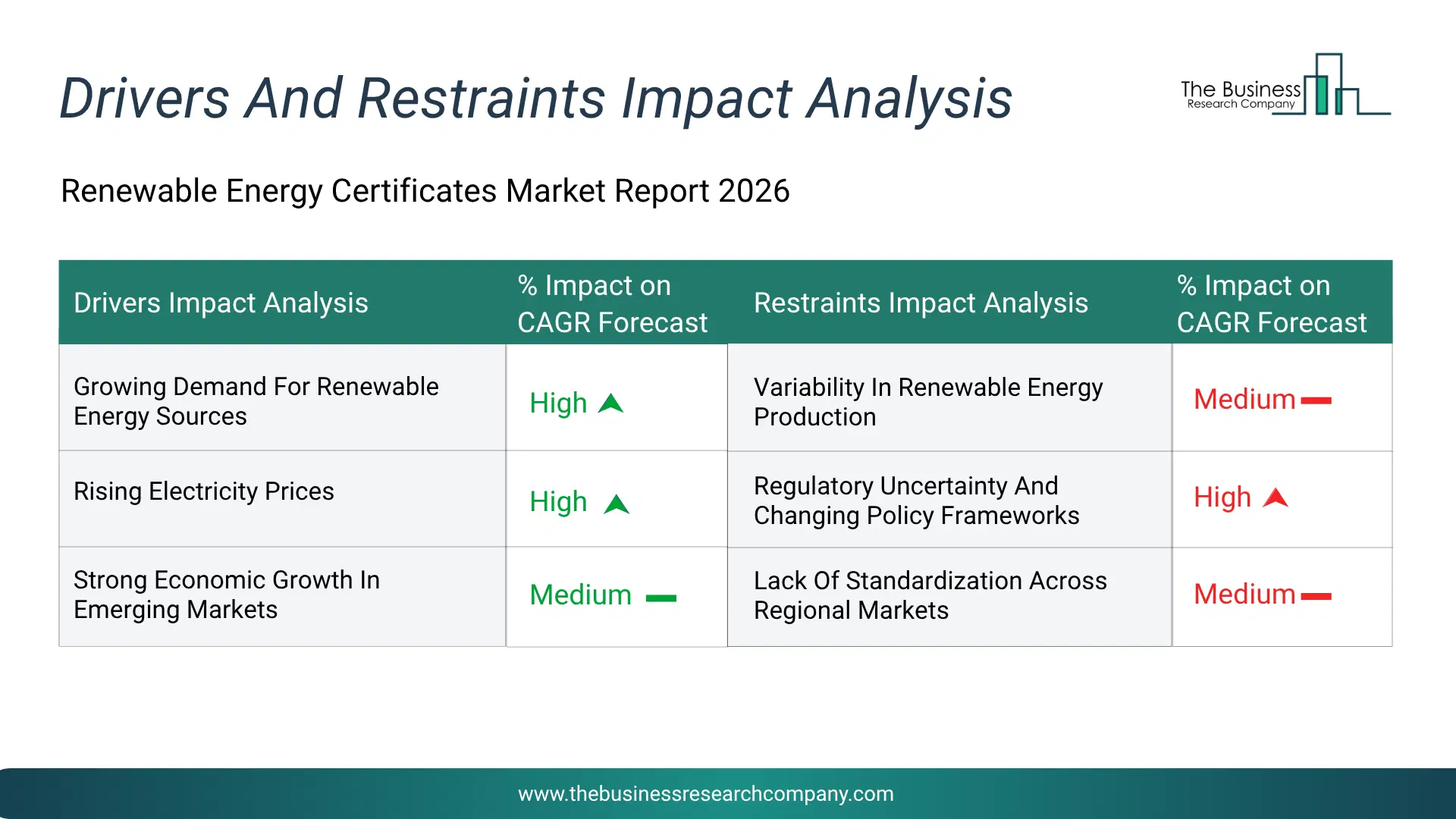
Infographic Chart Showing Key Market Drivers Analysis And Restraints For Renewable Energy Certificates Market
The chart presents an impact analysis of key drivers and restraints, quantifying their relative influence on the market's growth rate and helping assess the balance between growth enablers and limiting factors. This chart offers a high-level perspective; the full report contains more detailed insights.
How Will The Drivers Impact Growth In The Global Renewable Energy Certificates Market?
• Growing Demand For Renewable Energy Sources (High) – During the forecast period, the growing demand for renewable energy sources is expected to become a key growth driver for the renewable energy certificates market by 2030. Growing demand for renewable energy sources is a significant driver for the renewable energy certificates (rec) market, as consumers and businesses increasingly prioritize sustainable energy solutions to combat climate change and reduce carbon footprints. • Rising Electricity Prices (High) – During the forecast period, the rising electricity prices are expected to emerge as a major factor driving the expansion of the renewable energy certificates market by 2030. Rising electricity prices also propel the rec market, as higher costs for conventional energy sources encourage businesses and consumers to seek renewable options, thus increasing the demand for recs to offset their energy consumption. • Strong Economic Growth In Emerging Markets (Medium) – During the forecast period, the strong economic growth in emerging markets is expected to act as a key growth catalyst for the renewable energy certificates market by 2030. Strong economic growth in emerging markets contributes positively to the rec market, as these regions experience heightened energy needs and investments in renewable infrastructure, further driving the demand for renewable energy credits.How Will The Restraints Impact Growth In The Global Renewable Energy Certificates Market?
• Variability In Renewable Energy Production (Medium) – During the forecast period, the variability in renewable energy production serves as a restraint on the rec market, as fluctuations in energy generation from sources like wind and solar can create uncertainty in supply, making it challenging for businesses to rely on recs for consistent energy sourcing. • Regulatory Uncertainty And Changing Policy Frameworks (High) – During the forecast period, the the renewable energy certificate market is heavily influenced by government regulations, renewable energy targets, and compliance mechanisms. Changes in policy frameworks, eligibility criteria, or renewable energy mandates can significantly affect certificate demand and pricing. Market participants often face uncertainty when long-term regulations are not clearly defined. This regulatory unpredictability can discourage investments and limit market expansion. • Lack Of Standardization Across Regional Markets (Medium) – During the forecast period, the renewable energy certificate programs vary significantly across countries and regions in terms of certification processes, trading mechanisms, and reporting requirements. This lack of uniformity creates challenges for organizations operating across multiple jurisdictions. Buyers and sellers may face difficulties in verifying certificate quality and ensuring market transparency. As a result, fragmented market structures can reduce trading efficiency and hinder broader adoption of recs.Key Players In The Global Renewable Energy Certificates Market
Major companies operating in the renewable energy certificates market are NextEra Energy Resources LLC, Statkraft AS, U.S. Environment Protection Agency, EDF Renewables Inc., Western Area Power Administration, Green Mountain Energy Company, Carbon Clear, 3Degrees Group Inc., Central Electricity Regulatory Commission, Clean Power Research, Element Markets LLC, Renewable Choice Energy Inc., Community Energy Inc., Innovative Solar Systems, The CarbonNeutral Company, Green-e Energy, General Services Administration, Sterling Planet Inc., Sustainable Energy Advantage LLC, 3 Phases Renewables, NeXtWind Management GmbH, Environmental Tracking Network of North America, Defense Logistics Agency Energy, RECS International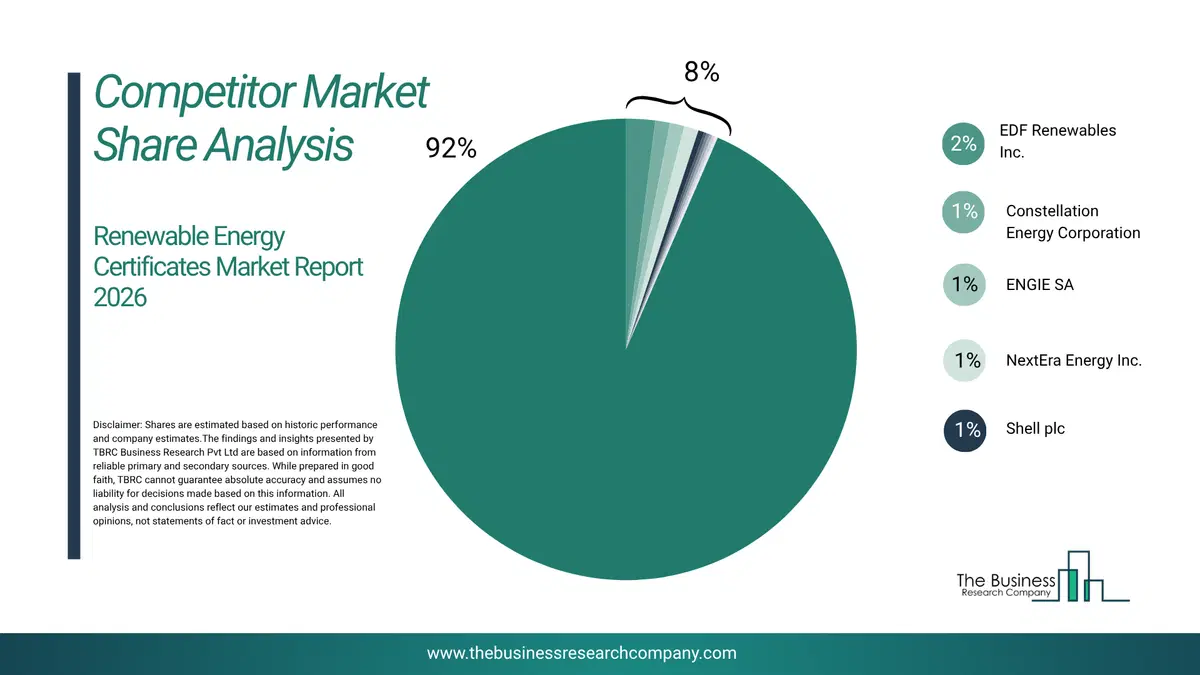
This chart is for illustrative purposes; the full report includes a detailed competitor analysis and comprehensive overview of the top 10 companies in the market.
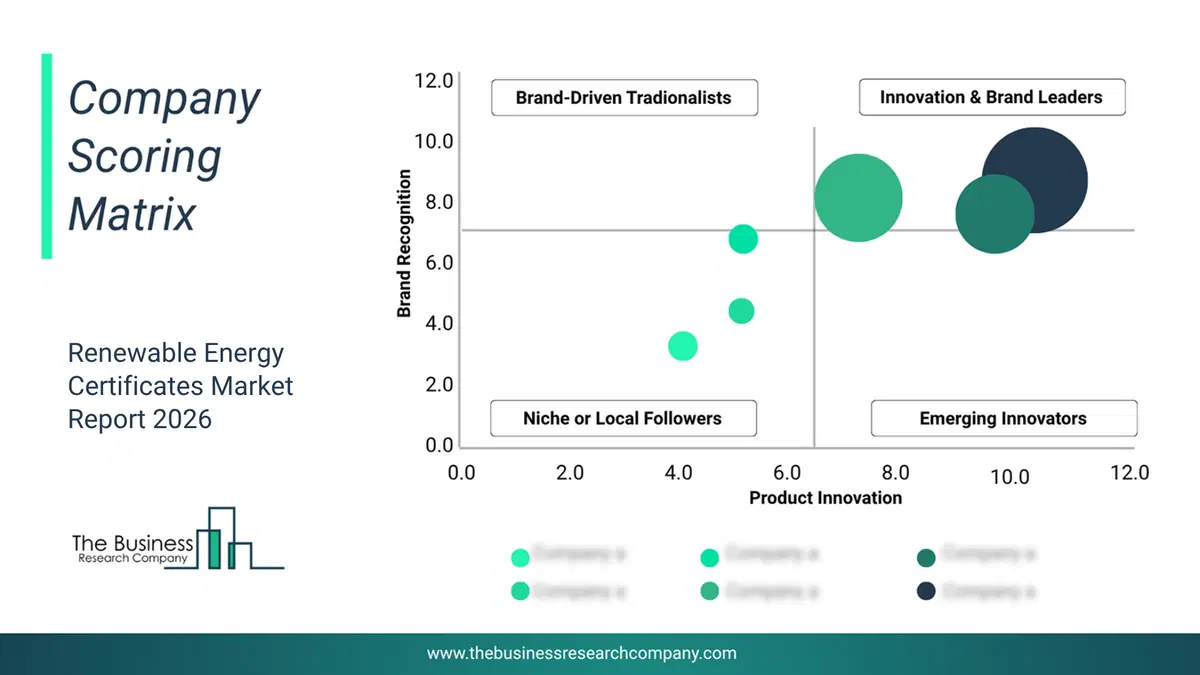
This chart maps companies by product innovation and brand strength, with bubble size indicating relative revenue, helping identify market leaders, challengers, and niche players. This is an illustrative chart; the full report provides a complete and accurate competitive analysis.
Global Renewable Energy Certificates Market Trends and Insights
Major companies operating in the renewable energy certificate market are concentrating on the development of innovative advancement solutions, such as renewable energy certificate services, to address the growing demand for renewable energy and to support companies in their decarbonization efforts. This certificate service provides certificates that represent the environmental attributes of renewable electricity generation and are used by individuals and organizations to claim the environmental benefits of renewable electricity. For instance, in February 2023, Shizen Energy Inc., a Japan-based energy development company, launched a renewable energy certificate (REC) service that provides renewable energy certificates, including non-fossil energy certificates with tracking, in adherence to major international sustainability standards such as RE100 and CDP. Additionally, these services are a low-cost and easy-to-obtain solution for companies to demonstrate that their electricity is generated from renewable sources and aim to provide an effective and affordable way for companies to initiate decarbonization efforts.What Are Latest Mergers And Acquisitions In The Renewable Energy Certificates Market?
In November 2023, E&C Consultants, a Belgium-based energy consultancy that offers a renewable certificate, partnered with the global data hub Veyt. This collaboration aims to empower clients to make smart decisions in their decarbonization efforts by providing them with transparent pricing information and market intelligence for renewable energy certificates and low-carbon markets. Veyt is a Norway-based global insight business for carbon markets and renewable energy.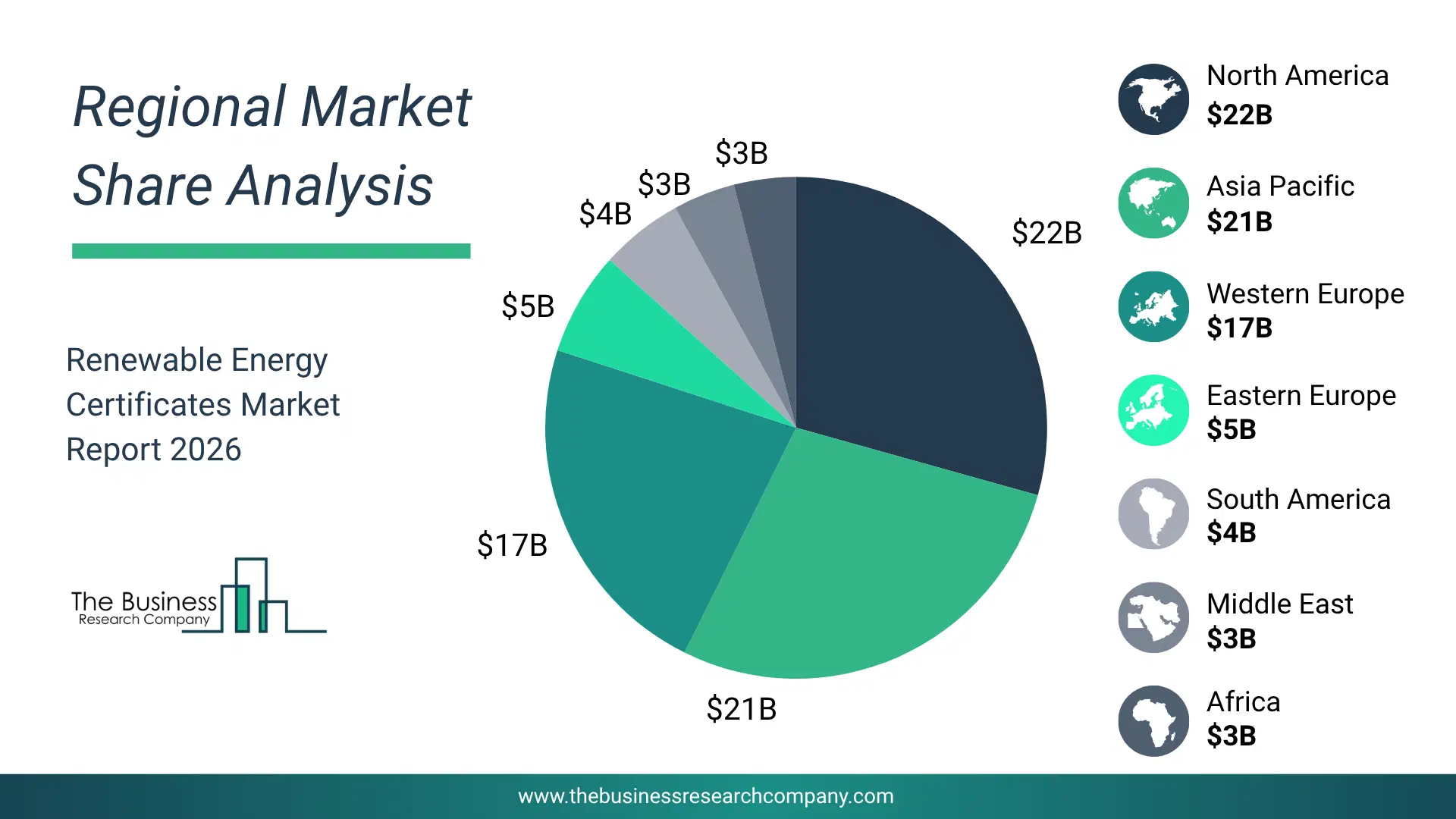
Regional Outlook
North America was the largest region in the renewable energy certificates market in 2025. Asia-Pacific is expected to be the fastest growing region in the forecast period. The regions covered in this market report are Asia-Pacific, South East Asia, Western Europe, Eastern Europe, North America, South America, Middle East, Africa. The countries covered in this market report are Australia, Brazil, China, France, Germany, India, Indonesia, Japan, Taiwan, Russia, South Korea, UK, USA, Canada, Italy, Spain.What Defines the Renewable Energy Certificates Market?
The renewable energy certificate market includes revenues earned by entities by services such as energy security, energy access, price stability, and educational and awareness services. The market value includes the value of related goods sold by the service provider or included within the service offering. Only goods and services traded between entities or sold to end consumers are included.How is Market Value Defined and Measured?
The market value is defined as the revenues that enterprises gain from the sale of goods and/or services within the specified market and geography through sales, grants, or donations in terms of the currency (in USD unless otherwise specified). The revenues for a specified geography are consumption values that are revenues generated by organizations in the specified geography within the market, irrespective of where they are produced. It does not include revenues from resales along the supply chain, either further along the supply chain or as part of other products.
This chart presents market attractiveness based on a quantitative evaluation of growth, competition, strategic alignment, and risk, offering a clear view of opportunity areas for decision-making. This chart is for illustrative purposes; the full report contains the complete analysis.

This chart highlights the Total Addressable Market (TAM) by estimating the maximum revenue opportunity using an assumption-driven approach, supporting strategic planning and opportunity sizing across markets. The chart is illustrative; the full report provides a more comprehensive analysis.
What Key Data and Analysis Are Included in the Renewable Energy Certificates Market Report 2026?
The renewable energy certificates market research report is one of a series of new reports from The Business Research Company that provides market statistics, including industry global market size, regional shares, competitors with the market share, detailed market segments, market trends and opportunities, and any further data you may need to thrive in the renewable energy certificates industry. The market research report delivers a complete perspective of everything you need, with an in-depth analysis of the current and future state of the industry.Renewable Energy Certificates Market Report 2026 Market Report Forecast Analysis
| Report Attribute | Details |
|---|---|
| Market Size Value In 2026 | $29.05 billion |
| Revenue Forecast In 2030 | $70.56 billion |
| Growth Rate | CAGR of 24.8% from 2026 to 2030 |
| Base Year For Estimation | 2025 |
| Actual Estimates/Historical Data | 2020-2025 |
| Forecast Period | 2026 - 2030 |
| Market Representation | Revenue in USD Billion and CAGR from 2026 to 2030 |
| Segments Covered | Energy Type, Capacity, End Use |
| Regional Scope | Asia-Pacific, Western Europe, Eastern Europe, North America, South America, Middle East, Africa |
| Country Scope | The countries covered in the report are Australia, Brazil, China, France, Germany, India, ... |
| Key Companies Profiled | NextEra Energy Resources LLC, Statkraft AS, U.S. Environment Protection Agency, EDF Renewables Inc., Western Area Power Administration, Green Mountain Energy Company, Carbon Clear, 3Degrees Group Inc., Central Electricity Regulatory Commission, Clean Power Research, Element Markets LLC, Renewable Choice Energy Inc., Community Energy Inc., Innovative Solar Systems, The CarbonNeutral Company, Green-e Energy, General Services Administration, Sterling Planet Inc., Sustainable Energy Advantage LLC, 3 Phases Renewables, NeXtWind Management GmbH, Environmental Tracking Network of North America, Defense Logistics Agency Energy, RECS International |
| Customization Scope | Request for Customization |
| Pricing And Purchase Options | Explore Purchase Options |