
Renewable Energy Market Report 2026
Global Outlook – By Type (Solar Energy, Wind Energy, Bio Energy, Hydro Energy, Geothermal Energy), By Capacity (0-1,000 Kwh, 1,100-5,000 Kwh, More Than 5,000 Kwh), By End User (Residential, Commercial, Industrial, Utility, Others) – Market Size, Trends, Strategies, and Forecast to 2030
Renewable Energy Market Overview
• Renewable Energy market size has reached to $1182.59 billion in 2025 • Expected to grow to $1851.41 billion in 2030 at a compound annual growth rate (CAGR) of 9.4% • Growth Driver: Surge In Power Consumption Fuels Accelerated Growth In The Renewable Energy Market • Market Trend: Boosting Renewable Gas Production with Advanced Biomass Technology • Asia-Pacific was the largest region in 2025 and North America is the fastest growing region.Market Gains By 2030 – Top Opportunities By Segment
Market Gain identifies the most promising market opportunities by highlighting the segments or products expected to generate the highest incremental revenue growth over the next five years.
What Is Covered Under Renewable Energy Market?
Renewable energy refers to energy produced from natural energy sources, such as the sun and wind that are constantly replenished. Renewable energy is used for space and water heating and cooling, electricity generation, and transportation. Renewable energy causes less global warming, improved public health, inexhaustible energy, stable energy prices, reliability, and resilience. The main types of renewable energy are solar energy, wind energy, bioenergy, hydro energy, and geothermal energy. The solar energy type of renewable energy is an energy form that uses solar energy for powering a home, building, water heating, and solar lights. It comes in various capacities such as 0-1,000kwh, 1,100-5,000kwh, and more than 5,000kwh, used by residential, commercial, industrial, utility, and others.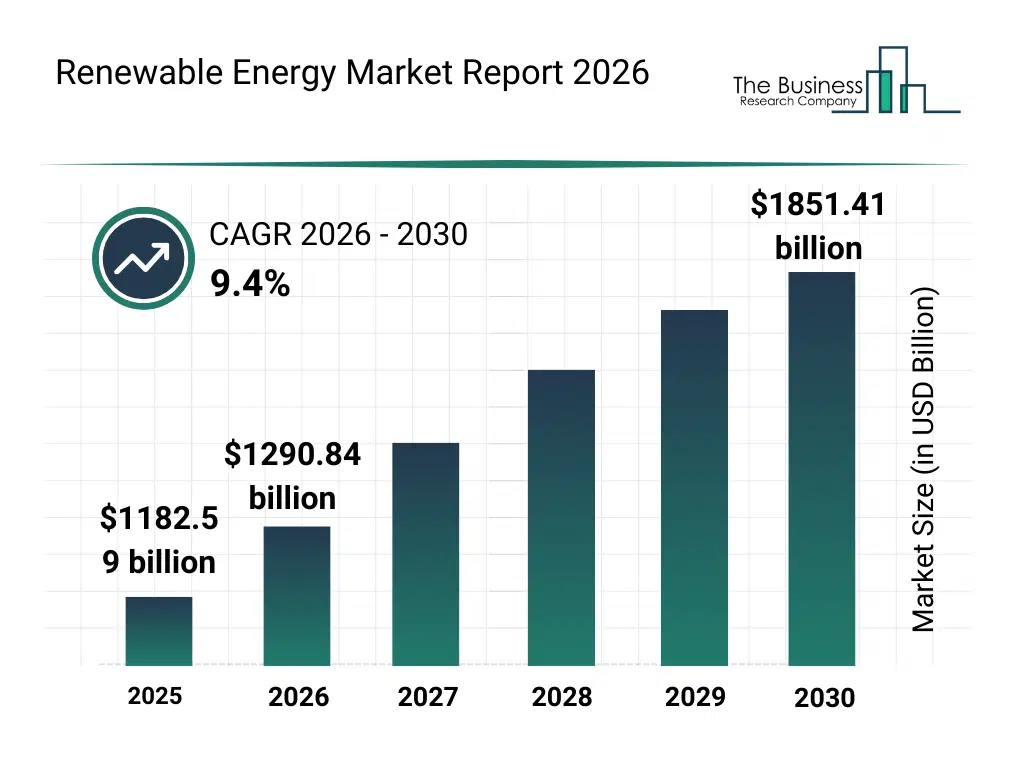
What Is The Renewable Energy Market Size and Share 2026?
The renewable energy market size has grown strongly in recent years. It will grow from $1182.59 billion in 2025 to $1290.84 billion in 2026 at a compound annual growth rate (CAGR) of 9.2%. The growth in the historic period can be attributed to expansion of solar and wind installations, declining renewable energy technology costs, supportive government renewable policies, increasing electricity demand, early grid modernization initiatives.What Is The Renewable Energy Market Growth Forecast?
The renewable energy market size is expected to see strong growth in the next few years. It will grow to $1851.41 billion in 2030 at a compound annual growth rate (CAGR) of 9.4%. The growth in the forecast period can be attributed to growing net-zero emission targets, rising investments in renewable infrastructure, increasing electrification across sectors, expansion of hybrid renewable systems, advancement in energy storage technologies. Major trends in the forecast period include expansion of utility-scale renewable power projects, rising deployment of distributed energy resources, growing integration of energy storage with renewables, increased focus on grid resilience and stability, acceleration of renewable energy capacity additions.
Global Renewable Energy Market Segmentation
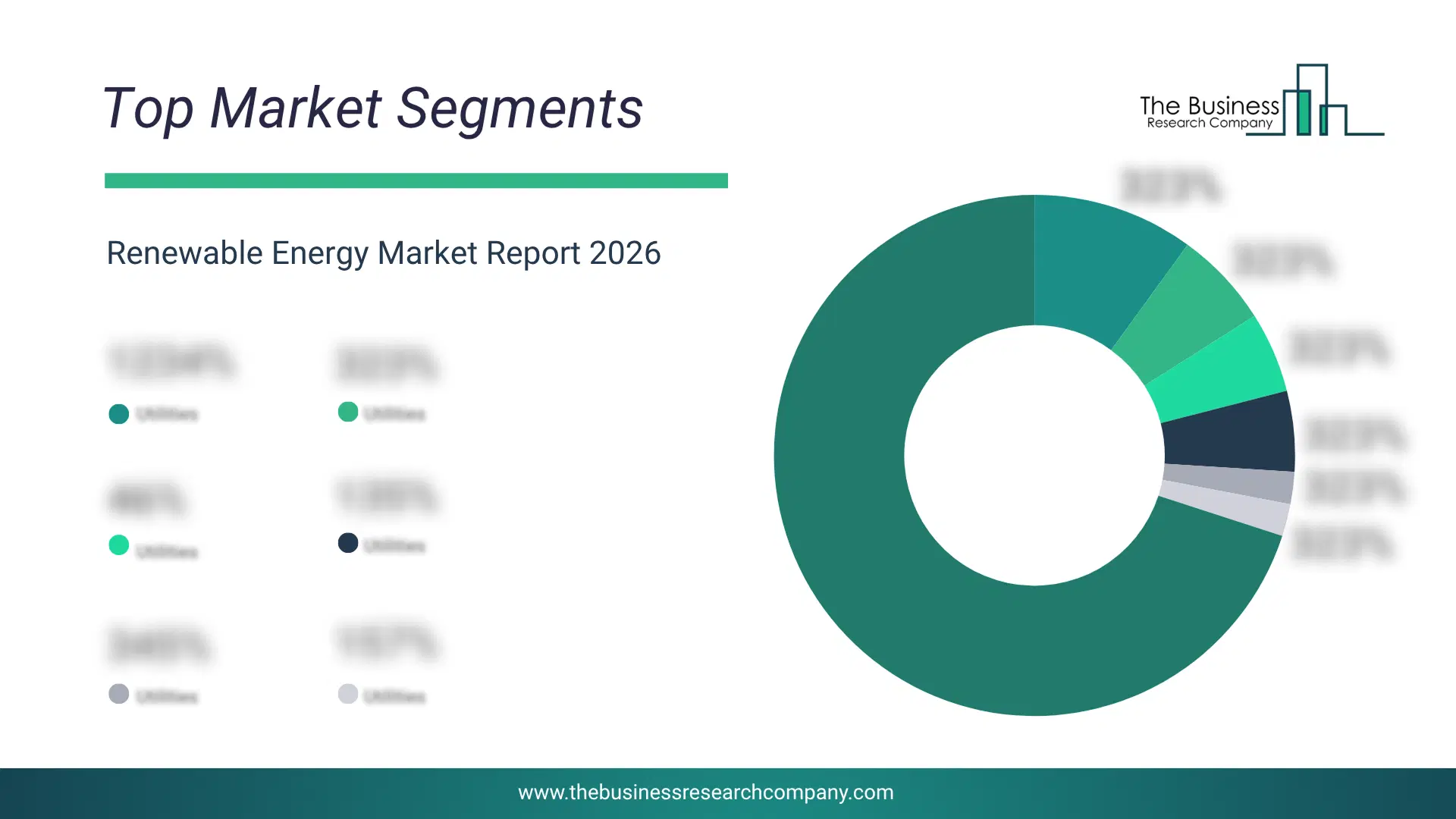
1) By Type: Solar Energy, Wind Energy, Bio Energy, Hydro Energy, Geothermal Energy 2) By Capacity: 0-1,000 Kwh, 1,100-5,000 Kwh, More Than 5,000 Kwh 3) By End User: Residential, Commercial, Industrial, Utility, Others Subsegments: 1) By Solar Energy: Photovoltaic (PV) Systems, Concentrated Solar Power (CSP), Solar Water Heating 2) By Wind Energy: Onshore Wind Energy, Offshore Wind Energy 3) By Bio Energy: Biomass, Biogas, Biofuels (Ethanol, Biodiesel) 4) By Hydro Energy: Small Hydropower, Large Hydropower, Run-of-River Hydropower 5) By Geothermal Energy: Flash Steam Plants, Dry Steam Plants, Binary Cycle Power Plants The top segments in the renewable energy market will be: • Solar Energy will reach $729.7 Billion by 2030. • Wind Energy will reach $540.9 Billion by 2030. • Hydro Energy will reach $328.3 Billion by 2030. • Bio Energy will reach $165.78 Billion by 2030. • Geothermal Energy will reach $86.73 Billion by 2030.What Is The Driver Of The Renewable Energy Market?
The increasing power consumption is expected to propel the growth of the renewable energy market going forward. Power consumption refers to the total electricity used by households, industries, and infrastructure. The increasing power consumption is driven by factors such as industrial growth, technological advancements, and population increase, which collectively boost energy requirements. Renewable energy supports sustainability by providing electricity with reduced greenhouse gas emissions, improving energy security, and lowering the environmental impact of fossil fuel use. For instance, in March 2025, according to the International Energy Agency, a France-based intergovernmental organization, global electricity consumption increased by nearly 1,100 terawatt-hours, representing a 4.3% rise compared to 2023. Therefore, the increasing power consumption is driving the growth of the renewable energy industry.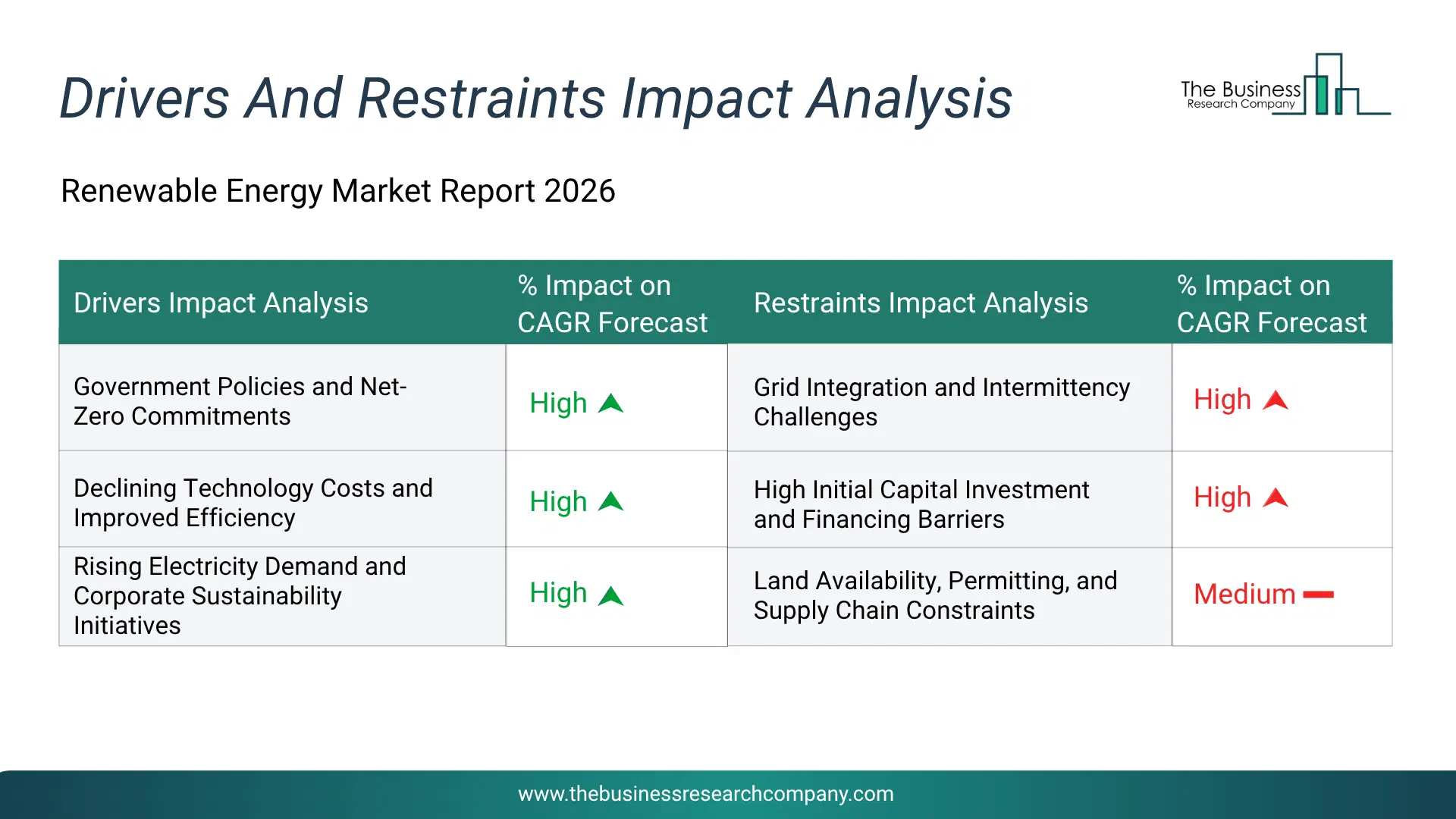
Infographic Chart Showing Key Market Drivers Analysis And Restraints For Renewable Energy Market
The chart presents an impact analysis of key drivers and restraints, quantifying their relative influence on the market's growth rate and helping assess the balance between growth enablers and limiting factors. This chart offers a high-level perspective; the full report contains more detailed insights.
How Will The Drivers Impact Growth In The Global Renewable Energy Market?
• Government Policies and Net-Zero Commitments (High) – During the forecast period, government policies and net-zero commitments are expected to become a key growth driver for the renewable energy market by 2030. Governments worldwide are introducing clean energy targets, emission reduction strategies, and supportive regulatory frameworks to increase the adoption of renewable power generation. Incentive programs, renewable energy auctions, and public investments are encouraging large-scale deployment of clean energy projects. Global climate commitments are further accelerating the transition toward sustainable electricity sources and reducing dependency on fossil fuels. These initiatives are strengthening renewable energy development across developed and emerging markets. • Declining Technology Costs and Improved Efficiency (High) – During the forecast period, declining technology costs and improved efficiency are expected to emerge as a major factor driving the expansion of the renewable energy market by 2030. Continuous advancements in solar panels, wind turbines, battery storage technologies, and power management systems are reducing project costs while improving energy output. Enhanced manufacturing capabilities and economies of scale are making renewable energy solutions more affordable and commercially competitive. Digital monitoring and smart technologies are also improving operational reliability and asset performance. The increasing affordability of renewable technologies is supporting broader adoption across multiple applications. • Rising Electricity Demand and Corporate Sustainability Initiatives (High) – During the forecast period, the rising electricity demand and corporate sustainability initiatives are expected to act as a key growth catalyst for the renewable energy market by 2030. Increasing power consumption from industrial growth, urban expansion, and electrification trends is creating strong demand for clean electricity generation. Businesses are increasingly adopting renewable energy solutions to achieve sustainability targets and reduce carbon footprints. Long-term renewable energy agreements and investments from commercial and industrial sectors are expanding clean power adoption. Growing environmental awareness is further supporting the shift toward sustainable energy systems globally.How Will The Restraints Impact Growth In The Global Renewable Energy Market?
• Grid Integration and Intermittency Challenges (High) – During the forecast period, solar and wind energy generation depends on weather conditions, leading to fluctuations in electricity production. Existing transmission and distribution networks in many regions are not fully equipped to manage large volumes of variable renewable power. Maintaining grid stability often requires additional investments in energy storage, backup generation, and smart grid technologies. Delays in transmission expansion can slow renewable project deployment. These integration challenges increase project complexity and overall system costs. • High Initial Capital Investment and Financing Barriers (High) – During the forecast period, although operating costs are relatively low, renewable energy projects require substantial upfront investment for equipment, land acquisition, transmission infrastructure, and installation. Financing large-scale projects can be difficult, particularly in developing economies where access to affordable capital is limited. Rising interest rates further increase borrowing costs and affect project profitability. Long project development timelines may also discourage private investment. These financial barriers can delay the implementation of new renewable energy capacity. • Land Availability, Permitting, and Supply Chain Constraints (High) – During the forecast period, utility-scale renewable energy projects often require significant land areas and lengthy environmental approval processes. Permitting delays, local community opposition, and land-use conflicts can postpone project construction. In addition, dependence on critical minerals, semiconductor components, and specialized manufacturing creates supply chain vulnerabilities. Price volatility of raw materials can increase equipment costs and extend delivery schedules. These factors collectively slow project execution and limit the pace of renewable energy expansion.Key Players In The Global Renewable Energy Market
Major companies operating in the renewable energy market are Orsted AS, Iberdrola SA, Enel Spa, Brookfield Corporation, Acciona SA, NEXTERA ENERGY INC, EDF SA, Xcel Energy Inc, The Tata Power Company Limited, Innergex Renewable Energy Inc, Adani Green Energy Limited, NTPC Limited, ReNew Power Private Limited, Japan Renewable Energy Co. Ltd, AGL Energy Ltd, Origin Energy, EOLFI, ABO Wind AG, EnviTec Biogas, Edison SpA, RusHydro, Hevel LLC, Fortum Oyj, Energias de Portugal S.A, Northland Power, National Grid Renewables, Duke Energy Corporation, Algonquin Power & Utilities Corp, TransAlta Renewables, Enel Green Power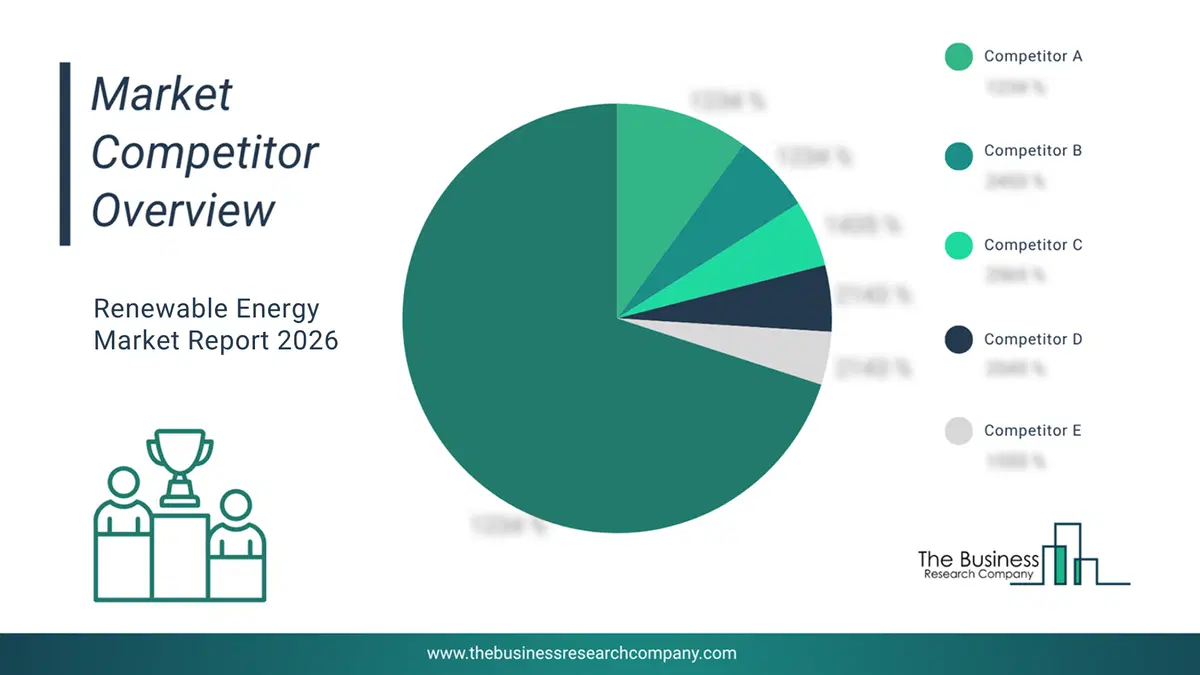
This chart is for illustrative purposes; the full report includes a detailed competitor analysis and comprehensive overview of the top 10 companies in the market.
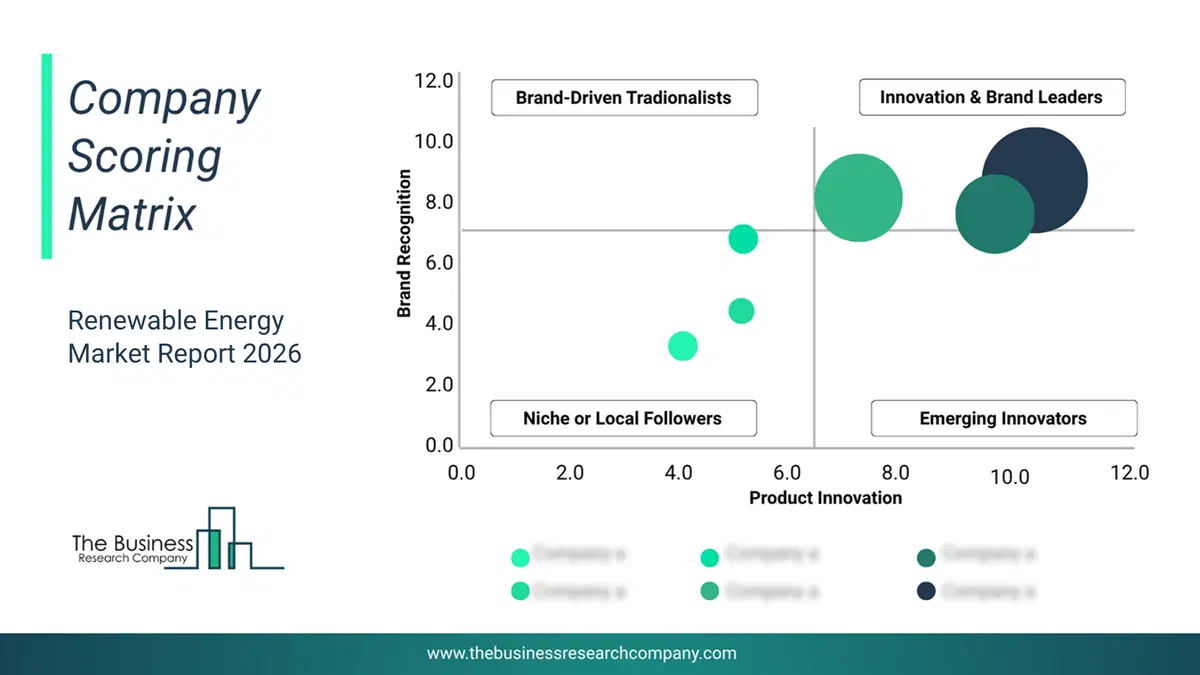
This chart maps companies by product innovation and brand strength, with bubble size indicating relative revenue, helping identify market leaders, challengers, and niche players. This is an illustrative chart; the full report provides a complete and accurate competitive analysis.
Global Renewable Energy Market Trends and Insights
Major companies operating in the renewable energy market are focusing on developing advanced solutions such as high temperature ablative pyrolysis (HTAP) to enhance renewable natural gas (RNG) production and digestate management. HTAP is a thermochemical technology that converts forestry residues, agricultural waste, and other non-food biomass into clean syngas, which can then be upgraded to pipeline-quality RNG. For instance, in December 2025, Clean Energy Technologies Inc a US-based manufacturing company, launched a biomass platform featuring HTAP technology. The platform integrates with existing anaerobic digestion (AD) and RNG facilities to address biogas output constraints and digestate handling challenges. Key features include conversion of digestate into syngas supporting up to 1.6 MW of onsite power or 8 MMBtu/hour of RNG, production of biochar for agricultural or industrial use, incremental RNG output of approximately 13 MMBtu/hour per HTAP unit, and enhanced economic and environmental performance for AD operators. This solution enables operators to maximize energy recovery from hard-to-digest biomass while reducing waste management costs.What Are Latest Mergers And Acquisitions In The Renewable Energy Market?
In December 2024, TotalEnergies SE, a France-based integrated energy company, acquired VSB Group for approximately $1.65 billion. With this acquisition, TotalEnergies aimed to strengthen and expand its renewable energy portfolio and integrated power business in key European markets, notably Germany, by enhancing its wind, solar, and storage project pipeline and expertise. VSB Group is a Germany-based renewable energy developer that specializes in developing, constructing, and managing onshore wind and photovoltaic parks, battery storage solutions, and related renewable energy assets across several European countries.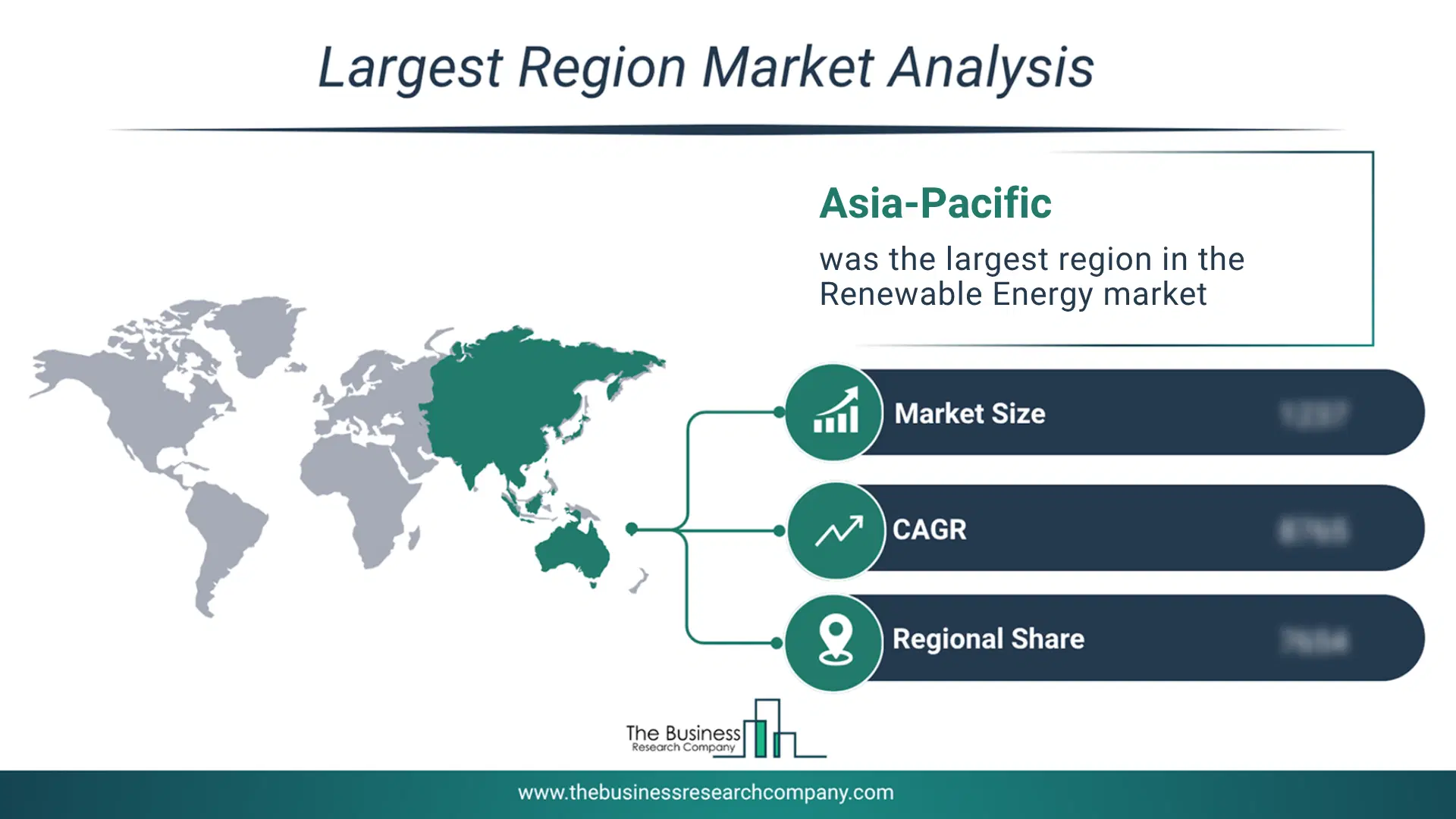
Regional Outlook
Asia-Pacific was the largest region in the renewable energy market in 2025. North America is expected to be the fastest-growing region in the forecast period. The regions covered in this market report are Asia-Pacific, South East Asia, Western Europe, Eastern Europe, North America, South America, Middle East, Africa. The countries covered in this market report are Australia, Brazil, China, France, Germany, India, Indonesia, Japan, Taiwan, Russia, South Korea, UK, USA, Canada, Italy, SpainWhat Defines the Renewable Energy Market?
The renewable energy market includes revenues earned by entities by nuclear energy, biomass and bioenergy, and applied energy. The market value includes the value of related goods sold by the service provider or included within the service offering. Only goods and services traded between entities or sold to end consumers are included.How is Market Value Defined and Measured?
The market value is defined as the revenues that enterprises gain from the sale of goods and/or services within the specified market and geography through sales, grants, or donations in terms of the currency (in USD unless otherwise specified). The revenues for a specified geography are consumption values that are revenues generated by organizations in the specified geography within the market, irrespective of where they are produced. It does not include revenues from resales along the supply chain, either further along the supply chain or as part of other products.
This chart presents market attractiveness based on a quantitative evaluation of growth, competition, strategic alignment, and risk, offering a clear view of opportunity areas for decision-making. This chart is for illustrative purposes; the full report contains the complete analysis.

This chart highlights the Total Addressable Market (TAM) by estimating the maximum revenue opportunity using an assumption-driven approach, supporting strategic planning and opportunity sizing across markets. The chart is illustrative; the full report provides a more comprehensive analysis.
What Key Data and Analysis Are Included in the Renewable Energy Market Report 2026?
The renewable energy market research report is one of a series of new reports from The Business Research Company that provides market statistics, including Market Report 2026?global market size, regional shares, competitors with the market share, detailed market segments, market trends and opportunities, and any further data you may need to thrive in the renewable energy Market Report 2026? The market research report delivers a complete perspective of everything you need, with an in-depth analysis of the current and future state of the Market Report 2026?Renewable Energy Market Report Forecast Analysis
| Report Attribute | Details |
|---|---|
| Market Size Value In 2026 | $1290.84 billion |
| Revenue Forecast In 2030 | $1851.41 billion |
| Growth Rate | CAGR of 9.2% from 2026 to 2030 |
| Base Year For Estimation | 2025 |
| Actual Estimates/Historical Data | 2020-2025 |
| Forecast Period | 2026 - 2030 |
| Market Representation | Revenue in USD Billion and CAGR from 2026 to 2030 |
| Segments Covered | Type, Capacity, End User |
| Regional Scope | Asia-Pacific, Western Europe, Eastern Europe, North America, South America, Middle East, Africa |
| Country Scope | The countries covered in the report are Australia, Brazil, China, France, Germany, India, ... |
| Key Companies Profiled | Orsted AS, Iberdrola SA, Enel Spa, Brookfield Corporation, Acciona SA, NEXTERA ENERGY INC, EDF SA, Xcel Energy Inc, The Tata Power Company Limited, Innergex Renewable Energy Inc, Adani Green Energy Limited, NTPC Limited, ReNew Power Private Limited, Japan Renewable Energy Co. Ltd, AGL Energy Ltd, Origin Energy, EOLFI, ABO Wind AG, EnviTec Biogas, Edison SpA, RusHydro, Hevel LLC, Fortum Oyj, Energias de Portugal S.A, Northland Power, National Grid Renewables, Duke Energy Corporation, Algonquin Power & Utilities Corp, TransAlta Renewables, Enel Green Power |
| Customization Scope | Request for Customization |
| Pricing And Purchase Options | Explore Purchase Options |