
Renewable Naphtha Market Report 2026
Global Outlook – By Product Type (Light Naphtha, Heavy Naphtha), By Source (Biomass, Vegetable Oils, Animal Fats, Municipal Solid Waste, Other Sources), By Distribution Channel (Direct, Indirect), By Application (Petrochemicals, Gasoline Blending, Plastics, Other Applications), By End-Use Industry (Automotive, Chemicals, Energy, Other End-Users) – Market Size, Trends, Strategies, and Forecast to 2035
Renewable Naphtha Market Overview
• Renewable Naphtha market size has reached to $127.02 billion in 2025 • Expected to grow to $229.79 billion in 2030 at a compound annual growth rate (CAGR) of 12.6% • Growth Driver: The Surge In Demand For Sustainable Packaging The Growth Of The Market Due To Rising Consumer Environmental Awareness • North America was the largest region in 2025 and Asia-Pacific is the fastest growing region.What Is Covered Under Renewable Naphtha Market?
Renewable naphtha refers to a hydrocarbon liquid produced from renewable sources such as biomass, waste oils, or other non-fossil feedstocks. It is chemically similar to conventional naphtha but is derived through processes that reduce reliance on crude oil. It is valued for its lower carbon footprint compared to traditional petroleum-based naphtha. The main product types of renewable naphtha include light naphtha and heavy naphtha. Light naphtha refers to a low-boiling hydrocarbon fraction derived from renewable feedstocks, commonly used as a feedstock in petrochemical processes and fuel blending applications. It is sourced from biomass, vegetable oils, animal fats, municipal solid waste, and other sources and is distributed through direct and indirect channels. The key applications of petrochemicals, gasoline blending, plastics, and others, while the end-use includes automotive, chemicals, energy, and others.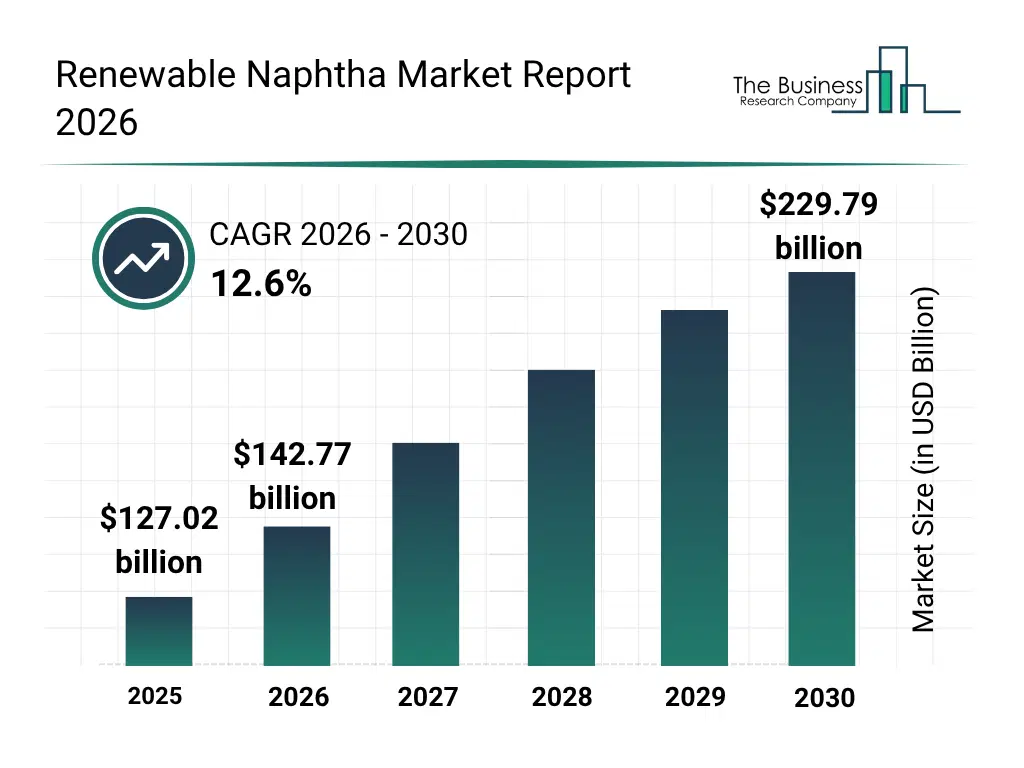
What Is The Renewable Naphtha Market Size and Share 2026?
The renewable naphtha market size has grown rapidly in recent years. It will grow from $127.02 billion in 2025 to $142.77 billion in 2026 at a compound annual growth rate (CAGR) of 12.4%. The growth in the historic period can be attributed to high dependency on fossil-based naphtha feedstocks limiting renewable adoption, limited availability of scalable biomass processing infrastructure, high production costs of renewable hydrocarbon alternatives, low regulatory pressure on carbon intensity reduction in petrochemicals, early-stage development of waste-to-fuel conversion technologies.What Is The Renewable Naphtha Market Growth Forecast?
The renewable naphtha market size is expected to see rapid growth in the next few years. It will grow to $229.79 billion in 2030 at a compound annual growth rate (CAGR) of 12.6%. The growth in the forecast period can be attributed to tightening global carbon emission regulations accelerating renewable naphtha demand, increasing investments in bio-refineries and circular feedstock supply chains, rising adoption of sustainable aviation fuel and green plastics driving feedstock demand, advancements in catalytic and pyrolysis technologies improving yield efficiency, corporate net-zero commitments increasing procurement of low-carbon feedstocks. Major trends in the forecast period include waste-to-chemicals based renewable naphtha production expansion, increasing adoption of bio-based feedstock diversification strategies, rising integration of circular economy models in petrochemical value chains, growth of low-carbon fuel certification and traceability systems, expansion of advanced catalytic conversion technologies for biomass upgrading.
Global Renewable Naphtha Market Segmentation
1) By Product Type: Light Naphtha, Heavy Naphtha 2) By Source: Biomass, Vegetable Oils, Animal Fats, Municipal Solid Waste, Other Sources 3) By Distribution Channel: Direct, Indirect 4) By Application: Petrochemicals, Gasoline Blending, Plastics, Other Applications 5) By End-Use Industry: Automotive, Chemicals, Energy, Other End-Users Subsegments: 1) By Light Naphtha: Paraffinic Light Naphtha, Isomerized Light Naphtha, Reformulated Light Naphtha, Straight Run Light Naphtha 2) By Heavy Naphtha: Paraffinic Heavy Naphtha, Aromatic Rich Heavy Naphtha, Catalytically Reformed Heavy Naphtha, Cracked Heavy NaphthaWhat Are The Drivers Of The Renewable Naphtha Market?
The surge in demand for sustainable packaging is expected to propel the growth of the renewable naphtha market going forward. Sustainable packaging refers to the design and use of packaging materials and systems that minimize environmental impact by reducing waste, using renewable or recyclable resources, and improving efficiency throughout the product’s life cycle. The surge in demand for sustainable packaging is primarily due to increasing environmental awareness among consumers and businesses, which is driving a shift toward eco-friendly materials to reduce pollution and minimize plastic waste. Renewable naphtha enables sustainable packaging by acting as a low-carbon feedstock for producing bio-based plastics and polymers that reduce dependence on fossil resources and lower overall packaging-related emissions. For instance, in April 2023, according to the 2023 Buying Green Report by Trivium Packaging, a Netherlands-based sustainable packaging company, 82% of consumers expressed willingness to pay more for sustainable packaging, reflecting a 4% increase from 2022. Therefore, the surge in demand for sustainable packaging is driving the growth of the renewable naphtha industry. The increasing investments in net-zero are expected to propel the growth of the renewable naphtha market going forward. Investments in net-zero refer to financial commitments made by governments, companies, or investors toward projects, technologies, and initiatives that aim to reduce greenhouse gas emissions to as close to zero as possible by balancing emitted and removed carbon. Increasing investments in net-zero are primarily driven by tightening climate regulations that compel governments and businesses to reduce greenhouse gas emissions, meet legally binding targets, and accelerate the transition toward low-carbon and sustainable energy systems. Increasing investments in net-zero drive greater funding for low-carbon fuel technologies and circular carbon solutions, thereby accelerating the production and adoption of renewable naphtha as a sustainable alternative to fossil-based feedstocks. For instance, in September 2023, according to Allen Overy Shearman Sterling LLP, a UK-based law firm, climate finance investment needs to be rapidly and substantially increased, with the estimated cumulative funding required to achieve Net Zero by 2050 rising to USD 226 trillion, up from USD 200 trillion last year. Therefore, the increasing investments in net-zero are driving the growth of the renewable naphtha industry.Key Players In The Global Renewable Naphtha Market
Major companies operating in the renewable naphtha market are Shell plc, TotalEnergies SE, BP p.l.c., Chevron Corporation, Valero Energy Corporation, Phillips 66 Co., Eni S.p.A., Petroliam Nasional Berhad, ENEOS Corporation, Indian Oil Corporation Limited, Repsol S.A., SK Innovation Co. Ltd., OMV Aktiengesellschaft, Neste Oyj, Galp Energia SGPS S.A., INEOS Group, Emirates National Oil Company Limited, UPM-Kymmene Corporation, World Energy LLC, Diamond Green Diesel LLC.What Are Latest Mergers And Acquisitions In The Renewable Naphtha Market?
In November 2025, Norsk e-Fuel AS, a Norway-based e-fuels company that produces e-naphtha, a synthetic renewable alternative to conventional fossil-based naphtha, entered into a strategic collaboration with Braskem S.A. to develop e-naphtha. Through this partnership, Norsk e-Fuel and Braskem aim to convert captured carbon dioxide into sustainable raw materials for plastics production by utilizing Power-to-X technology. Braskem S.A. is a Brazil-based petrochemical company specializing in thermoplastic resins and sustainable chemical solutions.Regional Outlook/Insights
North America was the largest region in the renewable naphtha market in 2025. Asia-Pacific is expected to be the fastest-growing region in the forecast period. The regions covered in this market report are Asia-Pacific, South East Asia, Western Europe, Eastern Europe, North America, South America, Middle East, Africa. The countries covered in this market report are Australia, Brazil, China, France, Germany, India, Indonesia, Japan, Taiwan, Russia, South Korea, UK, USA, Canada, Italy, Spain.What Defines the Renewable Naphtha Market?
The renewable naphtha market consists of sales of bio-based naphtha, green naphtha, and drop-in renewable naphtha. Values in this market are ‘factory gate’ values, that is, the value of goods sold by the manufacturers or creators of the goods, whether to other entities (including downstream manufacturers, wholesalers, distributors, and retailers) or directly to end customers. The value of goods in this market includes related services sold by the creators of the goods.How is Market Value Defined and Measured?
The market value is defined as the revenues that enterprises gain from the sale of goods and/or services within the specified market and geography through sales, grants, or donations in terms of the currency (in USD unless otherwise specified). The revenues for a specified geography are consumption values that are revenues generated by organizations in the specified geography within the market, irrespective of where they are produced. It does not include revenues from resales along the supply chain, either further along the supply chain or as part of other products.What Key Data and Analysis Are Included in the Renewable Naphtha Market Report 2026?
The renewable naphtha market research report is one of a series of new reports from The Business Research Company that provides market statistics, including industry global market size, regional shares, competitors with the market share, detailed market segments, market trends and opportunities, and any further data you may need to thrive in the renewable naphtha industry. The market research report delivers a complete perspective of everything you need, with an in-depth analysis of the current and future state of the industry.Renewable Naphtha Market Report Forecast Analysis
| Report Attribute | Details |
|---|---|
| Market Size Value In 2026 | $142.77 billion |
| Revenue Forecast In 2035 | $229.79 billion |
| Growth Rate | CAGR of 12.6% from 2026 to 2035 |
| Base Year For Estimation | 2025 |
| Actual Estimates/Historical Data | 2020-2025 |
| Forecast Period | 2026 - 2030 - 2035 |
| Market Representation | Revenue in USD Billion and CAGR from 2026 to 2035 |
| Segments Covered | Product Type, Source, Distribution Channel, Application, End-Use Industry |
| Regional Scope | Asia-Pacific, Western Europe, Eastern Europe, North America, South America, Middle East, Africa |
| Country Scope | The countries covered in the report are Australia, Brazil, China, France, Germany, India, Indonesia, Japan, Taiwan, Russia, South Korea, UK, USA, Canada, Italy, Spain. |
| Key Companies Profiled | Shell plc, TotalEnergies SE, BP p.l.c., Chevron Corporation, Valero Energy Corporation, Phillips 66 Co., Eni S.p.A., Petroliam Nasional Berhad, ENEOS Corporation, Indian Oil Corporation Limited, Repsol S.A., SK Innovation Co. Ltd., OMV Aktiengesellschaft, Neste Oyj, Galp Energia SGPS S.A., INEOS Group, Emirates National Oil Company Limited, UPM-Kymmene Corporation, World Energy LLC, Diamond Green Diesel LLC. |
| Customization Scope | Request for Customization |
| Pricing And Purchase Options | Explore Purchase Options |