

Requirements Management Market Report 2026
Global Outlook – By Component (Requirements Management Software Platforms, Application Lifecycle Management Tools With Requirement Modules, Project Management Tools With Requirement Features, Model-Based Systems Engineering Platforms, Requirements Collaboration And Review Tools, Traceability And Impact Analysis Software, Change Management Systems, Compliance And Audit Tracking Solutions), By Deployment Type (Cloud-Based Requirements Management, On-Premises Requirements Management, Hybrid Deployment), By Organization Size (Large Enterprises, Mid-Sized Organizations, Small And Medium Businesses, Government And Defense Contractors), By Application (Software Development, System Engineering, Product Development, Business Process Management), By End Users (Information Technology And Telecommunications, Aerospace And Defense, Healthcare And Life Sciences, Automotive And Transportation, Manufacturing And Industrial, Banking, Financial Services, And Insurance (BFSI), Energy And Utilities) – Market Size, Trends, Strategies, and Forecast to 2030
Requirements Management Market Overview
• Requirements Management market size has reached to $0.96 billion in 2025 • Expected to grow to $1.06 billion in 2030 at a compound annual growth rate (CAGR) of 10.9% • Growth Driver: Growth In Cloud-Based Solutions Driving The Market Growth Due To Accelerating Digital Transformation Across Enterprises • Market Trend: Advancements In Integrated Requirements And Systems Portals Enhance Traceability And Collaboration In Product Development • North America was the largest region in 2025 and Asia-Pacific is the fastest growing region.What Is Covered Under Requirements Management Market?
Requirements management is a structured process and software-enabled practice used to capture, document, analyze, trace, prioritize, and manage changes to business, product, and system requirements throughout the development lifecycle. It ensures alignment between stakeholders, development teams, and business objectives by maintaining clear visibility, version control, and traceability of requirements from ideation to delivery. The main components of requirements management include requirements management software platforms, application lifecycle management tools with requirement modules, project management tools with requirement features, model-based systems engineering platforms, requirements collaboration and review tools, traceability and impact analysis software, change management systems, and compliance and audit tracking solutions. Requirements management software platforms refer to digital tools used to capture, track, analyse, and manage system and project requirements throughout the development lifecycle. The deployment types include cloud-based requirements management, on-premises requirements management, and hybrid deployment, and the organization size includes large enterprises, mid-sized organizations, small and medium businesses, and government and defence contractors, and the applications include software development, system engineering, product development, and business process management, and the key end-users include information technology and telecommunications, aerospace and defence, healthcare and life sciences, automotive and transportation, manufacturing and industrial, banking financial services and insurance (bfsi), and energy and utilities.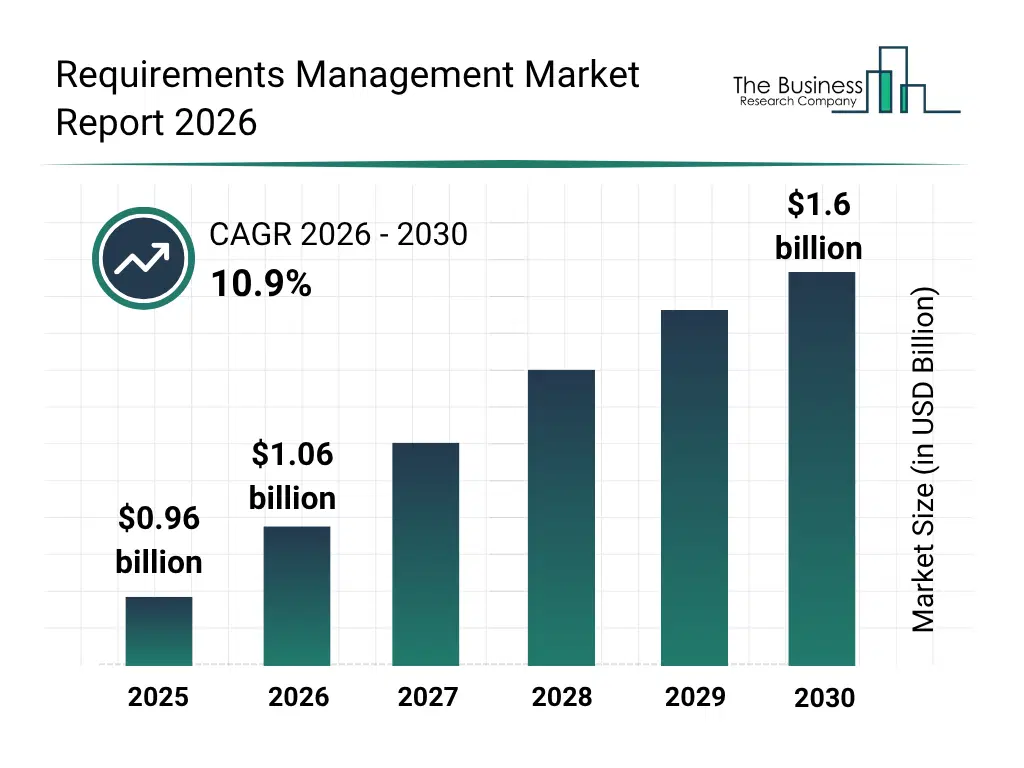
What Is The Requirements Management Market Size and Share 2026?
The requirements management market size has grown rapidly in recent years. It will grow from $0.96 billion in 2025 to $1.06 billion in 2026 at a compound annual growth rate (CAGR) of 10.7%. The growth in the historic period can be attributed to manual requirements documentation dependency, waterfall development model dominance, limited stakeholder collaboration tools, rising software complexity in enterprises, increasing need for regulatory compliance tracking.What Is The Requirements Management Market Growth Forecast?
The requirements management market size is expected to see rapid growth in the next few years. It will grow to $1.6 billion by 2030 at a compound annual growth rate (CAGR) of 10.9%. The growth in the forecast period can be attributed to expansion of agile and devops adoption, increasing use of AI assisted requirement engineering, growing demand for real time collaboration platforms, rise in complex multi system digital projects, stronger focus on end to end traceability and governance. Major trends in the forecast period include AI driven requirements elicitation and prioritization, digital twin based requirements modeling and validation, cloud based collaborative requirements management platforms, real time requirements traceability and impact analysis, agile and devops integrated requirements lifecycle management.
Global Requirements Management Market Segmentation
1) By Component: Requirements Management Software Platforms, Application Lifecycle Management Tools With Requirement Modules, Project Management Tools With Requirement Features, Model-Based Systems Engineering Platforms, Requirements Collaboration And Review Tools, Traceability And Impact Analysis Software, Change Management Systems, Compliance And Audit Tracking Solutions 2) By Deployment Type: Cloud-Based Requirements Management, On-Premises Requirements Management, Hybrid Deployment 3) By Organization Size: Large Enterprises, Mid-Sized Organizations, Small And Medium Businesses, Government And Defense Contractors 4) By Application: Software Development, System Engineering, Product Development, Business Process Management 5) By End Users: Information Technology And Telecommunications, Aerospace And Defense, Healthcare And Life Sciences, Automotive And Transportation, Manufacturing And Industrial, Banking, Financial Services, And Insurance (BFSI), Energy And Utilities Subsegments: 1) By Requirements Management Software Platforms: Cloud-Based Platforms, On-Premises Platforms, Hybrid Deployment Platforms, Open Source Platforms, Enterprise-Grade Platforms 2) By Application Lifecycle Management Tools With Requirement Modules: Agile Lifecycle Management Tools, Waterfall Lifecycle Management Tools, Devops Integrated Lifecycle Tools, End To End Lifecycle Platforms, Lightweight Lifecycle Tools 3) By Project Management Tools With Requirement Features: Task-Based Project Tools With Requirements, Agile Project Tools With Backlog Management, Portfolio Project Tools With Requirement Tracking, Collaborative Project Planning Tools, Resource Management Tools With Requirement Features 4) By Model-Based Systems Engineering Platforms: Graphical Modeling Platforms, Simulation Driven Engineering Platforms, Architecture Modeling Platforms, Digital Twin Enabled Platforms, Systems Design And Validation Platforms 5) By Requirements Collaboration And Review Tools: Real Time Collaboration Tools, Review And Approval Workflow Tools, Stakeholder Feedback Management Tools, Document Sharing And Annotation Tools, Discussion And Commenting Platforms 6) By Traceability And Impact Analysis Software: End To End Traceability Tools, Impact Visualization Tools, Dependency Mapping Tools, Change Impact Analysis Tools, Risk Assessment And Traceability Tools 7) By Change Management Systems: Workflow Driven Change Management Systems, Version Control Integrated Change Systems, Approval Based Change Tracking Systems, Configuration Management Systems, Enterprise Change Governance Systems 8) By Compliance And Audit Tracking Solutions: Regulatory Compliance Tracking Solutions, Audit Trail Management Solutions, Policy Management And Tracking Solutions, Quality Assurance Compliance Tools, Risk And Compliance Monitoring SolutionsWhat Is The Driver Of The Requirements Management Market?
The growth in cloud-based solutions is expected to propel the growth of the requirements management market going forward. Cloud-based solutions refer to software and services delivered over the internet that allow organizations to access, store, and manage data and applications remotely without relying on on-premises infrastructure. Cloud-based solutions are rising due to rapid digital transformation initiatives, as organizations shift operations online to enhance scalability, collaboration, and operational agility. The growing shift toward cloud infrastructure enables teams to access requirements management tools from anywhere, streamlining collaboration and accelerating product development cycles. For instance, in March 2025, according to the Office for National Statistics, a UK-based government department, in 2023, artificial intelligence (AI) was adopted by 9% of firms, while cloud-based computing systems and applications were adopted by 69% of firms in the UK. Therefore, growth in cloud-based solutions is driving the growth of the requirements management industry.Key Players In The Global Requirements Management Market
Major companies operating in the requirements management market are Siemens AG; International Business Machines Corporation; PTC Inc.; Aha Labs Inc.; Kovair Software Inc.; Modern Requirements Inc.; Blueprint Systems Inc.; SPEC Innovations Inc.; Inflectra Corporation; microTOOL GmbH; 3SL Ltd.; Accompa Inc.; Serlio Software Development Sp. z o.o.; Sparx Systems Pty Ltd.; Visure Solutions Inc.; Aligned Elements AB; Doc Sheets Ltd.; IRIS Business Architect Ltd.; ReqIF Studio GmbH; ReqTest AB; Xebrio Pvt. Ltd.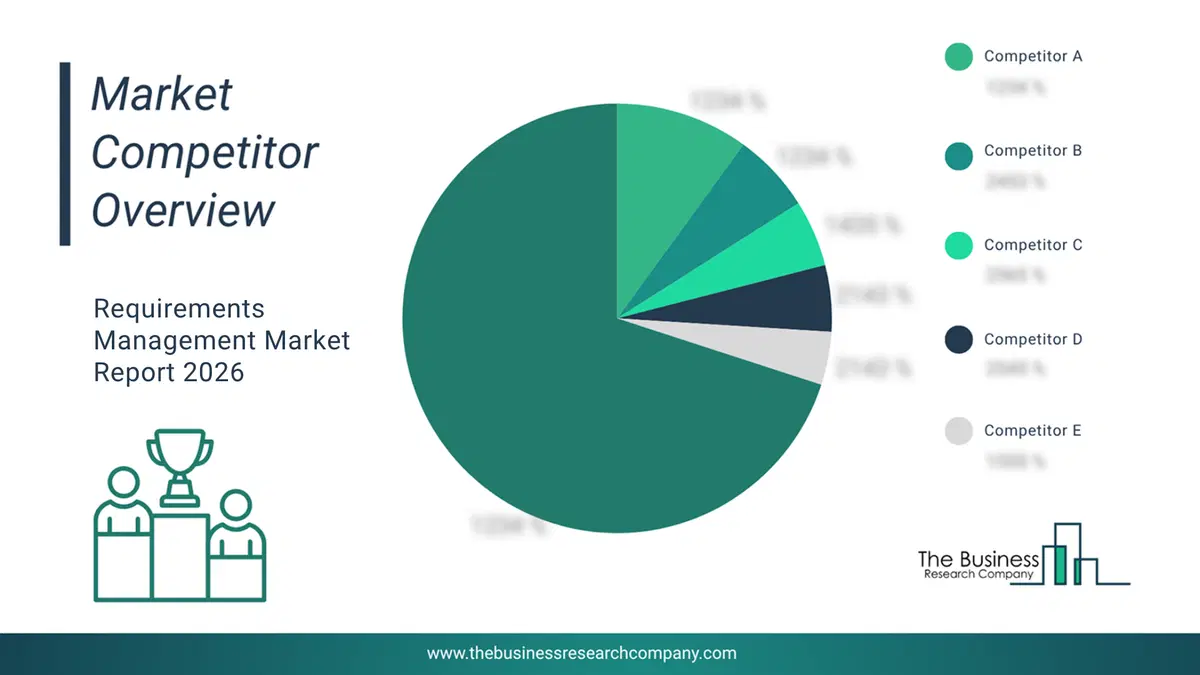
This chart is for illustrative purposes; the full report includes a detailed competitor analysis and comprehensive overview of the top 10 companies in the market.
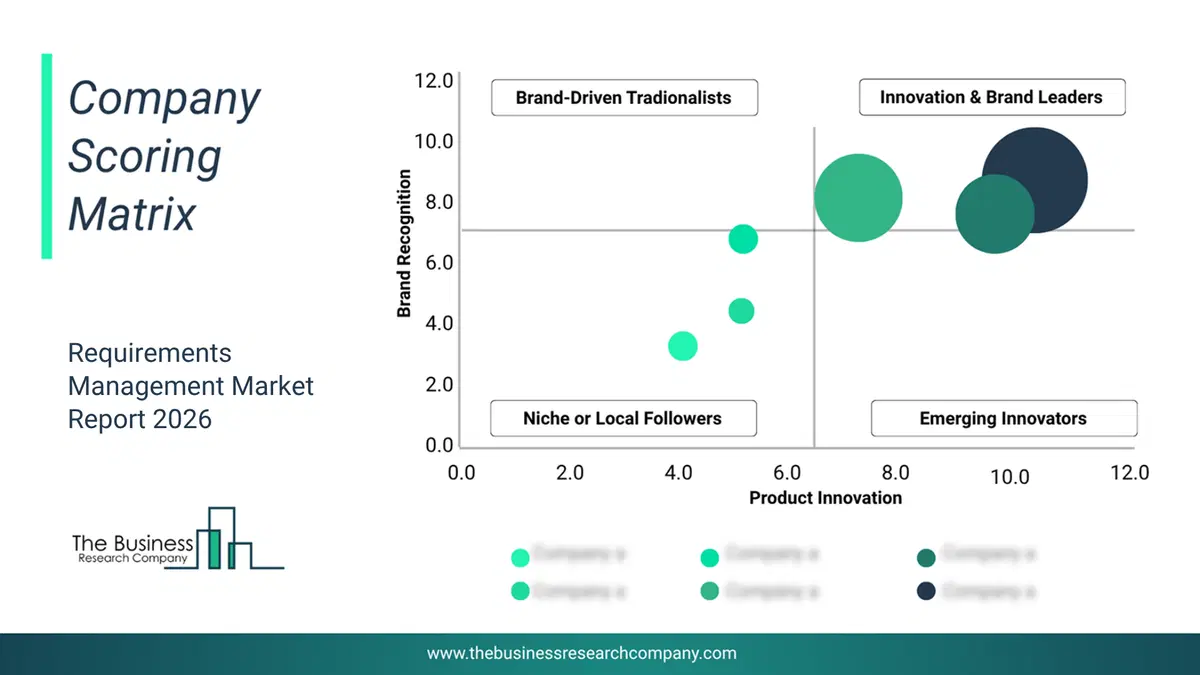
This chart maps companies by product innovation and brand strength, with bubble size indicating relative revenue, helping identify market leaders, challengers, and niche players. This is an illustrative chart; the full report provides a complete and accurate competitive analysis.
Global Requirements Management Market Trends and Insights
Major companies operating in the requirements management market are focusing on developing advanced solutions, such as integrated requirements and systems portals, to improve traceability, streamline collaboration, and ensure alignment between engineering and design teams. Integrated requirements and systems portals refer to centralized digital platforms that connect requirements definition, system design, and validation processes, enabling real-time visibility and efficient lifecycle management. For instance, in September 2024, Altium Pty. Ltd., a US-based electronics design software company, launched the Requirements Portal within Altium Develop and Altium Agile Teams, designed to bridge the gap between systems engineering and electronics design. The platform enables seamless requirements capture, bidirectional traceability, and cross-functional collaboration, allowing engineering teams to align design decisions with system-level requirements while improving product development efficiency and reducing errors.What Are Latest Mergers And Acquisitions In The Requirements Management Market?
In March 2024, Francisco Partners, a US-based private equity and technology investment firm, acquired Jama Software for $1.2 billion. With this acquisition, Francisco Partners aims to strengthen its portfolio in industrial and engineering software by scaling Jama Software’s leadership in requirements management and accelerating growth across mission-critical product development workflows. Jama Software is a US-based company that is a manufacturer of a tool for requirements management.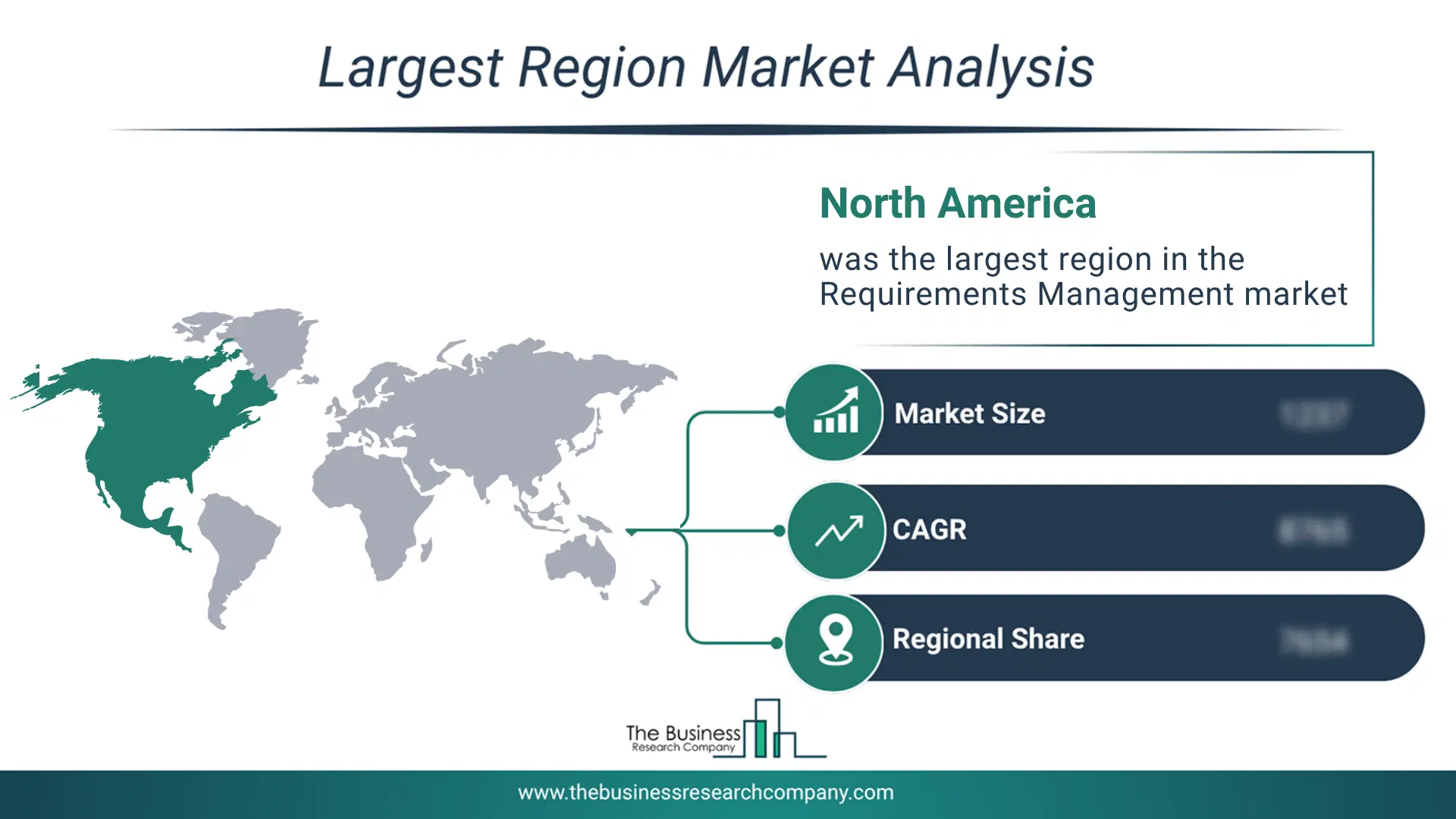
Regional Insights
North America was the largest region in the requirements management market in 2025. Asia-Pacific is expected to be the fastest-growing region in the forecast period. The regions covered in this market report are Asia-Pacific, South East Asia, Western Europe, Eastern Europe, North America, South America, Middle East, Africa. The countries covered in this market report are Australia, Brazil, China, France, Germany, India, Indonesia, Japan, Taiwan, Russia, South Korea, UK, USA, Canada, Italy, Spain.What Defines the Requirements Management Market?
The requirements management market consists of revenues earned by entities by providing services such as requirements elicitation, requirements analysis, requirements traceability, and change impact analysis. The market value includes the value of related goods sold by the service provider or included within the service offering. Only goods and services traded between entities or sold to end consumers are included.How is Market Value Defined and Measured?
The market value is defined as the revenues that enterprises gain from the sale of goods and/or services within the specified market and geography through sales, grants, or donations in terms of the currency (in USD unless otherwise specified). The revenues for a specified geography are consumption values that are revenues generated by organizations in the specified geography within the market, irrespective of where they are produced. It does not include revenues from resales along the supply chain, either further along the supply chain or as part of other products.
This chart presents market attractiveness based on a quantitative evaluation of growth, competition, strategic alignment, and risk, offering a clear view of opportunity areas for decision-making. This chart is for illustrative purposes; the full report contains the complete analysis.

This chart highlights the Total Addressable Market (TAM) by estimating the maximum revenue opportunity using an assumption-driven approach, supporting strategic planning and opportunity sizing across markets. The chart is illustrative; the full report provides a more comprehensive analysis.
What Key Data and Analysis Are Included in the Requirements Management Market Report 2026?
The requirements management market research report is one of a series of new reports from The Business Research Company that provides market statistics, including industry global market size, regional shares, competitors with the market share, detailed market segments, market trends and opportunities, and any further data you may need to thrive in the requirements management industry. The market research report delivers a complete perspective of everything you need, with an in-depth analysis of the current and future state of the industry.Requirements Management Market Report Forecast Analysis
| Report Attribute | Details |
|---|---|
| Market Size Value In 2026 | $1.06 billion |
| Revenue Forecast In 2030 | $1.6 billion |
| Growth Rate | CAGR of 10.9% from 2026 to 2030 |
| Base Year For Estimation | 2025 |
| Actual Estimates/Historical Data | 2020-2025 |
| Forecast Period | 2026 - 2030 |
| Market Representation | Revenue in USD Billion and CAGR from 2026 to 2030 |
| Segments Covered | Component, Deployment Type, Organization Size, Application, End Users |
| Regional Scope | Asia-Pacific, Western Europe, Eastern Europe, North America, South America, Middle East, Africa |
| Country Scope | The Countries Covered In This Market Report Are Australia, Brazil, China, France, Germany, India, Indonesia, Japan, Taiwan, Russia, South Korea, Uk, Usa, Canada, Italy, Spain. |
| Key Companies Profiled | Siemens AG, International Business Machines Corporation, PTC Inc., Aha Labs Inc., Kovair Software Inc., Modern Requirements Inc., Blueprint Systems Inc., SPEC Innovations Inc., Inflectra Corporation, microTOOL GmbH, 3SL Ltd., Accompa Inc., Serlio Software Development Sp. z o.o., Sparx Systems Pty Ltd., Visure Solutions Inc., Aligned Elements AB, Doc Sheets Ltd., IRIS Business Architect Ltd., ReqIF Studio GmbH, ReqTest AB, Xebrio Pvt. Ltd. |
| Customization Scope | Request for Customization |
| Pricing And Purchase Options | Explore Purchase Options |