

Research Antibodies And Reagents Market 2026
By Technology (Western blot, Immunofluorescence, Immunohistochemistry, Flow Cytometry, Enzyme-Linked Immunosorbent Assay (ELISA),Others), By Application (Proteomics, Genomics, Other Applications), By End User (Pharmaceutical And Biotechnology Industry, Academic And Research Institutes, Contract Research Organizations (CROs)), And By Region, Opportunities And Strategies – Global Forecast To 2035
Research Antibodies And Reagents Market Definition
Research antibodies and reagents are specialized biological tools used in scientific experiments to detect, quantify, and study specific molecules such as proteins, nucleic acids, or cellular components. Antibodies bind selectively to target antigens, while reagents such as buffers, enzymes, dyes, and substrates support various laboratory techniques, including immunoassays, flow cytometry, Western blotting, and molecular biology studies. The primary purpose of research antibodies and reagents is to enable accurate and reproducible biological research by facilitating the identification, characterization, and analysis of biomolecules. The research antibodies and reagent market consist of sales, by entities (organizations, sole traders, or partnerships), of research antibodies and reagents that are used predominantly by scientists and technical personnel in pharmaceutical and biotechnology companies, academic and research institutions, and contract research organizations (CROs). Their use spans from early-stage basic research to applied studies in drug discovery, disease understanding, and biomarker development.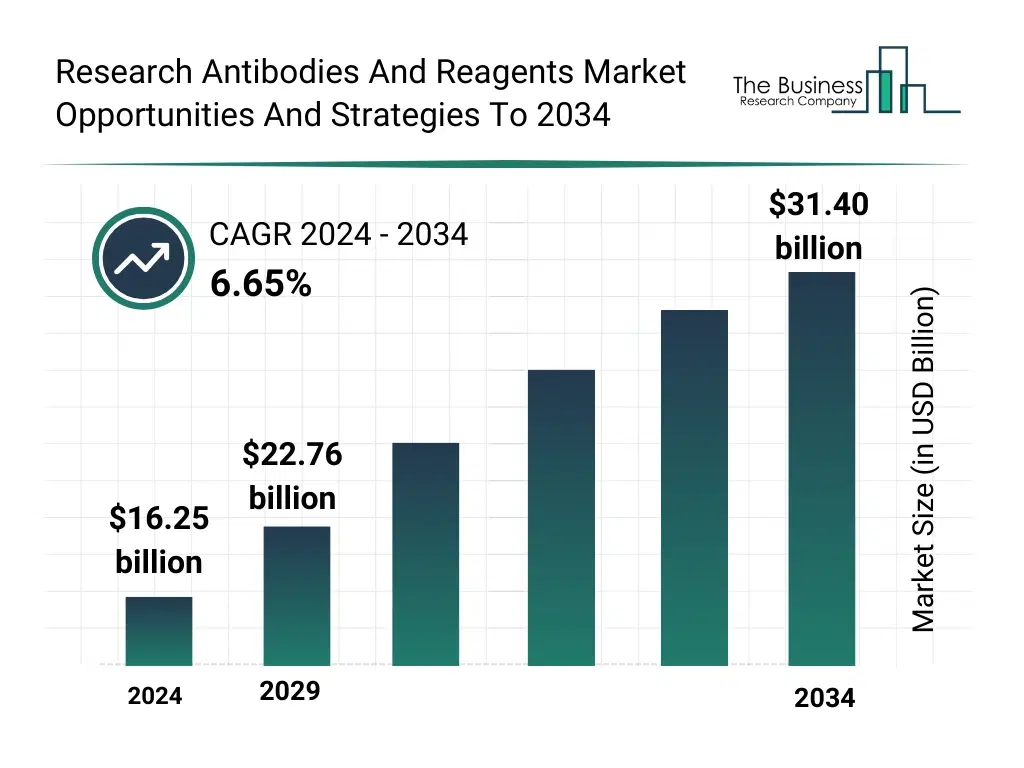
Research Antibodies And Reagents Market Size
The global research antibodies and reagents market reached a value of nearly $16,254.74 million in 2024, having grown at a compound annual growth rate (CAGR) of 7.75% since 2019. The market is expected to grow from $16,254.74 million in 2024 to $22,760.24 million in 2029 at a rate of 6.96%. The market is then expected to grow at a CAGR of 6.65% from 2029 and reach $31,404.45 million in 2034. Growth in the historic period resulted from rising demand for personalized medicine, growth in clinical trials, growth in life sciences research activity and expansion of contract research organizations (CROS). Factors that negatively affected growth in the historic period were high cost of quality antibodies and reagents and limited availability of skilled researchers and technicians. Going forward, increasing prevalence of chronic diseases, rising global healthcare and pharma R&D expenditure, expanding biopharma and biotech firm and expansion of proteomics and genomics research will drive the growth. Factors that could hinder the growth of the research antibodies and reagents market in the future include supply chain disruptions and raw material shortages, challenges in antibody quality and reproducibility and impact of trade war and tariff.Research Antibodies And Reagents Market Drivers
The key drivers of the research antibodies and reagents market include: Increasing Prevalence Of Chronic Diseases During the forecast period, the increasing prevalence of chronic diseases will significantly propel the growth of the research antibodies and reagents market. The rising global burden of chronic diseases such as cancer, cardiovascular disease, diabetes, and autoimmune disorders is driving demand for more and more research into disease biology, biomarker discovery, diagnostics, and therapeutic development. Since antibodies and reagents are fundamental tools for such research (in immunoassays, flow cytometry, western blotting, etc.), greater disease prevalence means more labs doing more experiments, more detection assays, and more reagent usage. For example, a press release emphasizes that the growing prevalence of chronic diseases is one of the major drivers of the in vitro diagnostic reagents market, since these conditions require regular monitoring and diagnostics. The increasing prevalence of chronic diseases growth during the forecast period in 2024 is 1.50%.Research Antibodies And Reagents Market Restraints
The key restraints on the research antibodies and reagents market include: Supply Chain Disruptions And Raw Material Shortages During the forecast period, supply chain disruptions and raw material shortages will pose a restraint on the growth of the research antibodies and reagents market. The antibody and reagent supply chain depends on a continuous flow of specialized raw materials such as media components, purification resins, enzymes, and chemicals. Disruptions caused by geopolitical tensions, transportation delays, or limited raw material availability can lead to production slowdowns and cost fluctuations. Several pharmaceutical and reagent manufacturers in China have shifted toward sourcing raw materials locally to reduce dependency on imported inputs and mitigate delivery delays. These disruptions increase production costs and challenge timely reagent availability, hindering consistent research workflows. Growth affected by supply chain disruptions and raw material shortages during the forecast period in 2024 is -2.50%.Research Antibodies And Reagents Market Trends
Major trends shaping the research antibodies and reagents market include: Integration Of Automated Western Blotting Systems Major companies in the research antibodies are increasing their offerings of automated Western blot platforms to improve throughput, reproducibility, and workflow standardization. In response to demands for higher throughput, better reproducibility, and streamlined workflows in protein analysis, companies are increasingly developing fully automated Western blot platforms that reduce manual steps and variability. For example, in July 2024, Bio-Techne, a US-based global life sciences company, introduced the Leo™ Simple Western System, expanding on its Simple Western line to offer higher throughput and full automation of traditional Western blot workflows. The Leo system allows processing of up to 100 samples in a single 3-hour run and is designed for both discovery research and bioanalytical applications. It is fully automated capillary western blotting that replaces traditional western blotting workflows, providing reproducibility, high sensitivity, and quantitative protein detection. Development Of High-Parameter Flow Cytometry Platforms Major companies in the research antibodies and reagents market are pushing the boundaries of flow cytometry by introducing platforms that can detect many more parameters per sample, enabling finer cellular phenotyping, rare cell detection, and richer data per test. In response to demands from immunology, oncology, and single-cell biology for deeper, high-dimensional profiling, firms are releasing spectral cytometers and sorters with increased numbers of lasers, detectors, automated maintenance, and enhanced throughput. For example, in May 2025, Cytek Biosciences, a US-based leading cell analysis solutions company, launched the Cytek Aurora Evo, a full-spectrum flow cytometer that sets a new benchmark for full spectrum flow cytometry, introducing notable advancements specifically aligned with research needs. It combines proven reliability and reproducibility with innovative enhancements that address contemporary laboratory workflows and enable greater experimental flexibility for researchers.Opportunities And Recommendations In The Research Antibodies And Reagents Market
Opportunities – The top opportunities in the research antibodies and reagents market segmented by technology will arise in the immunohistochemistry segment, which will gain $1,719.79 million of global annual sales by 2029. The top opportunities in the research antibodies and reagents market segmented by application will arise in the proteomics segment, which will gain $3,862.61 million of global annual sales by 2029. The top opportunities in the research antibodies and reagents market segmented by end-user will arise in the academic and research institutes segment, which will gain $3,454.16 million of global annual sales by 2029. The research antibodies and reagents market size will gain the most in the USA at $1,885.94 million. Recommendations- To take advantage of the opportunities, The Business Research Company recommends the research antibodies and reagents companies to focus on automated western blot platforms to drive growth, focus on high-parameter flow cytometry platforms, focus on multiplexed immunofluorescence imaging solutions, focus on immunohistochemistry for growth and market leadership, focus on expanding distribution channels in research antibodies and reagents, focus on strategic pricing for research antibodies and reagents, focus on strengthening digital and scientific marketing, focus on customer-centric promotional programs, focus on proteomics applications for market expansion, focus on pharmaceutical and biotechnology industry for strategic growth.
Research Antibodies And Reagents Market Segmentation
The Research Antibodies And Reagents market is segmented by technology, by application, and by end-user.By Technology –
The Research Antibodies And Reagents market is segmented by technology into:
- a) Western Blot
- b) Immunofluorescence
- c) Immunohistochemistry
- d) Flow Cytometry
- e) Enzyme-Linked Immunosorbent Assay (ELISA)
- f) Others
By Application –
The research antibodies and reagents market is segmented by application into:
- a) Proteomics
- b) Genomics
- c) Other Applications
By End-User –
The research antibodies and reagents market is segmented by end-user into:
- a) Pharmaceutical And Biotechnology Industry
- b) Academic And Research Institutes
- c) Contract Research Organizations (CROs
By Geography - The research antibodies and reagents market is segmented by geography into:
- • China
- • India
- • Japan
- • Australia
- • Indonesia
- • South Korea
- • Bangladesh
- • Thailand
- • Vietnam
- • Malaysia
- • Singapore
- • Phillipines
- • Hong kong
- • New Zealand
- • USA
- • Canada
- • Mexico
- • Brazil
- • Argentina
- • Chile
- • Colombiia
- • Peru
- • France
- • Germany
- • UK
- • Italy
- • Spain
- • Austria
- • Belgium
- • Denmark
- • Finland
- • Ireland
- • Netherland
- • Norway
- • Portugal
- • Sweden
- • Switzerland
- • Russia
- • Czech Republic
- • Poland
- • Romania
- • Ukraine
- • Saudi Arabia
- • Israel
- • Iran
- • Turkey
- • UAE o Africa
- • Egypt
- • Nigeria
- • South Africa
-
o Asia Pacific