
Residential Distribution Panel Global Market Opportunities And Strategies To 2035
By Mounting (Flush Mounting, Surface Mounting), By Voltage (Less Than Or Equal To 250 Volts, More Than 250 Volts To 750 Volts, More Than 750 Volts), By End-User (Single-Family Homes, Multi-Family Residential), And By Region, Opportunities And Strategies – Global Forecast To 2035
Residential Distribution Panel Market Definition
Residential distribution panels refer to electrical power distribution boards installed in residential buildings to safely distribute electricity from the main power supply to multiple branch circuits within a building. These panels, also commonly referred to as breaker panels, load centers or consumer units, serve as the central hub of a building’s electrical system and house protective devices such as circuit breakers or fuses that regulate the flow of electricity and protect electrical circuits from overloads or short circuits. The residential distribution panel market consists of sales by entities (organizations, sole traders, or partnerships) of main breaker load centers, main lug load centers, circuit breakers, subpanels, surge protection devices, bus bars, and grounding bars. Residential distribution panels are used by homeowners, property developers, electrical contractors, facility managers and electricians to manage and distribute electrical power within houses, apartments, residential complexes and small commercial establishments. They are typically used whenever electrical infrastructure is installed in new buildings, renovated properties or when electrical systems are upgraded to support additional appliances and modern electrical loads.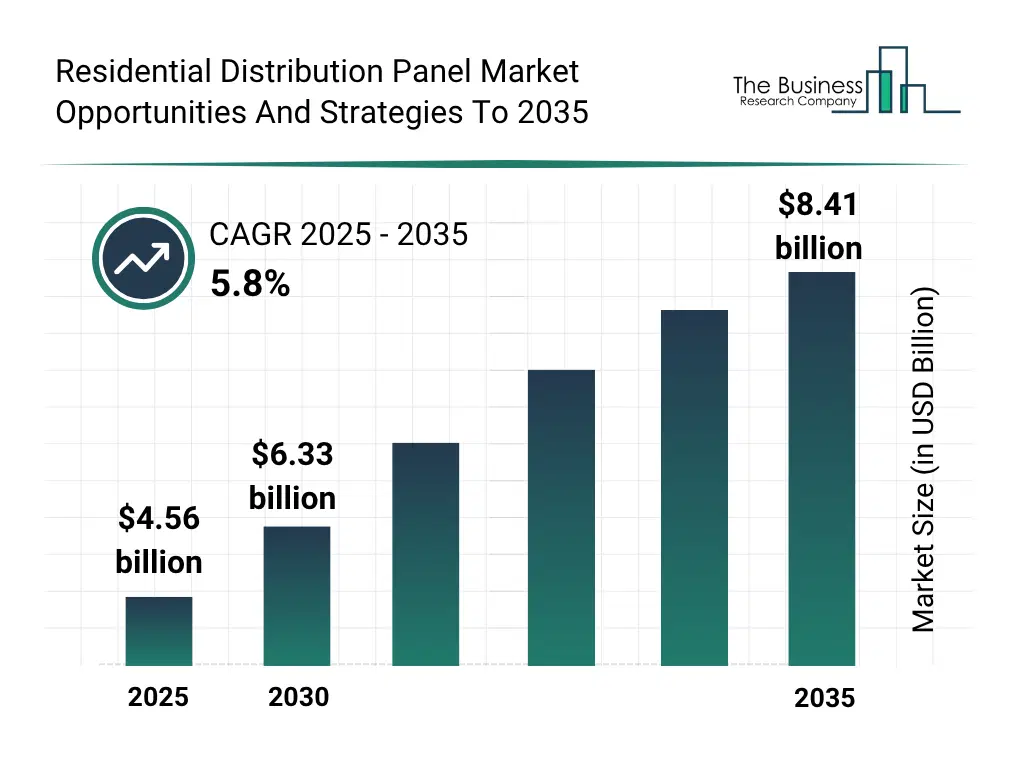
Residential Distribution Panel Market Size
The global residential distribution panel market reached a value of nearly $4,562.9 million in 2025, having grown at a compound annual growth rate (CAGR) of 7.2% since 2020. The market is expected to grow from $4,562.9 million in 2025 to $6,334.4 million in 2030 at a rate of 6.8%. The market is then expected to grow at a CAGR of 5.8% from 2030 and reach $8,408.5 million in 2035. Growth in the historic period resulted from growing adoption of rooftop solar photovoltaic (PV) systems, increasing adoption of smart home devices, rising residential construction activities and rising smart city infrastructure development programs. Factors that negatively affected growth in the historic period were high installation and upgrade costs and risk of electrical hazards. Going forward, grid modernization initiatives, rising government initiatives supporting energy-efficient housing, expansion of prefabricated and modular housing projects and expansion of rural electrification initiatives will drive the growth. Factors that could hinder the growth of the residential distribution panel market in the future include complex electrical regulations and compliance requirements, fluctuating prices of raw materials such as copper, steel, and aluminum and impact of trade wars and tariffs.
Residential Distribution Panel Market Segmentation
The residential distribution panel market is segmented by mounting, by voltage, by deployment, by end user.
By Mounting –
The residential distribution panel market is segmented by mounting into:
By Voltage –
The residential distribution panel market is segmented by voltage into:
By End User –
The residential distribution panel market is segmented by end user into:
By Geography - The residential distribution panel market is segmented by geography into:
By Mounting –
The residential distribution panel market is segmented by mounting into:
- a) Flush Mounting
- b) Surface Mounting
By Voltage –
The residential distribution panel market is segmented by voltage into:
- a) Less Than Or Equal To 250 Volts
- b) More Than 250 Volts To 750 Volts
- C) More Than 750 Volts
By End User –
The residential distribution panel market is segmented by end user into:
- a) Single-Family Homes
- b) Multi-Family Residential
By Geography - The residential distribution panel market is segmented by geography into:
- China
- India
- Japan
- Australia
- Indonesia
- South Korea
- USA
- Canada
- Brazil
- France
- Germany
- UK
- Italy
- Spain
- Russia
-
o Asia Pacific
o Africa