

Residential Heat Pump Market Report 2026
Global Outlook – By Type (Water Source, Geothermal, Air Source), By Power Source (Electric Powered, Hybrid Electric Systems, Renewable-Assisted Electric Systems), By Application (Single Family, Multi Family) – Market Size, Trends, Strategies, and Forecast to 2030
Residential Heat Pump Market Overview
• Residential Heat Pump market size has reached to $45.17 billion in 2025 • Expected to grow to $75.78 billion in 2030 at a compound annual growth rate (CAGR) of 11.1% • Growth Driver: Rising Residential Construction Fueling The Growth Of The Residential Heat Pump Market Due To Increasing Housing Demand And Energy-Efficiency Requirements • Market Trend: Advancements Driving The Future Of Eco-Friendly Home Heat Pumps • Asia Pacific was the largest region in 2025 and Asia Pacific is the fastest growing region.What Is Covered Under Residential Heat Pump Market?
Residential heat pump refers to an energy-efficient heating and cooling system that transfers heat between indoor spaces and the surrounding air, ground, or water for home climate control. They are used for providing space heating, cooling, and in some cases domestic hot water in residential buildings while reducing energy consumption and carbon emissions. The main types of residential heat pumps include water source, geothermal, and air source. A blood test for HCG is a clinical assessment designed to gauge the concentration of the human chorionic gonadotropin (HCG) hormone in the bloodstream. The various power source includes electric powered, gas powered, and others and are used by several applications such as single family, and multi family.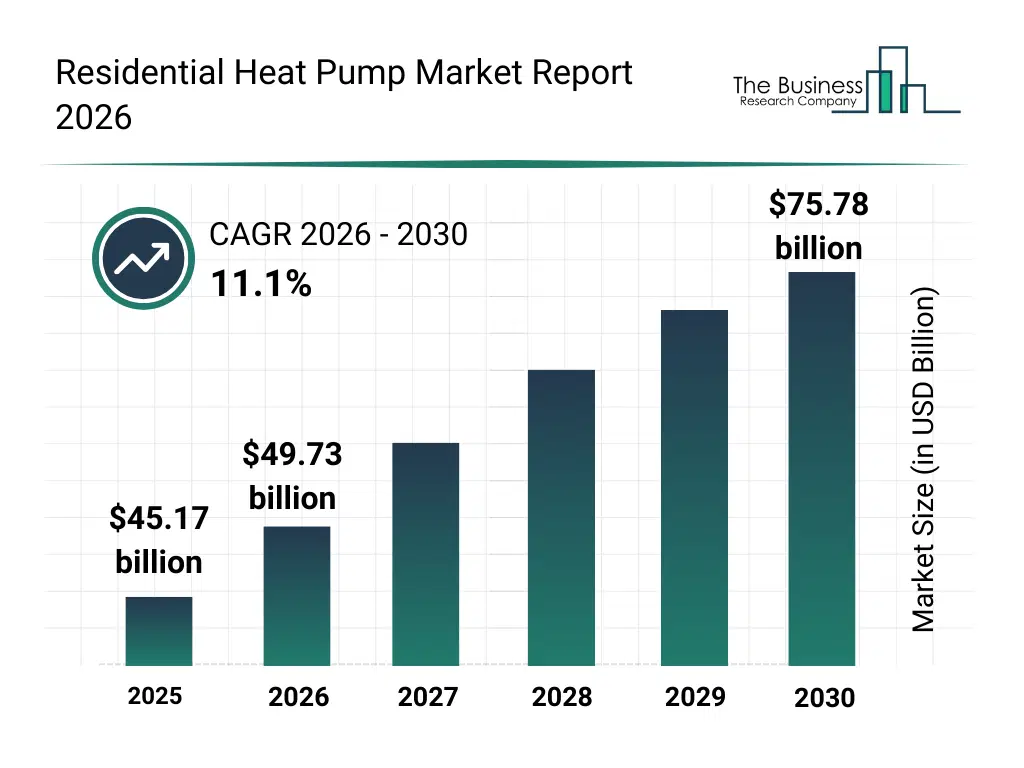
What Is The Residential Heat Pump Market Size and Share 2026?
The residential heat pump market size has grown rapidly in recent years. It will grow from $45.17 billion in 2025 to $49.73 billion in 2026 at a compound annual growth rate (CAGR) of 10.1%. The growth in the historic period can be attributed to rising residential heating demand, increasing awareness of energy efficiency, government incentives for heat systems, early adoption in cold regions, development of electric powered solutions.What Is The Residential Heat Pump Market Growth Forecast?
The residential heat pump market size is expected to see rapid growth in the next few years. It will grow to $75.78 billion in 2030 at a compound annual growth rate (CAGR) of 11.1%. The growth in the forecast period can be attributed to growing focus on sustainable home heating, rising shift from conventional heating systems, increasing regulatory support for eco heating technologies, expansion of residential infrastructure, rising consumer interest in energy efficient homes. Major trends in the forecast period include increasing integration of smart energy control systems, growing application of ai in performance optimization, rising connectivity of residential heating solutions, expansion of advanced manufacturing for heat pumps, strengthening focus on digitally managed home energy systems.
Global Residential Heat Pump Market Segmentation
1) By Type: Water Source, Geothermal, Air Source 2) By Power Source: Electric Powered, Hybrid Electric Systems, Renewable-Assisted Electric Systems 3) By Application: Single Family, Multi Family Subsegments: 1) By Water Source: Open Loop Systems, Closed Loop Systems 2) By Geothermals: Horizontal Ground Loop Systems, Vertical Ground Loop Systems, Pond Or Lake Systems 3) By Air Source: Air-To-Air Heat Pumps, Air-To-Water Heat Pumps, Ductless Mini-Split SystemsWhat Is The Driver Of The Residential Heat Pump Market?
The growth in residential construction is expected to propel the growth of the residential heat pump market going forward. Residential construction refers to the process of building, renovating, or remodeling housing structures such as single-family homes, multi-family apartments, and residential complexes. Residential construction is increasing due to rising urbanization and growing demand for new housing driven by population growth. Residential heat pump helps residential construction by enabling developers to meet energy-efficiency standards, reduce carbon emissions, and deliver cost-effective heating and cooling solutions in new housing projects. For instance, in June 2023, according to the U.S. Census Bureau and the U.S. Department of Housing and Urban Development, US-based government administrations, in May 2023, privately owned home starts were occurring at a seasonally adjusted annual pace of 1, 631, 000, representing an increase of 21.7% in the revised April 2023 prediction of 1, 340, 000 and 5.7% in the May 2022 rate of 1, 543, 000. The number of privately owned home completions in May 2023 was 1, 518, 000 on a seasonally adjusted yearly basis, representing an increase of 5.0% over the May 2022 rate of 1, 446, 000 and 9.5% above the revised April 2023 estimate of 1, 386, 000. Therefore, the increase in fertility rate is driving the growth of the residential heat pump industry.Key Players In The Global Residential Heat Pump Market
Major companies operating in the residential heat pump market report are Daikin Industries Ltd., Mitsubishi Electric Corporation, Panasonic Corporation, LG Electronics Inc., Carrier Global Corporation, Trane Technologies, Lennox International Inc., Bosch Thermotechnik GmbH, Viessmann Group, NIBE Group, Vaillant Group, Fujitsu General Ltd., Rheem Manufacturing Company, A O Smith Corporation, Stiebel Eltron Group, Ariston Group, Glen Dimplex Group, Samsung Electronics Co Ltd., Midea Group, Enertech Global LLC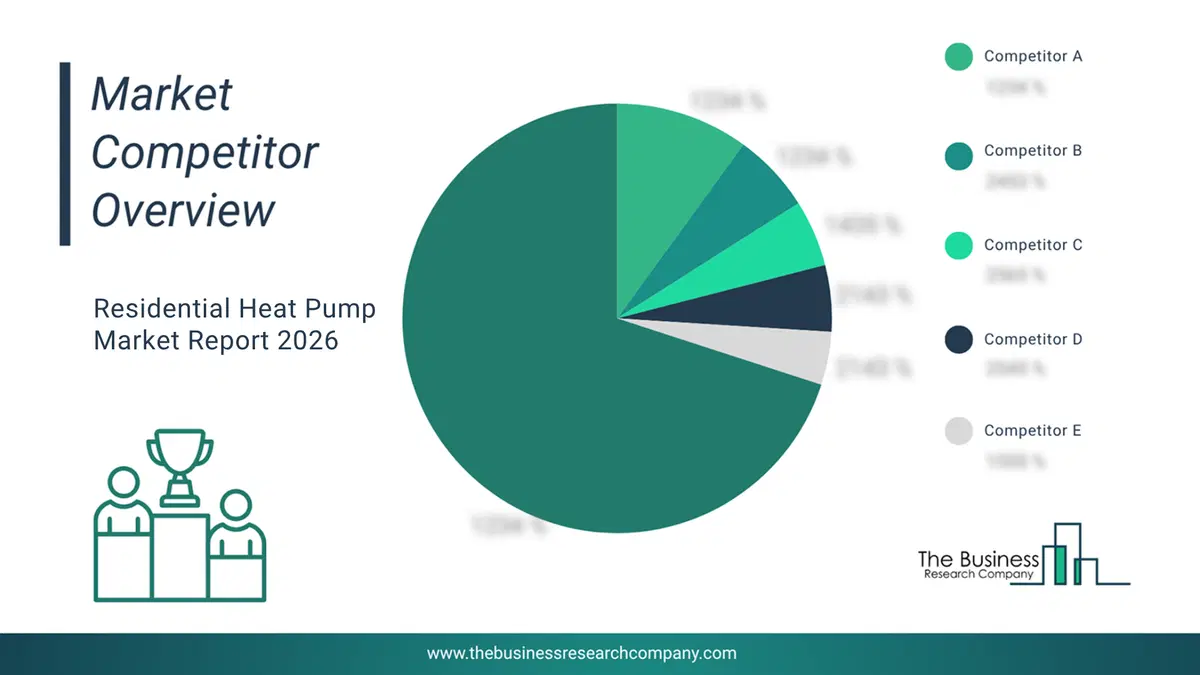
This chart is for illustrative purposes; the full report includes a detailed competitor analysis and comprehensive overview of the top 10 companies in the market.
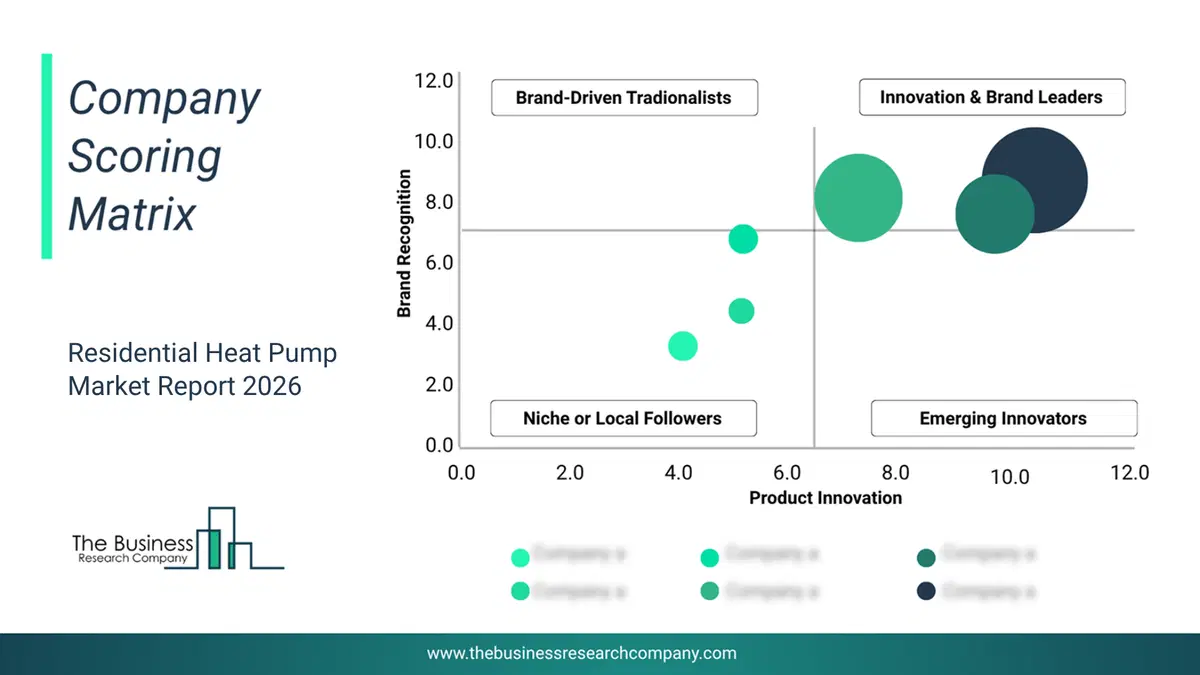
This chart maps companies by product innovation and brand strength, with bubble size indicating relative revenue, helping identify market leaders, challengers, and niche players. This is an illustrative chart; the full report provides a complete and accurate competitive analysis.
Global Residential Heat Pump Market Trends and Insights
Major companies operating in the residential heat pump market are focusing on developing innovative solutions, such as air-to-water propane heat pumps, to enhance energy efficiency, reduce carbon emissions, and meet the rising demand for eco-friendly home heating and cooling systems. Air-to-water propane heat pumps are high-efficiency heating systems that use propane (R290) as the refrigerant to extract heat from the outdoor air and transfer it into water for space heating, cooling, and domestic hot water. For instance, in August 2024, LG Electronics, a South Korea–based consumer and HVAC manufacturer, launched its new “Therma V R290 Monobloc” residential air-to-water heat pumps. These come in 7 kW and 9 kW versions, employ propane (R290) as refrigerant, and achieve a seasonal coefficient of performance (SCOP) of over 5. The units can deliver flow temperatures up to 75 °C even when the outside temperature is as low as –15 °C and maintain heating output down to 28 °C, they also operate quietly (around 49–50 dB(A)), and integrate with energy-storage systems (ESS) and home energy management via the firm’s ThinQ platform, enabling optimization with rooftop solar or other renewables. This release underscores a broader market shift toward sustainable, high-efficiency, climate-friendly residential heating solutions.What Are Latest Mergers And Acquisitions In The Residential Heat Pump Market?
In June 2024, Hometree Marketplace Limited, a UK‑based residential energy services company, acquired IMS Heat Pumps for an undisclosed amount. With this acquisition, Hometree aimed to accelerate its expansion into low‑carbon home energy solutions by bolstering its heat pump installation capabilities and supporting the broader home decarbonisation transition in the UK. IMS Heat Pumps Limited is a UK‑based renewable energy installer that specializes in supplying and installing bespoke ground source, air source, and water source heat pump systems for residential and commercial customers across England and Scotland.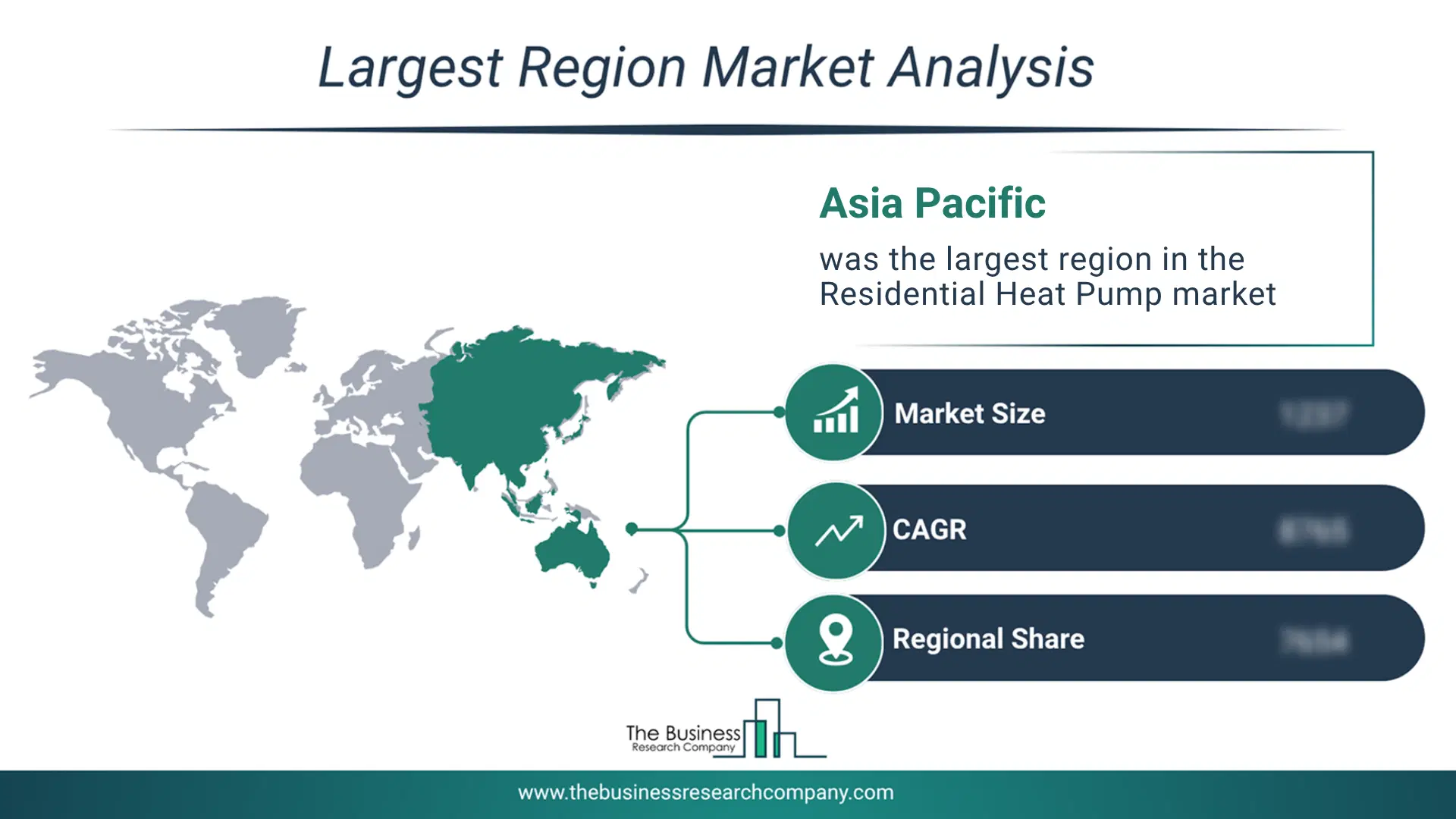
Regional Outlook
Asia Pacific was the largest region in the residential heat pump market in 2025. Asia Pacific is expected to be the fastest-growing region in the forecast period. The regions covered in this market report are Asia-Pacific, South East Asia, Western Europe, Eastern Europe, North America, South America, Middle East, Africa. The countries covered in this market report are Australia, Brazil, China, France, Germany, India, Indonesia, Japan, Taiwan, Russia, South Korea, UK, USA, Canada, Italy, SpainWhat Defines the Residential Heat Pump Market?
The residential heat pump market consists of sales of air-to-air heat pumps, air-to-water heat pumps, ducted heat pump systems, and solar-assisted heat pumps. Values in this market are ‘factory gate’ values, that is, the value of goods sold by the manufacturers or creators of the goods, whether to other entities (including downstream manufacturers, wholesalers, distributors, and retailers) or directly to end customers. The value of goods in this market includes related services sold by the creators of the goods.How is Market Value Defined and Measured?
The market value is defined as the revenues that enterprises gain from the sale of goods and/or services within the specified market and geography through sales, grants, or donations in terms of the currency (in USD unless otherwise specified). The revenues for a specified geography are consumption values that are revenues generated by organizations in the specified geography within the market, irrespective of where they are produced. It does not include revenues from resales along the supply chain, either further along the supply chain or as part of other products.
This chart presents market attractiveness based on a quantitative evaluation of growth, competition, strategic alignment, and risk, offering a clear view of opportunity areas for decision-making. This chart is for illustrative purposes; the full report contains the complete analysis.

This chart highlights the Total Addressable Market (TAM) by estimating the maximum revenue opportunity using an assumption-driven approach, supporting strategic planning and opportunity sizing across markets. The chart is illustrative; the full report provides a more comprehensive analysis.
What Key Data and Analysis Are Included in the Residential Heat Pump Market Report 2026?
The residential heat pump market research report is one of a series of new reports from The Business Research Company that provides market statistics, including industry global market size, regional shares, competitors with the market share, detailed market segments, market trends and opportunities, and any further data you may need to thrive in the residential heat pump industry. The market research report delivers a complete perspective of everything you need, with an in-depth analysis of the current and future state of the industry.Residential Heat Pump Market Report Forecast Analysis
| Report Attribute | Details |
|---|---|
| Market Size Value In 2026 | $49.73 billion |
| Revenue Forecast In 2030 | $75.78 billion |
| Growth Rate | CAGR of 10.1% from 2026 to 2030 |
| Base Year For Estimation | 2025 |
| Actual Estimates/Historical Data | 2020-2025 |
| Forecast Period | 2026 - 2030 - 2030 |
| Market Representation | Revenue in USD Billion and CAGR from 2026 to 2030 |
| Segments Covered | Type, Power Source, Application |
| Regional Scope | Asia-Pacific, Western Europe, Eastern Europe, North America, South America, Middle East, Africa |
| Country Scope | The countries covered in the report are Australia, Brazil, China, France, Germany, India, Indonesia, Japan, Taiwan, Russia, South Korea, UK, USA, Canada, Italy, Spain. |
| Key Companies Profiled | Daikin Industries Ltd., Mitsubishi Electric Corporation, Panasonic Corporation, LG Electronics Inc., Carrier Global Corporation, Trane Technologies, Lennox International Inc., Bosch Thermotechnik GmbH, Viessmann Group, NIBE Group, Vaillant Group, Fujitsu General Ltd., Rheem Manufacturing Company, A O Smith Corporation, Stiebel Eltron Group, Ariston Group, Glen Dimplex Group, Samsung Electronics Co Ltd., Midea Group, Enertech Global LLC |
| Customization Scope | Request for Customization |
| Pricing And Purchase Options | Explore Purchase Options |