
Residential Low Slope Roofing Market Report 2026
Global Outlook – By Type (Ethylene Propylene Diene Monomer (EPDM) Roofing, Thermoplastic Olefin (TPO) Roofing, Polyvinyl Chloride (PVC) Roofing, Modified Bitumen Roofing, Other Types), By Roofing Material (Bituminous Roofing, Metal Roofing, Tile Roofing, Other Roofing Materials), By Application (Commercial, Residential, Industrial) – Market Size, Trends, Strategies, and Forecast to 2030
Residential Low Slope Roofing Market Overview
• Residential Low Slope Roofing market size has reached to $21.46 billion in 2025 • Expected to grow to $32.25 billion in 2030 at a compound annual growth rate (CAGR) of 8.4% • Growth Driver: Growing Solar Panel Demand Drives Residential Low Slope Roofing Market Expansion • Market Trend: Innovations In Polypropylene Sheet Roofing Enhance Durability And Moisture Resistance In Residential Low-Slope Roofs • North America was the largest region and fastest growing region.What Is Covered Under Residential Low Slope Roofing Market?
Residential low slope roofing refers to roofing systems designed for residential buildings where the roof has a slight pitch or slope, typically less than 3:12 (3 inches of vertical rise for every 12 inches of horizontal run). The slight slope is designed to ensure that water flows toward drains or gutters, preventing water pooling, which can lead to leaks or structural damage. These roofs can also provide usable outdoor space for gardens, decks, or solar panel installations, especially in modern or urban designs. The main types in the residential low slope roofing market are ethylene propylene diene monomer (EPDM) roofing, thermoplastic olefin (TPO) roofing, polyvinyl chloride (PVC) roofing, modified bitumen roofing, and others. Ethylene propylene diene monomer (EPDM) roofing refers to a durable synthetic rubber roofing membrane widely used in low-slope buildings. The various roofing materials include bituminous roofing, metal roofing, tile roofing, and others, and several applications including commercial, residential, and industrial.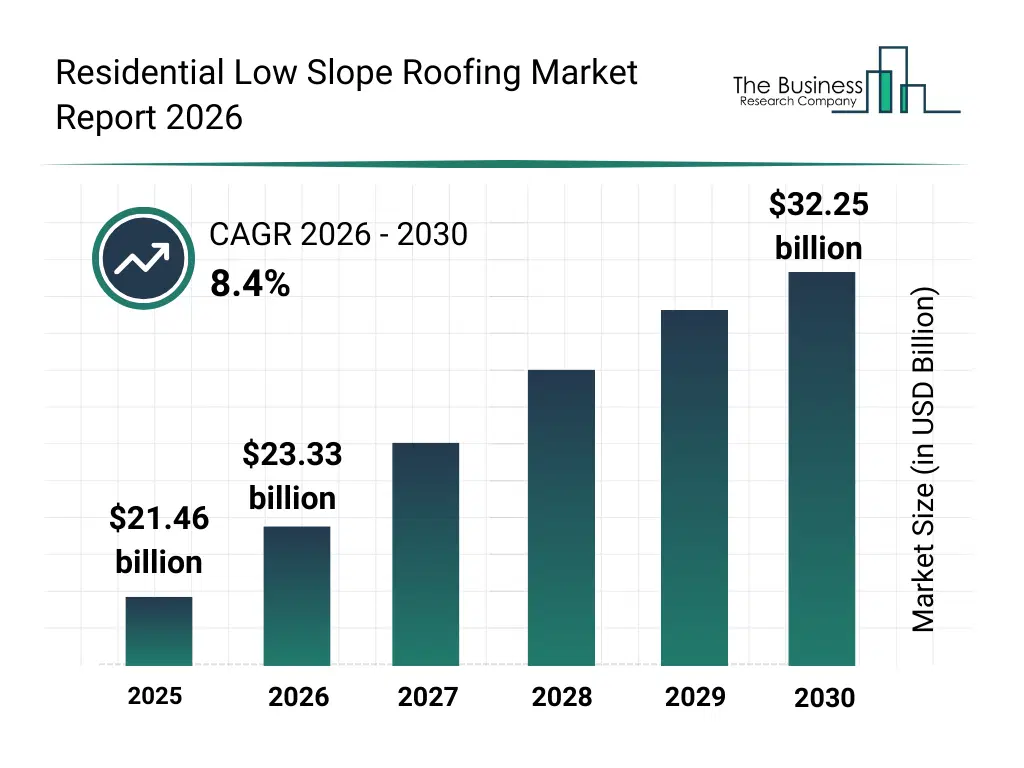
What Is The Residential Low Slope Roofing Market Size and Share 2026?
The residential low slope roofing market size has grown strongly in recent years. It will grow from $21.46 billion in 2025 to $23.33 billion in 2026 at a compound annual growth rate (CAGR) of 8.7%. The growth in the historic period can be attributed to increasing adoption of low slope roofing, rising use of energy-efficient materials, expansion in residential construction, growing focus on roof durability, rising popularity of green roofs.What Is The Residential Low Slope Roofing Market Growth Forecast?
The residential low slope roofing market size is expected to see strong growth in the next few years. It will grow to $32.25 billion in 2030 at a compound annual growth rate (CAGR) of 8.4%. The growth in the forecast period can be attributed to increasing use of automated installation systems, deployment of IoT-enabled monitoring, integration of AI-based maintenance, development of sustainable roofing solutions, expansion of synthetic and composite materials. Major trends in the forecast period include adoption of energy-efficient low slope roofing materials, deployment of smart roof monitoring systems, integration of AI-based maintenance and inspection solutions, expansion of IOT-enabled residential roofing platforms, development of automated installation techniques.
Global Residential Low Slope Roofing Market Segmentation
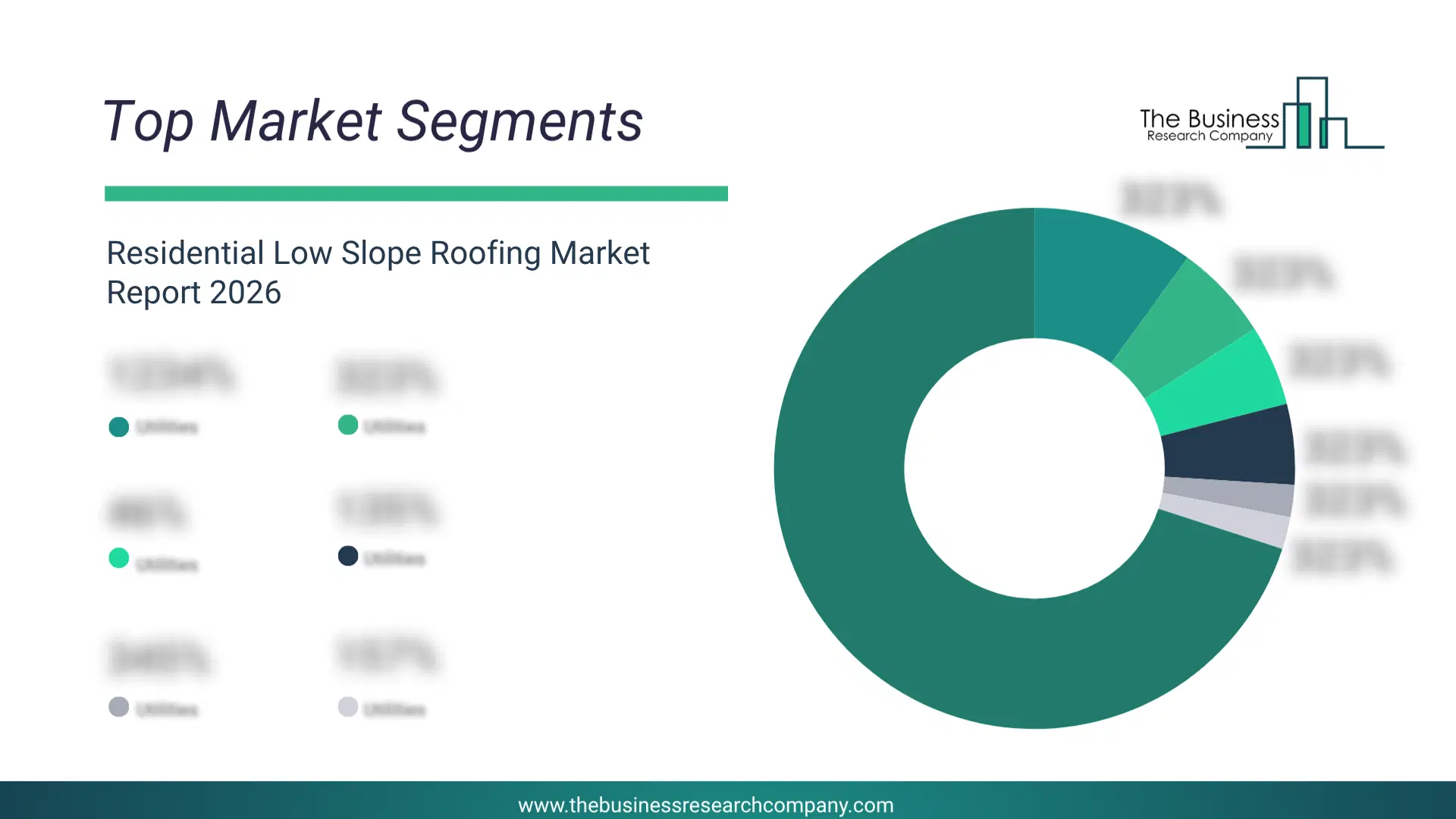
1) By Type: Ethylene Propylene Diene Monomer (EPDM) Roofing, Thermoplastic Olefin (TPO) Roofing, Polyvinyl Chloride (PVC) Roofing, Modified Bitumen Roofing, Other Types 2) By Roofing Material: Bituminous Roofing, Metal Roofing, Tile Roofing, Other Roofing Materials 3) By Application: Commercial, Residential, Industrial Subsegments: 1) By Ethylene Propylene Diene Monomer (EPDM) Roofing: Fully Adhered EPDM Roofing, Ballasted EPDM Roofing, Mechanically Attached EPDM Roofing 2) By Thermoplastic Olefin (TPO) Roofing: Single-Ply TPO Membranes, Mechanically Fastened TPO Roofing, Fully Adhered TPO Roofing, Ballasted TPO Roofing 3) By Polyvinyl Chloride (PVC) Roofing: Single-Ply PVC Membranes, Mechanically Fastened PVC Roofing, Fully Adhered PVC Roofing, Reinforced vs. Non-Reinforced PVC 4) By Modified Bitumen Roofing: APP (Atactic Polypropylene) Modified Bitumen, SBS (Styrene-Butadiene-Styrene) Modified Bitumen, Self-Adhering Modified Bitumen Systems, Torch-Applied Modified Bitumen Systems 5) By Other Types: Spray Polyurethane Foam (SPF) Roofing, Built-Up Roofing (BUR), Green Roof Systems (Vegetative Roofs), Liquid Applied Roofing SystemsWhat Is The Driver Of The Residential Low Slope Roofing Market?
The growing demand for solar panels is expected to propel the growth of the residential low-slope roofing market going forward. Solar panels are equipment that transforms sunlight into electricity using photovoltaic technology. The need for renewable energy sources, and supportive government regulations drives the increasing demand for solar panels. Residential low-slope roofs provide a relatively flat surface, allowing solar panels to be positioned and angled optimally to capture maximum sunlight. These low-slope roofs are safer and easier for workers to access, making installing solar panels less hazardous and more efficient. For instance, in May 2025, according to the SolarPower Europe, a Belgium-based non-profit government agency, global solar PV installations reached a new milestone in 2024, hitting 597 GW, representing a 33% growth compared to 2023. Therefore, the growing demand for solar panels drives the residential low-slope roofing market.Key Players In The Global Residential Low Slope Roofing Market
Major companies operating in the residential low slope roofing market are BASF SE, Sika AG, Owens Corning, Kingspan Group plc, Carlisle Construction Materials LLC, Johns Manville Inc., BMI Group Limited, CertainTeed Corporation, CentiMark Corporation, GAF Materials Corporation, Atlas Roofing Corporation, IKO Industries Ltd, The Garland Company Inc., TAMKO Building Products LLC, American Hydrotech Inc., GenFlex Roofing Systems LLC, Polyglass USA Inc, Malarkey Roofing Products Co., ATAS International Inc, ARAC Roof It Forward Inc., Hopkins Roofing LLC, Kemper System Inc., Mule-Hide Products Co Inc., Strategic Building Products LLC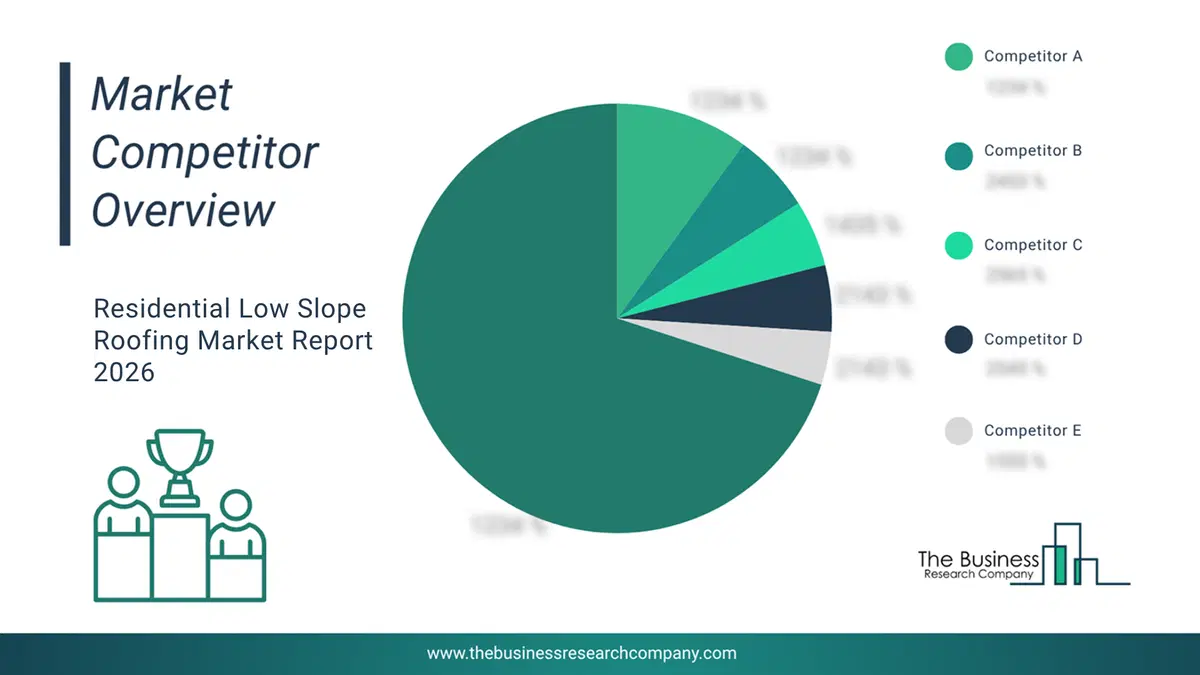
This chart is for illustrative purposes; the full report includes a detailed competitor analysis and comprehensive overview of the top 10 companies in the market.
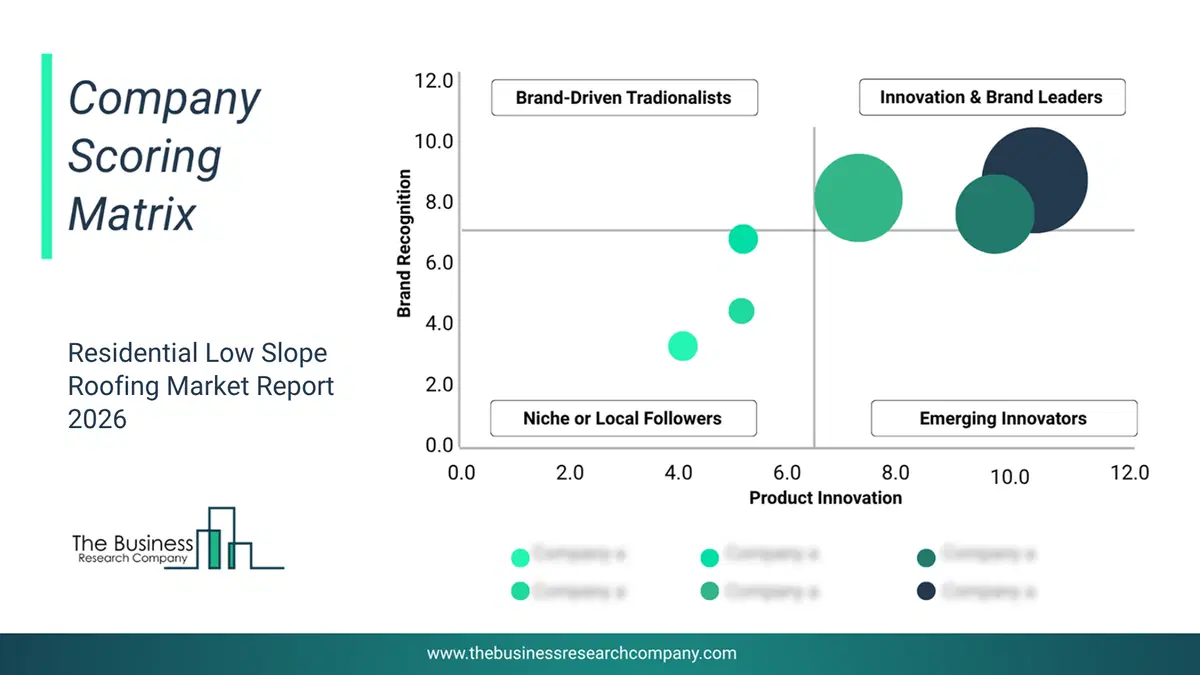
This chart maps companies by product innovation and brand strength, with bubble size indicating relative revenue, helping identify market leaders, challengers, and niche players. This is an illustrative chart; the full report provides a complete and accurate competitive analysis.
Global Residential Low Slope Roofing Market Trends and Insights
Major companies in the residential low-slope roofing market are developing polypropylene sheet roofing to improve durability, moisture resistance, and ease of installation. Polypropylene sheet roofing is a lightweight, thermoplastic material that provides strong protection against water, air, and weather damage while being simple to handle and install on low-slope and flat roofs. For instance, in August 2025, Polyglass U.S.A., Inc., a US-based manufacturer of bitumen roofing and waterproofing membranes, launched PolyVap SA S. The product serves as both an air barrier and a vapor barrier, using a high-strength polypropylene sheet with an aggressive acrylic-based adhesive on the bottom. It can be used as a temporary roofing system for up to 180 days before the final roof assembly. PolyVap SA S is fully impermeable to air, moisture, and water, and its self-adhesive bond provides strong wind uplift resistance. This innovation demonstrates the market’s focus on developing roofing solutions that are durable, weather-resistant, and easy to install, meeting the growing demand for efficient and long-lasting low-slope residential roofing systems.What Are Latest Mergers And Acquisitions In The Residential Low Slope Roofing Market?
In February 2023, Holcim, a Switzerland-based building materials manufacturing company, acquired Duro-Last for an undisclosed amount. Through this acquisition, Holcim aims to strengthen its position in the roofing market by enhancing its roofing systems with new technologies and energy-efficient solutions. The deal will support Holcim’s green growth strategy by leveraging innovations in sustainability and circularity. Duro-Last is a US-based company specializing in custom-fabricated thermoplastic roofing systems for commercial, industrial, and residential low-slope applications.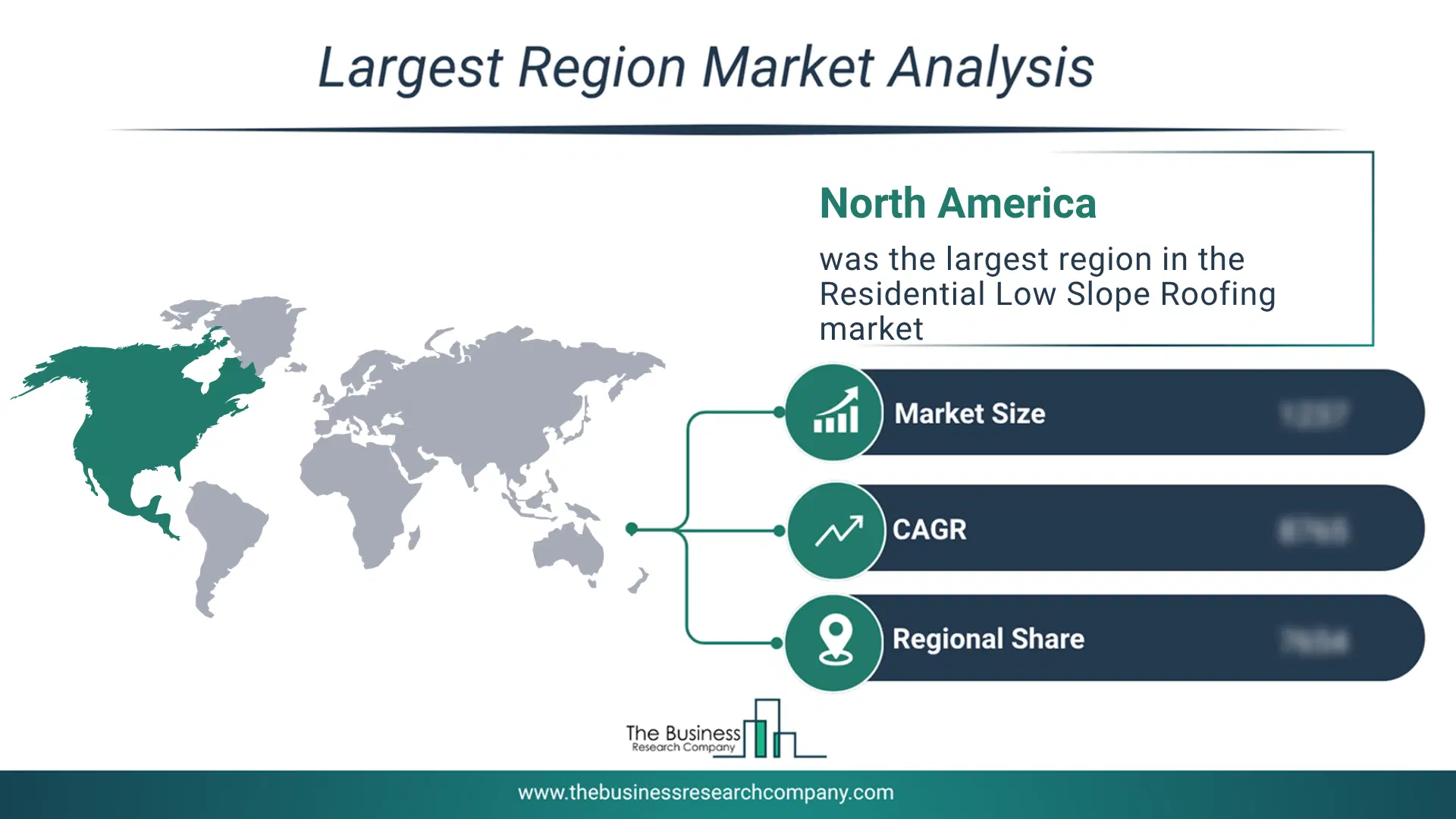
Regional Insights
North America was the largest region in the residential low slope roofing market in 2025. North America is expected to be the fastest-growing region in the forecast period. The regions covered in this market report are Asia-Pacific, South East Asia, Western Europe, Eastern Europe, North America, South America, Middle East, Africa. The countries covered in this market report are Australia, Brazil, China, France, Germany, India, Indonesia, Japan, Taiwan, Russia, South Korea, UK, USA, Canada, Italy, Spain.What Defines the Residential Low Slope Roofing Market?
The residential low slope roofing market consists of sales of spray foam roofing, roof coatings, green roof systems, asphalt shingles, synthetic roofing materials, and insulated roofing panels. Values in this market are ‘factory gate’ values, that is, the value of goods sold by the manufacturers or creators of the goods, whether to other entities (including downstream manufacturers, wholesalers, distributors, and retailers) or directly to end customers. The value of goods in this market includes related services sold by the creators of the goods.How is Market Value Defined and Measured?
The market value is defined as the revenues that enterprises gain from the sale of goods and/or services within the specified market and geography through sales, grants, or donations in terms of the currency (in USD unless otherwise specified). The revenues for a specified geography are consumption values that are revenues generated by organizations in the specified geography within the market, irrespective of where they are produced. It does not include revenues from resales along the supply chain, either further along the supply chain or as part of other products.
This chart presents market attractiveness based on a quantitative evaluation of growth, competition, strategic alignment, and risk, offering a clear view of opportunity areas for decision-making. This chart is for illustrative purposes; the full report contains the complete analysis.

This chart highlights the Total Addressable Market (TAM) by estimating the maximum revenue opportunity using an assumption-driven approach, supporting strategic planning and opportunity sizing across markets. The chart is illustrative; the full report provides a more comprehensive analysis.
What Key Data and Analysis Are Included in theResidential Low Slope Roofing Market Report 2026?
The residential low slope roofing market research report is one of a series of new reports from The Business Research Company that provides market statistics, including industry global market size, regional shares, competitors with the market share, detailed market segments, market trends and opportunities, and any further data you may need to thrive in the residential low slope roofing industry. The market research report delivers a complete perspective of everything you need, with an in-depth analysis of the current and future state of the industry.Residential Low Slope Roofing Market Report Forecast Analysis
| Report Attribute | Details |
|---|---|
| Market Size Value In 2026 | $23.33 billion |
| Revenue Forecast In 2030 | $32.25 billion |
| Growth Rate | CAGR of 8.7% from 2026 to 2030 |
| Base Year For Estimation | 2025 |
| Actual Estimates/Historical Data | 2020-2025 |
| Forecast Period | 2026 - 2030 |
| Market Representation | Revenue in USD Billion and CAGR from 2026 to 2030 |
| Segments Covered | Type, Roofing Material, Application |
| Regional Scope | Asia-Pacific, Western Europe, Eastern Europe, North America, South America, Middle East, Africa |
| Country Scope | The countries covered in this market report are Australia, Brazil, China, France, Germany, India, Indonesia, Japan, Taiwan, Russia, South Korea, UK, USA, Canada, Italy, Spain |
| Key Companies Profiled | BASF SE, Sika AG, Owens Corning, Kingspan Group plc, Carlisle Construction Materials LLC, Johns Manville Inc., BMI Group Limited, CertainTeed Corporation, CentiMark Corporation, GAF Materials Corporation, Atlas Roofing Corporation, IKO Industries Ltd, The Garland Company Inc., TAMKO Building Products LLC, American Hydrotech Inc., GenFlex Roofing Systems LLC, Polyglass USA Inc, Malarkey Roofing Products Co., ATAS International Inc, ARAC Roof It Forward Inc., Hopkins Roofing LLC, Kemper System Inc., Mule-Hide Products Co Inc., Strategic Building Products LLC |
| Customization Scope | Request for Customization |
| Pricing And Purchase Options | Explore Purchase Options |