
Residue Testing Market Report 2026
Global Outlook – By Testing Method (Chromatography, Spectroscopy, Immunoassay, Other Testing Methods), By Product Type (Pesticide Residues, Toxins, Heavy Metals, Food Allergens, Other Product Types), By Application (Meat And Poultry, Dairy Products, Processed Foods, Fruits And Vegetables, Cereals, Grains And Pulses, Nuts, Seed And Spice, Other Applications) – Market Size, Trends, Strategies, and Forecast to 2030
Residue Testing Market Overview
• Residue Testing market size has reached to $5.28 billion in 2025 • Expected to grow to $7.84 billion in 2030 at a compound annual growth rate (CAGR) of 8.2% • Growth Driver: Rising Demand For Processed Food To Drive Market Growth • Market Trend: Mobile Residue Testing Labs Transforming The Residue Testing Market • North America was the largest region in 2025 and Asia-Pacific is the fastest growing region.What Is Covered Under Residue Testing Market?
Residue testing is the process of detecting and measuring the level of chemical substances in an agricultural product by undergoing testing and analysis. Residue testing verifies that the products' quality matches both domestic and foreign market access and safety regulations. The main types of residue testing are chromatography, spectroscopy, immunoassay, and others. Chromatography is a method used for separating chemicals into individual components. Chromatography is used to test pesticides and their residues in residue testing. It is used to test pesticide residues, toxins, heavy metals, food allergens, and others. It is used in meat and poultry, dairy products, processed foods, fruits and vegetables, cereals, grains and pulses, nuts, seed and spice, and others.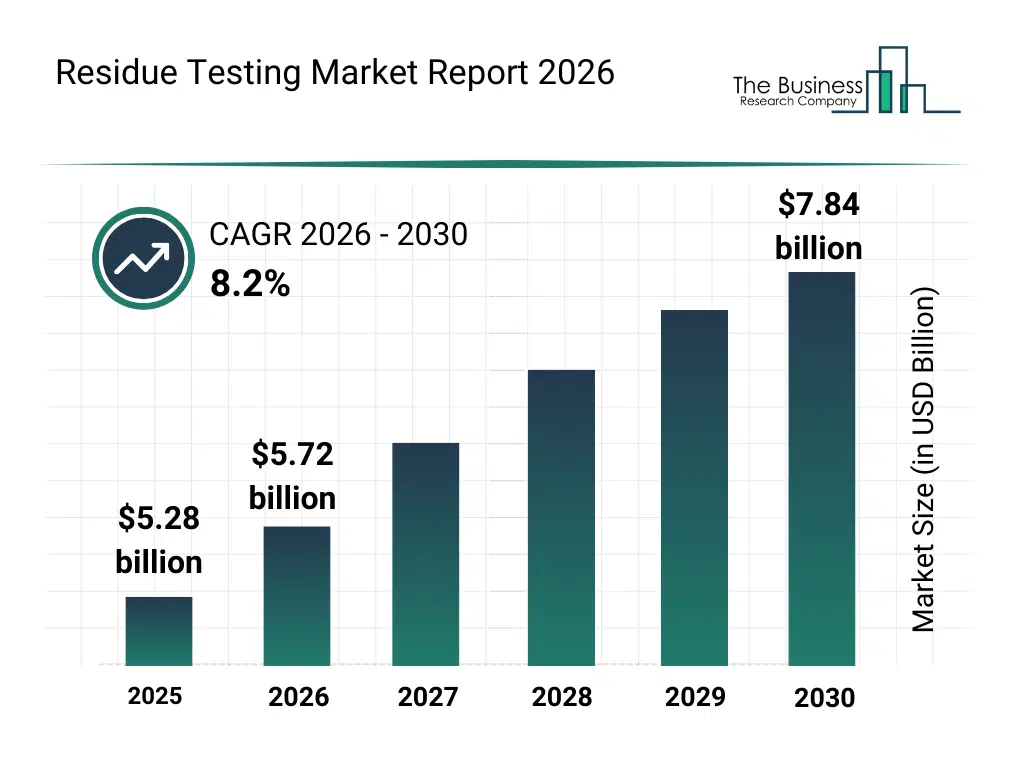
What Is The Residue Testing Market Size and Share 2026?
The residue testing market size has grown strongly in recent years. It will grow from $5.28 billion in 2025 to $5.72 billion in 2026 at a compound annual growth rate (CAGR) of 8.2%. The growth in the historic period can be attributed to rising global food trade regulations, growing contamination concerns, increasing government safety standards, expansion of testing laboratories, rising consumer safety awareness.What Is The Residue Testing Market Growth Forecast?
The residue testing market size is expected to see strong growth in the next few years. It will grow to $7.84 billion in 2030 at a compound annual growth rate (CAGR) of 8.2%. The growth in the forecast period can be attributed to increasing demand for certified food quality, rising export compliance needs, growing emphasis on residue free products, expanding processed food monitoring, rising focus on agricultural safety. Major trends in the forecast period include increasing focus on food safety compliance, growing adoption of advanced analytical testing methods, rising demand for high sensitivity contaminant detection, expanding application in export quality certification, increasing emphasis on consumer health protection.
Global Residue Testing Market Segmentation
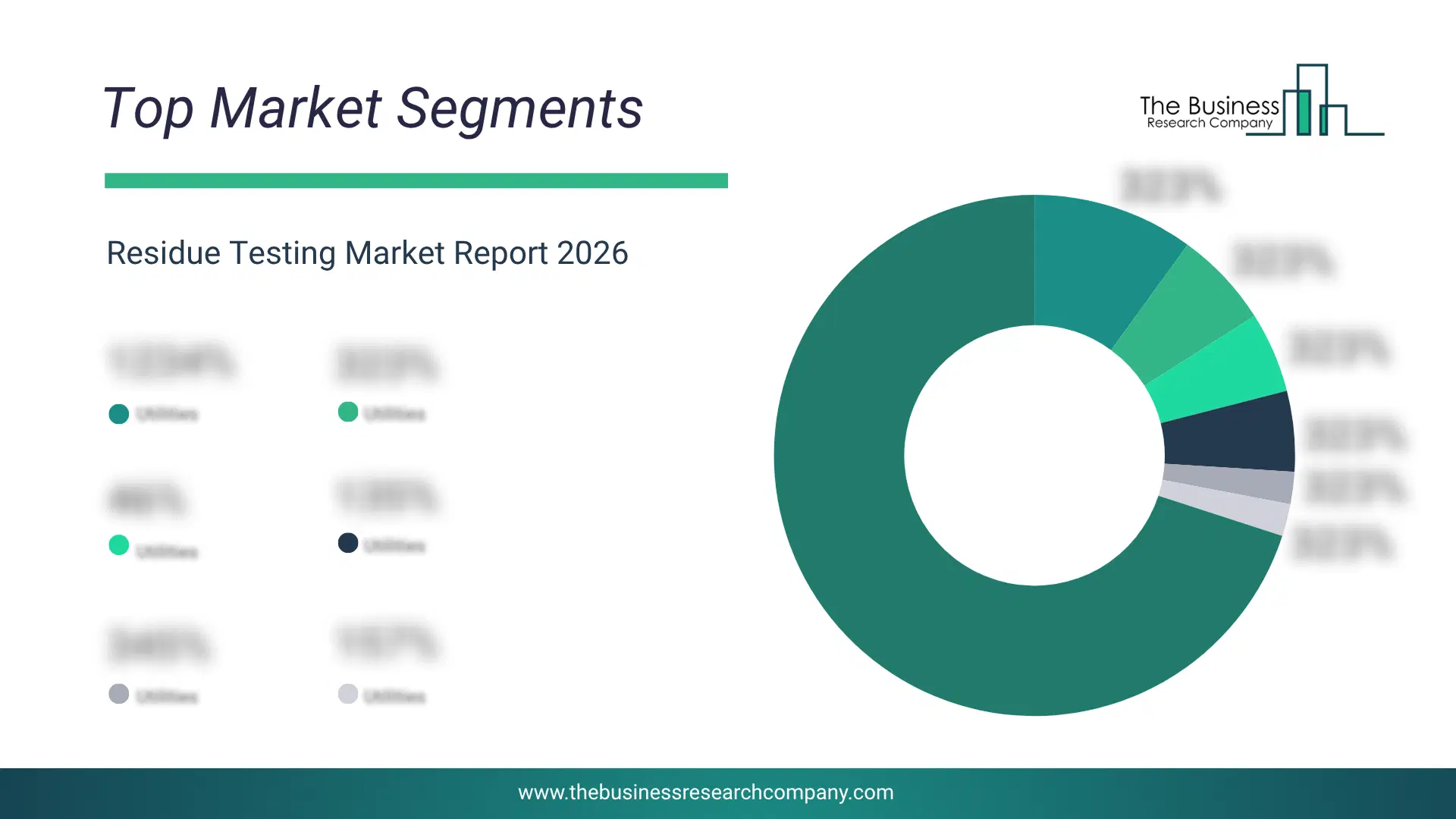
1) By Testing Method: Chromatography, Spectroscopy, Immunoassay, Other Testing Methods 2) By Product Type: Pesticide Residues, Toxins, Heavy Metals, Food Allergens, Other Product Types 3) By Application: Meat And Poultry, Dairy Products, Processed Foods, Fruits And Vegetables, Cereals, Grains And Pulses, Nuts, Seed And Spice, Other Applications Subsegments: 1) By Chromatography: Gas Chromatography (GC), Liquid Chromatography (LC), High-Performance Liquid Chromatography (HPLC) 2) By Spectroscopy: Mass Spectrometry (MS), Infrared Spectroscopy (IR), Ultraviolet-Visible Spectroscopy (UV-Vis) 3) By Immunoassay: Enzyme-Linked Immunosorbent Assay (ELISA), Radioimmunoassay (RIA), Lateral Flow Assays 4) By Other Testing Methods: Microbial Testing, Electrochemical AnalysisWhat Is The Driver Of The Residue Testing Market?
The increasing demand for processed food are expected to propel the growth of residue testing market going forward. Processed food refers to any food item that has undergone a series of mechanical, physical, thermal, or chemical transformations during the manufacturing process. Increasing demand for processed foods leads to higher production and consumption of processed products, which often undergo complex supply chains and involve the use of agricultural inputs. The globalization of the food supply chain further amplifies the need for thorough residue testing to meet stringent regulatory requirements, especially as processed foods are commonly traded on a global scale. For instance, in April 2024, according to a report published by the National Association of Convenience Stores (NACS), a US-based trade association, total industry foodservice sales, including prepared food, commissary items, and dispensed beverages, accounted for 26.9% of in-store sales in 2023, up from 25.6% in 2022, with prepared food sales per store per month growing by 12.2%. Therefore, the increasing demand for processed food is driving the growth of residue testing industry.Key Players In The Global Residue Testing Market
Major companies operating in the residue testing market report are Eurofins Scientific SE, Bureau Veritas SA, SGS SA, Intertek Group PLC, Symbio Laboratories Pty Ltd., ALS Limited, AsureQuality Limited, Microbac Laboratories Inc., QTS Analytical Ltd., NSF International, Fera Science Limited, AB Sciex LLC, Trilogy Analytical Laboratory Inc., Waters Agricultural Laboratories Inc., Neogen Corporation, Mérieux NutriSciences Corp., Romer Labs Division Holding GmbH, TÜV SÜD AG, Nelson Laboratories LLC, Pacific BioLabs Inc., Pace Analytical Services LLC, Avomeen Analytical Services, Brooks Applied Labs LLC, EMSL Analytical Inc., Exova Group Limited, Food Safety Net Services, IEH Laboratories & Consulting Group, Maxxam Analytics, Micro Quality Labs Inc., Midwest Laboratories Inc., RJ Lee Group Inc., Silliker Inc., SRC Analytical Laboratories, Summit Environmental Technologies Inc., TestAmerica Laboratories Inc., Whitehouse Laboratories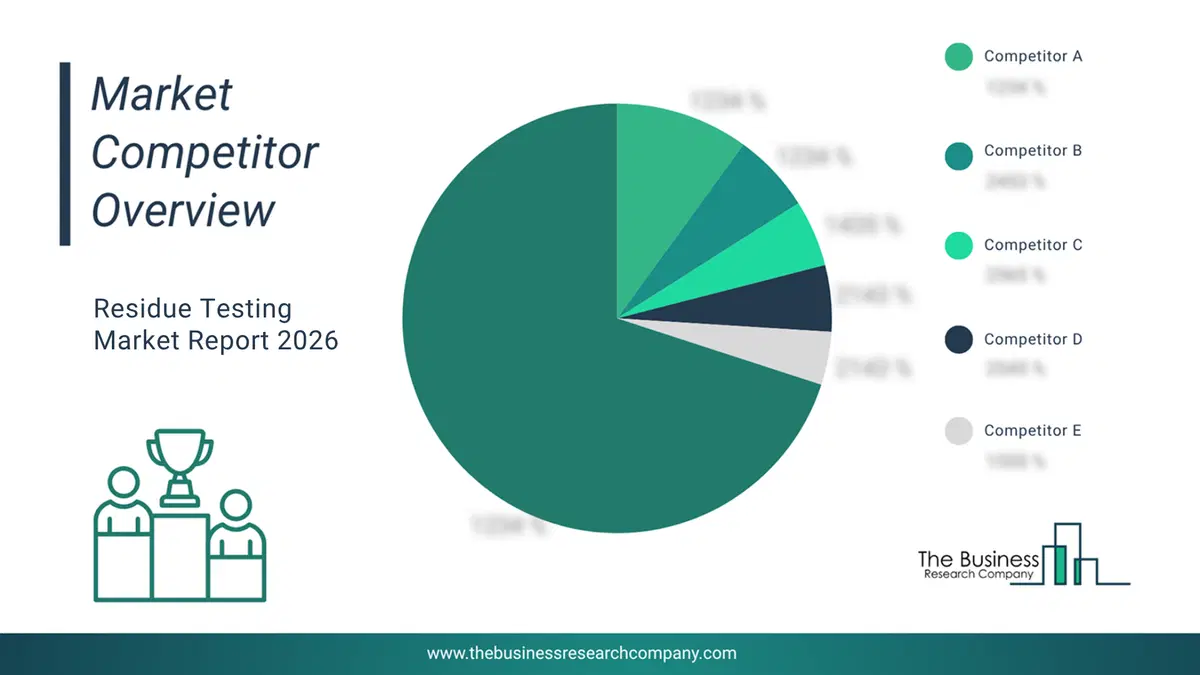
This chart is for illustrative purposes; the full report includes a detailed competitor analysis and comprehensive overview of the top 10 companies in the market.
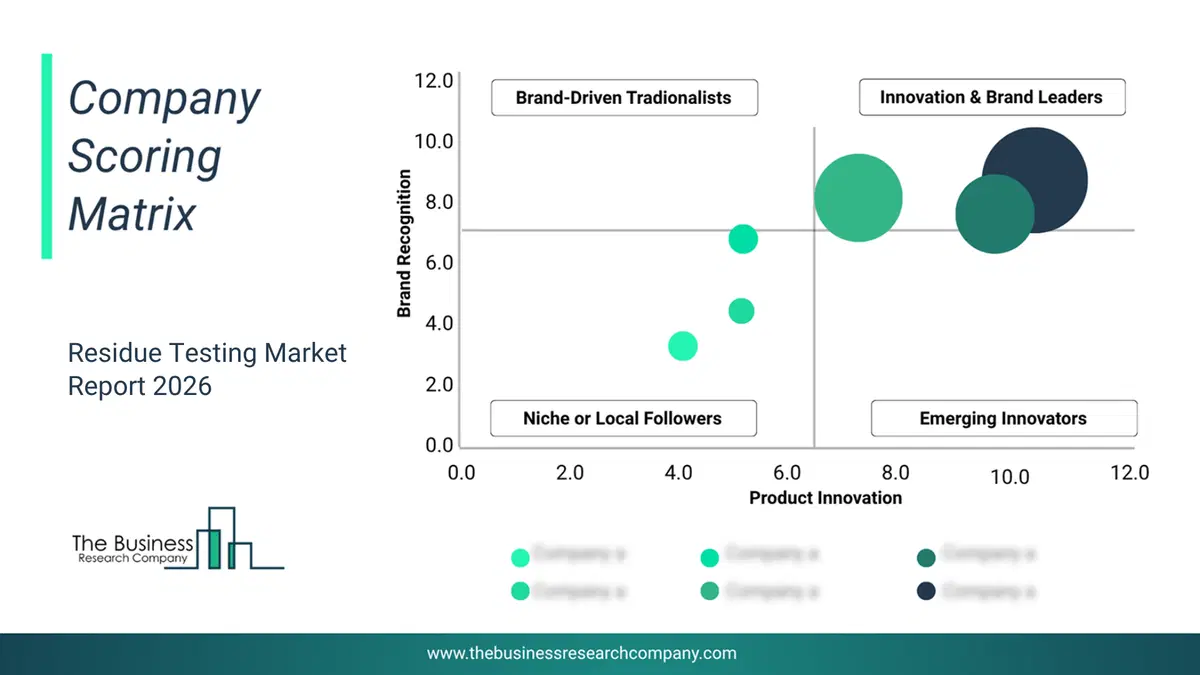
This chart maps companies by product innovation and brand strength, with bubble size indicating relative revenue, helping identify market leaders, challengers, and niche players. This is an illustrative chart; the full report provides a complete and accurate competitive analysis.
Global Residue Testing Market Trends and Insights
Major companies operating in the residue testing market are developing mobile residue testing labs specifically designed to support tea leaf testing to enhance efficiency and accuracy in detecting pesticide residues and contaminants in tea leaves. These mobile labs enable on-site testing, reducing the turnaround time for results and allowing for immediate corrective actions if unsafe levels are detected. This initiative is significant for several reasons, reflecting the growing importance of quality assurance in the tea industry. For instance, in June 2024, Eurofins Agro Laboratories, a Luxembourg-based company, launched a mobile residue testing lab. The mobile lab allows for rapid on-site testing, thereby enhancing the efficiency of quality control processes. The new mobile lab utilizes advanced testing technologies such as High-Performance Liquid Chromatography (HPLC) and Gas Chromatography-Mass Spectrometry (GC-MS). These methods are crucial for accurately analyzing chemical compositions, including caffeine and polyphenol levels, which are important indicators of tea quality.What Are Latest Mergers And Acquisitions In The Residue Testing Market?
In January 2023, Smithers Group Inc. an US-based provider of testing, consulting, and compliance services, acquired ResChem Analytical Limited for an undisclosed amount. Through this acquisition, Smithers aims to expand its pesticide residue testing capabilities by adding advanced analytical method validation, field residue studies, and GLP-compliant residue chemistry services to support regulatory submissions in the agrochemical sector. ResChem Analytical Limited is a UK-based company that provides pesticide residue analysis, storage-stability studies, ecotoxicology residue testing, and analytical support for operator exposure and environmental residue programs.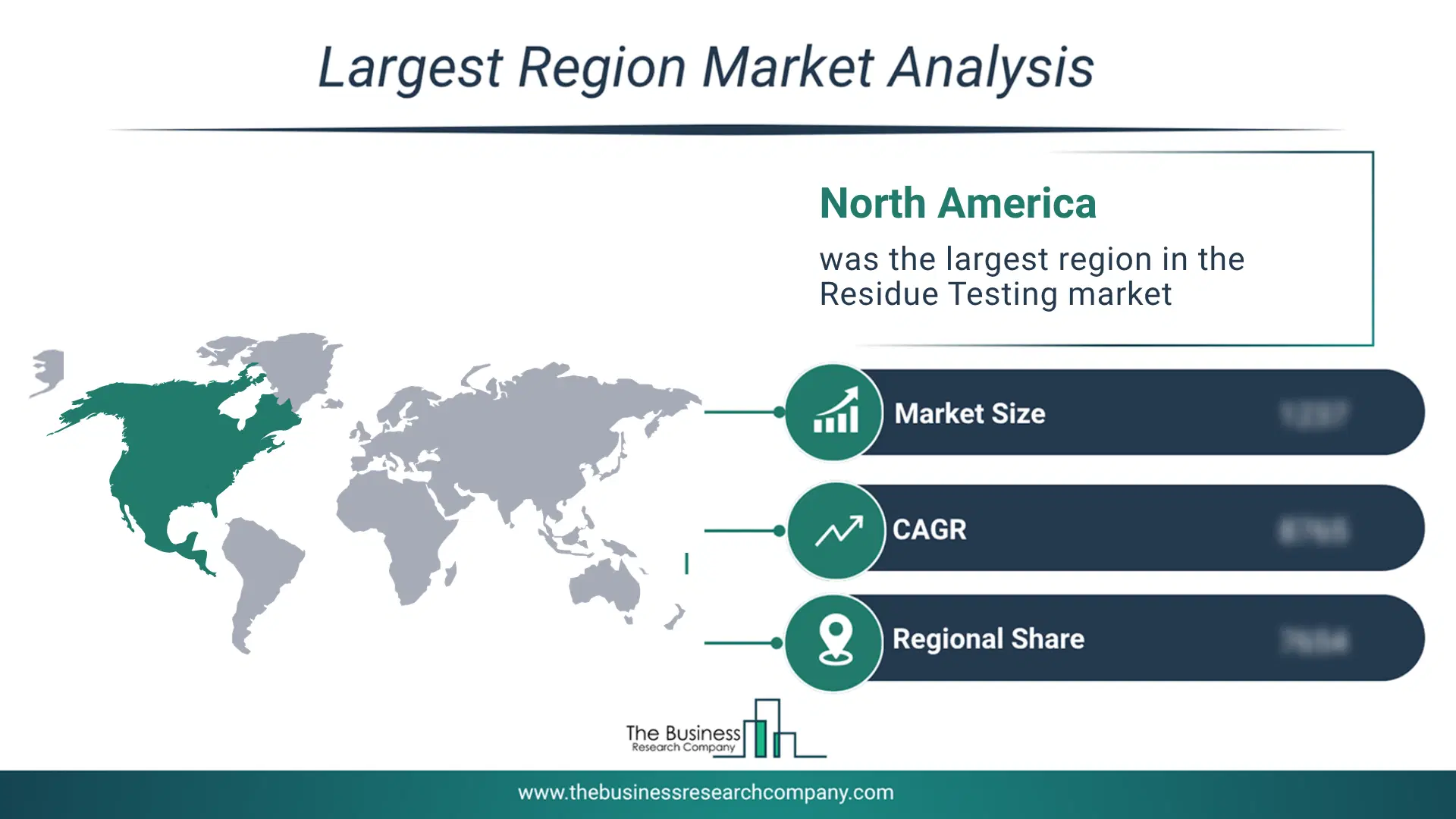
Regional Outlook
North America was the largest region in the residue testing market in 2025. Asia-Pacific is expected to be the fastest-growing region in the forecast period. The regions covered in this market report are Asia-Pacific, South East Asia, Western Europe, Eastern Europe, North America, South America, Middle East, Africa. The countries covered in this market report are Australia, Brazil, China, France, Germany, India, Indonesia, Japan, Taiwan, Russia, South Korea, UK, USA, Canada, Italy, SpainWhat Defines the Residue Testing Market?
The residue testing market includes revenues earned by entities by providing residue testing through ionization, liquid chromatography, and gas chromatography. The market value includes the value of related goods sold by the service provider or included within the service offering. Only goods and services traded between entities or sold to end consumers are included.How is Market Value Defined and Measured?
The market value is defined as the revenues that enterprises gain from the sale of goods and/or services within the specified market and geography through sales, grants, or donations in terms of the currency (in USD unless otherwise specified). The revenues for a specified geography are consumption values that are revenues generated by organizations in the specified geography within the market, irrespective of where they are produced. It does not include revenues from resales along the supply chain, either further along the supply chain or as part of other products.
This chart presents market attractiveness based on a quantitative evaluation of growth, competition, strategic alignment, and risk, offering a clear view of opportunity areas for decision-making. This chart is for illustrative purposes; the full report contains the complete analysis.

This chart highlights the Total Addressable Market (TAM) by estimating the maximum revenue opportunity using an assumption-driven approach, supporting strategic planning and opportunity sizing across markets. The chart is illustrative; the full report provides a more comprehensive analysis.
What Key Data and Analysis Are Included in the Residue Testing Market Report 2026?
The residue testing market research report is one of a series of new reports from The Business Research Company that provides market statistics, including industry global market size, regional shares, competitors with the market share, detailed market segments, market trends and opportunities, and any further data you may need to thrive in the residue testing industry. The market research report delivers a complete perspective of everything you need, with an in-depth analysis of the current and future state of the industry.Residue Testing Market Report Forecast Analysis
| Report Attribute | Details |
|---|---|
| Market Size Value In 2026 | $5.72 billion |
| Revenue Forecast In 2030 | $7.84 billion |
| Growth Rate | CAGR of 8.2% from 2026 to 2030 |
| Base Year For Estimation | 2025 |
| Actual Estimates/Historical Data | 2020-2025 |
| Forecast Period | 2026 - 2030 - 2030 |
| Market Representation | Revenue in USD Billion and CAGR from 2026 to 2030 |
| Segments Covered | Testing Method, Product Type, Application |
| Regional Scope | Asia-Pacific, Western Europe, Eastern Europe, North America, South America, Middle East, Africa |
| Country Scope | The countries covered in the report are Australia, Brazil, China, France, Germany, India, Indonesia, Japan, Taiwan, Russia, South Korea, UK, USA, Canada, Italy, Spain. |
| Key Companies Profiled | Eurofins Scientific SE, Bureau Veritas SA, SGS SA, Intertek Group PLC, Symbio Laboratories Pty Ltd., ALS Limited, AsureQuality Limited, Microbac Laboratories Inc., QTS Analytical Ltd., NSF International, Fera Science Limited, AB Sciex LLC, Trilogy Analytical Laboratory Inc., Waters Agricultural Laboratories Inc., Neogen Corporation, Mérieux NutriSciences Corp., Romer Labs Division Holding GmbH, TÜV SÜD AG, Nelson Laboratories LLC, Pacific BioLabs Inc., Pace Analytical Services LLC, Avomeen Analytical Services, Brooks Applied Labs LLC, EMSL Analytical Inc., Exova Group Limited, Food Safety Net Services, IEH Laboratories & Consulting Group, Maxxam Analytics, Micro Quality Labs Inc., Midwest Laboratories Inc., RJ Lee Group Inc., Silliker Inc., SRC Analytical Laboratories, Summit Environmental Technologies Inc., TestAmerica Laboratories Inc., Whitehouse Laboratories |
| Customization Scope | Request for Customization |
| Pricing And Purchase Options | Explore Purchase Options |