
Restorative Dental Glass-Ceramics Market Report 2026
Global Outlook – By Glass-Ceramics (Leucite-Reinforced Glass-Ceramics, Lithium Disilicate Glass-Ceramics, Glass Infiltrated Ceramics, Fluoride-Containing Glass-Ceramics), By Level Of Restoration (Preventive Restorations, Minor Restorations, Moderate Restorations, Extensive Restorations, Complex Full-Mouth Rehabilitations), By Material Form (Blocks, Pastes, Sheets, Powders), By Application (Crowns And Bridges, Inlays And Onlays, Veneers, Full-Arch Restorations, Post And Core), By End-User (Dentists, Dental Specialists, Dental Laboratories, Dental Schools And Educational Institutions, Hospitals And Clinics) – Market Size, Trends, Strategies, and Forecast to 2030
Restorative Dental Glass-Ceramics Market Report 2026 Market Overview
• Restorative Dental Glass-Ceramics Market Report 2026 market size has reached to $1.11 billion in 2025 • Expected to grow to $1.57 billion in 2030 at a compound annual growth rate (CAGR) of 7.1% • Growth Driver: Increasing Adoption Of Cosmetic Dentistry Driving The Market Growth Due To Rising Demand For Aesthetic Dental Enhancements • Market Trend: Innovation In Bilayered Glass-Ceramic Systems Advancing Aesthetic Realism And Strength In Dental Restorative Materials • North America was the largest region in 2025 and Asia-Pacific is the fastest growing region.What Is Covered Under Restorative Dental Glass-Ceramics Market?
Restorative dental glass-ceramics refer to advanced biocompatible dental materials composed of a hybrid structure of glass and crystalline phases, engineered for use in tooth restoration procedures. These materials are designed to replicate the natural appearance, translucency, and mechanical performance of teeth while providing high strength, wear resistance, and long-term durability. They are developed through controlled processing techniques such as crystallization and heat treatment to achieve precise aesthetic and functional properties suitable for restorative dental applications. The main glass-ceramics of restorative dental glass-ceramics include leucite-reinforced glass-ceramics, lithium disilicate glass-ceramics, glass infiltrated ceramics, and fluoride-containing glass-ceramics. Leucite-reinforced glass-ceramics refer to dental restorative materials strengthened with leucite crystals to improve aesthetics, strength, and durability in restorative procedures. These products are available across levels of restoration including preventive restorations, minor restorations, moderate restorations, extensive restorations, and complex full-mouth rehabilitations and are offered in material forms such as blocks, pastes, sheets, and powders. They are used across applications such as crowns and bridges, inlays and onlays, veneers, full-arch restorations, and post and core, and they are used by several end users such as dentists, dental specialists, dental laboratories, dental schools and educational institutions, and hospitals and clinics.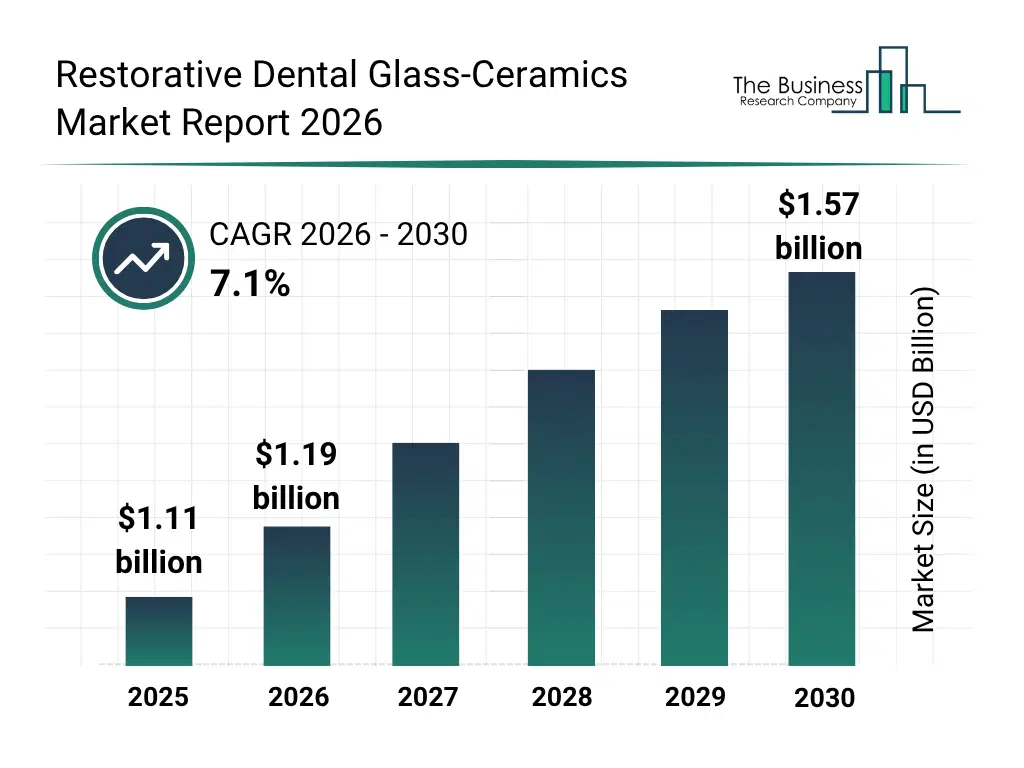
What Is The Restorative Dental Glass-Ceramics Market Size and Share 2026?
The restorative dental glass-ceramics market size has grown strongly in recent years. It will grow from $1.11 billion in 2025 to $1.19 billion in 2026 at a compound annual growth rate (CAGR) of 7.6%. The growth in the historic period can be attributed to growth of cosmetic dentistry procedures demand, increasing adoption of dental implants and restorations, rising awareness of oral aesthetics and hygiene, development of ceramic material science in dentistry, expansion of dental clinics and private practices.What Is The Restorative Dental Glass-Ceramics Market Growth Forecast?
The restorative dental glass-ceramics market size is expected to see strong growth in the next few years. It will grow to $1.57 billion in 2030 at a compound annual growth rate (CAGR) of 7.1%. The growth in the forecast period can be attributed to advancements in bioactive dental materials research, rising demand for minimally invasive restorative procedures, integration of digital dentistry and cad cam workflows, growing geriatric population requiring dental restorations, increasing adoption of personalized dental treatment solutions. Major trends in the forecast period include digital dentistry scanning integration for restorative ceramic design workflows, AI driven shade matching and tooth morphology replication systems, cad cam based precision milling of glass-ceramic restorations, bioactive glass-ceramic materials enhancing enamel regeneration and bonding, patient specific 3d printed dental restoration modeling and simulation platforms.
Global Restorative Dental Glass-Ceramics Market Segmentation
1) By Glass-Ceramics: Leucite-Reinforced Glass-Ceramics, Lithium Disilicate Glass-Ceramics, Glass Infiltrated Ceramics, Fluoride-Containing Glass-Ceramics 2) By Level Of Restoration: Preventive Restorations, Minor Restorations, Moderate Restorations, Extensive Restorations, Complex Full-Mouth Rehabilitations 3) By Material Form: Blocks, Pastes, Sheets, Powders 4) By Application: Crowns And Bridges, Inlays And Onlays, Veneers, Full-Arch Restorations, Post And Core 5) By End-User: Dentists, Dental Specialists, Dental Laboratories, Dental Schools And Educational Institutions, Hospitals And Clinics Subsegments: 1) By Leucite-Reinforced Glass-Ceramics: Feldspathic Leucite Ceramics, Pressable Leucite Ceramics, Machinable Leucite Ceramics, High-Translucency Leucite Ceramics 2) By Lithium Disilicate Glass-Ceramics: Pressed Lithium Disilicate Ceramics, Milled Lithium Disilicate Ceramics, High-Strength Lithium Disilicate Ceramics, High-Translucency Lithium Disilicate Ceramics 3) By Glass Infiltrated Ceramics: Alumina-Based Infiltrated Ceramics, Zirconia-Based Infiltrated Ceramics, Spinell-Based Infiltrated Ceramics, Composite Infiltrated Ceramics 4) By Fluoride-Containing Glass-Ceramics: Bioactive Fluoroapatite Ceramics, Fluorosilicate Glass-Ceramics, Fluoride-Releasing Dental Ceramics, Fluoroapatite Veneering CeramicsWhat Are The Drivers Of The Restorative Dental Glass-Ceramics Market?
The increasing adoption of cosmetic dentistry is expected to propel the growth of the restorative dental glass-ceramics market going forward. Cosmetic dentistry refers to dental procedures aimed at improving the appearance of teeth, gums, and overall smile aesthetics through elective or corrective treatments. The adoption of cosmetic dentistry is rising due to increasing aesthetic awareness among individuals as people are becoming more conscious of their appearance and are actively seeking dental treatments to improve smile aesthetics and overall facial attractiveness. Restorative dental glass-ceramics enhance cosmetic dentistry by providing tooth-like materials that closely replicate the natural translucency, color, and light-reflecting properties of enamel while also offering strong durability and biocompatibility, enabling dentists to create visually appealing and long-lasting restorations that improve smile aesthetics. For instance, in July 2025, according to the American Association of Orthodontists, a US-based professional organization, the average number of patients in active treatment per member rose from 574 in 2022 to 696 in 2024. Consequently, the total estimated number of adults receiving treatment from AAO members in the United States is approximately 1.91 million, a notable increase from 1.64 million in 2022. Therefore, the increasing adoption of cosmetic dentistry is driving the growth of the restorative dental glass-ceramics industry. The rising prevalence of dental caries and tooth decay is expected to propel the growth of the restorative dental glass-ceramics market going forward. Dental caries and tooth decay refer to the progressive destruction of tooth structure caused by bacterial activity that leads to demineralization of enamel and dentin. The prevalence of dental caries and tooth decay is growing due to increasing consumption of sugar-rich and processed foods combined with poor oral hygiene practices, which promote bacterial growth and acid production that damage tooth enamel over time. Restorative dental glass-ceramics help to prevent dental caries and tooth decay by providing strong, biocompatible, and aesthetically matched tooth restorations that seal damaged areas, restore tooth structure, and reduce the risk of further bacterial infiltration and enamel degradation. For instance, in March 2025, according to the World Health Organization, a Switzerland-based intergovernmental organization, oral diseases are estimated to affect approximately 3.7 billion people worldwide, with untreated dental caries (tooth decay) in permanent teeth being the most prevalent health condition. Therefore, the rising prevalence of dental caries and tooth decay is driving the growth of the restorative dental glass-ceramics industry.Key Players In The Global Restorative Dental Glass-Ceramics Market
Major companies operating in the restorative dental glass-ceramics market report are 3M Company, Dentsply Sirona Inc., Glidewell Laboratories, Ivoclar AG, Huge Dental Material Co. Ltd., COLTENE Group, VITA Zahnfabrik H. Rauter GmbH & Co. KG, SHOFU Dental Inc., VOCO GmbH, Argen Corporation, GC Corporation, Aidite Technology Co. Ltd., Shenzhen Yurucheng Dental Materials Co. Ltd., Cendres+Métaux SA, Zirkonzahn GmbH, Kuraray Noritake Dental Inc., Upcera Dental Technology Co. Ltd., Besmile Biotechnology Co. Ltd., HASS Bio Co. Ltd., Dental Direkt GmbH, Straumann Group, Jensen Dental.
This chart is for illustrative purposes; the full report includes a detailed competitor analysis and comprehensive overview of the top 10 companies in the market.
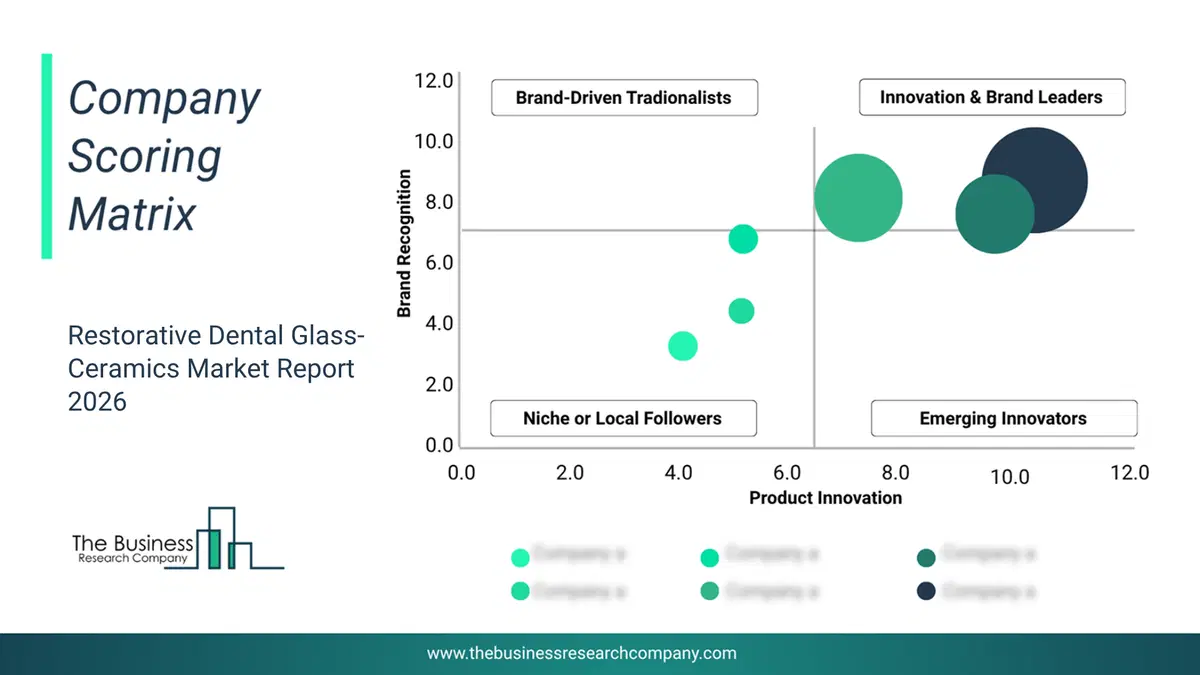
This chart maps companies by product innovation and brand strength, with bubble size indicating relative revenue, helping identify market leaders, challengers, and niche players. This is an illustrative chart; the full report provides a complete and accurate competitive analysis.
Global Restorative Dental Glass-Ceramics Market Trends and Insights
Major companies operating in the restorative dental glass-ceramics market are focusing on developing innovative products, such as bilayered glass-ceramic restorative systems, to enhance aesthetic realism, improve mechanical strength, and replicate the natural structure of human teeth in dental restorations. Bilayered glass-ceramic restorative systems are advanced dental materials that combine a strong zirconia core with a lithium disilicate glass-ceramic outer layer to mimic the enamel-dentin architecture of natural teeth, offering superior translucency, durability, and color matching compared to traditional monolithic ceramic or metal-based restorations. For instance, in August 2025, Glidewell Dental Ceramics Inc., a US-based dental solutions company, launched BruxZir Glass Restorations, a bilayered ceramic system designed to replicate natural tooth structure with high precision. The restoration combines a milled zirconia core shaped with anatomical features and a pressed lithium disilicate veneer that mimics enamel translucency and surface characteristics. Additionally, the system uses AI-enhanced production workflows to improve design accuracy and consistency, while delivering restorations that closely resemble natural dentition in both appearance and function.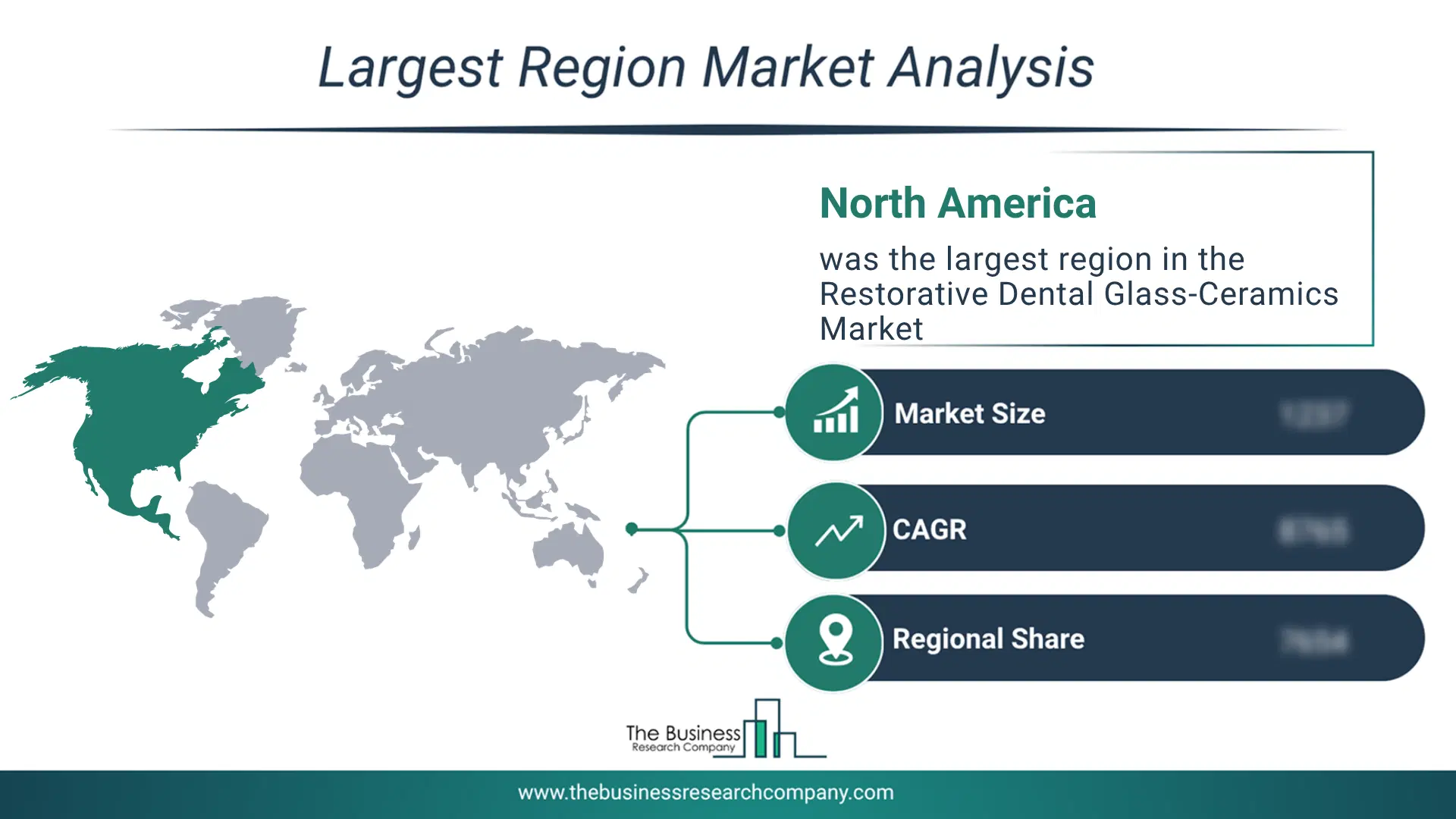
Regional Outlook
North America was the largest region in the restorative dental glass-ceramics market in 2025. Asia-Pacific is expected to be the fastest-growing region in the forecast period. The regions covered in this market report are Asia-Pacific, South East Asia, Western Europe, Eastern Europe, North America, South America, Middle East, Africa. The countries covered in this market report are Australia, Brazil, China, France, Germany, India, Indonesia, Japan, Taiwan, Russia, South Korea, UK, USA, Canada, Italy, Spain.What Defines the Restorative Dental Glass-Ceramics Market?
The restorative dental glass-ceramics market consists of sales of dental ceramic blocks, glass-ceramic crowns, and implant-supported restorations. Values in this market are ‘factory gate’ values, that is, the value of goods sold by the manufacturers or creators of the goods, whether to other entities (including downstream manufacturers, wholesalers, distributors, and retailers) or directly to end customers. The value of goods in this market includes related services sold by the creators of the goods.How is Market Value Defined and Measured?
The market value is defined as the revenues that enterprises gain from the sale of goods and/or services within the specified market and geography through sales, grants, or donations in terms of the currency (in USD unless otherwise specified). The revenues for a specified geography are consumption values that are revenues generated by organizations in the specified geography within the market, irrespective of where they are produced. It does not include revenues from resales along the supply chain, either further along the supply chain or as part of other products.
This chart presents market attractiveness based on a quantitative evaluation of growth, competition, strategic alignment, and risk, offering a clear view of opportunity areas for decision-making. This chart is for illustrative purposes; the full report contains the complete analysis.

This chart highlights the Total Addressable Market (TAM) by estimating the maximum revenue opportunity using an assumption-driven approach, supporting strategic planning and opportunity sizing across markets. The chart is illustrative; the full report provides a more comprehensive analysis.
What Key Data and Analysis Are Included in the Restorative Dental Glass-Ceramics Market Report 2026?
The restorative dental glass-ceramics market research report is one of a series of new reports from The Business Research Company that provides market statistics, including industry global market size, regional shares, competitors with the market share, detailed market segments, market trends and opportunities, and any further data you may need to thrive in the restorative dental glass-ceramics industry. The market research report delivers a complete perspective of everything you need, with an in-depth analysis of the current and future state of the industry.Restorative Dental Glass-Ceramics Market Report Forecast Analysis
| Report Attribute | Details |
|---|---|
| Market Size Value In 2026 | $1.19 billion |
| Revenue Forecast In 2030 | $1.57 billion |
| Growth Rate | CAGR of 7.1% from 2026 to 2030 |
| Base Year For Estimation | 2025 |
| Actual Estimates/Historical Data | 2020-2025 |
| Forecast Period | 2026 - 2030 |
| Market Representation | Revenue in USD Billion and CAGR from 2026 to 2030 |
| Segments Covered | Glass-Ceramics, Level Of Restoration, Material Form, Application, End-User |
| Regional Scope | Asia-Pacific, Western Europe, Eastern Europe, North America, South America, Middle East, Africa |
| Country Scope | The countries covered in the report are Australia, Brazil, China, France, Germany, India, Indonesia, Japan, Taiwan, Russia, South Korea, UK, USA, Canada, Italy, Spain. |
| Key Companies Profiled | 3M Company, Dentsply Sirona Inc., Glidewell Laboratories, Ivoclar AG, Huge Dental Material Co. Ltd., COLTENE Group, VITA Zahnfabrik H. Rauter GmbH & Co. KG, SHOFU Dental Inc., VOCO GmbH, Argen Corporation, GC Corporation, Aidite Technology Co. Ltd., Shenzhen Yurucheng Dental Materials Co. Ltd., Cendres+Métaux SA, Zirkonzahn GmbH, Kuraray Noritake Dental Inc., Upcera Dental Technology Co. Ltd., Besmile Biotechnology Co. Ltd., HASS Bio Co. Ltd., Dental Direkt GmbH, Straumann Group, Jensen Dental. |
| Customization Scope | Request for Customization |
| Pricing And Purchase Options | Explore Purchase Options |