

Retail E-Commerce Market Report 2026
Global Outlook – By Type (Pure Marketplace, Hybrid Marketplace, Brand, Retail Chain), By Sector (Organized, Unorganized), By Distribution Channel (Supermarkets And Hypermarkets, Convenience Stores, Specialty Stores, Department Stores, E-Commerce, Other Distribution Channels) – Market Size, Trends, Strategies, and Forecast to 2030
Retail E-Commerce Market Overview
• Retail E-Commerce market size has reached to $3648.62 billion in 2025 • Expected to grow to $6239.22 billion in 2030 at a compound annual growth rate (CAGR) of 11.2% • Growth Driver: Rising Smartphone Usage Propels The Growth Of Retail E-Commerce • Market Trend: Retail E-Commerce Companies Embrace E-Commerce Clouds For Scalability And Intelligence • Asia-Pacific was the largest region in 2025.Market Gains By 2030 – Top Opportunities By Segment
Market Gain identifies the most promising market opportunities by highlighting the segments or products expected to generate the highest incremental revenue growth over the next five years.
What Is Covered Under Retail E-Commerce Market?
Retail e-commerce refers to the buying and selling of consumer goods and services through online platforms operated by retailers, including websites and mobile applications. It is used for enabling customers to browse products, compare prices, place orders, and complete payments digitally with home delivery or pickup options. The main types of retail e-commerce are pure marketplace, hybrid marketplace, brand, and retail chain. Retail e-commerce can operate as a pure marketplace which refers to a marketplace that only provides selling, payment, and transaction facilities for sellers. They are based on organized and unorganized sectors operated through various distribution channels including supermarkets, hypermarkets, convenience stores, specialty stores, department stores, e-commerce, and others.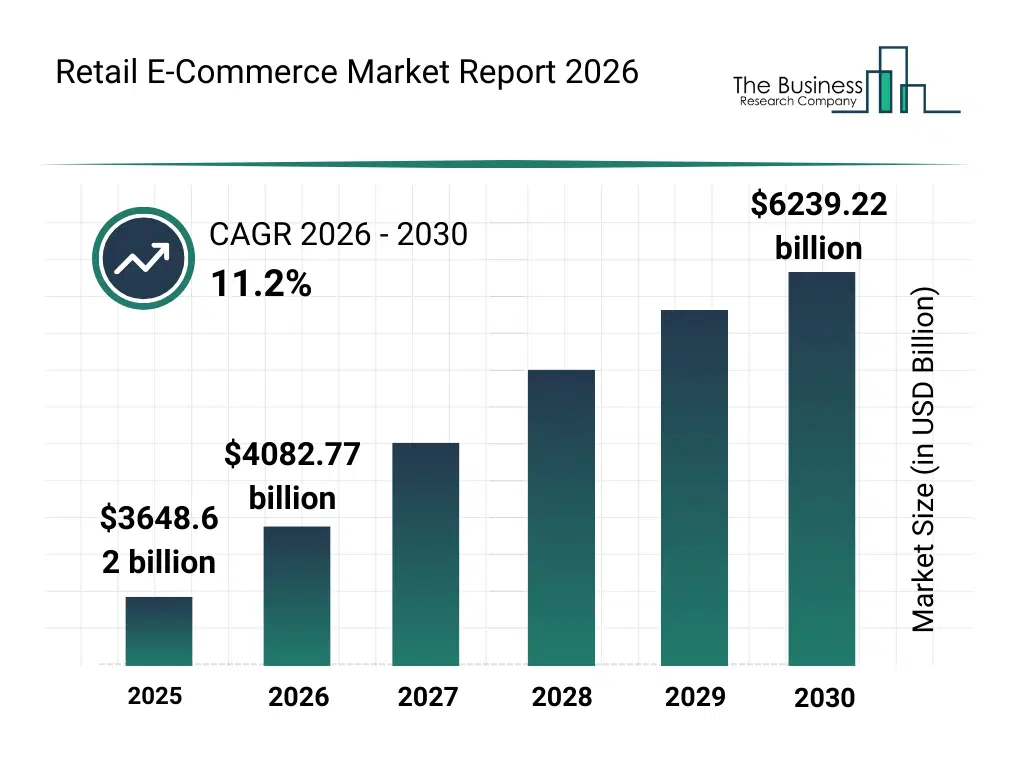
What Is The Retail E-Commerce Market Size and Share 2026?
The retail e-commerce market size has grown rapidly in recent years. It will grow from $3648.62 billion in 2025 to $4082.77 billion in 2026 at a compound annual growth rate (CAGR) of 11.9%. The growth in the historic period can be attributed to rise of smartphones and internet penetration, growth of e-payment solutions, increasing consumer trust in online transactions, expansion of courier and logistics networks, growth of organized retail chains.What Is The Retail E-Commerce Market Growth Forecast?
The retail e-commerce market size is expected to see rapid growth in the next few years. It will grow to $6239.22 billion in 2030 at a compound annual growth rate (CAGR) of 11.2%. The growth in the forecast period can be attributed to adoption of AR/VR for shopping experiences, rise of sustainable packaging solutions, integration of AI-driven customer analytics, expansion of social commerce platforms, growth in cross-border e-commerce. Major trends in the forecast period include mobile commerce adoption, personalization & recommendation engines, social commerce growth, omnichannel integration, fast delivery & last-mile logistics.
Global Retail E-Commerce Market Segmentation
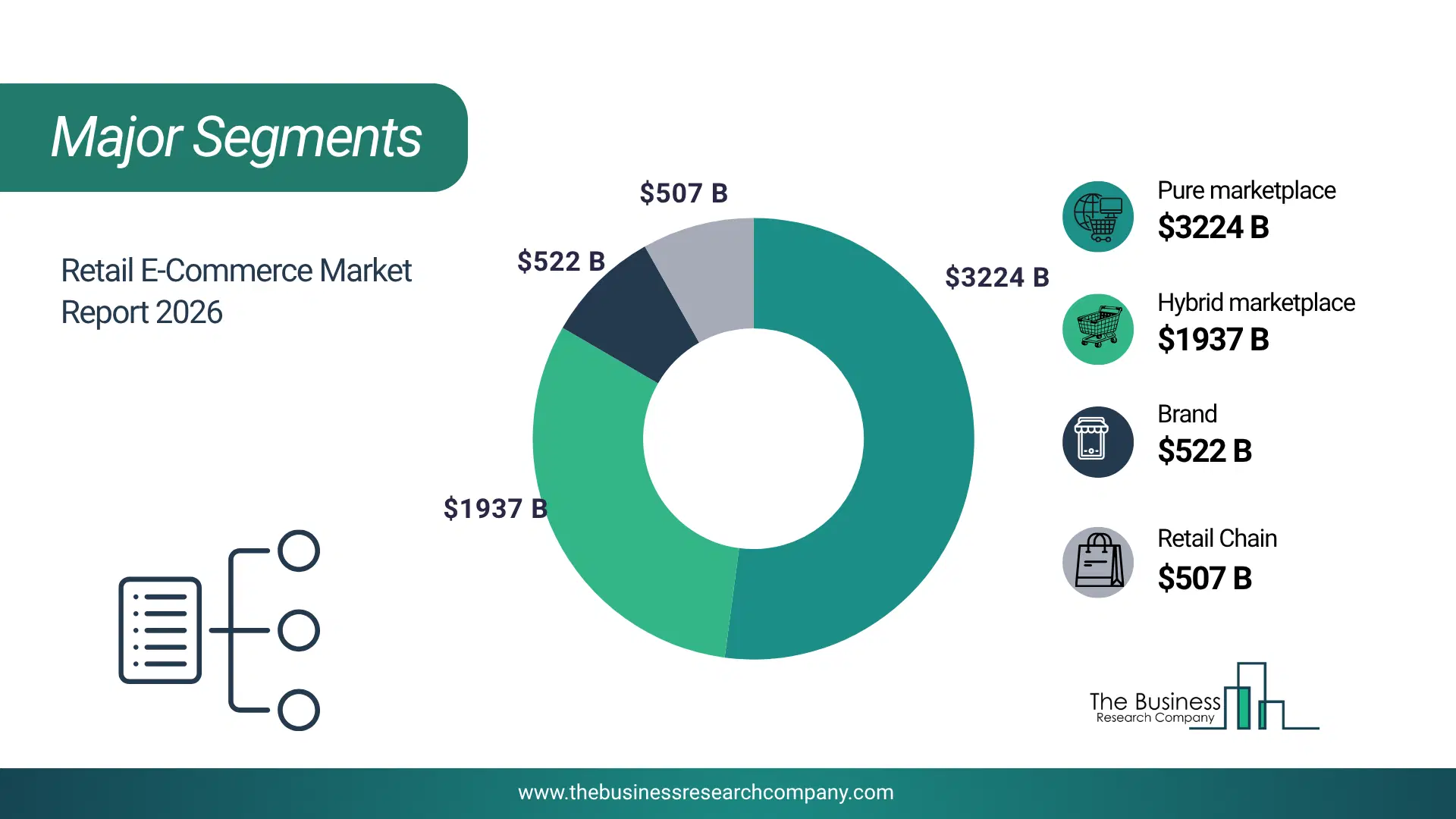
1) By Type: Pure Marketplace, Hybrid Marketplace, Brand, Retail Chain 2) By Sector: Organized, Unorganized 3) By Distribution Channel: Supermarkets And Hypermarkets, Convenience Stores, Specialty Stores, Department Stores, E-Commerce, Other Distribution Channels Subsegments: 1) By Pure Marketplace: Online-Only Platforms, Multiple Third-Party Sellers, No Inventory Ownership 2) By Hybrid Marketplace: Combination Of First-Party And Third-Party Sellers, Own Inventory And Allow Third-Party Sales, Flexible Selling Options 3) By Brand: Direct Sales From Brand Websites, Focus On Brand-Specific Products, Enhanced Customer Experience And Loyalty 4) By Retail Chain: Established Brick-And-Mortar Retailers With Online Presence, Omnichannel Retailing Strategies, Integration Of Online And Offline Shopping Experiences The top segments in the retail e-commerce market will be: • Pure marketplace will reach $3224.34 Billion by 2030. • Hybrid marketplace will reach $1936.77 Billion by 2030. • Brand will reach $521.8 Billion by 2030. • Retail Chain will reach $506.59 Billion by 2030.What Is The Driver Of The Retail E-Commerce Market?
The increase in the usage of smartphones is significantly contributing to the growth of the retail e-commerce market going forward. Smartphone refers to a cellular telephone with an integrated computer and other features such as an operating system, the ability to run software applications, and web browsing. Smartphones help retail e-commerce by facilitating buying and selling goods and services through this wireless handheld device. For instance, in October 2023, according to the Global System for Mobile Communications Association (GSMA), a UK-based global industry organisation, 54% of the global population, some 4.3 billion people, now owns a smartphone. Therefore, increase in the usage of smartphones is driving the retail e-commerce industry.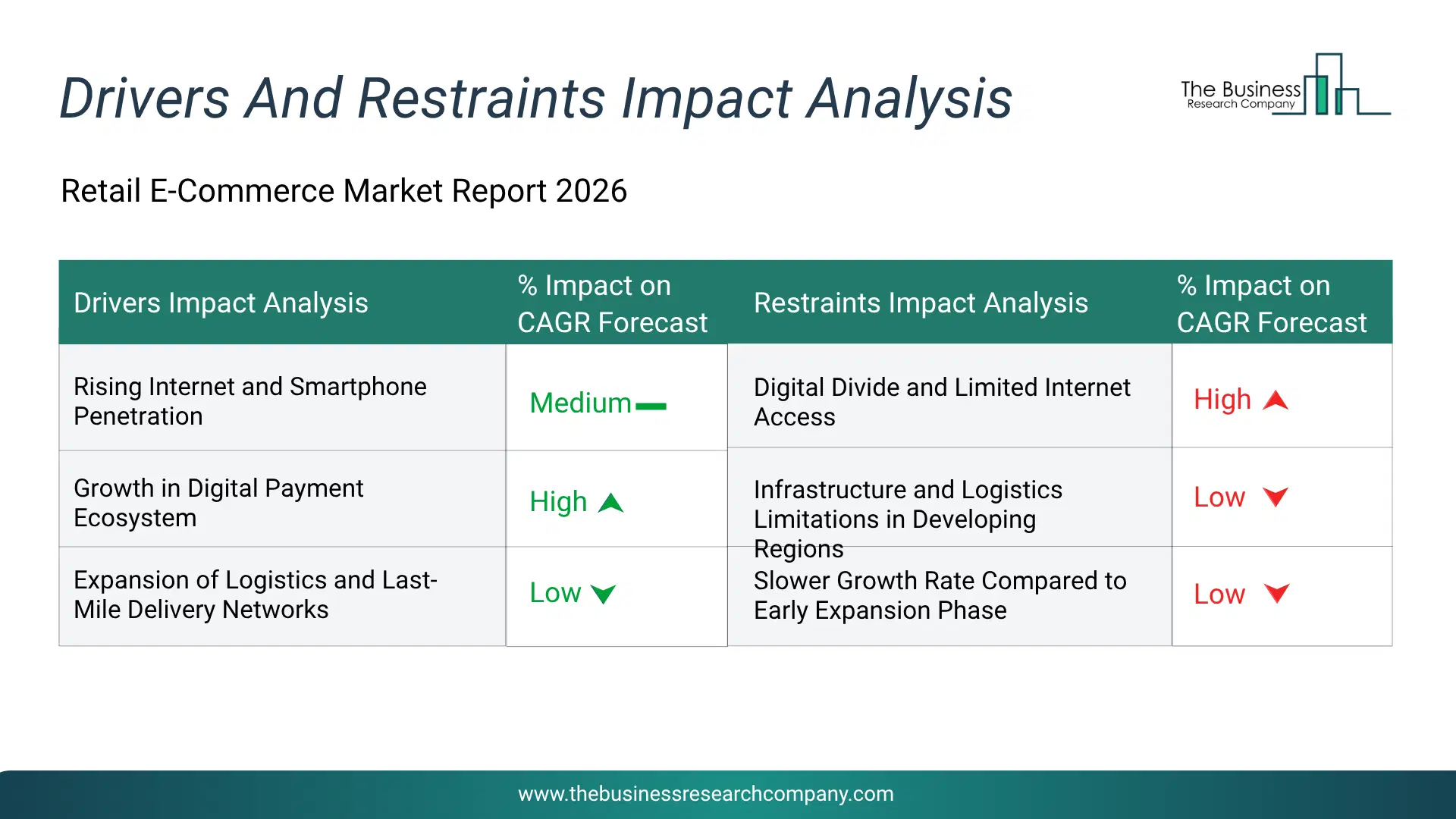
Infographic Chart Showing Key Market Drivers Analysis And Restraints For Retail E-Commerce Market
The chart presents an impact analysis of key drivers and restraints, quantifying their relative influence on the market's growth rate and helping assess the balance between growth enablers and limiting factors. This chart offers a high-level perspective; the full report contains more detailed insights.
How Will The Drivers Impact Growth In The Global Retail E-Commerce Market?
• Rising Internet and Smartphone Penetration (Medium) – During the forecast period, the increasing internet and smartphone penetration is expected to become a key growth driver for the retail e-commerce market by 2030. Expanding access to affordable smartphones and high-speed internet connectivity is enabling a larger consumer base to participate in online shopping across both urban and rural regions. This widespread digital access is accelerating the shift from offline to online retail, particularly in emerging economies where first-time users are entering the e-commerce ecosystem. Retailers are leveraging mobile-first platforms and app-based interfaces to enhance accessibility and user experience. • Growth in Digital Payment Ecosystem (High) – During the forecast period, the growth in the digital payment ecosystem is expected to emerge as a major factor driving the expansion of the retail e-commerce market by 2030. The increasing adoption of digital wallets, real-time payment systems, and secure online transaction platforms is simplifying the checkout process and enhancing consumer trust in online purchases. Financial technology innovations are enabling seamless cross-border transactions and reducing dependency on cash-based systems. Additionally, integration of payment solutions within e-commerce platforms is improving transaction efficiency and reducing cart abandonment rates. The continuous evolution of secure and user-friendly payment infrastructures is strengthening the foundation of online retail. • Expansion of Logistics and Last-Mile Delivery Networks (Low) – During the forecast period, the expansion of logistics and last-mile delivery networks is expected to act as a key growth catalyst for the retail e-commerce market by 2030. Advancements in warehousing, fulfillment centers, and delivery technologies are enabling faster and more reliable order fulfillment across diverse geographies. Companies are investing in automated sorting systems, route optimization, and localized distribution hubs to improve delivery efficiency and reduce turnaround times. The increasing availability of same-day and next-day delivery options is enhancing customer satisfaction and encouraging repeat purchases. Furthermore, improved logistics capabilities are supporting the penetration of e-commerce into remote and underserved areas.How Will The Restraints Impact Growth In The Global Retail E-Commerce Market?
• Digital Divide and Limited Internet Access (Medium) – During the forecast period, the digital divide and limited internet access are significantly restricting the growth of the retail e-commerce market. Unequal access to reliable internet connectivity and digital devices, particularly in rural and low-income regions, is limiting market penetration and reducing the overall addressable consumer base. • Infrastructure and Logistics Limitations in Developing Regions (High) – During the forecast period, infrastructure and logistics limitations in developing regions are significantly restricting the growth of the retail e-commerce market. Poor transportation networks, inadequate warehousing facilities, and inefficient supply chain systems are increasing delivery times and operational costs, thereby hindering market expansion. • Slower Growth Rate Compared to Early Expansion Phase (Low) – During the forecast period, infrastructure and logistics limitations in developing regions are significantly restricting the growth of the retail e-commerce market. Poor transportation networks, inadequate warehousing facilities, and inefficient supply chain systems are increasing delivery times and operational costs, thereby hindering market expansion.Key Players In The Global Retail E-Commerce Market
Major companies operating in the retail e-commerce market are Walmart Inc., Amazon.com Inc., Apple Inc., Costco Wholesale Corporation, The Home Depot Inc., The Kroger Co, Alibaba Group Holding Ltd., Target Corporation, Dell Technologies Inc., Albertsons Companies Inc, Best Buy Co Inc., Inter IKEA Systems B.V., Hewlett-Packard Company, Macy's Inc., Coupang Corp, Otto GmbH & Co KG, Nordstrom Inc., Wayfair Inc., Rakuten Group Inc., eBay Inc., Shopify Inc., Etsy Inc., IndiaMART InterMESH Ltd., IKEA AB, Ebates Inc., Taobao, Clues Network Pvt Ltd.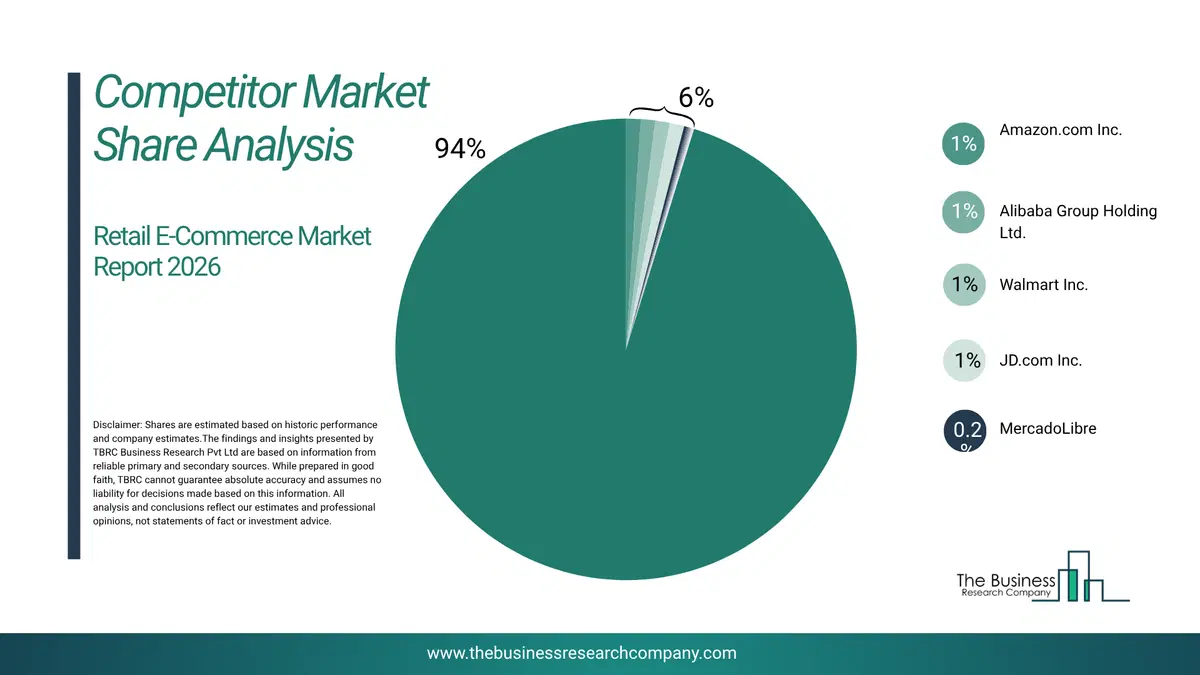
This chart is for illustrative purposes; the full report includes a detailed competitor analysis and comprehensive overview of the top 10 companies in the market.
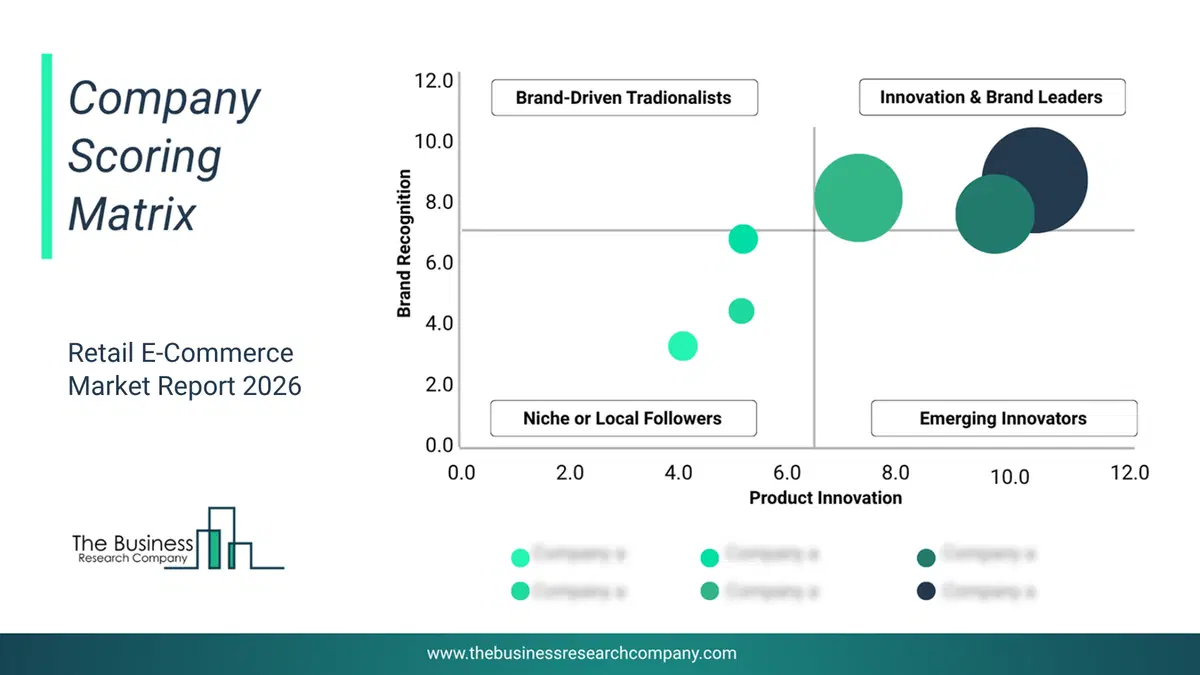
This chart maps companies by product innovation and brand strength, with bubble size indicating relative revenue, helping identify market leaders, challengers, and niche players. This is an illustrative chart; the full report provides a complete and accurate competitive analysis.
Global Retail E-Commerce Market Trends and Insights
Major companies operating in the retail e-commerce market are increasing their focus on introducing e-commerce clouds to gain a competitive edge in the market. The e-commerce cloud refers to a cloud computing environment that provides scalable and flexible infrastructure, storage, and computing resources to support and host e-commerce applications and websites. For instance, in October 2023, Flipkart, an India-based e-commerce company, launched the Flipkart Commerce Cloud. It is a suite of retail intelligence solutions designed to help retailers and e-commerce companies globally grow their businesses and solve business needs through intelligent and AI-driven solutions. Each solution is built using artificial intelligence and machine learning and is constantly scale-tested at Flipkart every day. The system is designed to help retailers across the world grow their businesses and solve business needs through intelligent and AI-driven solutions.What Are Latest Mergers And Acquisitions In The Retail E-Commerce Market?
In February 2024, Qoo10, a Singapore-based e-commerce company, acquired Wish from ContextLogic for approximately $173 million. With this acquisition, Qoo10 aimed to expand its global marketplace footprint and strengthen its cross-border e-commerce capabilities by leveraging Wish’s international customer base and mobile-first shopping platform. Wish is a US-based e-commerce marketplace company that specializes in connecting value-conscious consumers with third-party merchants through an online and mobile platform offering a broad range of consumer products.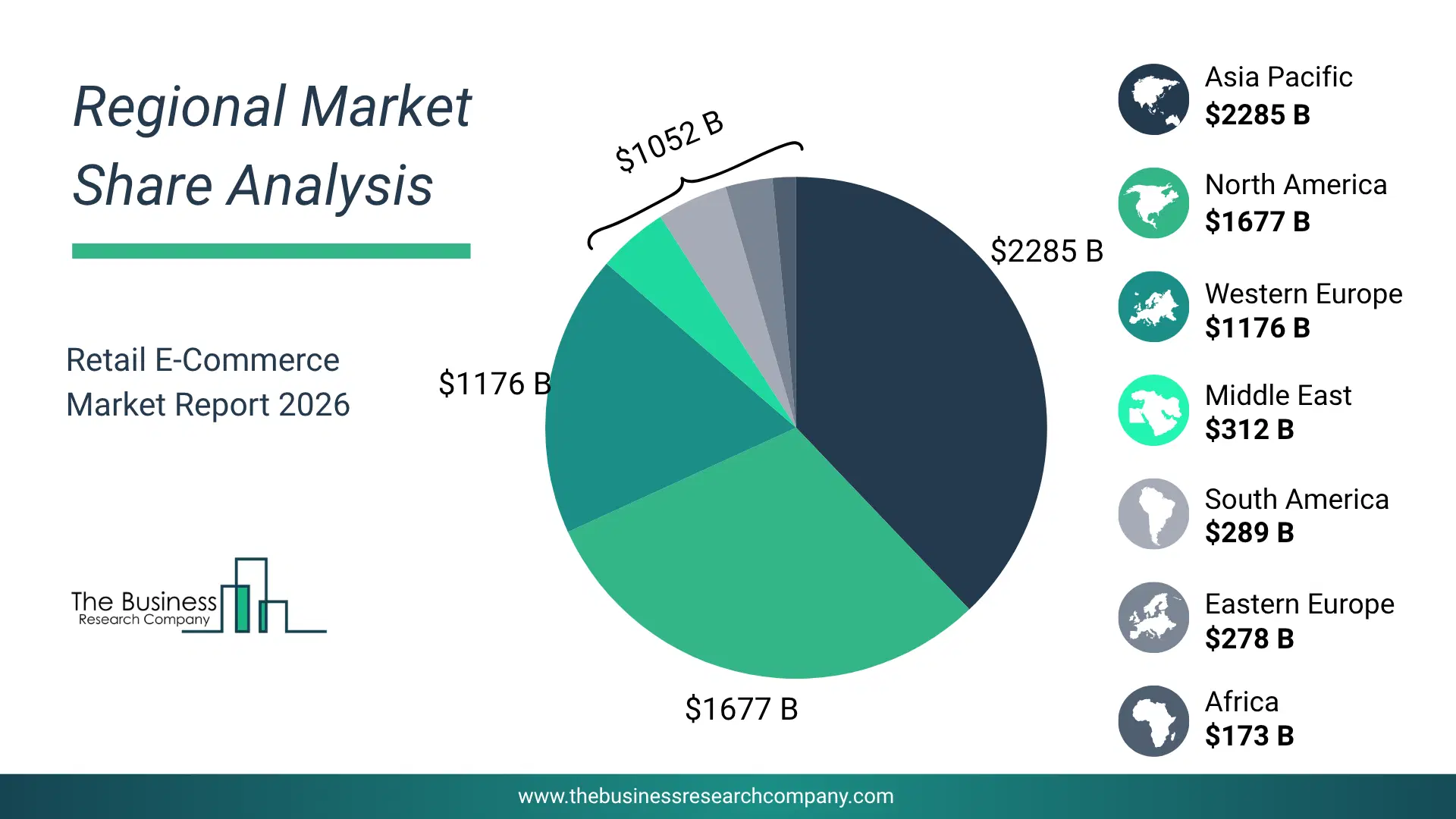
Regional Outlook
Asia-Pacific was the largest region in the retail e-commerce market in 2025. The regions covered in this market report are Asia-Pacific, South East Asia, Western Europe, Eastern Europe, North America, South America, Middle East and Africa. The countries covered in this market report are Australia; Brazil; China; France; Germany; India; Indonesia; Japan; Taiwan; Russia; South Korea; UK; USA; Canada; Italy; Spain.What Defines the Retail E-Commerce Market?
The retail e-commerce market includes revenues earned by entities by providing services such as food e-commerce, grocery e-commerce, and e-commerce logistics and grocery retail. The market value includes the value of related goods sold by the service provider or included within the service offering. Only goods and services traded between entities or sold to end consumers are included.How is Market Value Defined and Measured?
The market value is defined as the revenues that enterprises gain from the sale of goods and/or services within the specified market and geography through sales, grants, or donations in terms of the currency (in USD unless otherwise specified). The revenues for a specified geography are consumption values that are revenues generated by organizations in the specified geography within the market, irrespective of where they are produced. It does not include revenues from resales along the supply chain, either further along the supply chain or as part of other products.
This chart presents market attractiveness based on a quantitative evaluation of growth, competition, strategic alignment, and risk, offering a clear view of opportunity areas for decision-making. This chart is for illustrative purposes; the full report contains the complete analysis.

This chart highlights the Total Addressable Market (TAM) by estimating the maximum revenue opportunity using an assumption-driven approach, supporting strategic planning and opportunity sizing across markets. The chart is illustrative; the full report provides a more comprehensive analysis.
What Key Data and Analysis Are Included in the Retail E-Commerce Market Report 2026?
The retail e-commerce market research report is one of a series of new reports from The Business Research Company that provides market statistics, including industry global market size, regional shares, competitors with the market share, detailed market segments, market trends and opportunities, and any further data you may need to thrive in the retail e-commerce industry. The market research report delivers a complete perspective of everything you need, with an in-depth analysis of the current and future state of the industry.Retail E-Commerce Market Report Forecast Analysis
| Report Attribute | Details |
|---|---|
| Market Size Value In 2026 | $4082.77 billion |
| Revenue Forecast In 2030 | $6239.22 billion |
| Growth Rate | CAGR of 11.2% from 2026 to 2030 |
| Base Year For Estimation | 2025 |
| Actual Estimates/Historical Data | 2020-2025 |
| Forecast Period | 2026 - 2030 |
| Market Representation | Revenue in USD Billion and CAGR from 2026 to 2030 |
| Segments Covered | Type, Sector, Distribution Channel |
| Regional Scope | Asia-Pacific, Western Europe, Eastern Europe, North America, South America, Middle East, Africa |
| Country Scope | The countries covered in the report are Australia, Brazil, China, France, Germany, India, Indonesia, Japan, Taiwan, Russia, South Korea, UK, USA, Canada, Italy, Spain. |
| Key Companies Profiled | Walmart Inc., Amazon.com Inc., Apple Inc., Costco Wholesale Corporation, The Home Depot Inc., The Kroger Co, Alibaba Group Holding Ltd., Target Corporation, Dell Technologies Inc., Albertsons Companies Inc, Best Buy Co Inc., Inter IKEA Systems B.V., Hewlett-Packard Company, Macy's Inc., Coupang Corp, Otto GmbH & Co KG, Nordstrom Inc., Wayfair Inc., Rakuten Group Inc., eBay Inc., Shopify Inc., Etsy Inc., IndiaMART InterMESH Ltd., IKEA AB, Ebates Inc., Taobao, Clues Network Pvt Ltd. |
| Customization Scope | Request for Customization |
| Pricing And Purchase Options | Explore Purchase Options |