
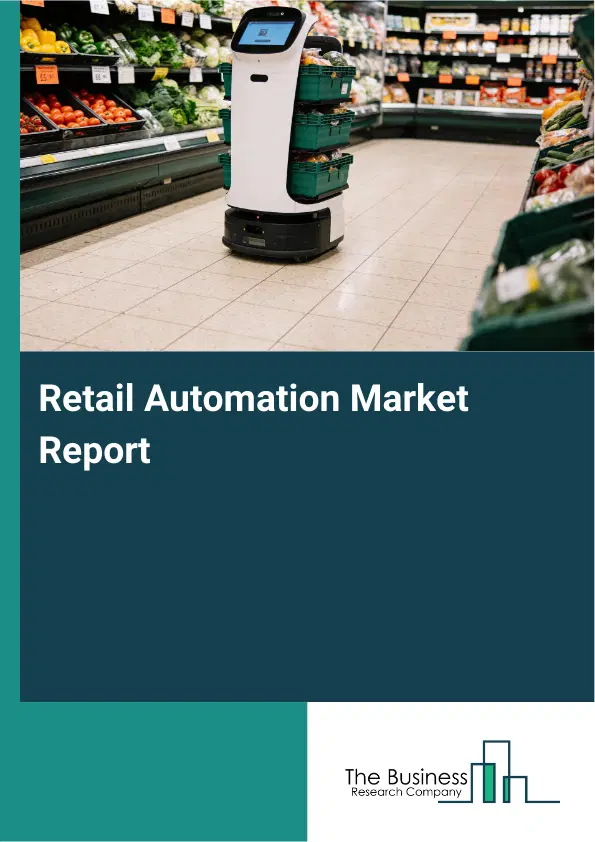
Retail Automation Market Report 2026
Global Outlook – By Product (Point-Of-Sale (POS), RFID And Barcode, Camera, Electronic Shelf Label, Warehouse Robotics, Other Products), By Implementation (In-Store, Warehouse), By End-Use (Hypermarkets, Single Item Stores, Supermarkets, Fuel Stations, Retail Pharmacies, Other End-Uses) – Market Size, Trends, Strategies, and Forecast to 2030
Retail Automation Market Overview
• Retail Automation market size has reached to $22.39 billion in 2025 • Expected to grow to $39.99 billion in 2030 at a compound annual growth rate (CAGR) of 12.3% • Growth Driver: Rising Consumer Expectations Driving Retail Automation Growth. • Market Trend: Introduction Of Collaborative Robots Revolutionizes Retail Automation • North America was the largest region in 2025 and Asia-Pacific is the fastest growing region.What Is Covered Under Retail Automation Market?
Retail automation refers to the use of innovative tools and technology to improve processes and ensure efficiency in retail operations. It encompasses a wide range of technologies and solutions that streamline standard operations, such as inventory management, point-of-sale (POS) systems, ordering software, and warehouse management solutions. The main products of retail automation market covered are point-of-sale (PoS), RFID and barcode, camera, electronic shelf label, warehouse robotics, other products. In-store is used to relate to conditioning or what's available in a department store or supermarket. The products involved are in-store and warehouse which are used by various end user industries including hypermarkets, single item stores, supermarkets, fuel stations, retail pharmacies, and others.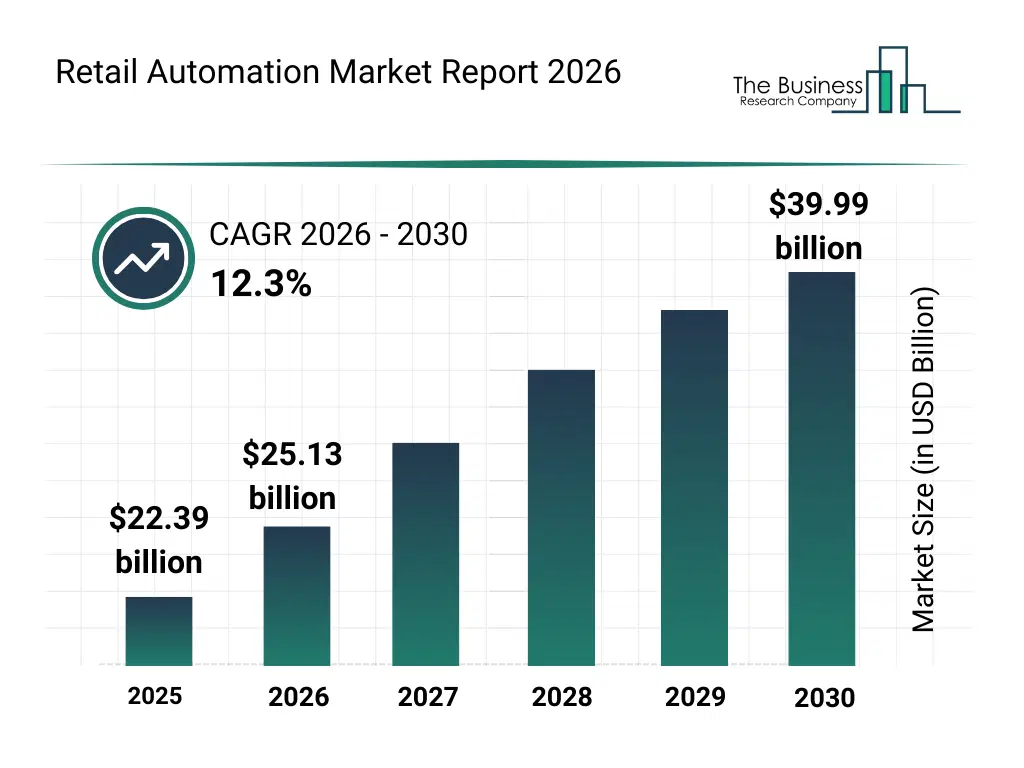
What Is The Retail Automation Market Size and Share 2026?
The retail automation market size has grown rapidly in recent years. It will grow from $22.39 billion in 2025 to $25.13 billion in 2026 at a compound annual growth rate (CAGR) of 12.2%. The growth in the historic period can be attributed to growing need for operational efficiency, rising labor costs, expansion of organized retail, increasing adoption of pos systems, demand for faster checkout processes.What Is The Retail Automation Market Growth Forecast?
The retail automation market size is expected to see rapid growth in the next few years. It will grow to $39.99 billion in 2030 at a compound annual growth rate (CAGR) of 12.3%. The growth in the forecast period can be attributed to adoption of AI-powered retail solutions, integration of iot with retail operations, growth in e-commerce fulfillment, demand for contactless transactions, rise of omnichannel retail strategies. Major trends in the forecast period include enhanced inventory management solutions, cloud-based retail platforms, automated checkout systems, real-time sales analytics, integrated warehouse management.
Global Retail Automation Market Segmentation
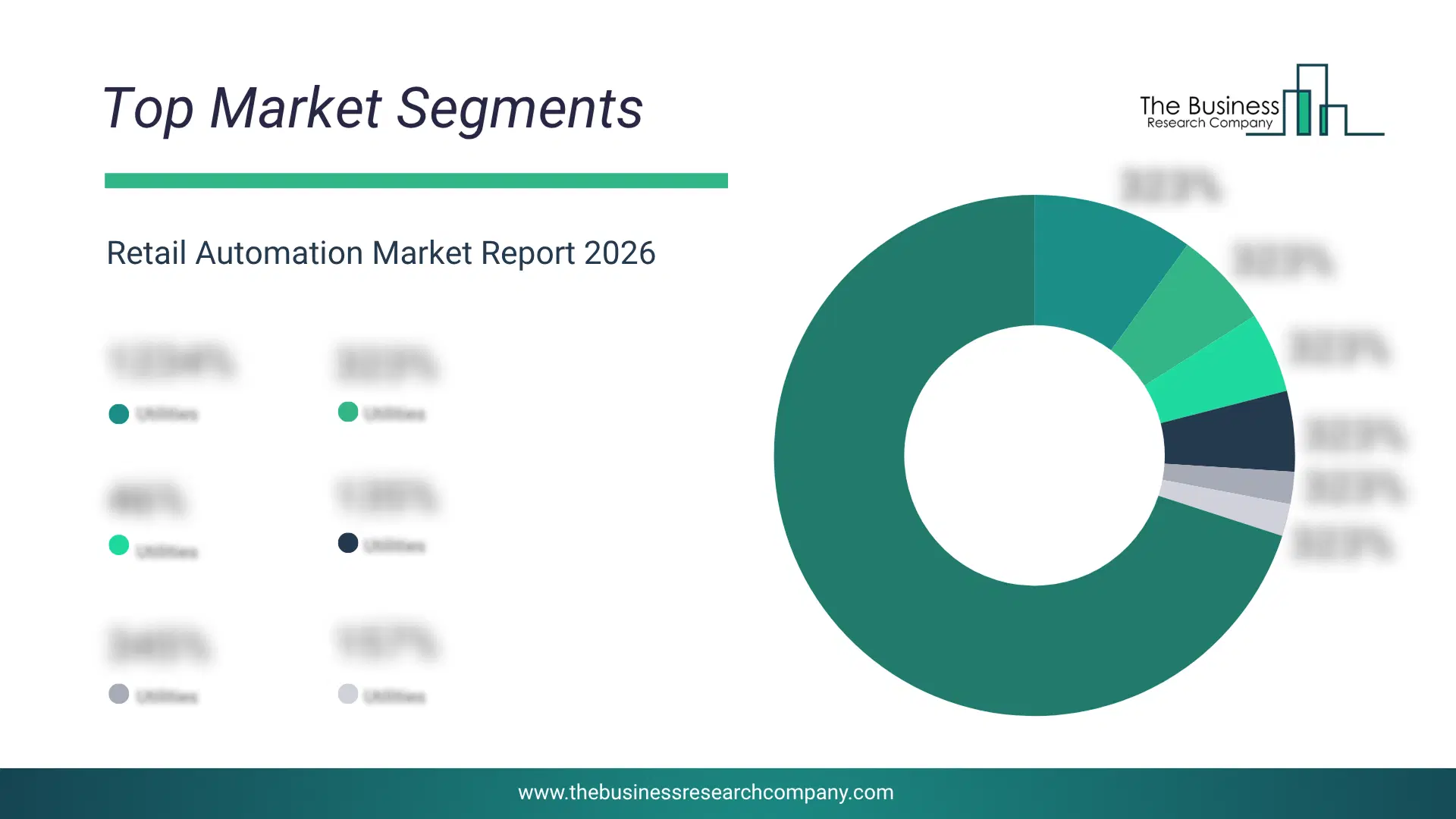
1) By Product: Point-Of-Sale (POS), RFID And Barcode, Camera, Electronic Shelf Label, Warehouse Robotics, Other Products 2) By Implementation: In-Store, Warehouse 3) By End-Use: Hypermarkets, Single Item Stores, Supermarkets, Fuel Stations, Retail Pharmacies, Other End-Uses Subsegments: 1) By Point-Of-Sale (POS): Traditional POS Systems, Mobile POS Systems, Cloud-Based POS Systems 2) By RFID And Barcode: RFID Tags And Readers, Barcode Scanners, Inventory Management Systems 3) By Camera: Surveillance Cameras, Smart Cameras For Analytics, Customer Behavior Tracking Cameras 4) By Electronic Shelf Label: LCD Shelf Labels, E-Paper Shelf Labels, Wireless Communication Systems 5) By Warehouse Robotics: Automated Guided Vehicles (AGVs), Autonomous Mobile Robots (AMRs), Robotic Picking Systems 6) By Other Products: Self-Service Kiosks, Digital Signage, Payment SolutionsWhat Is The Driver Of The Retail Automation Market?
The rising consumer expectations for faster and seamless shopping expected to propel the growth of the retail automation market going forward. Faster and seamless shopping refers to the entail’s swift transactions, streamlined processes, and minimal friction for customers, including quick checkouts, easy navigation, access to product details, and seamless payments. Faster and seamless shopping accelerates growth in the retail automation market through enhanced customer satisfaction, streamlined processes, and data-driven optimization, fostering innovation and expansion. Retail automation uses technology to streamline and expedite the shopping experience, enhancing efficiency and convenience for consumers through quicker transactions and seamless processes. For instance, in February 2024, according to the Census Bureau of the Department of Commerce, a US-based government department, the fourth quarter 2023 e-commerce estimate increased 7.5% (±1.2%) from the fourth quarter of 2022, while total retail sales increased 2.8% (±0.4%) in the same period. Therefore, the rising consumer expectations for faster and seamless shopping is driving the growth of the retail automation industry.Key Players In The Global Retail Automation Market
Major companies operating in the retail automation market are Samsung Electronics Co. Ltd., Amazon Web Services Inc., Honeywell International Inc., Fujitsu Limited, Posiflex Technology Inc., NCR Corporation, Zebra Technologies Corporation, KUKA AG, Diebold Nixdorf Inc., Casio Computer Co. Ltd., Capillary Technologies, PAX Technology Inc., Datalogic S.p.A, Toshiba Global Commerce Solutions Inc., WiseTech Global group, First Data Corporation, Optimove Inc., Tecsys Inc., ECR Software Corporation, SandenVendo, E&K Automation GmbH, 6 River Systems LLC, Focus Softnet FZ LLC, Vinculum Solutions Pvt. Ltd., Pricer AB, Future Way Technical Services LLC, QR Retail Automation (Asia) Sdn Bhd, Napse, Kiosk & Display LLC, Wincor Nixdorf AG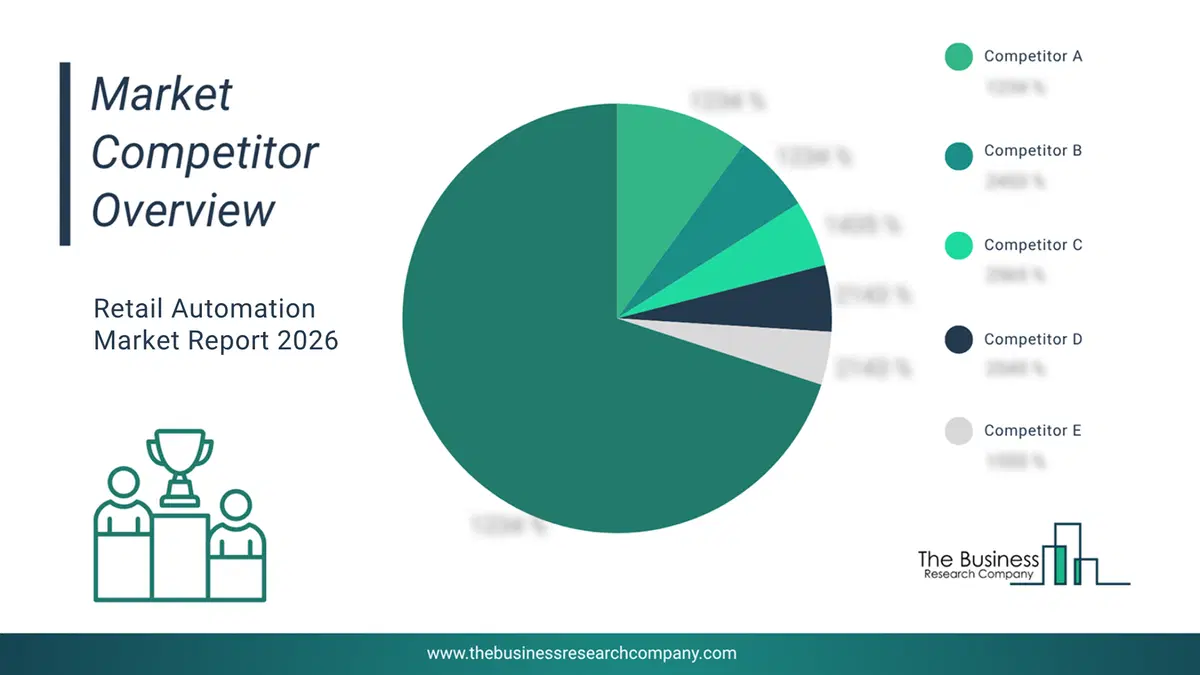
This chart is for illustrative purposes; the full report includes a detailed competitor analysis and comprehensive overview of the top 10 companies in the market.
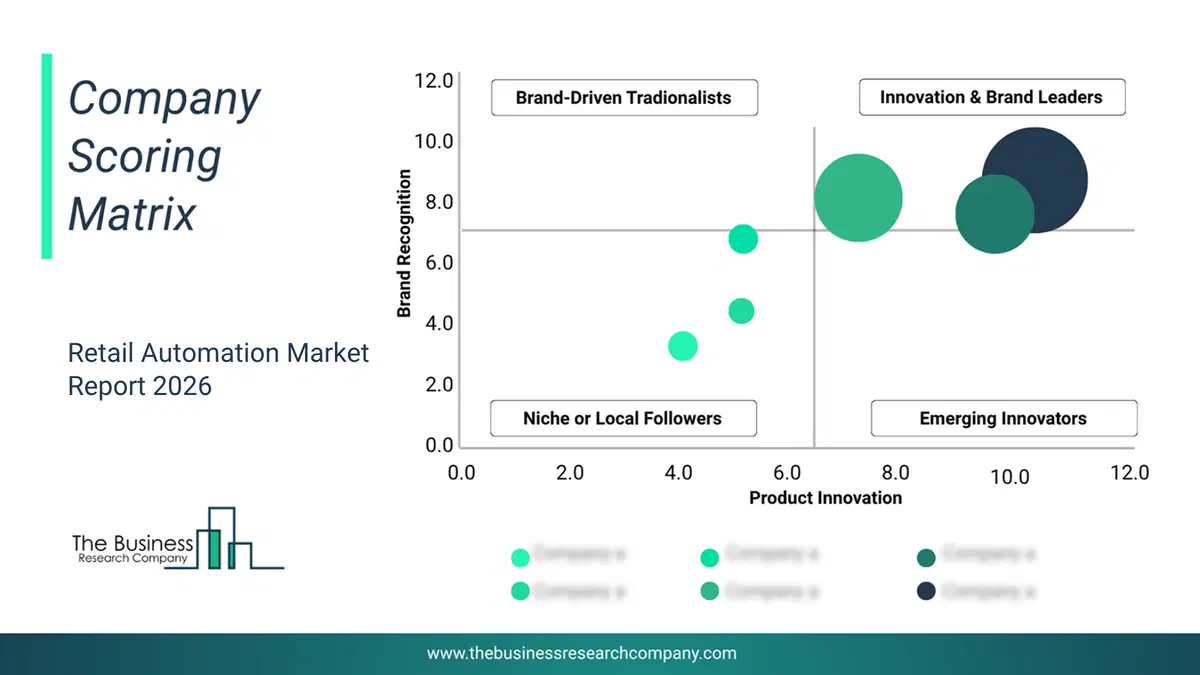
This chart maps companies by product innovation and brand strength, with bubble size indicating relative revenue, helping identify market leaders, challengers, and niche players. This is an illustrative chart; the full report provides a complete and accurate competitive analysis.
Global Retail Automation Market Trends and Insights
Major companies operating in the retail automation market are developing advanced technologies, such as the integration of robotics and automation, to serve customers better with advanced features. Integrating robotics and automation refers to incorporating robotic systems and automated processes into various aspects of industrial operations, manufacturing, or other industries. For instance, in August 2023, Dobot, a Japan-based robotic arms producer, launched Nova collaborative robots for retail automation. The first two Nova models have 2 kg and 5 kg payloads for handling retail and physiotherapy tasks, respectively. The Nova Series has multiple safety features to sense human movement intelligently and stops operation in 0.01 seconds upon collision detection. In case of a power outage, Nova automatically freezes in position to ensure the safety of others.What Are Latest Mergers And Acquisitions In The Retail Automation Market?
In July 2024, Accenture, an Ireland-based professional services company acquired Logic for an undisclosed amount. Through this acquisition, Accenture aimed to enhance its capabilities in digital transformation and data analytics, focusing on integrating advanced technology solutions to drive innovation for its clients. Logic is a US-based company recognized for its expertise in providing cutting-edge software and analytics solutions tailored to optimize business performance.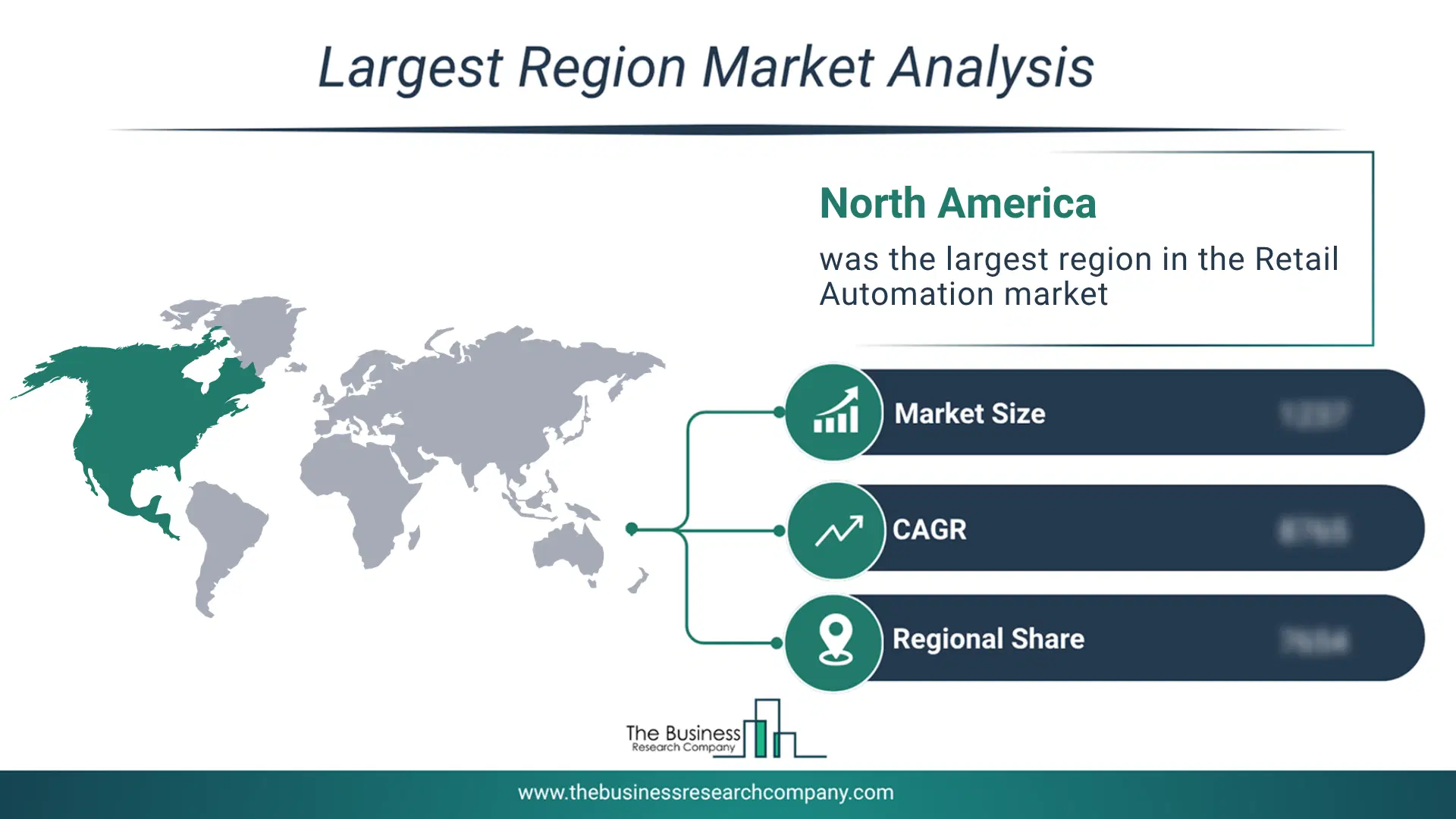
Regional Outlook
North America was the largest region in the retail automation market in 2025. Asia-Pacific is expected to be the fastest-growing region in the forecast period. The regions covered in this market report are Asia-Pacific, South East Asia, Western Europe, Eastern Europe, North America, South America, Middle East and Africa. The countries covered in this market report are Australia; Brazil; China; France; Germany; India; Indonesia; Japan; Taiwan; Russia; South Korea; UK; USA; Canada; Italy; Spain.What Defines the Retail Automation Market?
The retail automation market consists of revenues earned by entities by providing services such as workflow automation, analytics automation, inventory management, point of sale (POS) software, customer relationship management (CRM) software, and e-commerce and supply chain management systems. The market value includes the value of related goods sold by the service provider or included within the service offering. The retail automation market also includes sales point of sale systems and replacement parts. Values in this market are ‘factory gate’ values, that is the value of goods sold by the manufacturers or creators of the goods, whether to other entities (including downstream manufacturers, wholesalers, distributors and retailers) or directly to end customers. The value of goods in this market includes related services sold by the creators of the goods.How is Market Value Defined and Measured?
The market value is defined as the revenues that enterprises gain from the sale of goods and/or services within the specified market and geography through sales, grants, or donations in terms of the currency (in USD unless otherwise specified). The revenues for a specified geography are consumption values that are revenues generated by organizations in the specified geography within the market, irrespective of where they are produced. It does not include revenues from resales along the supply chain, either further along the supply chain or as part of other products.
This chart presents market attractiveness based on a quantitative evaluation of growth, competition, strategic alignment, and risk, offering a clear view of opportunity areas for decision-making. This chart is for illustrative purposes; the full report contains the complete analysis.

This chart highlights the Total Addressable Market (TAM) by estimating the maximum revenue opportunity using an assumption-driven approach, supporting strategic planning and opportunity sizing across markets. The chart is illustrative; the full report provides a more comprehensive analysis.
What Key Data and Analysis Are Included in the Retail Automation Market Report 2026?
The retail automation market research report is one of a series of new reports from The Business Research Company that provides market statistics, including industry global market size, regional shares, competitors with the market share, detailed market segments, market trends and opportunities, and any further data you may need to thrive in the retail automation industry. The market research report delivers a complete perspective of everything you need, with an in-depth analysis of the current and future state of the industry.Retail Automation Market Report Forecast Analysis
| Report Attribute | Details |
|---|---|
| Market Size Value In 2026 | $25.13 billion |
| Revenue Forecast In 2030 | $39.99 billion |
| Growth Rate | CAGR of 12.3% from 2026 to 2030 |
| Base Year For Estimation | 2025 |
| Actual Estimates/Historical Data | 2020-2025 |
| Forecast Period | 2026 - 2030 |
| Market Representation | Revenue in USD Billion and CAGR from 2026 to 2030 |
| Segments Covered | Product, Implementation, End-Use |
| Regional Scope | Asia-Pacific, Western Europe, Eastern Europe, North America, South America, Middle East, Africa |
| Country Scope | The countries covered in the report are Australia, Brazil, China, France, Germany, India, Indonesia, Japan, Taiwan, Russia, South Korea, UK, USA, Canada, Italy, Spain. |
| Key Companies Profiled | Samsung Electronics Co. Ltd., Amazon Web Services Inc., Honeywell International Inc., Fujitsu Limited, Posiflex Technology Inc., NCR Corporation, Zebra Technologies Corporation, KUKA AG, Diebold Nixdorf Inc., Casio Computer Co. Ltd., Capillary Technologies, PAX Technology Inc., Datalogic S.p.A, Toshiba Global Commerce Solutions Inc., WiseTech Global group, First Data Corporation, Optimove Inc., Tecsys Inc., ECR Software Corporation, SandenVendo, E&K Automation GmbH, 6 River Systems LLC, Focus Softnet FZ LLC, Vinculum Solutions Pvt. Ltd., Pricer AB, Future Way Technical Services LLC, QR Retail Automation (Asia) Sdn Bhd, Napse, Kiosk & Display LLC, Wincor Nixdorf AG |
| Customization Scope | Request for Customization |
| Pricing And Purchase Options | Explore Purchase Options |