
Retail Cloud Market Report 2026
Global Outlook – By Type (Channel Operations, Supply Chain Management, Customer Management, Merchandising, Workforce Management, Reporting and Analytics, Data Security), By Service Model (Software as a Service (SaaS), Platform as a Service (PaaS), Infrastructure as a Service (IaaS)), By Deployment (Public Cloud, Private Cloud, Hybrid Cloud), By Organization Size (Small and Medium Enterprise, Large Enterprise) – Market Size, Trends, Strategies, and Forecast to 2030
Retail Cloud Market Overview
• Retail Cloud market size has reached to $44.72 billion in 2025 • Expected to grow to $120.03 billion in 2030 at a compound annual growth rate (CAGR) of 21.8% • Growth Driver: The Expansion Of E-Commerce Driving The Growth Of The Market Due To Increased Internet Access And Smartphone Usage • Market Trend: Innovative Retail Analytics Platforms Gain Traction In The Market • North America was the largest region in 2025 and Asia-Pacific is the fastest growing region.What Is Covered Under Retail Cloud Market?
Retail cloud is a cloud-based retail solution that combines artificial intelligence (AI) and data analytics, which allow retailers to build goods responsive to consumer feedback. Retailers can use cloud computing to obtain information from internet sources to meet their customers' needs. Cloud computing allows for the streamlining of supply chains and logistics and the delivery of high-quality and seamless client experiences. The main types of retail cloud are channel operations, supply chain management, customer management, merchandising, workforce management, reporting and analytics, and data security. Channel operations refer to the process through which a company develops numerous marketing and sales strategies in order to reach the broadest possible audience. The retail cloud is utilized in channel operations by integrating numerous data sources to create a unified view of customers across transactions and channels (in-store, mobile, web, and even social media). The various service model includes software as a service (SaaS), platform as a service (PaaS), infrastructure as a service (IaaS), that are deployment through public cloud, private cloud, and hybrid cloud. It is used by small and medium enterprises and large enterprises.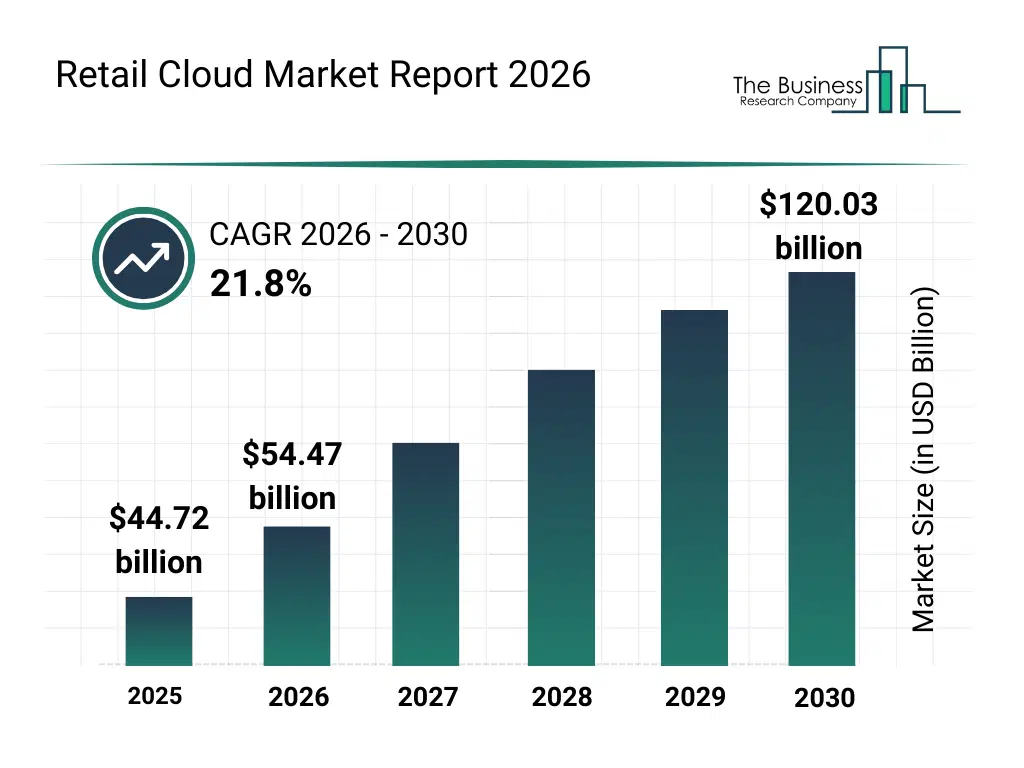
What Is The Retail Cloud Market Size and Share 2026?
The retail cloud market size has grown exponentially in recent years. It will grow from $44.72 billion in 2025 to $54.47 billion in 2026 at a compound annual growth rate (CAGR) of 21.8%. The growth in the historic period can be attributed to adoption of cloud-based retail solutions, growth in e-commerce penetration, increasing need for supply chain efficiency, rising consumer demand for personalized experiences, integration of data analytics in retail operations.What Is The Retail Cloud Market Growth Forecast?
The retail cloud market size is expected to see exponential growth in the next few years. It will grow to $120.03 billion in 2030 at a compound annual growth rate (CAGR) of 21.8%. The growth in the forecast period can be attributed to expansion of omnichannel retail platforms, advancements in AI-driven customer insights, adoption of IoT-enabled smart stores, rising investment in immersive AR/VR retail experiences, growing demand for predictive analytics in inventory and logistics. Major trends in the forecast period include real-time inventory visibility, personalized customer experience, automated order fulfillment, omnichannel retail integration, predictive demand analytics.
Global Retail Cloud Market Segmentation
1) By Type: Channel Operations, Supply Chain Management, Customer Management, Merchandising, Workforce Management, Reporting and Analytics, Data Security 2) By Service Model: Software as a Service (SaaS), Platform as a Service (PaaS), Infrastructure as a Service (IaaS) 3) By Deployment: Public Cloud, Private Cloud, Hybrid Cloud 4) By Organization Size: Small and Medium Enterprise, Large Enterprise Subsegments: 1) By Channel Operations: Omnichannel Management, E-commerce Solutions, Point Of Sale (POS) Integration 2) By Supply Chain Management: Inventory Management, Order Management, Logistics And Transportation Management 3) By Customer Management: Customer Relationship Management (CRM), Customer Engagement Solutions, Loyalty Programs 4) By Merchandising: Product Information Management, Pricing Management, Promotion Management 5) By Workforce Management: Employee Scheduling, Time And Attendance Tracking, Performance Management 6) By Reporting and Analytics: Business Intelligence Tools, Sales Analytics, Customer Insights 7) By Data Security: Data Encryption Solutions, Access Control Management, Compliance ManagementWhat Is The Driver Of The Retail Cloud Market?
The expansion of the e-commerce industry is expected to propel the growth of the retail cloud market going forward. E-commerce involves the buying and selling of goods and services over the Internet. The expansion of the e-commerce industry is due to increased internet access and widespread smartphone usage, which make online shopping more convenient and accessible to a larger population. Retail cloud in e-commerce facilitates seamless online retail operations by providing scalable infrastructure, secure data storage, and real-time analytics, enhancing the efficiency, agility, and customer experience of digital storefronts. For instance, in February 2024, according to the U.S. Census Bureau, a US-based government statistical agency, in 2023, total e-commerce sales were estimated at $1,118.7 billion, marking a 7.6% (±1.2%) increase compared to 2022. During the same period, overall retail sales grew by 2.1% (±0.4%) from the previous year. E-commerce accounted for 15.4% of total retail sales in 2023, up from 14.7% in 2022. Therefore, the expansion of the e-commerce industry is driving the growth of the retail cloud industry.Key Players In The Global Retail Cloud Market
Major companies operating in the retail cloud market are Alphabet Inc.; Google LLC; Microsoft Corporation; Alibaba Group Holding Limited; NTT Limited; Amazon Web Services Inc.; Accenture plc; International Business Machines Corporation; Cisco Systems Inc.; Oracle Corporation; Fujitsu Limited; SAP SE; Salesforce.com Inc.; Cognizant Technology Solutions Corp; Adobe Inc.; VMware Inc.; Atos SE; T-Systems International GmbH; Infor Inc.; Rackspace Technology Inc.; Nutanix Inc.; Blue Yonder Group Inc.; Epicor Software Corporation; Lightspeed Commerce Inc.; JDA Software Group Inc.; Tekion Corp; SPS Commerce Inc.; SymphonyAI Retail CPG
This chart is for illustrative purposes; the full report includes a detailed competitor analysis and comprehensive overview of the top 10 companies in the market.
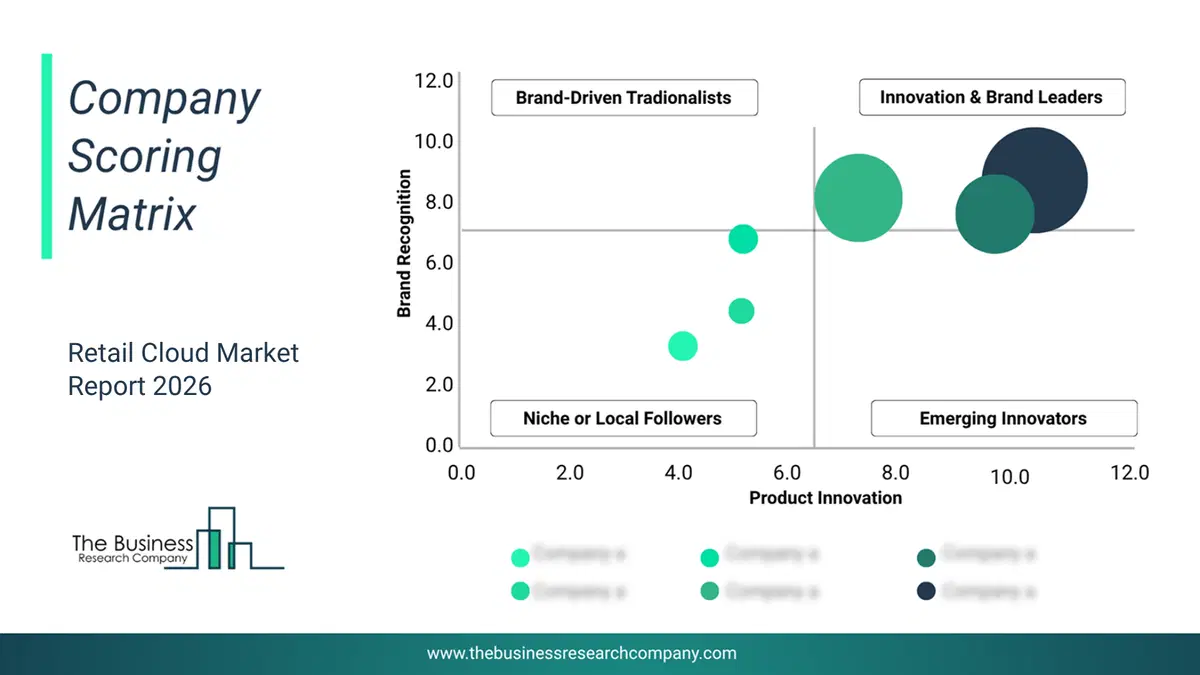
This chart maps companies by product innovation and brand strength, with bubble size indicating relative revenue, helping identify market leaders, challengers, and niche players. This is an illustrative chart; the full report provides a complete and accurate competitive analysis.
Global Retail Cloud Market Trends and Insights
Major companies operating in the retail cloud market are increasing their focus on introducing retail analytics platforms, such as EY Retail Intelligence, to maximize their revenues in the market. EY Retail Intelligence is a comprehensive analytics solution that uses data-driven insights to help retailers make strategic decisions, improve customer experiences, and optimize operational efficiency across the retail value chain. For instance, in January 2023, Ernst & Young Global Limited, a UK-based company, launched a new EY Retail Intelligence solution. This new version builds on the Microsoft Cloud and Cloud for Retail to provide consumers with a seamless and streamlined shopping experience. The platform uses advanced technologies such as artificial intelligence, image recognition, and analytics to collect data across all channels and turn it into valuable EY Retail Intelligence.What Are Latest Mergers And Acquisitions In The Retail Cloud Market?
In January 2024, GLORY LTD., a Japan-based cash technology solutions company, acquired Flooid Topco Limited for $0.204 billion. The acquisition of Flooid Topco Limited aims to enhance Glory Global Solutions' capabilities in cash handling and related technologies by integrating Flooid and its subsidiaries into the company. Flooid Topco Limited is a UK-based unified retail commerce platform that offers cloud infrastructure services, operational support, and managed services.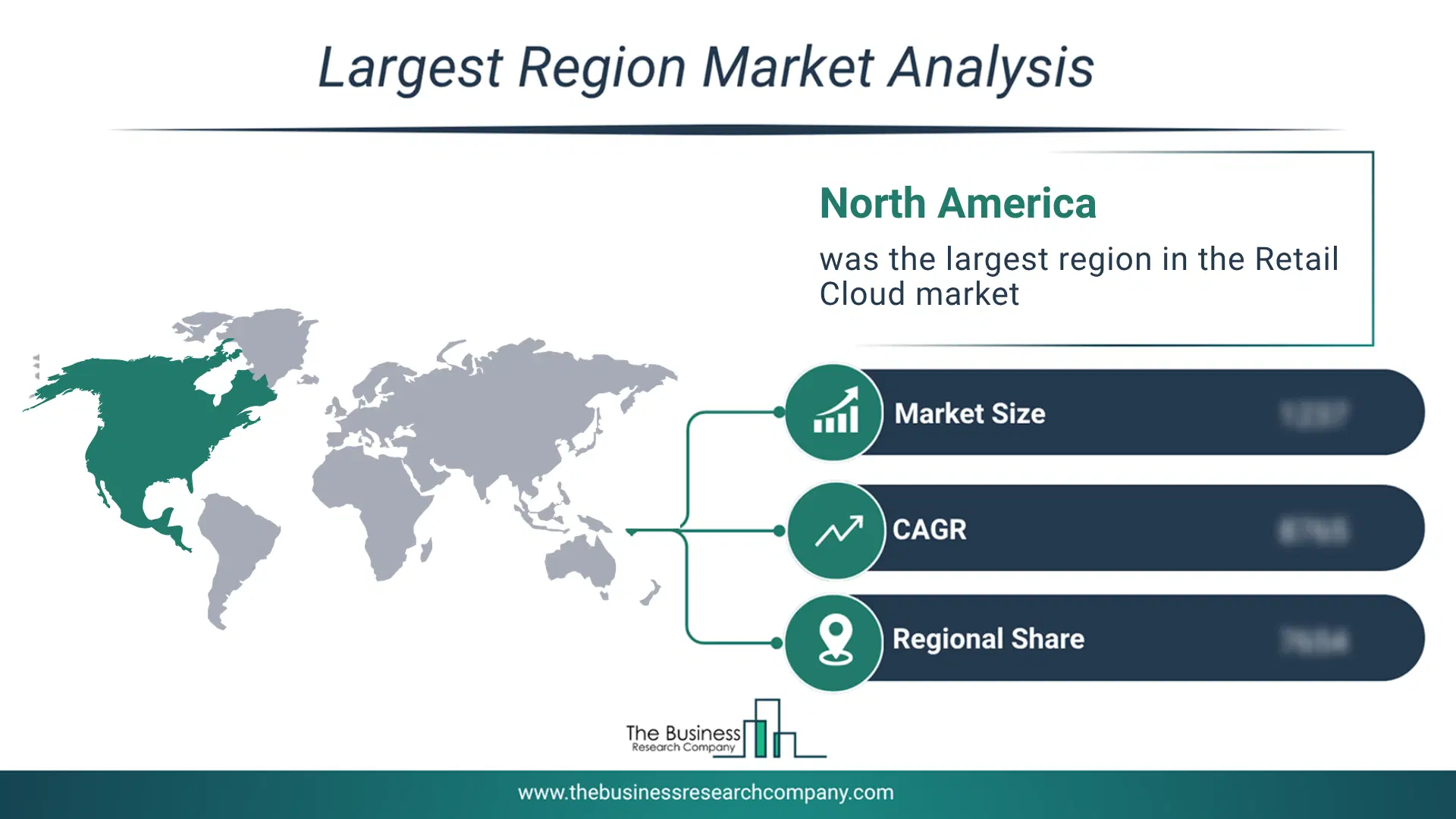
Regional Insights
North America was the largest region in the retail cloud market in 2025. Asia-Pacific is expected to be the fastest-growing region in the forecast period. The regions covered in this market report are Asia-Pacific, South East Asia, Western Europe, Eastern Europe, North America, South America, Middle East, Africa. The countries covered in this market report are Australia, Brazil, China, France, Germany, India, Indonesia, Japan, Taiwan, Russia, South Korea, UK, USA, Canada, Italy, SpainWhat Defines the Retail Cloud Market?
The retail cloud market includes revenues earned by entities by providing real-time data, enabling real-time monitoring and tracking of inventory, pricing and margin management, and storing customer data. The market value includes the value of related goods sold by the service provider or included within the service offering. Only goods and services traded between entities or sold to end consumers are included.How is Market Value Defined and Measured?
The market value is defined as the revenues that enterprises gain from the sale of goods and/or services within the specified market and geography through sales, grants, or donations in terms of the currency (in USD unless otherwise specified). The revenues for a specified geography are consumption values that are revenues generated by organizations in the specified geography within the market, irrespective of where they are produced. It does not include revenues from resales along the supply chain, either further along the supply chain or as part of other products.
This chart presents market attractiveness based on a quantitative evaluation of growth, competition, strategic alignment, and risk, offering a clear view of opportunity areas for decision-making. This chart is for illustrative purposes; the full report contains the complete analysis.

This chart highlights the Total Addressable Market (TAM) by estimating the maximum revenue opportunity using an assumption-driven approach, supporting strategic planning and opportunity sizing across markets. The chart is illustrative; the full report provides a more comprehensive analysis.
What Key Data and Analysis Are Included in the Retail Cloud Market Report 2026?
The retail cloud market research report is one of a series of new reports from The Business Research Company that provides market statistics, including industry global market size, regional shares, competitors with the market share, detailed market segments, market trends and opportunities, and any further data you may need to thrive in the retail cloud industry. The market research report delivers a complete perspective of everything you need, with an in-depth analysis of the current and future state of the industry.Retail Cloud Market Report Forecast Analysis
| Report Attribute | Details |
|---|---|
| Market Size Value In 2026 | $54.47 billion |
| Revenue Forecast In 2030 | $120.03 billion |
| Growth Rate | CAGR of 21.8% from 2026 to 2030 |
| Base Year For Estimation | 2025 |
| Actual Estimates/Historical Data | 2020-2025 |
| Forecast Period | 2026 - 2030 |
| Market Representation | Revenue in USD Billion and CAGR from 2026 to 2030 |
| Segments Covered | Type, Service Model, Deployment, Organization Size |
| Regional Scope | Asia-Pacific, Western Europe, Eastern Europe, North America, South America, Middle East, Africa |
| Country Scope | The Countries Covered In This Market Report Are Australia, Brazil, China, France, Germany, India, Indonesia, Japan, Taiwan, Russia, South Korea, Uk, Usa, Canada, Italy, Spain. |
| Key Companies Profiled | Alphabet Inc., Google LLC, Microsoft Corporation, Alibaba Group Holding Limited, NTT Limited, Amazon Web Services Inc., Accenture plc, International Business Machines Corporation, Cisco Systems Inc., Oracle Corporation, Fujitsu Limited, SAP SE, Salesforce.com Inc., Cognizant Technology Solutions Corp, Adobe Inc., VMware Inc., Atos SE, T-Systems International GmbH, Infor Inc., Rackspace Technology Inc., Nutanix Inc., Blue Yonder Group Inc., Epicor Software Corporation, Lightspeed Commerce Inc., JDA Software Group Inc., Tekion Corp, SPS Commerce Inc., SymphonyAI Retail CPG |
| Customization Scope | Request for Customization |
| Pricing And Purchase Options | Explore Purchase Options |