
Retail Logistic Solutions Market Report 2026
Global Outlook – By Solution Type (Transportation Management, Warehousing And Storage, Inventory Control And Management, Order Fulfillment, Value Added Services), By Mode Of Transport (Roadways, Railways, Airways, Waterways), By Technology Integration (Automation And Robotics Enabled Logistics, Artificial Intelligence And Predictive Analytics Solutions, Cloud Based Logistics Platforms, Internet Of Things Enabled Tracking Systems, Warehouse Management Systems, Real Time Tracking And Visibility Tools), By End User Industry (Grocery, Food And Beverage, Fashion, Apparel And Lifestyle, Consumer Electronics And Appliances, Personal And Household Care, Pharmaceuticals And Healthcare Retail, Home And Furniture Retail) – Market Size, Trends, Strategies, and Forecast to 2030
Retail Logistic Solutions Market Overview
• Retail Logistic Solutions market size has reached to $179.85 billion in 2025 • Expected to grow to $268.64 billion in 2030 at a compound annual growth rate (CAGR) of 8.3% • Growth Driver: The Rising Growth Of E Commerce Retail Fueling The Growth Of The Market Due To Consumer Preference For Convenience And Seamless Price Comparison • Market Trend: Cloud-Based Warehouse Automation Enhances Operational Efficiency And Order Fulfillment In Retail Logistics • North America was the largest region in 2025 and Asia-Pacific is the fastest growing region.What Is Covered Under Retail Logistic Solutions Market?
Retail logistic solutions refer to integrated systems and services that manage the efficient movement, storage, and flow of goods from suppliers to retail distribution networks. These solutions focus on optimizing transportation, warehousing, inventory control, and order fulfillment to ensure timely and cost-effective product availability. They leverage coordination, planning, and operational management techniques to improve overall supply chain efficiency and reliability in retail operations. The main solution types of retail logistic solutions include transportation management, warehousing and storage, inventory control and management, order fulfillment, and value added services. Transportation management refers to logistics solutions that optimize the movement of goods from suppliers to retail locations by improving route planning, shipment coordination, and delivery efficiency. These solutions are supported through transportation modes including roadways, railways, airways, and waterways. They integrate technologies such as automation and robotics enabled logistics, artificial intelligence and predictive analytics solutions, cloud based logistics platforms, Internet of Things enabled tracking systems, warehouse management systems, and real time tracking and visibility tools and are utilized by end user industries including grocery, food and beverage, fashion, apparel and lifestyle, consumer electronics and appliances, personal and household care, pharmaceuticals and healthcare retail, and home and furniture retail.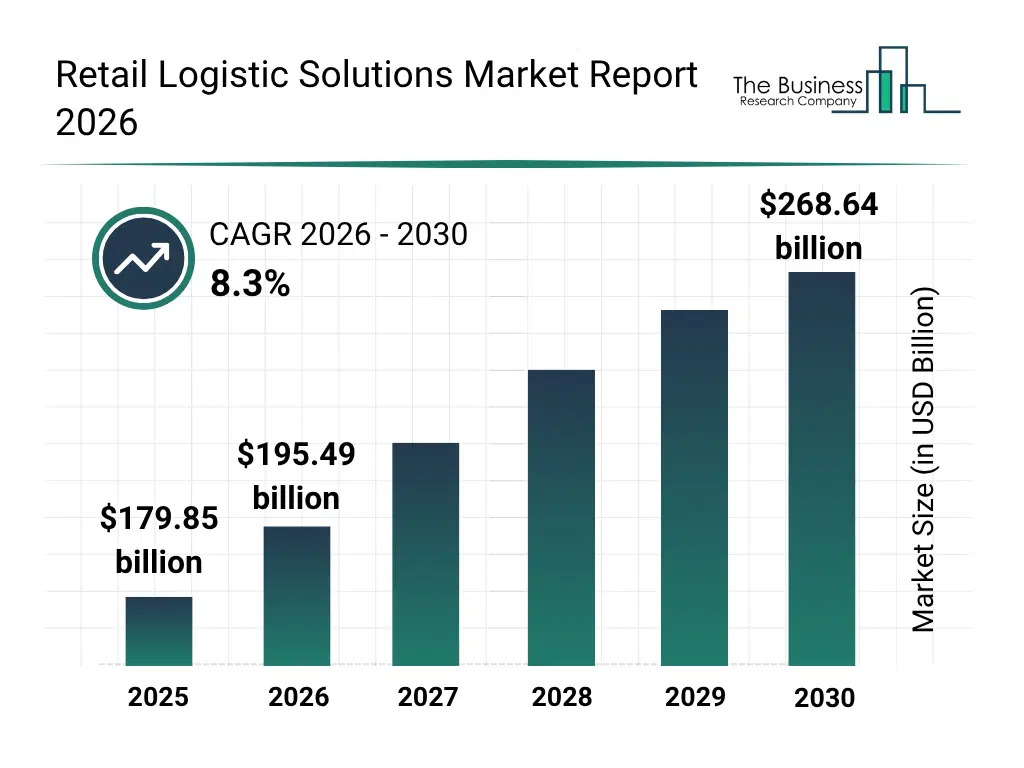
What Is The Retail Logistic Solutions Market Size and Share 2026?
The retail logistic solutions market size has grown strongly in recent years. It will grow from $179.85 billion in 2025 to $195.49 billion in 2026 at a compound annual growth rate (CAGR) of 8.7%. The growth in the historic period can be attributed to increasing expansion of retail networks and distribution channels, rising demand for efficient product movement and storage, growing adoption of organized retail operations, increasing need for improved inventory management, expansion of e commerce and omnichannel retail activities.What Is The Retail Logistic Solutions Market Growth Forecast?
The retail logistic solutions market size is expected to see strong growth in the next few years. It will grow to $268.64 billion in 2030 at a compound annual growth rate (CAGR) of 8.3%. The growth in the forecast period can be attributed to growing demand for faster order fulfillment operations, increasing requirement for supply chain resilience, rising expansion of online retail platforms, growing need for cost optimization in logistics operations, increasing focus on sustainable transportation and delivery practices. Major trends in the forecast period include increasing adoption of integrated retail supply chain management solutions, growing demand for real time inventory visibility and order tracking, rising focus on efficient last mile delivery optimization, increasing development of flexible and scalable retail logistics networks, growing implementation of advanced warehouse management practices.
Global Retail Logistic Solutions Market Segmentation
2) By Mode Of Transport: Roadways, Railways, Airways, Waterways 3) By Technology Integration: Automation And Robotics Enabled Logistics, Artificial Intelligence And Predictive Analytics Solutions, Cloud Based Logistics Platforms, Internet Of Things Enabled Tracking Systems, Warehouse Management Systems, Real Time Tracking And Visibility Tools 4) By End User Industry: Grocery, Food And Beverage, Fashion, Apparel And Lifestyle, Consumer Electronics And Appliances, Personal And Household Care, Pharmaceuticals And Healthcare Retail, Home And Furniture Retail Subsegments: 1) By Transportation Management: Freight Optimization And Routing, Fleet Management And Tracking, Carrier Selection And Management, Load Planning And Consolidation, Route Planning And Scheduling 2) By Warehousing And Storage: Storage Space Optimization, Warehouse Layout Planning, Goods Receiving And Dispatch Handling, Cross Docking Operations, Storage Condition Management 3) By Inventory Control And Management: Stock Level Monitoring, Demand Forecast Based Replenishment, Inventory Tracking And Visibility, Safety Stock Management, Multi Location Inventory Coordination 4) By Order Fulfillment: Order Processing And Validation, Pick Pack And Ship Operations, Last Mile Delivery Coordination, Order Tracking And Status Updates, Returns And Reverse Logistics Handling 5) By Value Added Services: Product Labeling And Packaging, Kitting And Assembly Services, Customization And Personalization Services, Quality Inspection And Assurance, After Sales Support ServicesWhat Is The Driver Of The Retail Logistic Solutions Market?
The rising growth of e-commerce retail is expected to propel the growth of the retail logistics solutions market going forward. E-commerce retail growth refers to the sustained increase in the total value and volume of goods sold through online platforms to consumers. The rise in e-commerce retail growth is driven by increasing consumer preference for convenience, as online shopping enables consumers to purchase products quickly and efficiently without the need to visit physical stores, reducing the time and effort required for the shopping process. Retail logistics solutions support e-commerce retail by streamlining inventory management, order fulfillment, and last-mile delivery, enabling faster product distribution and improved customer satisfaction. For instance, in January 2026, according to the Australian Bureau of Statistics, an Australian government statistics agency, online retail turnover in Australia reached AUD 4,182.6 million (USD 2,927.8 million) in November 2024, representing an 8.7 percent year-over-year increase compared to November 2023. Therefore, the rising growth of e-commerce retail is driving the growth of the retail logistics solutions market.Key Players In The Global Retail Logistic Solutions Market
Major companies operating in the retail logistic solutions market are United Parcel Service Inc., FedEx Corporation, DHL Supply Chain, A.P. Møller – Mærsk A/S, Kuehne + Nagel International AG, DSV A/S, C.H. Robinson Worldwide Inc., CEVA Logistics, Nippon Express Holdings Inc., GEODIS SA, J.B. Hunt Transport Services Inc., Ryder System Inc., GXO Logistics Inc., Expeditors International of Washington Inc., XPO Inc., TFI International Inc., DP World, Penske Logistics LLC, FM Logistic Group, Röhlig Logistics GmbH & Co. KG, Fracht Group, USPack Logistics LLC, DCL Logistics Inc., Bergen Logistics LLC, CKB Logistics Group, AmerTrans Logistics Inc.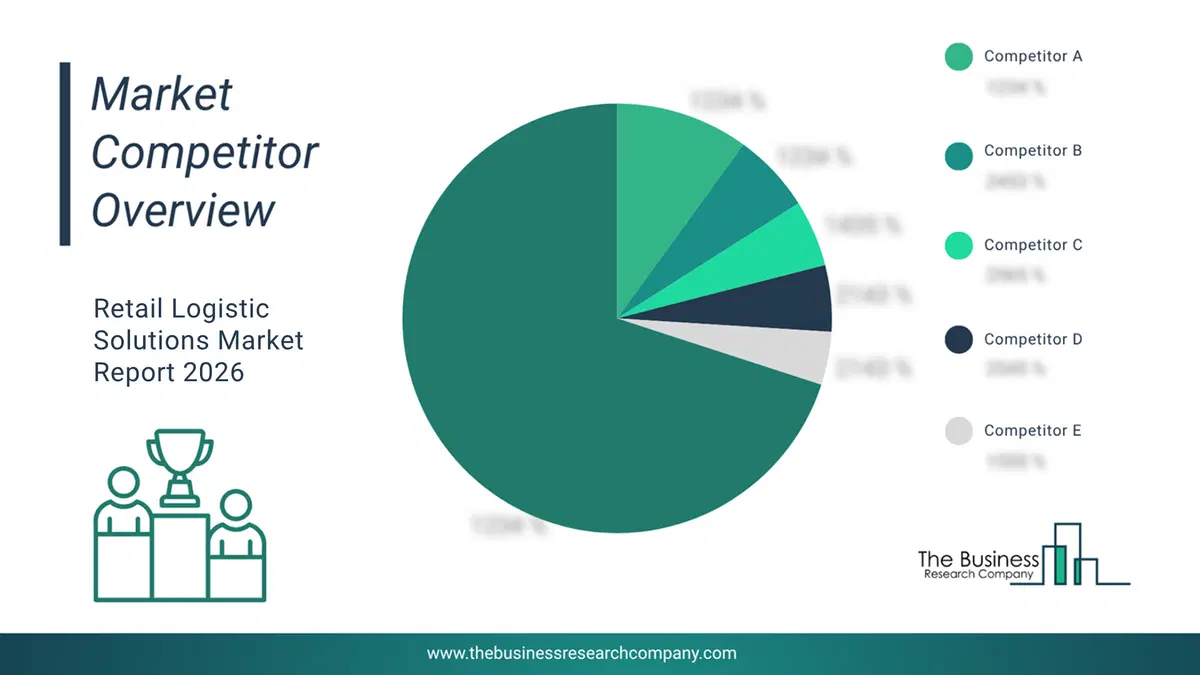
This chart is for illustrative purposes; the full report includes a detailed competitor analysis and comprehensive overview of the top 10 companies in the market.
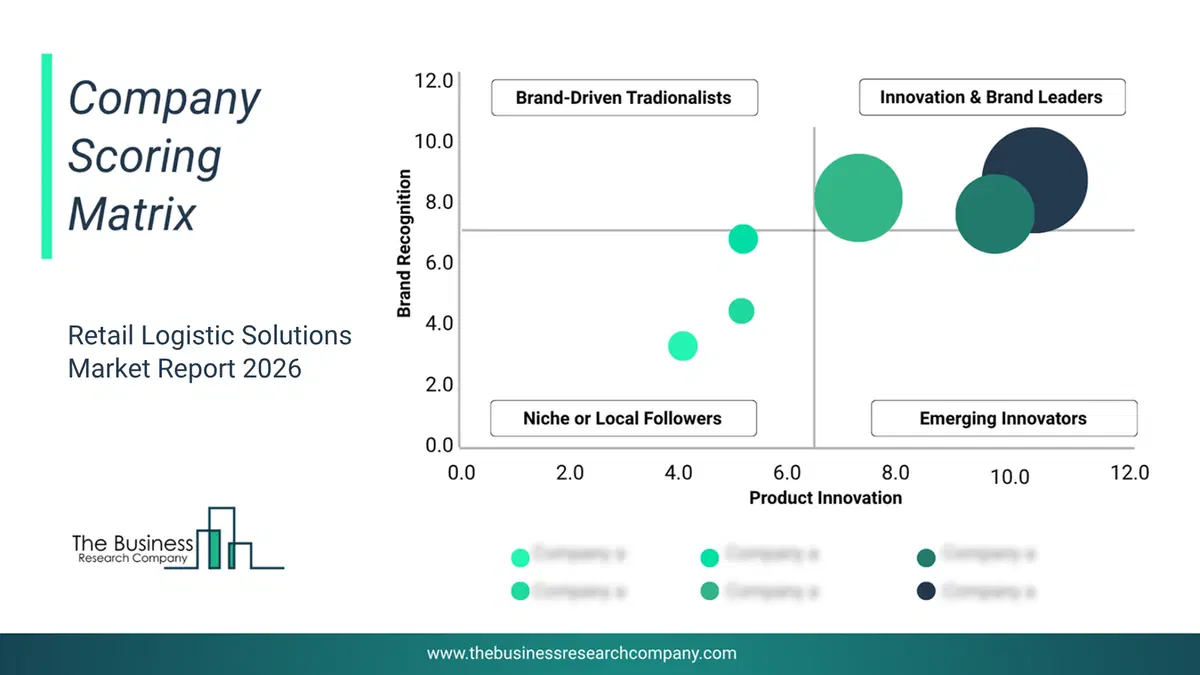
This chart maps companies by product innovation and brand strength, with bubble size indicating relative revenue, helping identify market leaders, challengers, and niche players. This is an illustrative chart; the full report provides a complete and accurate competitive analysis.
Global Retail Logistic Solutions Market Trends and Insights
Major companies operating in the retail logistics solutions market are focusing on developing advanced cloud-based warehouse automation to improve warehouse automation, optimize order fulfillment, enhance operational visibility, and support scalable logistics operations. Cloud-based warehouse automation refers to a digital platform that uses cloud platforms to automate inventory tracking, order processing, and warehouse workflows, enabling real-time visibility, greater efficiency, and scalable operations. For instance, in March 2025, Honeywell International Inc., a US-based industrial automation company, introduced its warehouse execution software (WES) platform. The cloud-based solution enables distribution and fulfillment centers to manage picking, routing, order processing, labor allocation, and capacity planning through a scalable cloud infrastructure. The platform also provides real-time operational insights, supports AI-powered analytics, reduces IT infrastructure costs, and improves warehouse agility by integrating data from robots, scanners, and other automation systems to enhance supply chain performance.What Are Latest Mergers And Acquisitions In The Retail Logistic Solutions Market?
In May 2025, DHL Supply Chain, a Germany-based contract logistics and supply chain management company, acquired IDS Fulfillment for an undisclosed amount. Through this acquisition, DHL Supply Chain expanded its e-commerce fulfillment and retail distribution capabilities across North America, strengthening its warehousing, transportation, and order fulfillment services. IDS Fulfillment is a US-based provider of e-commerce fulfillment and retail distribution logistics services.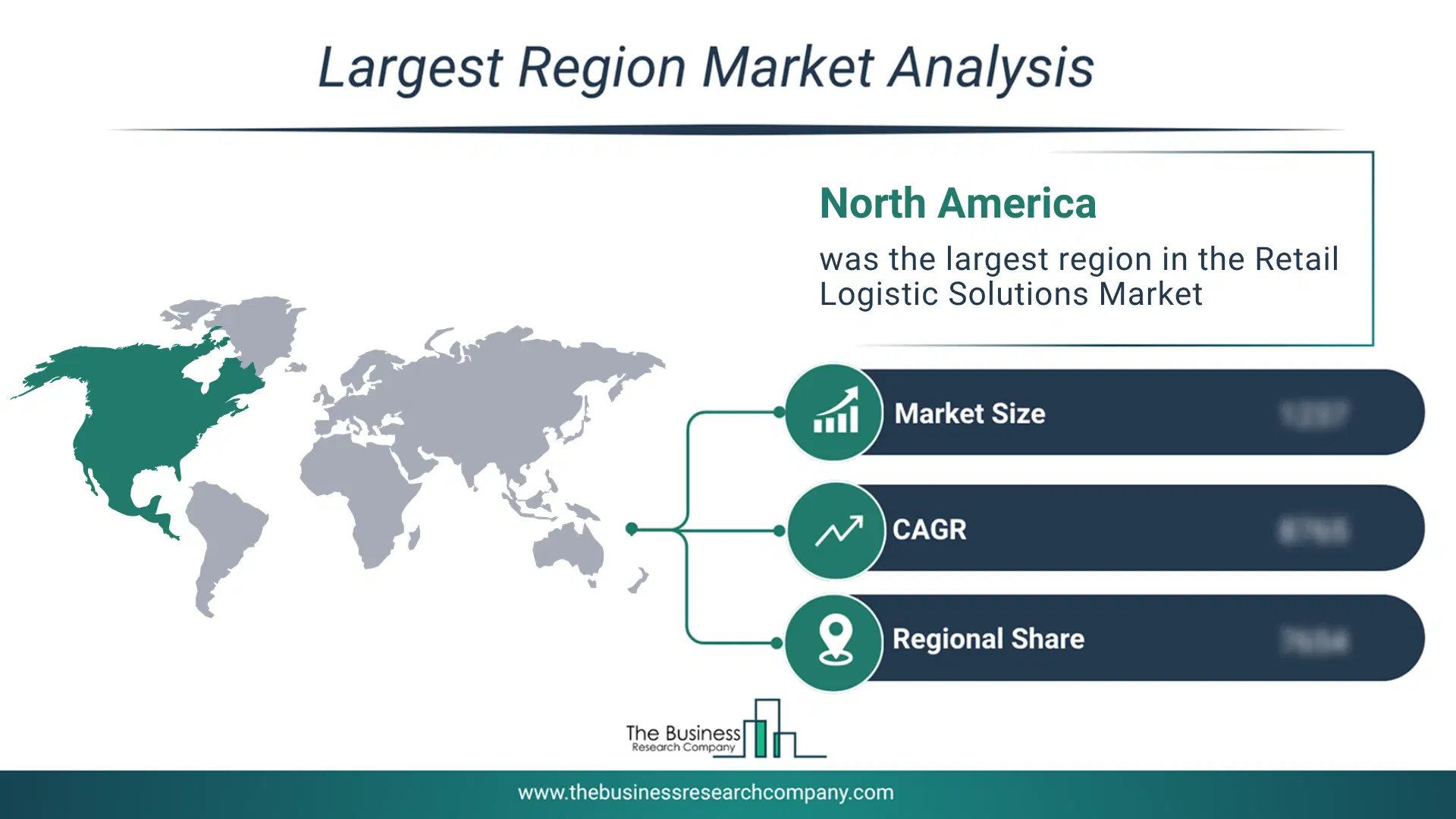
Regional Outlook/Insights
North America was the largest region in the retail logistic solutions market in 2025. Asia-Pacific is expected to be the fastest-growing region in the forecast period. The regions covered in this market report are Asia-Pacific, South East Asia, Western Europe, Eastern Europe, North America, South America, Middle East, Africa. The countries covered in this market report are Australia, Brazil, China, France, Germany, India, Indonesia, Japan, Taiwan, Russia, South Korea, UK, USA, Canada, Italy, Spain.What Defines the Retail Logistic Solutions Market?
The retail logistics solutions market consists of revenues earned by entities by providing services such as reverse logistics, last-mile delivery, freight forwarding, and supply chain consulting. The market value includes the value of related goods sold by the service provider or included within the service offering. The retail logistics solutions market also includes sales of barcode scanners, handheld mobile computers, RFID readers, and automated sorting equipment. Values in this market are ‘factory gate’ values, that is, the value of goods sold by the manufacturers or creators of the goods, whether to other entities (including downstream manufacturers, wholesalers, distributors, and retailers) or directly to end customers. The value of goods in this market includes related services sold by the creators of the goods.How is Market Value Defined and Measured?
The market value is defined as the revenues that enterprises gain from the sale of goods and/or services within the specified market and geography through sales, grants, or donations in terms of the currency (in USD unless otherwise specified). The revenues for a specified geography are consumption values that are revenues generated by organizations in the specified geography within the market, irrespective of where they are produced. It does not include revenues from resales along the supply chain, either further along the supply chain or as part of other products.
This chart presents market attractiveness based on a quantitative evaluation of growth, competition, strategic alignment, and risk, offering a clear view of opportunity areas for decision-making. This chart is for illustrative purposes; the full report contains the complete analysis.

This chart highlights the Total Addressable Market (TAM) by estimating the maximum revenue opportunity using an assumption-driven approach, supporting strategic planning and opportunity sizing across markets. The chart is illustrative; the full report provides a more comprehensive analysis.
What Key Data and Analysis Are Included in the Retail Logistic Solutions Market Report 2026?
The retail logistic solutions market research report is one of a series of new reports from The Business Research Company that provides retail logistic solutions market statistics, including retail logistic solutions industry global market size, regional shares, competitors with a retail logistic solutions market share, detailed retail logistic solutions market segments, market trends and opportunities, and any further data you may need to thrive in the retail logistic solutions industry. This retail logistic solutions market research report delivers a complete perspective of everything you need, with an in-depth analysis of the current and future scenario of the industry.Retail Logistic Solutions Market Report Forecast Analysis
| Report Attribute | Details |
|---|---|
| Market Size Value In 2026 | $195.49 billion |
| Revenue Forecast In 2030 | $268.64 billion |
| Growth Rate | CAGR of 8.3% from 2026 to 2030 |
| Base Year For Estimation | 2025 |
| Actual Estimates/Historical Data | 2020-2025 |
| Forecast Period | 2026 - 2030 |
| Market Representation | Revenue in USD Billion and CAGR from 2026 to 2030 |
| Segments Covered | Solution Type, Mode Of Transport, Technology Integration, End User Industry |
| Regional Scope | Asia-Pacific, Western Europe, Eastern Europe, North America, South America, Middle East, Africa |
| Country Scope | The countries covered in the report are Australia, Brazil, China, France, Germany, India, Indonesia, Japan, Taiwan, Russia, South Korea, UK, USA, Canada, Italy, Spain. |
| Key Companies Profiled | United Parcel Service Inc., FedEx Corporation, DHL Supply Chain, A.P. Møller – Mærsk A/S, Kuehne + Nagel International AG, DSV A/S, C.H. Robinson Worldwide Inc., CEVA Logistics, Nippon Express Holdings Inc., GEODIS SA, J.B. Hunt Transport Services Inc., Ryder System Inc., GXO Logistics Inc., Expeditors International of Washington Inc., XPO Inc., TFI International Inc., DP World, Penske Logistics LLC, FM Logistic Group, Röhlig Logistics GmbH & Co. KG, Fracht Group, USPack Logistics LLC, DCL Logistics Inc., Bergen Logistics LLC, CKB Logistics Group, AmerTrans Logistics Inc. |
| Customization Scope | Request for Customization |
| Pricing And Purchase Options | Explore Purchase Options |