
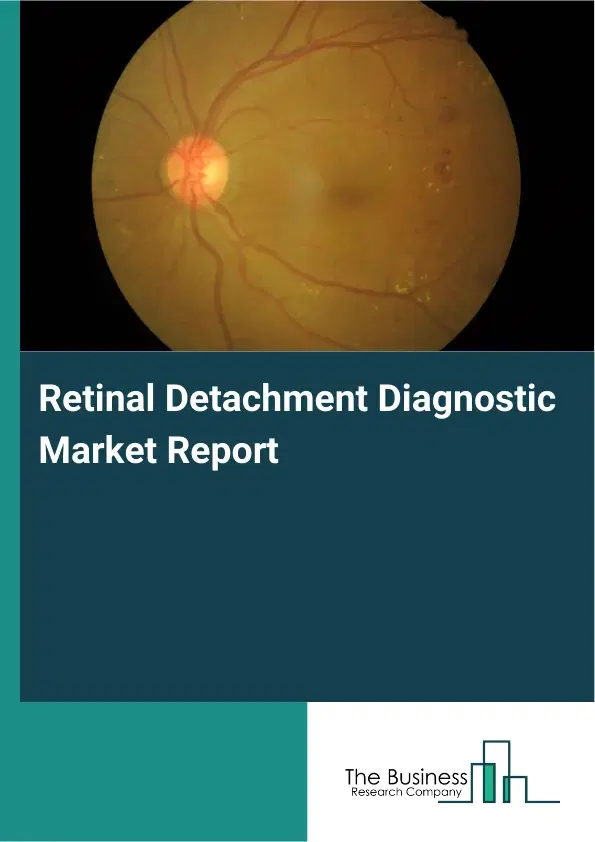
Retinal Detachment Diagnostic Market Report 2026
Global Outlook – By Disease Type (Tractional Retinal Detachment, Rhegmatogenous Retinal Detachment), By Diagnostic Type (Fundus Photography, Ophthalmoscopy, Optical Coherence Tomography Scanners, Fundus Cameras, Ophthalmic Ultrasound Imaging Systems, Ophthalmic A Scan Ultrasound, Ophthalmic B Scan Ultrasound), By Technology (Imaging Based Diagnostics, Non Imaging Clinical Examination, Advanced Digital Ophthalmic Systems), By Application (Vitreo Retinal Disorders, Cataract, Glaucoma, Refractive Disorders), By End Use (Hospitals And Eye Clinics, Academic And Research Laboratories, Other End Uses) – Market Size, Trends, Strategies, and Forecast to 2030
Retinal Detachment Diagnostic Market Overview
• Retinal Detachment Diagnostic market size has reached to $1.42 billion in 2025 • Expected to grow to $2.13 billion in 2030 at a compound annual growth rate (CAGR) of 8.4% • Growth Driver: Growing Incidence Of Myopia And High Myopia Cases Is Fueling The Growth Of The Market Due To Rising Global Prevalence And Increased Risk Of Retinal Complications • Market Trend: Advancements In Ultra-Widefield OCT Imaging For Improved Retinal Detachment Diagnosis • North America was the largest region in 2025 and Asia-Pacific is the fastest growing region.What Is Covered Under Retinal Detachment Diagnostic Market?
Retinal detachment diagnostics refer to the medical tests, imaging techniques, and clinical examinations used to detect, confirm, and assess the severity and extent of separation of the retina from the underlying tissue in the eye. These diagnostics help ophthalmologists identify the type, location, and cause of retinal detachment to guide timely treatment and prevent permanent vision loss. The main disease types of retinal detachment diagnostic are tractional retinal detachment and rhegmatogenous retinal detachment. Tractional retinal detachment refers to a type of retinal detachment caused by fibrous or fibrovascular tissue pulling the retina away from its underlying layer. Diagnostics are performed using various diagnostic types, including fundus photography, ophthalmoscopy, optical coherence tomography scanners, fundus cameras, ophthalmic ultrasound imaging systems, ophthalmic A scan ultrasound, and ophthalmic B scan ultrasound. These solutions utilize different technologies, such as imaging-based diagnostics, non-imaging clinical examination, and advanced digital ophthalmic systems, and are applied across vitreo-retinal disorders, cataract, glaucoma, and refractive disorders. They are used by multiple end-users, including hospitals and eye clinics, academic and research laboratories, and other end uses.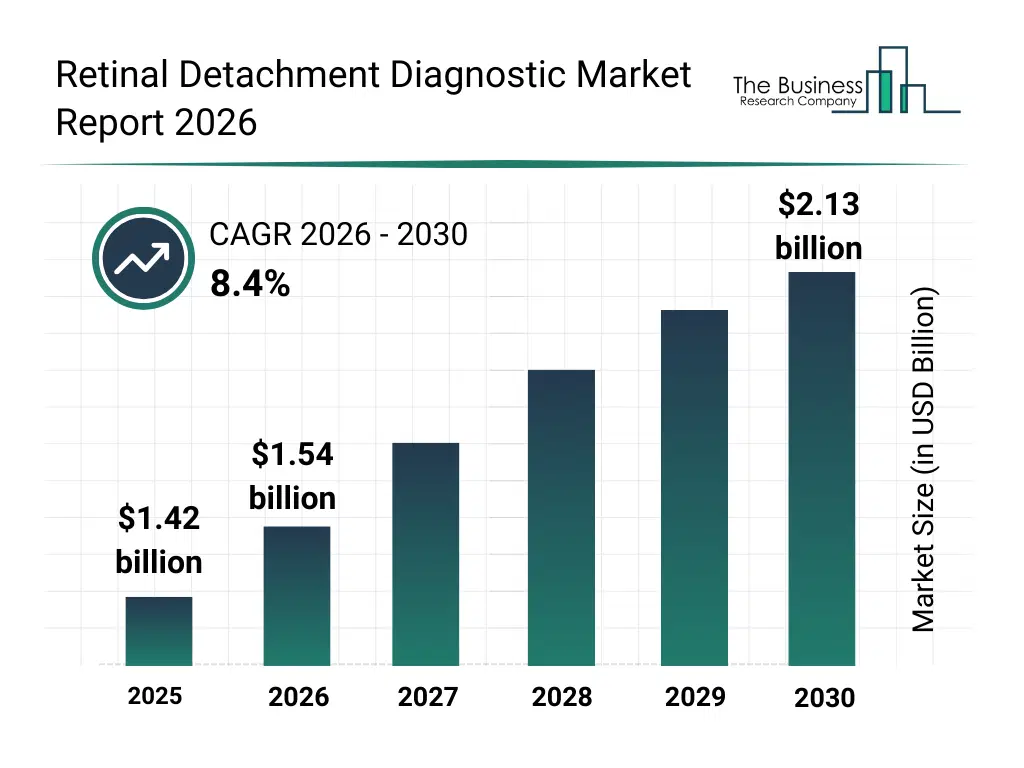
What Is The Retinal Detachment Diagnostic Market Size and Share 2026?
The retinal detachment diagnostic market size has grown strongly in recent years. It will grow from $1.42 billion in 2025 to $1.54 billion in 2026 at a compound annual growth rate (CAGR) of 8.2%. The growth in the historic period can be attributed to increase in diabetic eye disease cases, growth in ophthalmic imaging centers, rising awareness of retinal disorders, expansion of hospital eye clinics, early adoption of oct scanners.What Is The Retinal Detachment Diagnostic Market Growth Forecast?
The retinal detachment diagnostic market size is expected to see strong growth in the next few years. It will grow to $2.13 billion in 2030 at a compound annual growth rate (CAGR) of 8.4%. The growth in the forecast period can be attributed to growing aging population, rising demand for early vision diagnosis, expansion of remote eye screening programs, increasing investment in ophthalmic imaging, higher prevalence of myopia and diabetes. Major trends in the forecast period include rising use of optical coherence tomography imaging, growing adoption of teleophthalmology screening services, expansion of digital fundus photography systems, increasing use of AI assisted retinal image analysis, higher deployment of portable ophthalmic ultrasound devices.
Global Retinal Detachment Diagnostic Market Segmentation
1) By Disease Type: Tractional Retinal Detachment; Rhegmatogenous Retinal Detachment 2) By Diagnostic Type: Fundus Photography; Ophthalmoscopy; Optical Coherence Tomography Scanners; Fundus Cameras; Ophthalmic Ultrasound Imaging Systems; Ophthalmic A Scan Ultrasound; Ophthalmic B Scan Ultrasound 3) By Technology: Imaging Based Diagnostics; Non Imaging Clinical Examination; Advanced Digital Ophthalmic Systems 4) By Application: Vitreo Retinal Disorders; Cataract; Glaucoma; Refractive Disorders 5) By End Use: Hospitals And Eye Clinics; Academic And Research Laboratories; Other End Uses Subsegments: 1) By Tractional Retinal Detachment: Diabetic Tractional Retinal Detachment; Proliferative Vitreoretinopathy Related Tractional Retinal Detachment; Inflammatory Tractional Retinal Detachment; Trauma Induced Tractional Retinal Detachment; Post Surgical Tractional Retinal Detachment; Neovascularization Associated Tractional Retinal Detachment 2) By Rhegmatogenous Retinal Detachment: Superior Break Rhegmatogenous Retinal Detachment; Inferior Break Rhegmatogenous Retinal Detachment; Giant Retinal Tear Related Rhegmatogenous Retinal Detachment; Lattice Degeneration Related Rhegmatogenous Retinal Detachment; Trauma Related Rhegmatogenous Retinal Detachment; Myopic Degeneration Related Rhegmatogenous Retinal Detachment; Post Cataract Surgery Rhegmatogenous Retinal DetachmentWhat Is The Driver Of The Retinal Detachment Diagnostic Market?
The growing incidence of myopia and high myopia cases is expected to propel the growth of the retinal detachment diagnostic market going forward. Myopia and high myopia cases refer to the increasing prevalence of shortsightedness and severe shortsightedness conditions that impair distant vision and raise the risk of serious eye complications. The rise in myopia and high myopia cases due to prolonged screen exposure and reduced outdoor activities is accelerating vision strain, leading to earlier onset and faster progression of refractive errors. The retinal detachment diagnostics support myopia and high myopia cases by enabling early detection of retinal complications, supporting timely clinical intervention, and reducing the risk of severe vision loss. For instance, in July 2025, according to Woo University, a US-based non-profit organization, currently, 30% of the world is myopic, and this is expected to rise to nearly 50% by 2050, affecting around 5 billion people. Therefore, the growing incidence of myopia and high myopia cases is driving the growth of the retinal detachment diagnostic industry.Key Players In The Global Retinal Detachment Diagnostic Market
Major companies operating in the retinal detachment diagnostic market are Canon Inc., Essilor International S.A., NIDEK Co Ltd., Alcon Inc., Nikon Corporation, Kowa Company Ltd., Carl Zeiss Meditec AG, Topcon Corporation, Tomey Corporation, Forus Health Pvt Ltd., Reichert Technologies, Optos plc, Revenio Group, Visionix USA Inc., Haag-Streit Group, Optomed Plc, Remidio Innovative Solutions, Intelligent Retinal Imaging Systems (IRIS), Santec Corporation, and D‑EYE Srl.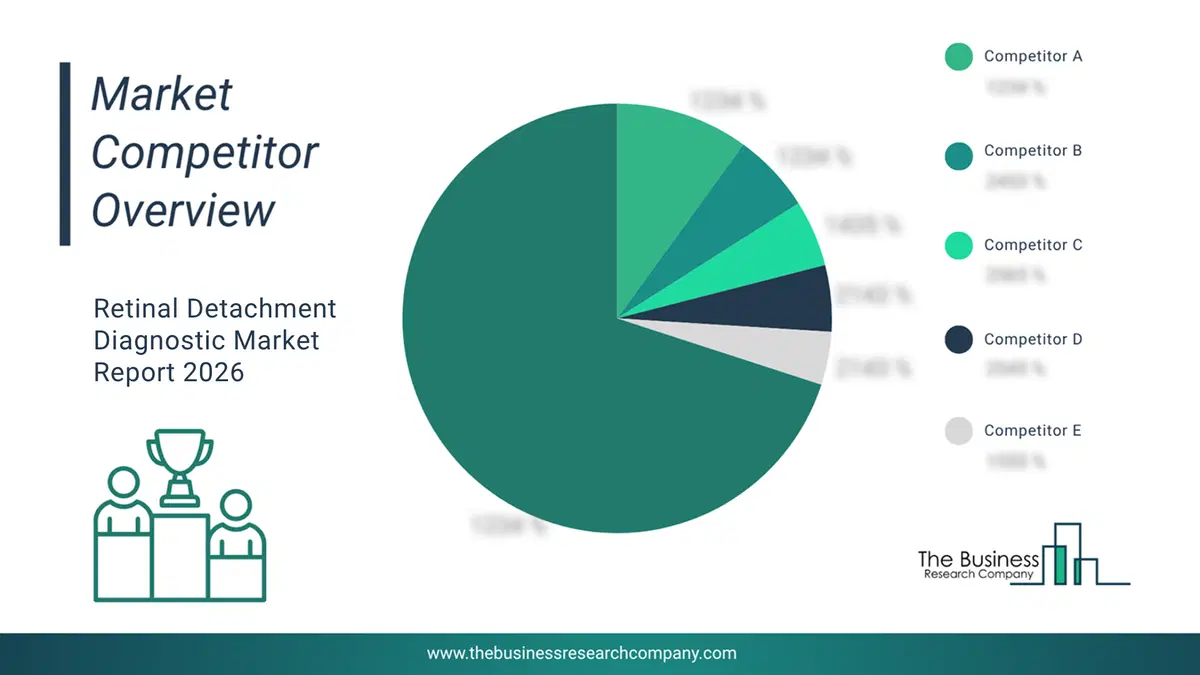
This chart is for illustrative purposes; the full report includes a detailed competitor analysis and comprehensive overview of the top 10 companies in the market.
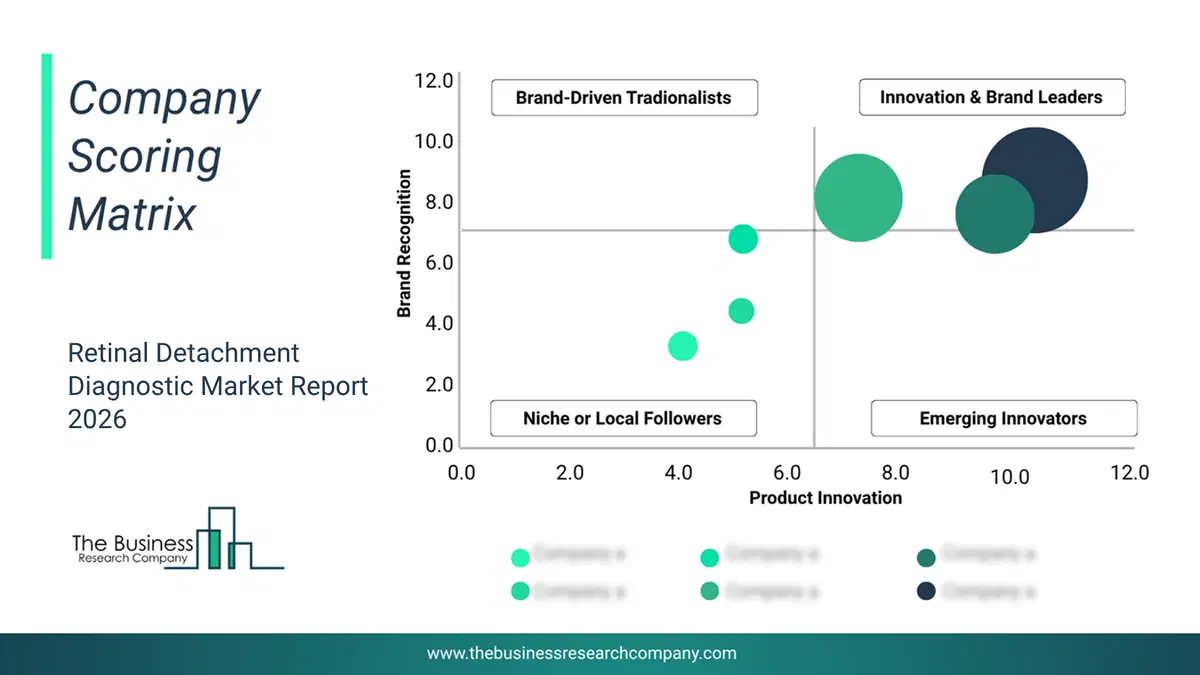
This chart maps companies by product innovation and brand strength, with bubble size indicating relative revenue, helping identify market leaders, challengers, and niche players. This is an illustrative chart; the full report provides a complete and accurate competitive analysis.
Global Retinal Detachment Diagnostic Market Trends and Insights
Major companies operating in the retinal detachment diagnostic market are focusing on developing advanced imaging solutions, such as ultra-widefield optical coherence tomography (OCT), to enhance detection accuracy, improve visualization of the peripheral retina, and support early identification of retinal tears and detachments. Ultra-widefield OCT refers to an imaging technology that captures high-resolution, wide-angle views of the retina, enabling clinicians to detect subtle or peripheral retinal abnormalities that might otherwise be missed. For instance, in March 2025, Optos PLC, a UK-based retinal imaging company, launched MonacoPro, its next-generation ultra-widefield SLO and spectral domain retinal imaging system. Designed to assist eye care professionals with improved diagnostic precision and workflow efficiency, MonacoPro features high-quality OCT imaging, integrated 200° optomap visualization, and the new AreaAssist tool, which automates area measurement and analysis, collectively enhancing clinicians’ ability to detect retinal detachments and other ocular pathologies.What Are Latest Mergers And Acquisitions In The Retinal Detachment Diagnostic Market?
In February 2025, EssilorLuxottica SA, a France-based ophthalmic instruments manufacturing company, acquired Cellview Imaging for an undisclosed amount. Through this acquisition, EssilorLuxottica aims to expand its portfolio of ophthalmic instruments and med-tech solutions by integrating Cellview’s ultra-widefield retinal imaging technology, enhancing early diagnosis of retinal pathologies, and advancing vision health care globally. Cellview Imaging Inc. is a Canada-based company that provides innovative retinal imaging solutions, including retinal detachment diagnostics and ultra-widefield retinal cameras for the early detection of retinal pathologies.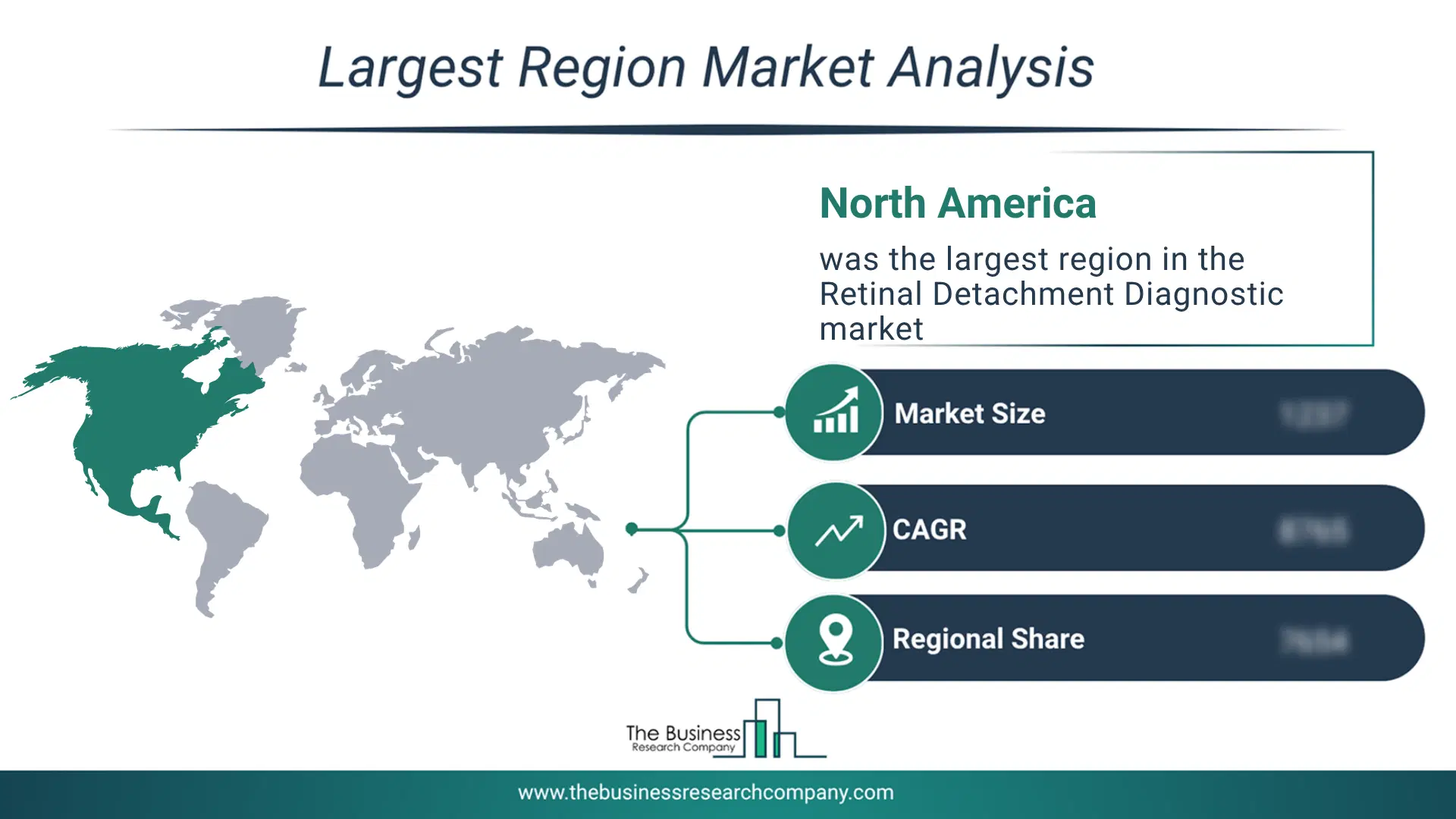
Regional Insights
North America was the largest region in the retinal detachment diagnostic market in 2025. Asia-Pacific is expected to be the fastest-growing region in the forecast period. The regions covered in this market report are Asia-Pacific, South East Asia, Western Europe, Eastern Europe, North America, South America, Middle East, Africa. The countries covered in this market report are Australia, Brazil, China, France, Germany, India, Indonesia, Japan, Taiwan, Russia, South Korea, UK, USA, Canada, Italy, Spain.What Defines the Retinal Detachment Diagnostic Market?
The retinal detachment diagnostic market includes revenues earned by entities through retinal imaging services, optical coherence tomography services, fundus photography services, ophthalmic ultrasound services, diagnostic interpretation services, teleophthalmology services, screening and referral services, and clinical consultation services. The market value includes the value of related goods sold by the service provider or included within the service offering. Only goods and services traded between entities or sold to end consumers are included.How is Market Value Defined and Measured?
The market value is defined as the revenues that enterprises gain from the sale of goods and/or services within the specified market and geography through sales, grants, or donations in terms of the currency (in USD unless otherwise specified). The revenues for a specified geography are consumption values that are revenues generated by organizations in the specified geography within the market, irrespective of where they are produced. It does not include revenues from resales along the supply chain, either further along the supply chain or as part of other products.
This chart presents market attractiveness based on a quantitative evaluation of growth, competition, strategic alignment, and risk, offering a clear view of opportunity areas for decision-making. This chart is for illustrative purposes; the full report contains the complete analysis.

This chart highlights the Total Addressable Market (TAM) by estimating the maximum revenue opportunity using an assumption-driven approach, supporting strategic planning and opportunity sizing across markets. The chart is illustrative; the full report provides a more comprehensive analysis.
What Key Data and Analysis Are Included in the Retinal Detachment Diagnostic Market Report 2026?
The retinal detachment diagnostic market research report is one of a series of new reports from The Business Research Company that provides market statistics, including industry global market size, regional shares, competitors with the market share, detailed market segments, market trends and opportunities, and any further data you may need to thrive in the retinal detachment diagnostic industry. The market research report delivers a complete perspective of everything you need, with an in-depth analysis of the current and future state of the industry.Retinal Detachment Diagnostic Market Report Forecast Analysis
| Report Attribute | Details |
|---|---|
| Market Size Value In 2026 | $1.54 billion |
| Revenue Forecast In 2030 | $2.13 billion |
| Growth Rate | CAGR of 8.4% from 2026 to 2030 |
| Base Year For Estimation | 2025 |
| Actual Estimates/Historical Data | 2020-2025 |
| Forecast Period | 2026 - 2030 |
| Market Representation | Revenue in USD Billion and CAGR from 2026 to 2030 |
| Segments Covered | Disease Type, Diagnostic Type, Technology, Application, End Use |
| Regional Scope | Asia-Pacific, Western Europe, Eastern Europe, North America, South America, Middle East, Africa |
| Country Scope | The countries covered in the report are Australia, Brazil, China, France, Germany, India, Indonesia, Japan, Taiwan, Russia, South Korea, UK, USA, Canada, Italy, Spain |
| Key Companies Profiled | Canon Inc., Essilor International S.A., NIDEK Co Ltd., Alcon Inc., Nikon Corporation, Kowa Company Ltd., Carl Zeiss Meditec AG, Topcon Corporation, Tomey Corporation, Forus Health Pvt Ltd., Reichert Technologies, Optos plc, Revenio Group, Visionix USA Inc., Haag-Streit Group, Optomed Plc, Remidio Innovative Solutions, Intelligent Retinal Imaging Systems (IRIS), Santec Corporation, and D‑EYE Srl. |
| Customization Scope | Request for Customization |
| Pricing And Purchase Options | Explore Purchase Options |