
Retinal Dystrophy Treatment Market Report 2026
Global Outlook – By Treatment Type (Gene Therapy Treatment, Symptomatic Treatment, Retinal Implants, Stem Cell Therapy, Drug Therapy), By Disease Type (Retinitis Pigmentosa, Leber Congenital Amaurosis, Stargardt Disease, Cone Rod Dystrophy, Other Inherited Retinal Dystrophies), By Route Of Administration (Intravitreal Injection, Subretinal Injection, Oral Administration, Topical Administration, Implantable Delivery Systems), By End User (Hospitals, Specialty Clinics, Research Institutes, Ambulatory Surgical Centers) – Market Size, Trends, Strategies, and Forecast to 2030
Retinal Dystrophy Treatment Market Report 2026 Market Overview
• Retinal Dystrophy Treatment Market Report 2026 market size has reached to $12.55 billion in 2025 • Expected to grow to $21.41 billion in 2030 at a compound annual growth rate (CAGR) of 11.3% • Growth Driver: Increasing Adoption Of Precision And Personalized Medicine Approaches Fueling The Growth Of The Market Due To Rising Demand For Targeted Genetic Therapies For Inherited Retinal Diseases • Market Trend: AAV-Based Gene Therapies Advance Precision Treatment For Inherited Retinal Dystrophies • North America was the largest region in 2025 and Asia-Pacific is the fastest growing region.What Is Covered Under Retinal Dystrophy Treatment Market?
Retinal dystrophy treatment refers to therapies and medical interventions used to manage inherited retinal disorders that cause progressive degeneration of the retina and vision loss. The purpose of retinal dystrophy treatment is to slow disease progression, preserve remaining vision, restore visual function where possible, and improve patients' quality of life. The main treatment types of retinal dystrophy treatment include gene therapy treatment, symptomatic treatment, retinal implants, stem cell therapy, and drug therapy. Gene therapy treatment refers to advanced therapeutic approaches designed to correct or replace defective genes associated with inherited retinal disorders. These treatments are used for disease types including retinitis pigmentosa, Leber congenital amaurosis, Stargardt disease, cone rod dystrophy, and other inherited retinal dystrophies. They are administered through routes such as intravitreal injection, subretinal injection, oral administration, topical administration, and implantable delivery systems, while the end-users hospitals, specialty clinics, research institutes, and ambulatory surgical centers.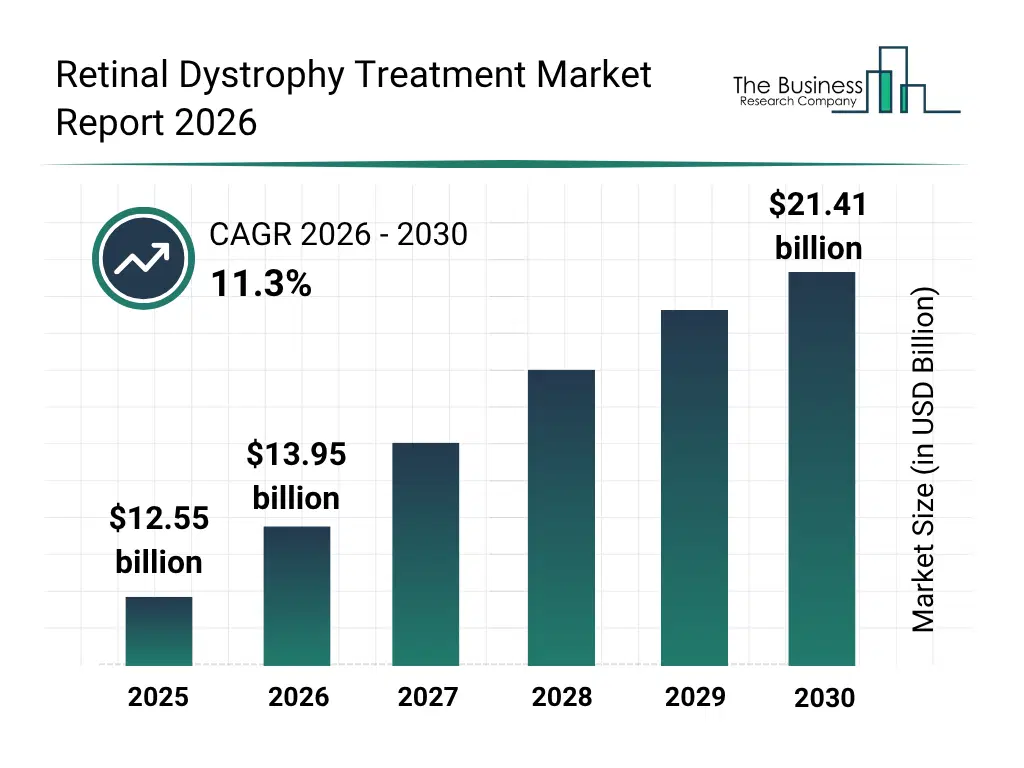
What Is The Retinal Dystrophy Treatment Market Size and Share 2026?
The retinal dystrophy treatment market size has grown rapidly in recent years. It will grow from $12.55 billion in 2025 to $13.95 billion in 2026 at a compound annual growth rate (CAGR) of 11.1%. The growth in the historic period can be attributed to increasing prevalence of inherited retinal disorders, growing adoption of symptomatic vision supportive therapies, expansion of ophthalmology specialty care centers, rising awareness of rare genetic eye diseases, development of early retinal imaging diagnostic tools.What Is The Retinal Dystrophy Treatment Market Growth Forecast?
The retinal dystrophy treatment market size is expected to see rapid growth in the next few years. It will grow to $21.41 billion in 2030 at a compound annual growth rate (CAGR) of 11.3%. The growth in the forecast period can be attributed to rising adoption of gene therapy and regenerative medicine approaches, increasing investment in precision ophthalmology and genomic diagnostics, expansion of AI driven early detection and monitoring systems, growth in clinical trials for retinal implant technologies, increasing demand for personalized and long duration treatment solutions. Major trends in the forecast period include ai-assisted retinal imaging and early diagnosis of retinal dystrophies enabling precision intervention planning, expansion of gene editing based therapies targeting inherited retinal degeneration pathways, development of next-generation retinal organoid and stem cell derived tissue regeneration approaches, increasing adoption of sustained release intravitreal drug delivery systems for long term disease management, growth of personalized precision medicine approaches based on genomic profiling of retinal disorders.
Global Retinal Dystrophy Treatment Market Segmentation
1) By Treatment Type: Gene Therapy Treatment, Symptomatic Treatment, Retinal Implants, Stem Cell Therapy, Drug Therapy 2) By Disease Type: Retinitis Pigmentosa, Leber Congenital Amaurosis, Stargardt Disease, Cone Rod Dystrophy, Other Inherited Retinal Dystrophies 3) By Route Of Administration: Intravitreal Injection, Subretinal Injection, Oral Administration, Topical Administration, Implantable Delivery Systems 4) By End User: Hospitals, Specialty Clinics, Research Institutes, Ambulatory Surgical Centers Subsegments: 1) By Gene Therapy Treatment: Viral Vector Gene Therapy, Non Viral Gene Therapy, In Vivo Gene Therapy, Ex Vivo Gene Therapy 2) By Symptomatic Treatment: Vision Supportive Care, Anti Inflammatory Treatment, Nutritional Supplement Treatment, Laser Symptomatic Treatment 3) By Retinal Implants: Epiretinal Implant, Subretinal Implant, Suprachoroidal Implant, Bionic Eye Implant 4) By Stem Cell Therapy: Embryonic Stem Cell Therapy, Induced Pluripotent Stem Cell Therapy, Mesenchymal Stem Cell Therapy, Retinal Progenitor Cell Therapy 5) By Drug Therapy: Anti Vascular Endothelial Growth Factor Drug Therapy, Corticosteroid Drug Therapy, Neuroprotective Drug Therapy, Immunomodulatory Drug TherapyWhat Is The Driver Of The Retinal Dystrophy Treatment Market?
The increasing adoption of precision and personalized medicine approaches is expected to propel the growth of the retinal dystrophy treatment market going forward. Precision and personalized medicine refers to medical treatment strategies tailored to individual patient genetic profiles and molecular disease characteristics, enabling ophthalmologists to select the most appropriate interventions based on confirmed genetic diagnoses and disease pathologies. Increasing adoption of precision and personalized medicine approaches is driven by advancements in genetic testing, which enable the identification of specific disease-causing mutations in individual patients. Retinal dystrophy treatments are used in precision and personalized medicine to target specific genetic mutations causing inherited retinal diseases, enabling tailored therapies that improve treatment effectiveness and visual outcomes. For instance, in February 2024, Personalized Medicine Coalition, a US-based non-profit organization, reported that in 2023, the FDA approved 16 new personalized treatments for patients with rare diseases, a significant increase from the six approved in 2022. Therefore, the increasing adoption of precision and personalized medicine approaches is driving the growth of the retinal dystrophy treatment industry.Key Players In The Global Retinal Dystrophy Treatment Market
Major companies operating in the retinal dystrophy treatment market report are AAVantgarde Bio S.r.l., Aldeyra Therapeutics Inc., AviadoBio Limited, Beacon Therapeutics Limited, Coave Therapeutics SAS, EyeStem Research Private Limited, GenSight Biologics S.A., Johnson & Johnson, MeiraGTx Holdings plc, Novartis AG, Nanoscope Therapeutics Inc., Ocugen Inc., Opus Genetics Inc., Pfizer Inc., ProQR Therapeutics N.V., PYC Therapeutics Limited, Ray Therapeutics Inc., REGENXBIO Inc., Regeneron Pharmaceuticals Inc., Roche Holding AG, SparingVision SAS, VeonGen Therapeutics Inc.
This chart is for illustrative purposes; the full report includes a detailed competitor analysis and comprehensive overview of the top 10 companies in the market.
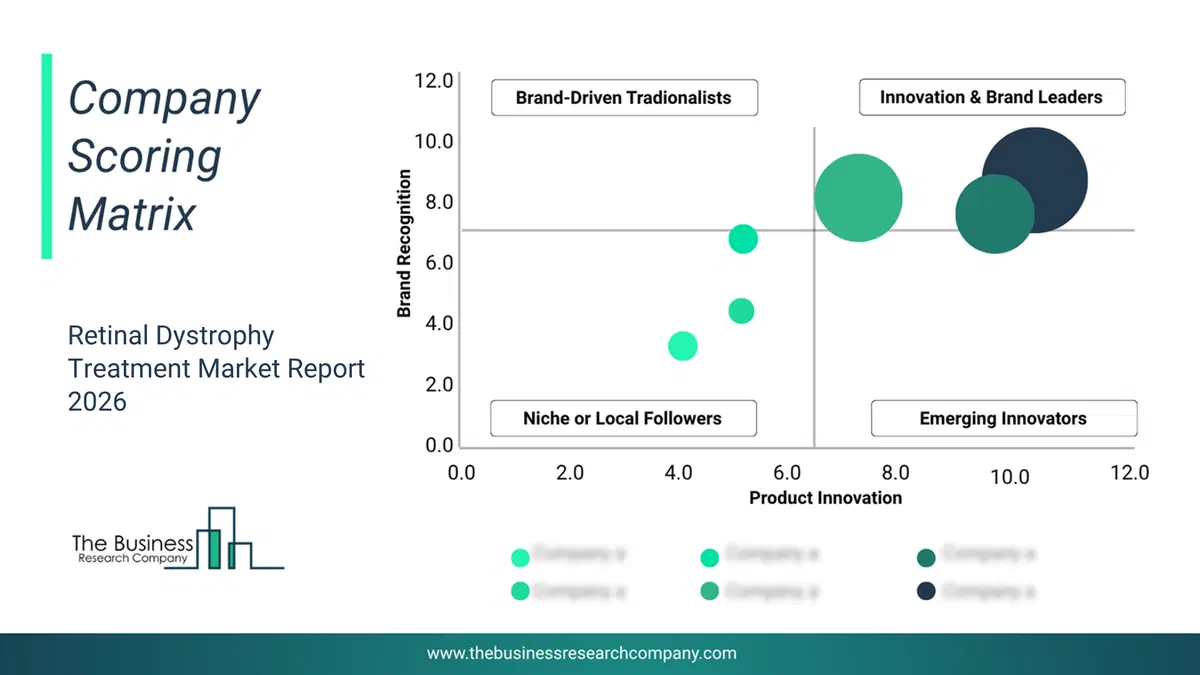
This chart maps companies by product innovation and brand strength, with bubble size indicating relative revenue, helping identify market leaders, challengers, and niche players. This is an illustrative chart; the full report provides a complete and accurate competitive analysis.
Global Retinal Dystrophy Treatment Market Trends and Insights
Major companies operating in the retinal dystrophy treatment market are focusing on developing advanced gene therapy solutions, such as adeno-associated virus (AAV)-based gene therapies, to address the underlying genetic causes of inherited retinal diseases, improve visual outcomes, and expand treatment options for patients with rare forms of blindness. AAV-based gene therapy refers to a therapeutic approach that uses adeno-associated viral vectors to deliver functional genes into retinal cells, helping restore or preserve vision by correcting disease-causing genetic mutations. For instance, in January 2023, HuidaGene Therapeutics, a China-based genetic medicine company, announced that the U.S. Food and Drug Administration (FDA) had cleared the Investigational New Drug (IND) application for HG004, enabling the initiation of a multinational clinical trial. HG004 is an AAV-based gene therapy designed to treat RPE65 mutation-associated inherited retinal dystrophies, including Leber congenital amaurosis and retinitis pigmentosa. The therapy aims to restore retinal function by delivering a functional copy of the RPE65 gene, supporting vision preservation and advancing the development of targeted genetic treatments for inherited blindness.What Are Latest Mergers And Acquisitions In The Retinal Dystrophy Treatment Market?
In November 2025, MeiraGTx Limited, a UK-based genetic medicines company, entered into a strategic collaboration with Eli Lilly and Company to develop and commercialize AAV-AIPL1, an investigational gene therapy for AIPL1-associated Leber congenital amaurosis (LCA4), a severe inherited retinal dystrophy. AAV-AIPL1 is designed to address the underlying genetic cause of the disease through adeno-associated virus (AAV)-mediated gene replacement and has demonstrated the potential to restore retinal function in preclinical and clinical studies. The collaboration also includes access to MeiraGTx’s proprietary manufacturing capabilities and supports the advancement of innovative genetic medicines for inherited retinal diseases, strengthening the development pipeline within the retinal dystrophy treatment market. Eli Lilly and Company is a US-based pharmaceutical company engaged in the discovery, development, manufacturing, and commercialization of medicines.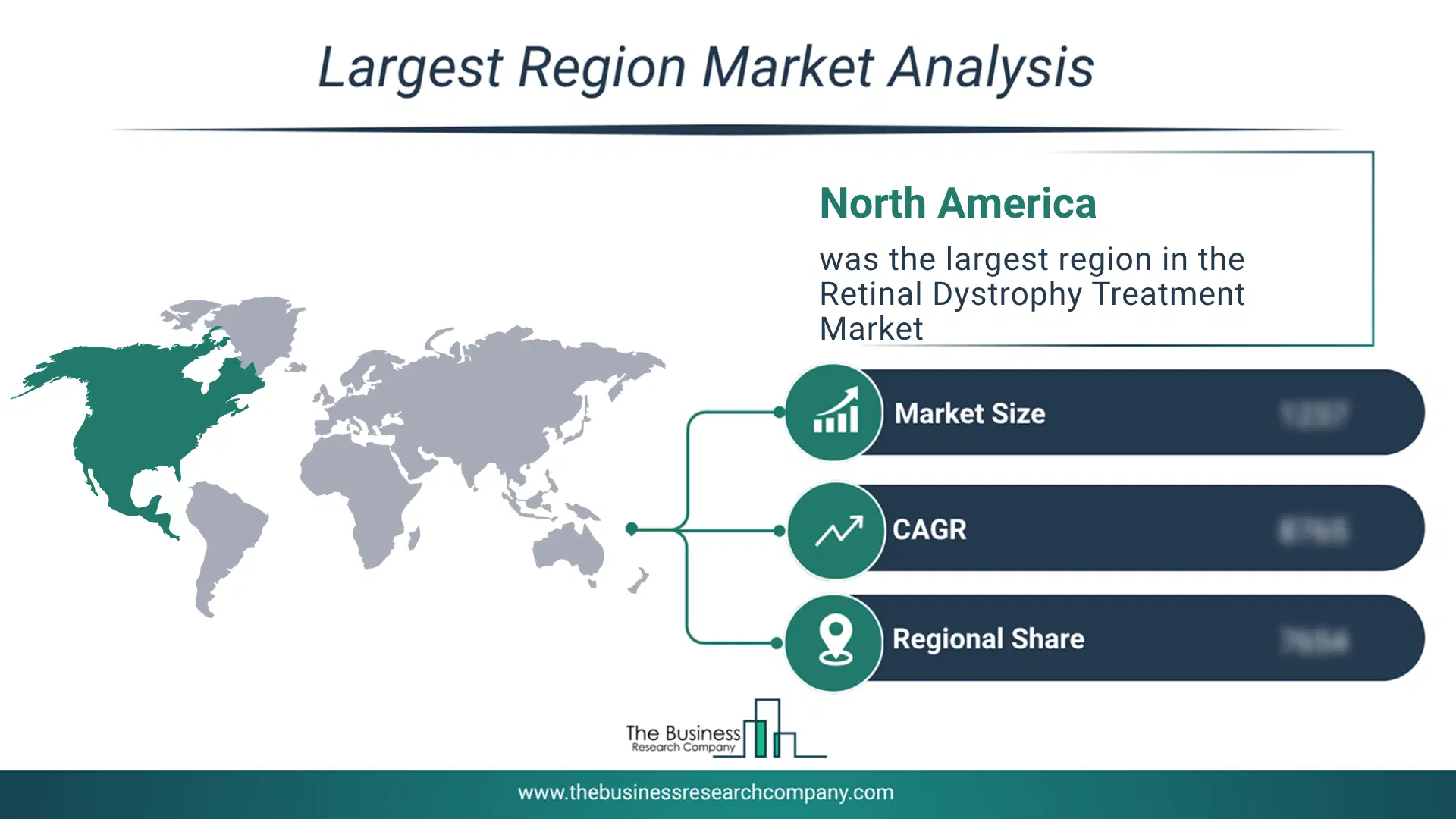
Regional Outlook
North America was the largest region in the retinal dystrophy treatment market in 2025. Asia-Pacific is expected to be the fastest-growing region in the forecast period. The regions covered in this market report are Asia-Pacific, South East Asia, Western Europe, Eastern Europe, North America, South America, Middle East, Africa. The countries covered in this market report are Australia, Brazil, China, France, Germany, India, Indonesia, Japan, Taiwan, Russia, South Korea, UK, USA, Canada, Italy, Spain.What Defines the Retinal Dystrophy Treatment Market?
The retinal dystrophy treatment market consists of revenues earned by entities by providing services such as subretinal surgical delivery services, clinical trial recruitment and enrollment services, patient monitoring, vision function assessment services, and low-vision rehabilitation services. The market value includes the value of related goods sold by the service provider or included within the service offering. The retinal dystrophy treatment market also includes sales of neuroprotective drugs, small-molecule retinal disease therapeutics, retinal prostheses, and subretinal drug delivery systems. Values in this market are ‘factory gate’ values, that is the value of goods sold by the manufacturers or creators of the goods, whether to other entities (including downstream manufacturers, wholesalers, distributors and retailers) or directly to end customers. The value of goods in this market includes related services sold by the creators of the goods.How is Market Value Defined and Measured?
The market value is defined as the revenues that enterprises gain from the sale of goods and/or services within the specified market and geography through sales, grants, or donations in terms of the currency (in USD unless otherwise specified). The revenues for a specified geography are consumption values that are revenues generated by organizations in the specified geography within the market, irrespective of where they are produced. It does not include revenues from resales along the supply chain, either further along the supply chain or as part of other products.
This chart presents market attractiveness based on a quantitative evaluation of growth, competition, strategic alignment, and risk, offering a clear view of opportunity areas for decision-making. This chart is for illustrative purposes; the full report contains the complete analysis.

This chart highlights the Total Addressable Market (TAM) by estimating the maximum revenue opportunity using an assumption-driven approach, supporting strategic planning and opportunity sizing across markets. The chart is illustrative; the full report provides a more comprehensive analysis.
What Key Data and Analysis Are Included in the Retinal Dystrophy Treatment Market Report 2026?
The retinal dystrophy treatment market research report is one of a series of new reports from The Business Research Company that provides market statistics, including industry global market size, regional shares, competitors with the market share, detailed market segments, market trends and opportunities, and any further data you may need to thrive in the retinal dystrophy treatment industry. The market research report delivers a complete perspective of everything you need, with an in-depth analysis of the current and future state of the industry.Retinal Dystrophy Treatment Market Report Forecast Analysis
| Report Attribute | Details |
|---|---|
| Market Size Value In 2026 | $13.95 billion |
| Revenue Forecast In 2030 | $21.41 billion |
| Growth Rate | CAGR of 11.3% from 2026 to 2030 |
| Base Year For Estimation | 2025 |
| Actual Estimates/Historical Data | 2020-2025 |
| Forecast Period | 2026 - 2030 |
| Market Representation | Revenue in USD Billion and CAGR from 2026 to 2030 |
| Segments Covered | Treatment Type, Disease Type, Route Of Administration, End User |
| Regional Scope | Asia-Pacific, Western Europe, Eastern Europe, North America, South America, Middle East, Africa |
| Country Scope | The countries covered in the report are Australia, Brazil, China, France, Germany, India, Indonesia, Japan, Taiwan, Russia, South Korea, UK, USA, Canada, Italy, Spain. |
| Key Companies Profiled | AAVantgarde Bio S.r.l., Aldeyra Therapeutics Inc., AviadoBio Limited, Beacon Therapeutics Limited, Coave Therapeutics SAS, EyeStem Research Private Limited, GenSight Biologics S.A., Johnson & Johnson, MeiraGTx Holdings plc, Novartis AG, Nanoscope Therapeutics Inc., Ocugen Inc., Opus Genetics Inc., Pfizer Inc., ProQR Therapeutics N.V., PYC Therapeutics Limited, Ray Therapeutics Inc., REGENXBIO Inc., Regeneron Pharmaceuticals Inc., Roche Holding AG, SparingVision SAS, VeonGen Therapeutics Inc. |
| Customization Scope | Request for Customization |
| Pricing And Purchase Options | Explore Purchase Options |