
Return Freight Insurance Market Report 2026
Global Outlook – By Coverage Type (All Risks, Named Perils, Limited Coverage), By Mode Of Transportation (Air Freight, Sea Freight, Road Freight, Rail Freight), By Customer Type (Individual Shippers, Small And Medium Enterprises, Large Corporations, Freight Forwarders), By Policy Term (Short Term Policies, Long Term Policies, Permanent Policies), By End User (Manufacturing, E Commerce, Retail, Pharmaceuticals, Automotive) – Market Size, Trends, Strategies, and Forecast to 2030
Return Freight Insurance Market Overview
• Return Freight Insurance market size has reached to $2.13 billion in 2025 • Expected to grow to $3.38 billion in 2030 at a compound annual growth rate (CAGR) of 9.6% • Growth Driver: Surge In E-Commerce And Online Distribution Channels Fueling The Growth Of The Market Due To Enhanced Product Accessibility And Efficient Procurement Solutions • Market Trend: Strategic Partnerships Accelerate Automated Return Shipping Reimbursement And Enhance Customer Experience In E-Commerce • North America was the largest region in 2025 and Asia-Pacific is the fastest growing region.What Is Covered Under Return Freight Insurance Market?
Return freight insurance is a protection service that covers the financial risks associated with the return transportation of goods due to damage, defects, delivery issues, or other unforeseen circumstances. It helps businesses and individuals recover costs related to shipping returned items, including transportation expenses and associated handling charges. Return freight insurance improves financial security, supports efficient reverse logistics, and reduces losses arising from product returns. The main coverage types of return freight insurance include all risks, named perils, and limited coverage. All risks refers to comprehensive insurance coverage that protects shipments against a wide range of potential losses, damages, or risks during the return transportation process. These insurance policies are available across transportation modes including air freight, sea freight, road freight, and rail freight and are offered to customer types such as individual shippers, small and medium enterprises, large corporations, and freight forwarders. They are provided through policy terms including short term policies, long term policies, and permanent policies and are utilized by end users including manufacturing, e commerce, retail, pharmaceuticals, and automotive.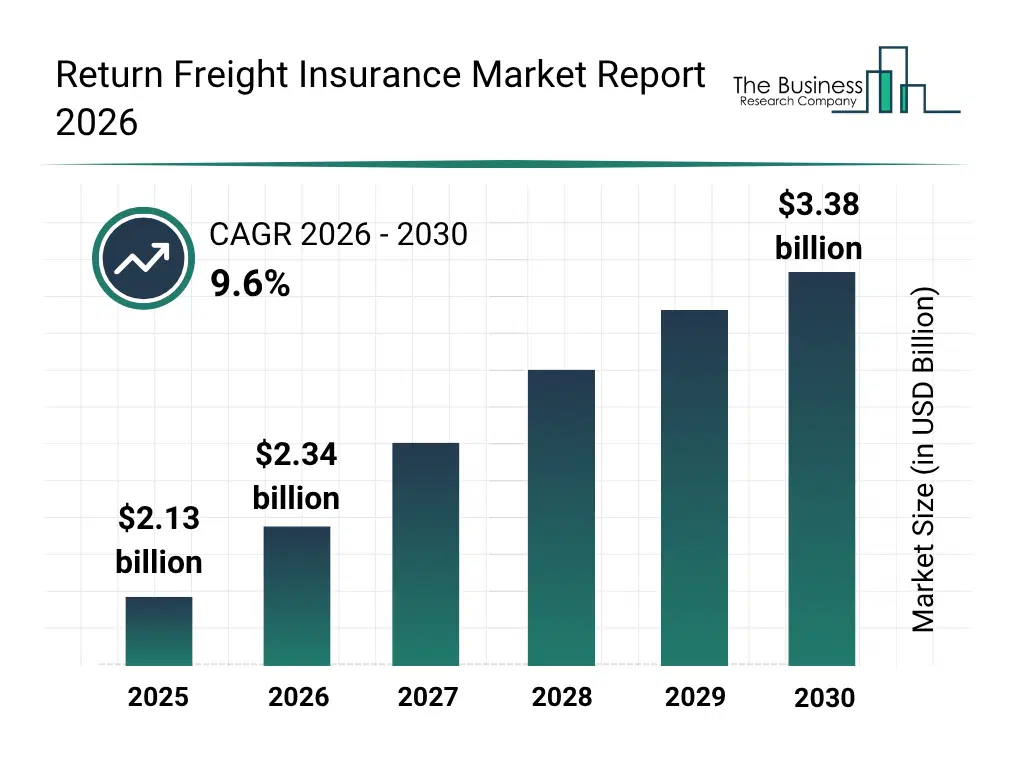
What Is The Return Freight Insurance Market Size and Share 2026?
The return freight insurance market size has grown rapidly in recent years. It will grow from $2.13 billion in 2025 to $2.34 billion in 2026 at a compound annual growth rate (CAGR) of 10.0%. The growth in the historic period can be attributed to growing e commerce product returns, increasing international trade activities, rising demand for cargo risk protection, expanding reverse logistics operations, increasing awareness of shipping loss recovery.What Is The Return Freight Insurance Market Growth Forecast?
The return freight insurance market size is expected to see strong growth in the next few years. It will grow to $3.38 billion in 2030 at a compound annual growth rate (CAGR) of 9.6%. The growth in the forecast period can be attributed to growing demand for return freight insurance services, rising cross border e commerce shipments, increasing investments in reverse logistics infrastructure, expanding adoption of comprehensive cargo protection solutions, growing need for cost effective return management. Major trends in the forecast period include increasing adoption of comprehensive return freight protection services, growing demand for reverse logistics risk management solutions, rising integration of return freight insurance with e commerce fulfillment services, expanding coverage for cross border product return shipments, increasing focus on cost efficient product return management.
Global Return Freight Insurance Market Segmentation
2) By Mode Of Transportation: Air Freight, Sea Freight, Road Freight, Rail Freight 3) By Customer Type: Individual Shippers, Small And Medium Enterprises, Large Corporations, Freight Forwarders 4) By Policy Term: Short Term Policies, Long Term Policies, Permanent Policies 5) By End User: Manufacturing, E Commerce, Retail, Pharmaceuticals, Automotive Subsegments: 1) By All Risks: Comprehensive Cargo Damage Coverage, Theft And Loss Coverage, Natural Disaster Coverage, Accidental Damage Coverage 2) By Named Perils: Fire Damage Coverage, Collision Damage Coverage, Storm And Flood Coverage, Loading And Unloading Damage Coverage 3) By Limited Coverage: Partial Loss Coverage, Basic Transit Damage Coverage, Restricted Value Coverage, Deductible Based CoverageWhat Are The Drivers Of The Return Freight Insurance Market?
The expansion of e-commerce and online distribution channels is expected to propel the growth of the return freight insurance market going forward. E-commerce and online distribution channels refer to digital platforms and web-based retail networks that enable manufacturers, businesses, and consumers to purchase products through online marketplaces, company websites, and business-to-business procurement portals. The rapid growth of e-commerce is driven by increasing internet penetration, which enables wider access to online shopping platforms and convenient digital transactions across diverse consumer segments. Return freight insurance supports e-commerce activities by covering the cost and risk associated with product returns during transit, thereby enabling smoother reverse logistics. For instance, in February 2025, according to the United States Census Bureau, a US-based government agency, retail e-commerce sales in the United States reached $308.9 billion in the fourth quarter of 2024, reflecting a 9.4% increase compared to the same period in 2023. Therefore, the expansion of e-commerce and online distribution channels is driving the growth of the return freight insurance industry. The rising cross-border trade is expected to propel the growth of the return freight insurance market going forward. Cross-border trade refers to the movement of goods and services across international borders between businesses or consumers in different countries. The expansion of cross-border trade is largely driven by the rapid growth of e-commerce, as online platforms enable businesses to reach global customers, significantly increasing the volume of international shipments that require transit protection. As the volume of goods transported across borders rises, businesses face greater exposure to risks such as loss, damage, or theft during transit, directly boosting demand for return freight insurance to safeguard shipments and ensure financial protection throughout the supply chain. For instance, in September 2025, according to the Office for National Statistics, a UK-based government department, UK payments made to foreign investors increased by £5.6 billion (approximately $7.47 billion) from the previous quarter, reaching £111.7 billion (approximately $148.96 billion) in Quarter second of 2025. Therefore, rising cross-border trade is driving the growth of the return freight insurance industry.Key Players In The Global Return Freight Insurance Market
Major companies operating in the return freight insurance market are Allianz SE, American International Group Inc., Aon plc, Arch Capital Group Limited, Assicurazioni Generali S.p.A., Assurant Inc., AXA XL Insurance Company UK Limited, Beazley plc, Berkshire Hathaway Specialty Insurance Company, Chubb Limited, HDI Global SE, Hiscox Ltd, Liberty Mutual Insurance Company, Marsh & McLennan Companies Inc., Munich Reinsurance Company, QBE Insurance Group Limited, Sompo Holdings Inc., Tokio Marine Kiln Insurance Limited, The Travelers Companies Inc., Zurich Insurance Group Ltd
This chart is for illustrative purposes; the full report includes a detailed competitor analysis and comprehensive overview of the top 10 companies in the market.
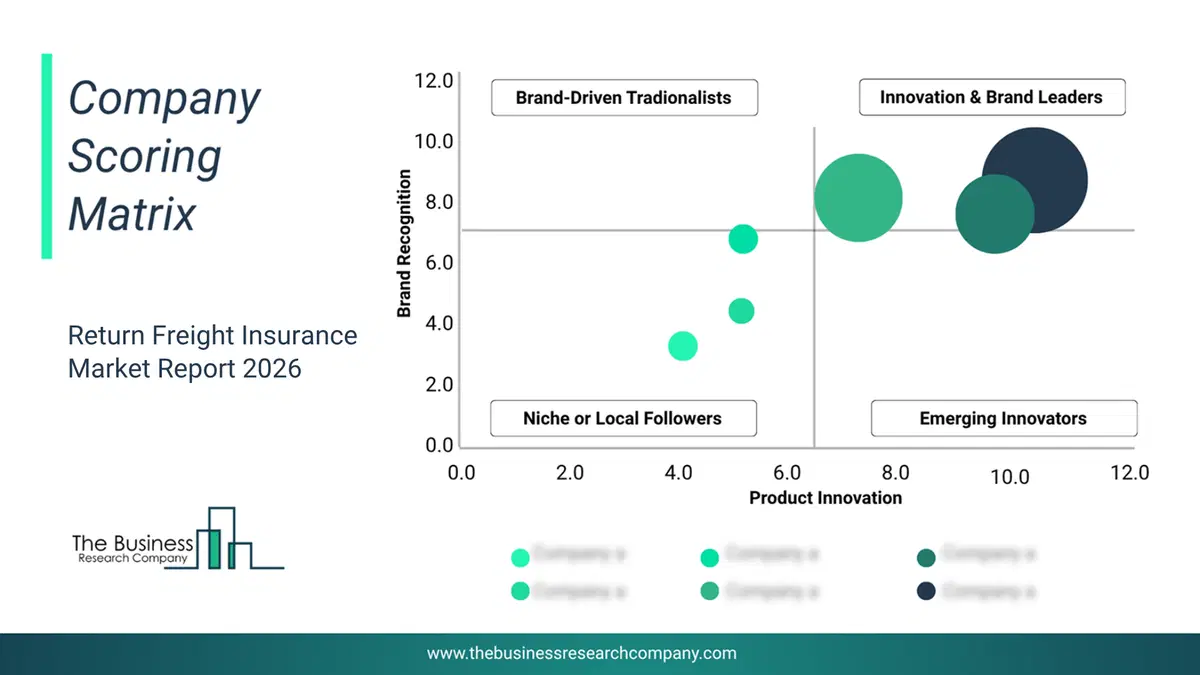
This chart maps companies by product innovation and brand strength, with bubble size indicating relative revenue, helping identify market leaders, challengers, and niche players. This is an illustrative chart; the full report provides a complete and accurate competitive analysis.
Global Return Freight Insurance Market Trends and Insights
Major companies operating in the return freight insurance market are focusing on adopting strategic partnerships to eliminate manual processing and instantly reimburse cardholders for return postage costs. Strategic partnerships are alliances between organizations that leverage shared resources, expertise, and technologies to drive innovation, expand market presence, and enhance competitive advantage. For instance, in November 2024, Mastercard, a US-based financial services company, partnered with Qover, a Belgium-based insurtech company specializing in embedded insurance solutions, to launch an automated return shipping reimbursement service. This service covers return shipping costs up to thirty euros per occurrence when retailers do not offer free returns. The AI platform processes claims automatically, requiring no manual document review from cardholders. The service offers a maximum coverage of ninety euros annually across three separate claims, providing predictable protection for frequent online shoppers.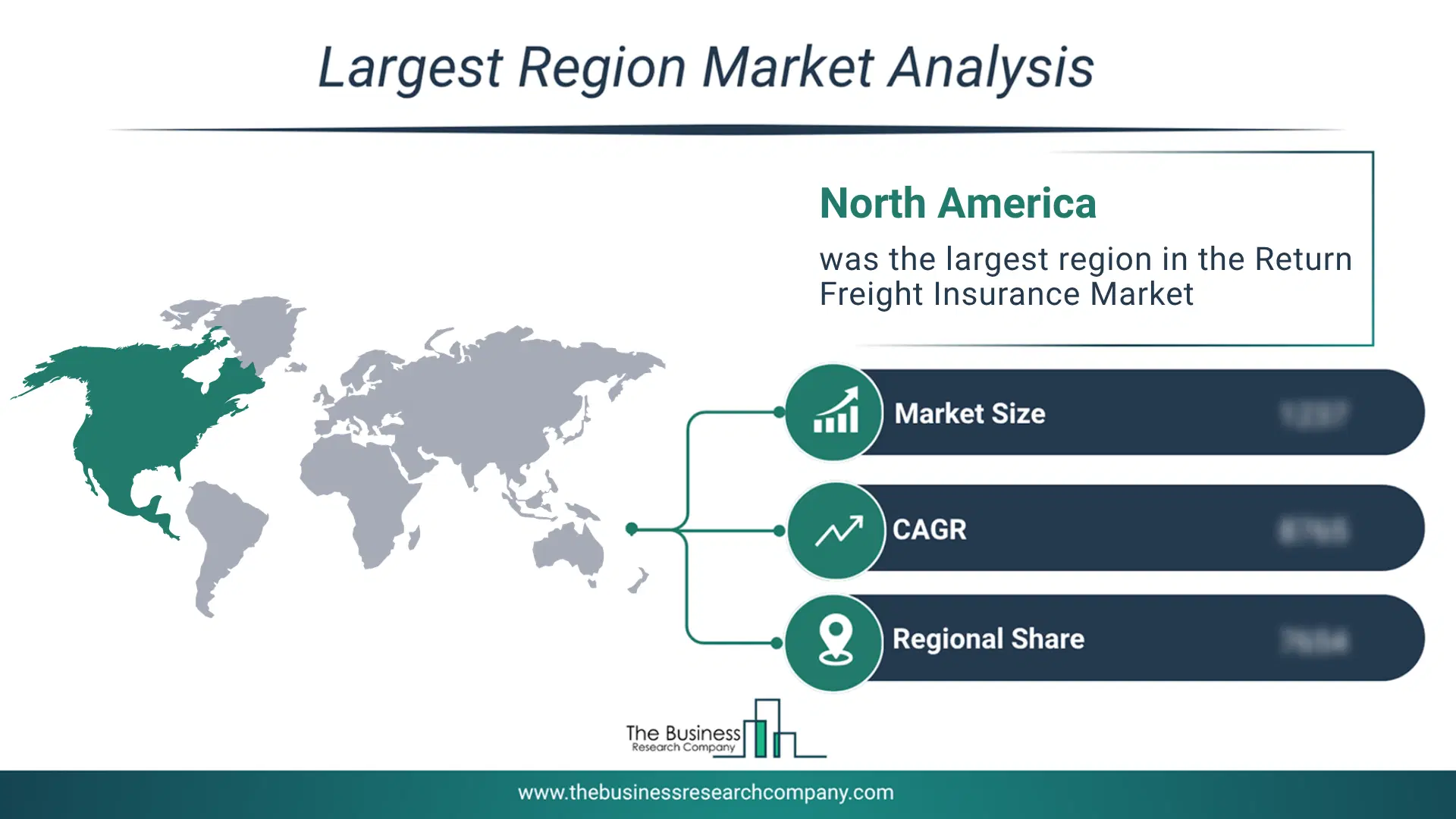
Regional Outlook/Insights
North America was the largest region in the return freight insurance market in 2025. Asia-Pacific is expected to be the fastest-growing region in the forecast period. The regions covered in this market report are Asia-Pacific, South East Asia, Western Europe, Eastern Europe, North America, South America, Middle East, Africa. The countries covered in this market report are Australia, Brazil, China, France, Germany, India, Indonesia, Japan, Taiwan, Russia, South Korea, UK, USA, Canada, Italy, Spain.What Defines the Return Freight Insurance Market?
The return freight insurance market includes revenues earned by entities by providing services such as return shipping coverage, claims processing, reverse logistics support, transportation risk assessment, cargo damage protection, refund reimbursement services, policy underwriting, shipment tracking support, return cost compensation, and dispute resolution services. The market value includes the value of related goods sold by the service provider or included within the service offering. Only goods and services traded between entities or sold to end consumers are included.How is Market Value Defined and Measured?
The market value is defined as the revenues that enterprises gain from the sale of goods and/or services within the specified market and geography through sales, grants, or donations in terms of the currency (in USD unless otherwise specified). The revenues for a specified geography are consumption values that are revenues generated by organizations in the specified geography within the market, irrespective of where they are produced. It does not include revenues from resales along the supply chain, either further along the supply chain or as part of other products.
This chart presents market attractiveness based on a quantitative evaluation of growth, competition, strategic alignment, and risk, offering a clear view of opportunity areas for decision-making. This chart is for illustrative purposes; the full report contains the complete analysis.

This chart highlights the Total Addressable Market (TAM) by estimating the maximum revenue opportunity using an assumption-driven approach, supporting strategic planning and opportunity sizing across markets. The chart is illustrative; the full report provides a more comprehensive analysis.
What Key Data and Analysis Are Included in the Return Freight Insurance Market Report 2026?
The return freight insurance market research report is one of a series of new reports from The Business Research Company that provides return freight insurance market statistics, including return freight insurance industry global market size, regional shares, competitors with a return freight insurance market share, detailed return freight insurance market segments, market trends and opportunities, and any further data you may need to thrive in the return freight insurance industry. This return freight insurance market research report delivers a complete perspective of everything you need, with an in-depth analysis of the current and future scenario of the industry.Return Freight Insurance Market Report Forecast Analysis
| Report Attribute | Details |
|---|---|
| Market Size Value In 2026 | $2.34 billion |
| Revenue Forecast In 2030 | $3.38 billion |
| Growth Rate | CAGR of 9.6% from 2026 to 2030 |
| Base Year For Estimation | 2025 |
| Actual Estimates/Historical Data | 2020-2025 |
| Forecast Period | 2026 - 2030 |
| Market Representation | Revenue in USD Billion and CAGR from 2026 to 2030 |
| Segments Covered | Coverage Type, Mode Of Transportation, Customer Type, Policy Term, End User |
| Regional Scope | Asia-Pacific, Western Europe, Eastern Europe, North America, South America, Middle East, Africa |
| Country Scope | The countries covered in the report are Australia, Brazil, China, France, Germany, India, Indonesia, Japan, Taiwan, Russia, South Korea, UK, USA, Canada, Italy, Spain. |
| Key Companies Profiled | Allianz SE, American International Group Inc., Aon plc, Arch Capital Group Limited, Assicurazioni Generali S.p.A., Assurant Inc., AXA XL Insurance Company UK Limited, Beazley plc, Berkshire Hathaway Specialty Insurance Company, Chubb Limited, HDI Global SE, Hiscox Ltd, Liberty Mutual Insurance Company, Marsh & McLennan Companies Inc., Munich Reinsurance Company, QBE Insurance Group Limited, Sompo Holdings Inc., Tokio Marine Kiln Insurance Limited, The Travelers Companies Inc., Zurich Insurance Group Ltd |
| Customization Scope | Request for Customization |
| Pricing And Purchase Options | Explore Purchase Options |