
Reusable Launch Vehicle Market Report 2026
Global Outlook – By Type (Partially Reusable Launch Vehicle, Fully Reusable Launch Vehicle), By Orbit Type (Low Earth Orbit (LEO), Geosynchronous Transfer Orbit (GTO)), By Vehicle Weight (Up to 6,000 lbs, 6,000 to 10,000 lbs, Over 10,000 lbs), By Configuration (Single Stage, Multi Stage), By Application (Commercial, Defense ) – Market Size, Trends, Strategies, and Forecast to 2030
Reusable Launch Vehicle Market Overview
• Reusable Launch Vehicle market size has reached to $3.61 billion in 2025 • Expected to grow to $7.7 billion in 2030 at a compound annual growth rate (CAGR) of 16.3% • Growth Driver: Rise In Satellite Launches Driving Market Growth Due To Increasing Demand For Communication, Earth Observation, And Navigation Services • Market Trend: Revolutionizing Space Travel With Multi-Use Rocket Technology • North America was the largest region and fastest growing region.What Is Covered Under Reusable Launch Vehicle Market?
A reusable launch vehicle refers to a launch vehicle that can be launched more than once. It is designed to return to earth completely unharmed, or it has vehicle stages that a launch operator may be retrieved and employed in the future to run an essentially comparable launch vehicle. These vehicles can dramatically reduce launch costs, decreasing the barrier to entry into space. The main types of reusable launch vehicle are partially reusable launch vehicle and fully reusable launch vehicle. Partially reusable launch vehicles refer to launch vehicles that allow the reuse of the first stage. Partially reusable launch vehicles are used to save launch expenses by 30% to 40% overall. The different types of reusable launch vehicle are low earth orbit (LEO) and geosynchronous transfer orbit (GTO), that has multiple vehicle weight up to 6,000 lbs, 6,000 to 10,000 lbs and over 10,000 lbs, which is configured in a single stage and multistage. The different applications include commercial and defense.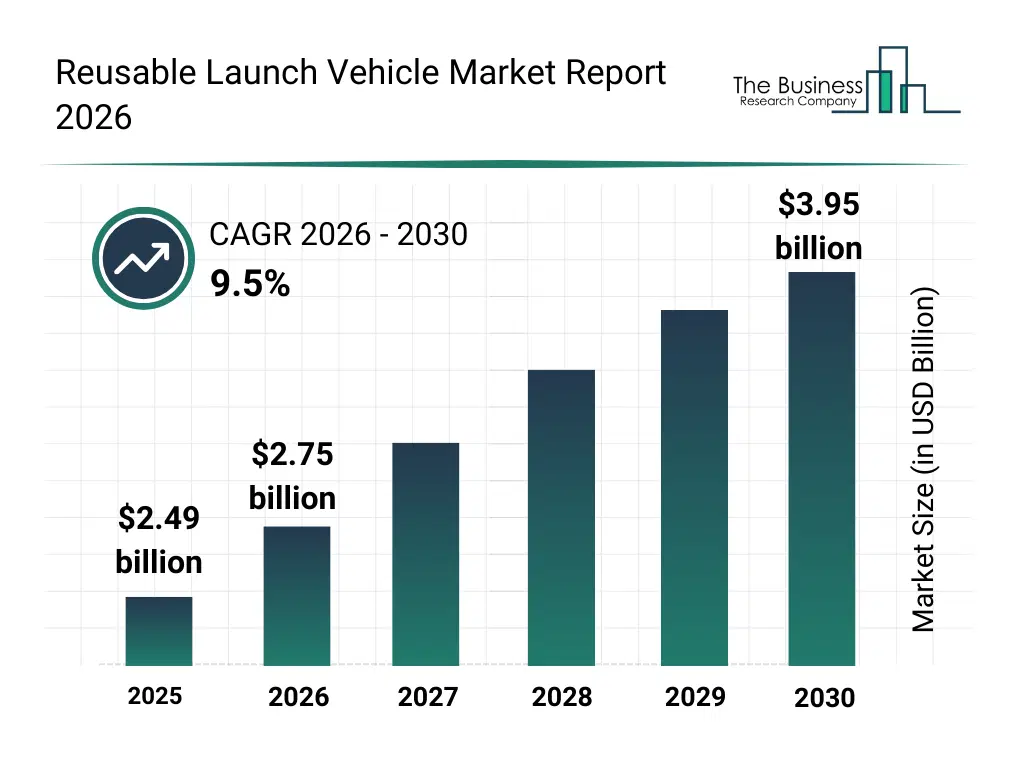
What Is The Reusable Launch Vehicle Market Size and Share 2026?
The reusable launch vehicle market size has grown rapidly in recent years. It will grow from $3.61 billion in 2025 to $4.22 billion in 2026 at a compound annual growth rate (CAGR) of 16.7%. The growth in the historic period can be attributed to early demonstrations of reusable rocket stages by private launch providers, rising demand for lower-cost access to space driving interest in reusability, development of advanced thermal protection systems enabling safe vehicle return, growth in satellite deployment requirements supporting frequent launch cycles, advancements in propulsion reliability improving reflight capability.What Is The Reusable Launch Vehicle Market Growth Forecast?
The reusable launch vehicle market size is expected to see rapid growth in the next few years. It will grow to $7.7 billion in 2030 at a compound annual growth rate (CAGR) of 16.3%. The growth in the forecast period can be attributed to increasing commercialization of space requiring high-cadence reusable launches, advancements in fully reusable spacecraft and booster architectures, growing demand for reusable small-lift and medium-lift vehicles for satellite constellations, expansion of refurbishment and rapid-turnaround services offered by launch providers, rising government–industry partnerships to scale reusable launch infrastructure. Major trends in the forecast period include reusable rocket stage recovery systems, advanced heat shield technologies, rapid turnaround launch capabilities, modular and scalable launch vehicle designs, integration of small satellite deployment systems.
Global Reusable Launch Vehicle Market Segmentation
2) By Orbit Type: Low Earth Orbit (LEO), Geosynchronous Transfer Orbit (GTO) 3) By Vehicle Weight: Up to 6,000 lbs, 6,000 to 10,000 lbs, Over 10,000 lbs 4) By Configuration: Single Stage, Multi Stage 5) By Application: Commercial, Defense Subsegments: 1) By Partially Reusable Launch Vehicle: First Stage Reusable Vehicles, Second Stage Reusable Vehicles, Solid Rocket Boosters 2) By Fully Reusable Launch Vehicle: Vertical Takeoff, Vertical Landing (VTVL), Horizontal Takeoff, Horizontal Landing (HTHL), Single-Stage to Orbit (SSTO), Multi-Stage Reusable VehiclesWhat Is The Driver Of The Reusable Launch Vehicle Market?
The rise in satellite launches is expected to propel the growth of the reusable launch vehicle market going forward. Satellite launches refer to the deployment of spacecraft into orbit using launch vehicles for purposes including communication, navigation, Earth observation, and scientific research. The increasing frequency of satellite launches is driven by the expansion of commercial satellite constellations, as companies deploy large networks of satellites to provide global internet coverage and enhanced telecommunications services. The growing number of satellite launches creates strong demand for cost-effective and frequently reusable launch systems that can accommodate the high launch cadence required for constellation deployment. For instance, in January 2024, according to Space Foundation, a nonprofit organization, global launch activity hit record levels for the third consecutive year, totaling 223 launch attempts with 212 successful missions. Commercial launches surged 50% compared to 2022. The United States experienced a 33% rise in launch attempts, while China, India, and Japan also reported increased activity. Therefore, the rise in satellite launches is driving the growth of the reusable launch vehicle industry.Key Players In The Global Reusable Launch Vehicle Market
Major companies operating in the reusable launch vehicle market are LinkSpace Aerospace Technology Group, Blue Origin LLC, National Aeronautics and Space Administration, Indian Space Research Organisation, Space Exploration Technologies Corp., The Boeing Company, European Space Agency, Ariane Group, German Aerospace Center, Relativity Space, Galactic Energy Aerospace Technology, Beijing Interstellar Glory Space Technology Co. Ltd., Payload Aerospace S.L., Bellatrix Aerospace Pvt. Ltd., Lockheed Martin Corporation, Rocket Labs USA Inc., The Spaceship Company, Virgin Galactic Holdings Inc., Sierra Nevada Corporation, Reaction Engines Ltd., Boeing HorizonX Ventures, Firefly Aerospace Inc., Astra Space Inc., Vector Space Systems Inc., Rocket Crafters Inc., Generation Orbit Launch Services, Orbital Sciences Corporation, XCOR Aerospace Inc., Blue Canyon Technologies Inc., Masten Space Systems, Stratolaunch Systems Corp., Interorbital Systems, Exos Aerospace Systems & Technologies Inc., Space Tango Inc., Spaceflight Industries Inc., NanoRacks LLC, Made In Space Inc., Planetary Resources Inc.
This chart is for illustrative purposes; the full report includes a detailed competitor analysis and comprehensive overview of the top 10 companies in the market.
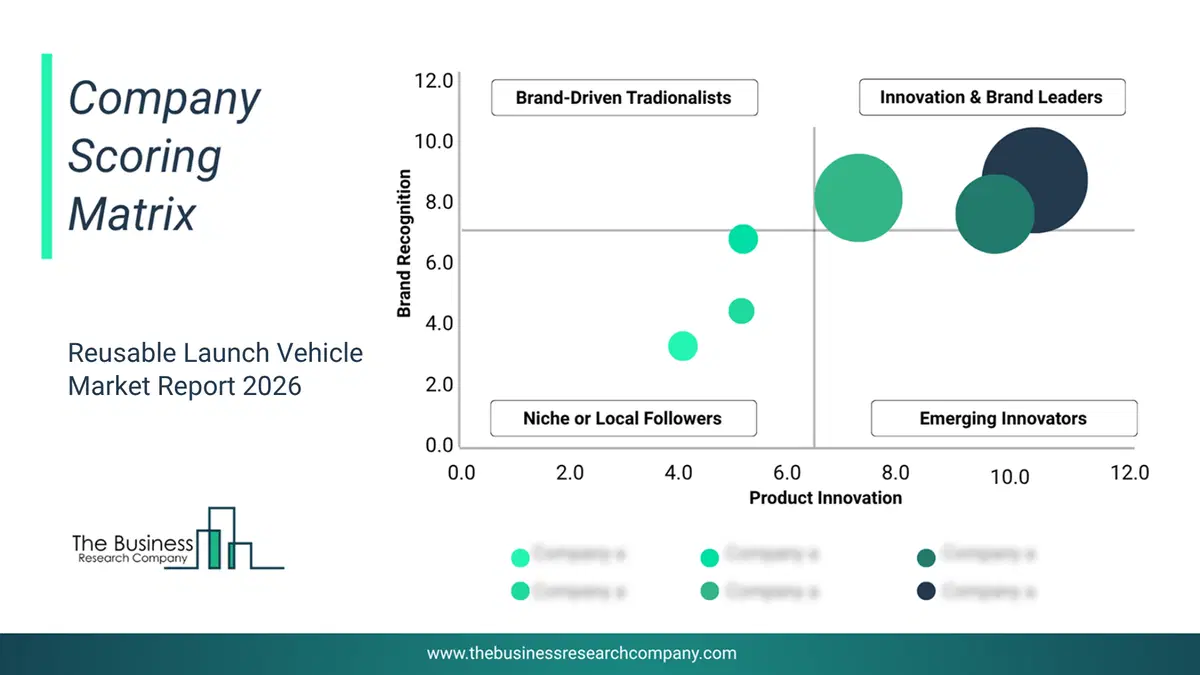
This chart maps companies by product innovation and brand strength, with bubble size indicating relative revenue, helping identify market leaders, challengers, and niche players. This is an illustrative chart; the full report provides a complete and accurate competitive analysis.
Global Reusable Launch Vehicle Market Trends and Insights
Major companies operating in the reusable launch vehicle market are focusing on developing innovative products such as reusable rockets to reduce launch costs and increase launch frequency. A reusable rocket is a rocket designed to be launched, landed, and used multiple times instead of being discarded after a single flight, helping to significantly reduce launch costs, save resources, and increase the frequency of space missions. For instance, in June 2025, Honda R&D Co. Ltd., a Japan-based manufacturing company, successfully conducted a launch and landing test of an experimental reusable rocket. Measuring 6.3 meters in length and weighing 1,312 kg at launch, the rocket reached an altitude of 271.4 meters and landed within 37 centimeters of its target. The test demonstrated key technologies for rocket reusability, including flight stability, precise landing capability, and robust safety systems, highlighting Honda’s application of its core expertise in combustion, control systems, and robotics to advance space technology. The initiative reflects Honda’s long-term vision to leverage its technological strengths beyond traditional automotive and mobility sectors, exploring space as a platform for innovation.What Are Latest Mergers And Acquisitions In The Reusable Launch Vehicle Market?
In August 2023, Vector Acquisition Corporation, a US-based financial services company, merged with Rocket Lab. With this merger, both companies intend to support future space application activities to supply data and services from space and additional organic and inorganic expansion in the Space Systems ecosystem. Rocket Lab is a US-based company that manufactures reusable launch vehicles.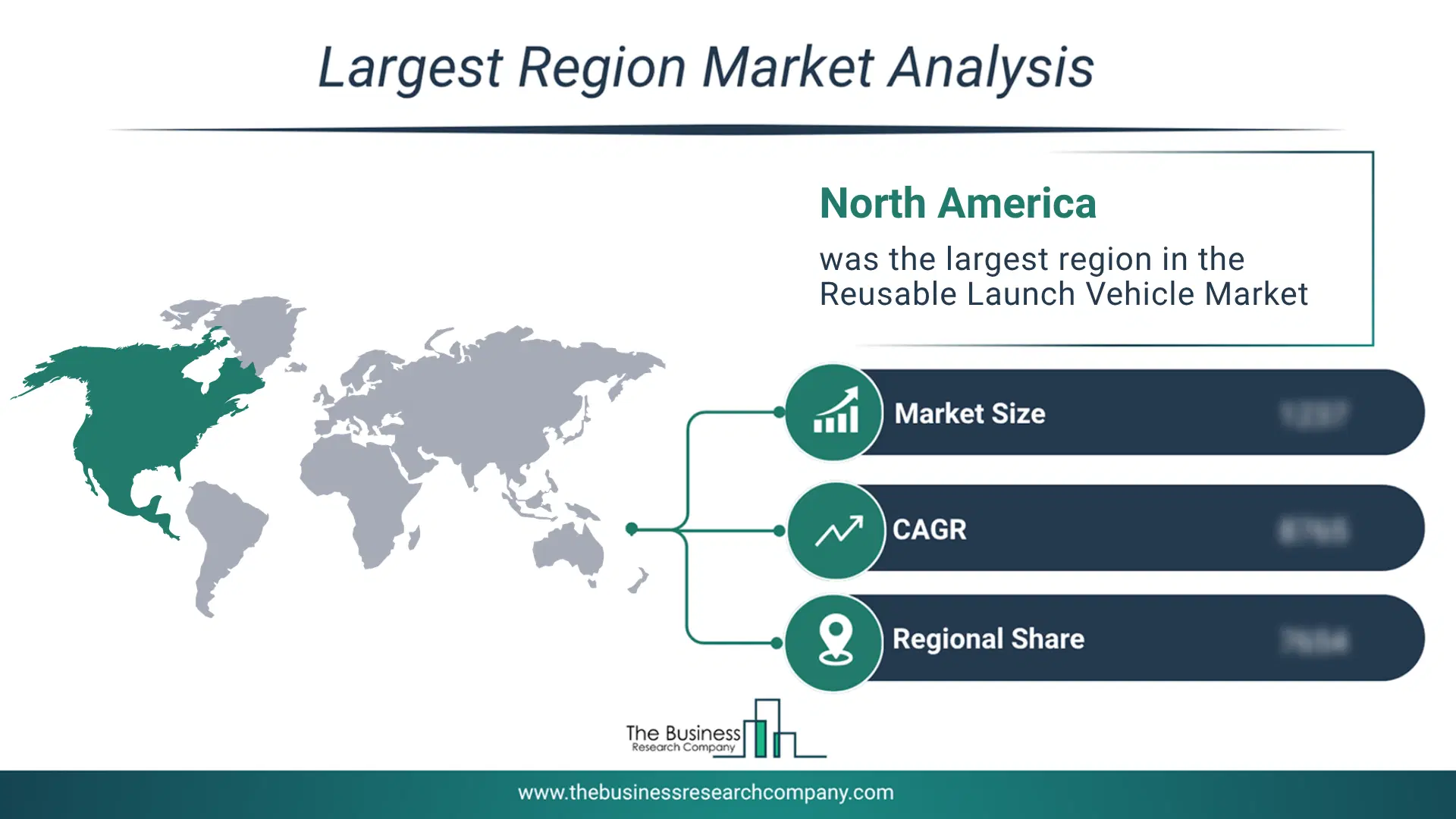
Regional Outlook
North America was the largest region in the reusable launch vehicle market in 2025. North America is expected to be the fastest growing region in the forecast period. The regions covered in this market report are Asia-Pacific, South East Asia, Western Europe, Eastern Europe, North America, South America, Middle East, Africa. The countries covered in this market report are Australia, Brazil, China, France, Germany, India, Indonesia, Japan, Taiwan, Russia, South Korea, UK, USA, Canada, Italy, Spain.What Defines the Reusable Launch Vehicle Market?
The reusable launch vehicle market consists of sales of satellites, spacecraft, spaceships, and rockets. Values in this market are ‘factory gate’ values, that is the value of goods sold by the manufacturers or creators of the goods, whether to other entities (including downstream manufacturers, wholesalers, distributors, and retailers) or directly to end customers. The value of goods in this market includes related services sold by the creators of the goods.How is Market Value Defined and Measured?
The market value is defined as the revenues that enterprises gain from the sale of goods and/or services within the specified market and geography through sales, grants, or donations in terms of the currency (in USD unless otherwise specified). The revenues for a specified geography are consumption values that are revenues generated by organizations in the specified geography within the market, irrespective of where they are produced. It does not include revenues from resales along the supply chain, either further along the supply chain or as part of other products.
This chart presents market attractiveness based on a quantitative evaluation of growth, competition, strategic alignment, and risk, offering a clear view of opportunity areas for decision-making. This chart is for illustrative purposes; the full report contains the complete analysis.

This chart highlights the Total Addressable Market (TAM) by estimating the maximum revenue opportunity using an assumption-driven approach, supporting strategic planning and opportunity sizing across markets. The chart is illustrative; the full report provides a more comprehensive analysis.
What Key Data and Analysis Are Included in the Reusable Launch Vehicle Market Report 2026?
The reusable launch vehicle market research report is one of a series of new reports from The Business Research Company that provides market statistics, including industry global market size, regional shares, competitors with the market share, detailed market segments, market trends and opportunities, and any further data you may need to thrive in the reusable launch vehicle industry. The market research report delivers a complete perspective of everything you need, with an in-depth analysis of the current and future state of the industry.Reusable Launch Vehicle Market Report Forecast Analysis
| Report Attribute | Details |
|---|---|
| Market Size Value In 2026 | $4.22 billion |
| Revenue Forecast In 2030 | $7.7 billion |
| Growth Rate | CAGR of 16.3% from 2026 to 2030 |
| Base Year For Estimation | 2025 |
| Actual Estimates/Historical Data | 2020-2025 |
| Forecast Period | 2026 - 2030 |
| Market Representation | Revenue in USD Billion and CAGR from 2026 to 2030 |
| Segments Covered | Type, Orbit Type, Vehicle Weight, Configuration, Application |
| Regional Scope | Asia-Pacific, Western Europe, Eastern Europe, North America, South America, Middle East, Africa |
| Country Scope | The countries covered in the report are Australia, Brazil, China, France, Germany, India, Indonesia, Japan, Taiwan, Russia, South Korea, UK, USA, Canada, Italy, Spain. |
| Key Companies Profiled | LinkSpace Aerospace Technology Group, Blue Origin LLC, National Aeronautics and Space Administration, Indian Space Research Organisation, Space Exploration Technologies Corp., The Boeing Company, European Space Agency, Ariane Group, German Aerospace Center, Relativity Space, Galactic Energy Aerospace Technology, Beijing Interstellar Glory Space Technology Co. Ltd., Payload Aerospace S.L., Bellatrix Aerospace Pvt. Ltd., Lockheed Martin Corporation, Rocket Labs USA Inc., The Spaceship Company, Virgin Galactic Holdings Inc., Sierra Nevada Corporation, Reaction Engines Ltd., Boeing HorizonX Ventures, Firefly Aerospace Inc., Astra Space Inc., Vector Space Systems Inc., Rocket Crafters Inc., Generation Orbit Launch Services, Orbital Sciences Corporation, XCOR Aerospace Inc., Blue Canyon Technologies Inc., Masten Space Systems, Stratolaunch Systems Corp., Interorbital Systems, Exos Aerospace Systems & Technologies Inc., Space Tango Inc., Spaceflight Industries Inc., NanoRacks LLC, Made In Space Inc., Planetary Resources Inc. |
| Customization Scope | Request for Customization |
| Pricing And Purchase Options | Explore Purchase Options |