
Reusable Medical Battery Market Report 2026
Global Outlook – By Type (Primary Lithium Ion Batteries, Secondary Rechargeable Lithium Ion Batteries, Silver Zinc Batteries), By Distribution Channel (Original Equipment Manufacturers, Aftermarket Suppliers, Online Sales, Offline Sales, Direct Sales), By Application (Patient Monitoring Devices, Defibrillators, Infusion Pumps, Surgical Instruments, Portable Diagnostic Devices), By End User (Hospitals, Clinics, Ambulatory Surgical Centers, Home Care Settings, Diagnostic Centers) – Market Size, Trends, Strategies, and Forecast to 2030
Reusable Medical Battery Market Overview
• Reusable Medical Battery market size has reached to $2.84 billion in 2025 • Expected to grow to $4.65 billion in 2030 at a compound annual growth rate (CAGR) of 10.4% • Growth Driver: Expansion Of Home Healthcare And Telemedicine Fueling The Growth Of The Market Due To Increasing Demand For Reliable Power Solutions For Portable Medical Devices • Market Trend: Advanced Rechargeable Battery Architectures Improving Implant Longevity • North America was the largest region in 2025 and Asia-Pacific is the fastest growing region.What Is Covered Under Reusable Medical Battery Market?
Reusable medical batteries are rechargeable power storage devices designed for use in medical equipment and healthcare devices. They are engineered for repeated charging cycles, long operational life, and compliance with medical safety standards. The main types of reusable medical battery include primary lithium ion batteries, secondary rechargeable lithium ion batteries, and silver zinc batteries. Primary lithium ion batteries refer to high-energy-density power sources designed for reliable operation in medical devices requiring long-lasting performance. These batteries are distributed through original equipment manufacturers, aftermarket suppliers, online sales, offline sales, and direct sales channels. The key applications of patient monitoring devices, defibrillators, infusion pumps, surgical instruments, and portable diagnostic devices, while the end-users hospitals, clinics, ambulatory surgical centers, home care settings, and diagnostic centers.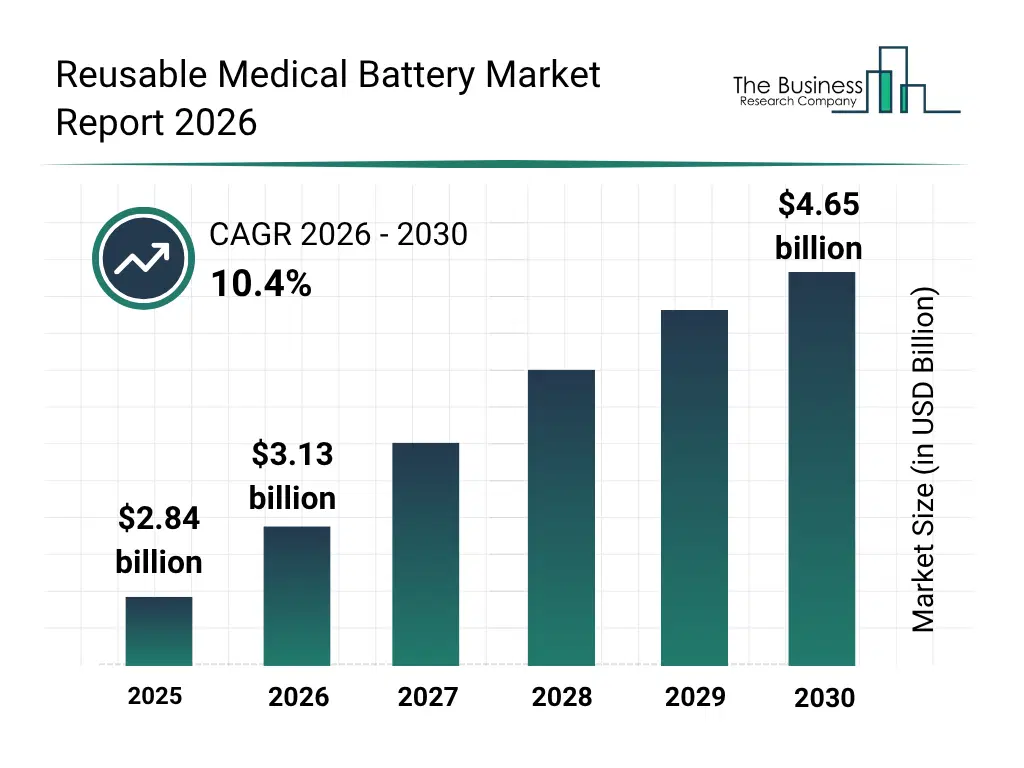
What Is The Reusable Medical Battery Market Size and Share 2026?
The reusable medical battery market size has grown rapidly in recent years. It will grow from $2.84 billion in 2025 to $3.13 billion in 2026 at a compound annual growth rate (CAGR) of 10.2%. The growth in the historic period can be attributed to rising adoption of portable medical devices, increasing demand for uninterrupted power supply in hospitals, growth in patient monitoring equipment usage, expansion of home healthcare services, increasing reliance on battery-powered diagnostic tools.What Is The Reusable Medical Battery Market Growth Forecast?
The reusable medical battery market size is expected to see rapid growth in the next few years. It will grow to $4.65 billion in 2030 at a compound annual growth rate (CAGR) of 10.4%. The growth in the forecast period can be attributed to rising demand for wearable and remote patient monitoring systems, increasing focus on energy-efficient and long-life battery technologies, expansion of digital healthcare infrastructure, growing adoption of IoT-enabled medical devices, increasing need for backup power in critical care applications. Major trends in the forecast period include rising adoption of high-density lithium-ion rechargeable batteries for medical devices to support longer operational runtime, increasing integration of smart battery management systems for real-time monitoring of charge health and safety, growing demand for compact and lightweight battery solutions in portable and wearable medical equipment, expansion of fast-charging and long-cycle-life medical batteries for critical care and emergency applications, increasing focus on safe chemistries such as lithium iron phosphate to enhance thermal stability and reliability.
Global Reusable Medical Battery Market Segmentation
1) By Type: Primary Lithium Ion Batteries; Secondary Rechargeable Lithium Ion Batteries; Silver Zinc Batteries 2) By Distribution Channel: Original Equipment Manufacturers; Aftermarket Suppliers; Online Sales; Offline Sales; Direct Sales 3) By Application: Patient Monitoring Devices; Defibrillators; Infusion Pumps; Surgical Instruments; Portable Diagnostic Devices 4) By End User: Hospitals; Clinics; Ambulatory Surgical Centers; Home Care Settings; Diagnostic Centers Subsegments: 1) By Primary Lithium Ion Batteries: Lithium Manganese Dioxide Batteries; Lithium Thionyl Chloride Batteries; Lithium Carbon Monofluoride Batteries; Lithium Iron Disulfide Batteries; Lithium Sulfur Dioxide Batteries 2) By Secondary Rechargeable Lithium Ion Batteries: Lithium Cobalt Oxide Batteries; Lithium Iron Phosphate Batteries; Lithium Nickel Manganese Cobalt Batteries; Lithium Titanate Batteries; Lithium Manganese Oxide Batteries 3) By Silver Zinc Batteries: Rechargeable Silver Zinc Batteries; Primary Silver Zinc Batteries; High Capacity Silver Zinc Batteries; Miniature Silver Zinc Batteries; Sealed Silver Zinc BatteriesWhat Are The Drivers Of The Reusable Medical Battery Market?
The expansion of home healthcare and telemedicine is expected to propel the growth of the reusable medical batteries market going forward. Home healthcare and telemedicine refer to the delivery of healthcare services, patient monitoring, consultations, and medical support remotely through home-based medical devices and digital communication technologies. The expansion of home healthcare and telemedicine is increasing due to rising demand for remote patient monitoring, growing aging populations, and stronger preference for convenient and cost-effective healthcare delivery outside traditional hospital settings. Reusable medical batteries support home healthcare and telemedicine by enabling reliable and continuous operation of portable medical devices such as wearable monitors, infusion pumps, ventilators, and diagnostic equipment that require rechargeable and long-lasting power sources in remote care environments. For instance, in April 2023, FAIR Health Inc., a US-based non-profit organization, showed a 7.3% national increase in telehealth usage, rising from 5.5% of medical claim lines in December 2022 to 5.9% in January 2023 Therefore, the expansion of home healthcare and telemedicine is driving the growth of the reusable medical batteries market. The rising prevalence of chronic diseases is expected to propel growth of the reusable medical batteries market going forward. Chronic diseases refer to long-duration health conditions such as cardiovascular disorders, diabetes, cancer, and respiratory illnesses that require ongoing monitoring and long-term medical intervention. The prevalence of chronic diseases is increasing due to aging populations and higher exposure to lifestyle risk factors such as sedentary behavior and poor dietary patterns. Reusable medical batteries are used in chronic disease management to provide reliable rechargeable power for long-term medical devices such as pacemakers, neurostimulators, insulin pumps, ventilators, and patient monitoring systems. For instance, in March 2025, according to the Office for Health Improvement and Disparities, a UK-based government organization, general practitioner (GP) recorded prevalence of type 2 diabetes among adults aged 17 years and above in England increased from 6.8% in March 2023 to 7.0% in March 2024. Therefore, the rising prevalence of chronic diseases is driving the growth of the reusable medical batteries market.Key Players In The Global Reusable Medical Battery Market
Major companies operating in the reusable medical battery market are LG Energy Solution Ltd.; Panasonic Energy Co. Ltd.; Samsung SDI Co. Ltd.; Murata Manufacturing Co. Ltd.; Maxell Holdings Ltd.; GS Yuasa Corporation; Saft Groupe SA; EnerSys; Exide Technologies; Integer Holdings Corporation; VARTA AG; Inventus Power; EaglePicher Technologies; Ultralife Corporation; Power-Sonic Corporation; RRC power solutions GmbH; Cell-Con Inc.; Wyon AGGlobal Reusable Medical Battery Market Trends and Insights
Major companies operating in the reusable medical batteries market are focusing on the development of long-life rechargeable neuromodulation systems, such as rechargeable sacral neuromodulation systems with low-frequency wireless charging capabilities, to improve patient convenience, extend implant lifespan, and enhance therapy efficiency in chronic bladder and bowel disorder treatments. Rechargeable sacral neuromodulation systems refer to implantable medical devices powered by rechargeable batteries that deliver mild electrical stimulation to sacral nerves to treat bladder and bowel dysfunction disorders. For instance, in January 2023, Axonics Inc., a US-based medical technology company, received U.S. Food and Drug Administration approval for its fourth-generation Axonics R20 rechargeable sacral neuromodulation system. The implantable neurostimulator is designed with a rechargeable battery architecture that supports a functional life of at least 20 years and requires wireless recharging only once every six to ten months for approximately one hour. The system also maintains a compact implant size and improves overall patient usability through enhanced energy efficiency and simplified remote-control functionality.Regional Outlook
North America was the largest region in the reusable medical battery market in 2025. Asia-Pacific is expected to be the fastest-growing region in the forecast period. The regions covered in this market report are Asia-Pacific, South East Asia, Western Europe, Eastern Europe, North America, South America, Middle East, Africa. The countries covered in this market report are Australia, Brazil, China, France, Germany, India, Indonesia, Japan, Taiwan, Russia, South Korea, UK, USA, Canada, Italy, Spain.What Defines the Reusable Medical Battery Market?
The reusable medical battery market consists of sales of battery packs, charging systems, and power management solutions. Values in this market are ‘factory gate’ values, that is the value of goods sold by the manufacturers or creators of the goods, whether to other entities (including downstream manufacturers, wholesalers, distributors and retailers) or directly to end customers. The value of goods in this market includes related services sold by the creators of the goods.How is Market Value Defined and Measured?
The market value is defined as the revenues that enterprises gain from the sale of goods and/or services within the specified market and geography through sales, grants, or donations in terms of the currency (in USD unless otherwise specified). The revenues for a specified geography are consumption values that are revenues generated by organizations in the specified geography within the market, irrespective of where they are produced. It does not include revenues from resales along the supply chain, either further along the supply chain or as part of other products.What Key Data and Analysis Are Included in the Reusable Medical Battery Market Report 2026?
The reusable medical battery market research report is one of a series of new reports from The Business Research Company that provides market statistics, including industry global market size, regional shares, competitors with the market share, detailed market segments, market trends and opportunities, and any further data you may need to thrive in the reusable medical battery industry. The market research report delivers a complete perspective of everything you need, with an in-depth analysis of the current and future state of the industry.Reusable Medical Battery Market Report Forecast Analysis
| Report Attribute | Details |
|---|---|
| Market Size Value In 2026 | $3.13 billion |
| Revenue Forecast In 2030 | $4.65 billion |
| Growth Rate | CAGR of 10.4% from 2026 to 2030 |
| Base Year For Estimation | 2025 |
| Actual Estimates/Historical Data | 2020-2025 |
| Forecast Period | 2026 - 2030 |
| Market Representation | Revenue in USD Billion and CAGR from 2026 to 2030 |
| Segments Covered | Type, Distribution Channel, Application, End User |
| Regional Scope | Asia-Pacific, Western Europe, Eastern Europe, North America, South America, Middle East, Africa |
| Country Scope | The countries covered in the report are Australia, Brazil, China, France, Germany, India, ... |
| Key Companies Profiled | LG Energy Solution Ltd.; Panasonic Energy Co. Ltd.; Samsung SDI Co. Ltd.; Murata Manufacturing Co. Ltd.; Maxell Holdings Ltd.; GS Yuasa Corporation; Saft Groupe SA; EnerSys; Exide Technologies; Integer Holdings Corporation; VARTA AG; Inventus Power; EaglePicher Technologies; Ultralife Corporation; Power-Sonic Corporation; RRC power solutions GmbH; Cell-Con Inc.; Wyon AG |
| Customization Scope | Request for Customization |
| Pricing And Purchase Options | Explore Purchase Options |