

Reusable Medical Devices Market Report 2026
Global Outlook – By Product Type (Endoscopes, Surgical Instruments, Implants, Monitoring Equipment, Diagnostic Equipment), By Material (Stainless Steel, Titanium, Medical Grade Plastics, Silicone, Glass), By Sterilization Method (Steam Sterilization, Ethylene Oxide Sterilization, Hydrogen Peroxide Plasma Sterilization, Radiation Sterilization, Chemical Sterilization), By Application (Surgery, Cardiology, Orthopedics, Dental, Ophthalmology), By End User (Hospitals, Ambulatory Surgical Centers, Diagnostic Laboratories) – Market Size, Trends, Strategies, and Forecast to 2030
Reusable Medical Devices Market Overview
• Reusable Medical Devices market size has reached to $15.03 billion in 2025 • Expected to grow to $21.62 billion in 2030 at a compound annual growth rate (CAGR) of 7.6% • Growth Driver: Rising Volume Of Surgical Procedures Fueling The Growth Of The Market Due To Increasing Chronic Disease Burden • Market Trend: Technological Advancements In Automated Medical Device Reprocessing Systems For Enhanced Infection Prevention And Healthcare Efficiency • North America was the largest region in 2025 and Asia-Pacific is the fastest growing region.What Is Covered Under Reusable Medical Devices Market?
Reusable medical devices refer to medical instruments and equipment designed to be used multiple times after undergoing cleaning, disinfection, sterilization, and maintenance procedures. These devices are manufactured using durable materials to maintain performance, safety, and reliability across repeated usage cycles in healthcare environments. They support cost efficiency, waste reduction, and long-term clinical functionality while meeting regulatory and hygiene standards. The main product types of reusable medical devices include endoscopes, surgical instruments, implants, monitoring equipment, and diagnostic equipment. Endoscopes refer to reusable medical devices designed for internal examination and minimally invasive diagnostic procedures. These devices are made using materials such as stainless steel, titanium, medical grade plastics, silicone, and glass, and are sterilized using methods such as steam sterilization, ethylene oxide sterilization, hydrogen peroxide plasma sterilization, radiation sterilization, and chemical sterilization. The key applications of surgery, cardiology, orthopedics, dental, and ophthalmology, while the end-users hospitals, ambulatory surgical centers, and diagnostic laboratories.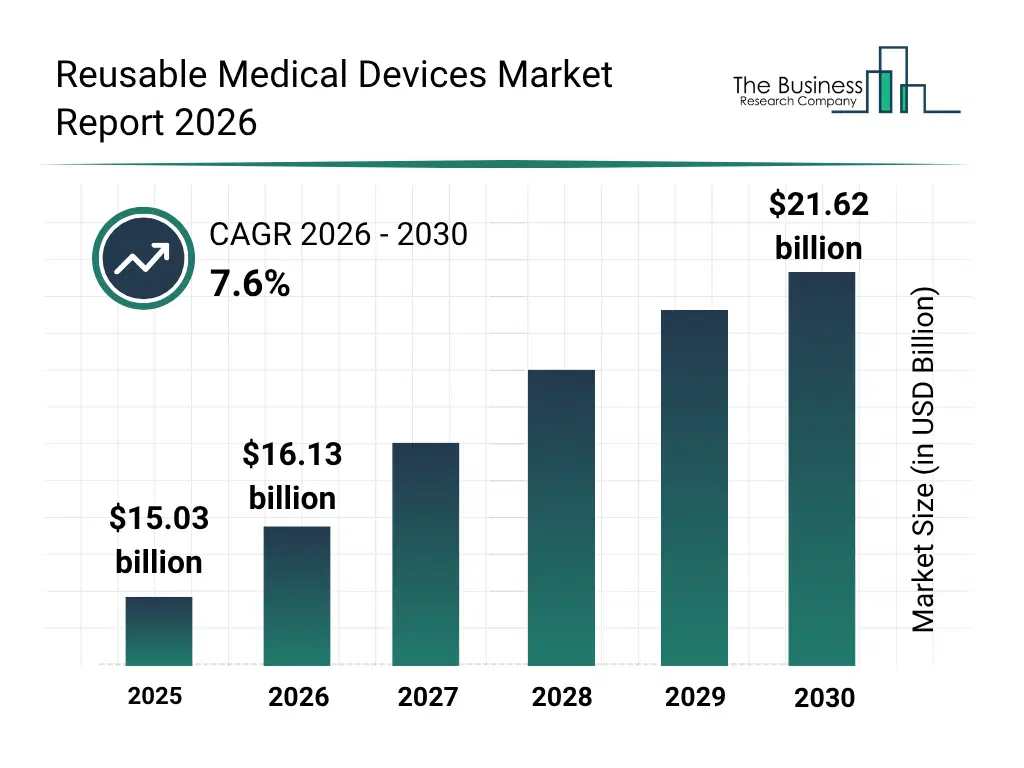
What Is The Reusable Medical Devices Market Size and Share 2026?
The reusable medical devices market size has grown strongly in recent years. It will grow from $15.03 billion in 2025 to $16.13 billion in 2026 at a compound annual growth rate (CAGR) of 7.4%. The growth in the historic period can be attributed to rising adoption of reusable medical instruments in hospitals, increasing focus on cost reduction in healthcare procurement, expansion of hospital infrastructure and surgical procedures, growing awareness of infection prevention and hygiene standards, development of durable medical-grade materials.What Is The Reusable Medical Devices Market Growth Forecast?
The reusable medical devices market size is expected to see strong growth in the next few years. It will grow to $21.62 billion in 2030 at a compound annual growth rate (CAGR) of 7.6%. The growth in the forecast period can be attributed to increasing demand for sustainable healthcare waste reduction, rising surgical volumes driven by aging population, expansion of ambulatory surgical centers globally, growing emphasis on lifecycle management of medical devices, strengthening global regulatory frameworks for medical device safety. Major trends in the forecast period include infection control standardization in reusable device processing, enhanced sterilization validation and monitoring protocols, rising focus on medical device durability and lifecycle performance optimization, cost-efficient hospital procurement strategies for reusable equipment, strengthened regulatory compliance and hygiene assurance frameworks.
Global Reusable Medical Devices Market Segmentation
1) By Product Type: Endoscopes; Surgical Instruments; Implants; Monitoring Equipment; Diagnostic Equipment 2) By Material: Stainless Steel; Titanium; Medical Grade Plastics; Silicone; Glass 3) By Sterilization Method: Steam Sterilization; Ethylene Oxide Sterilization; Hydrogen Peroxide Plasma Sterilization; Radiation Sterilization; Chemical Sterilization 4) By Application: Surgery; Cardiology; Orthopedics; Dental; Ophthalmology 5) By End User: Hospitals; Ambulatory Surgical Centers; Diagnostic Laboratories Subsegments: 1) By Endoscopes: Flexible Endoscopes; Rigid Endoscopes; Video Endoscopes; Fiber Optic Endoscopes; Capsule Endoscopes 2) By Surgical Instruments: Cutting Instruments; Grasping Instruments; Clamping Instruments; Retracting Instruments; Suturing Instruments 3) By Implants: Orthopedic Implants; Dental Implants; Cardiovascular Implants; Spinal Implants; Craniofacial Implants 4) By Monitoring Equipment: Cardiac Monitoring Equipment; Respiratory Monitoring Equipment; Temperature Monitoring Equipment; Blood Pressure Monitoring Equipment; Multi Parameter Monitoring Equipment 5) By Diagnostic Equipment: Imaging Diagnostic Equipment; Ultrasound Diagnostic Equipment; Endoscopic Diagnostic Equipment; Laboratory Diagnostic Equipment; Electrodiagnostic EquipmentWhat Is The Driver Of The Reusable Medical Devices Market?
The rising number of surgical procedures is expected to propel the growth of the reusable medical devices market going forward. Surgical procedures are medical operations in which a surgeon uses instruments to treat, repair, or diagnose a condition by physically intervening in the body. The volume of surgical procedures is rising due to the increasing prevalence of chronic diseases, which often necessitate operative interventions to manage or treat their complications. Reusable medical devices help surgical procedures by providing durable and sterilizable instruments that enable safe, accurate, and cost-effective operations while supporting infection control and improving operating room efficiency. For instance, in May 2025, according to the 2024 annual report by Intuitive Surgical Inc., a US-based medical device company, around 2,683,000 surgical procedures were carried out using da Vinci surgical systems, up from approximately 2,286,000 procedures in 2023 and 1,875,000 procedures in 2022, reflecting steady year-over-year growth in utilization. Therefore, the rising number of surgical procedures is driving the growth of the reusable medical devices industry.Key Players In The Global Reusable Medical Devices Market
Major companies operating in the reusable medical devices market are Johnson & Johnson; GE HealthCare Technologies Inc.; Siemens Healthineers AG; Medtronic plc; Stryker Corporation; Koninklijke Philips N.V.; FUJIFILM Holdings Corporation; B. Braun Melsungen AG; Boston Scientific Corporation; Intuitive Surgical Inc.; Olympus Corporation; Smith & Nephew plc; Hoya Corporation (PENTAX Medical); STERIS plc; Integra LifeSciences Holdings Corporation; KARL STORZ SE & Co. KG; CONMED Corporation; Richard Wolf GmbHGlobal Reusable Medical Devices Market Trends and Insights
Major companies operating in the reusable medical devices market are focusing on developing innovative products, such as endoscope washer disinfectors, to enhance infection prevention, improve reprocessing efficiency, and support sustainable healthcare operations. Endoscope washer disinfectors are automated medical device reprocessing systems designed to clean, disinfect, and dry reusable endoscopes through validated cycles that ensure high hygiene standards, offering greater consistency, reduced manual handling, and improved contamination control compared to traditional manual cleaning methods. For instance, in June 2023, Olympus Corporation, a Japan-based medical technology company, launched the Olympus ETD Endoscope Washer Disinfector in two versions, ETD Basic and ETD Premium, as part of its infection prevention portfolio. The system was developed to improve the efficiency and sustainability of endoscope reprocessing while delivering cleaning and disinfection results that exceed standard healthcare requirements. It incorporates automated workflow functions, enhanced usability features, and streamlined reprocessing cycles to reduce healthcare staff workload and improve operational productivity. The device also supports consistent high-level disinfection performance, helping healthcare facilities strengthen patient safety and infection control practices.What Are Latest Mergers And Acquisitions In The Reusable Medical Devices Market?
In August 2023, STERIS plc, an Ireland-based healthcare technology company, acquired the surgical instrumentation, laparoscopic instrumentation, and sterilization container assets of Becton, Dickinson and Company (BD) for an undisclosed amount. With this acquisition, STERIS plc aimed to expand and strengthen its surgical and infection prevention portfolio by integrating established surgical instrument brands and complementary operating room products, thereby enhancing its offerings for hospitals and surgical centers globally. Becton, Dickinson and Company is a US-based healthcare technology company that specializes in providing reusable medical devices.Regional Outlook
North America was the largest region in the reusable medical devices market in 2025. Asia-Pacific is expected to be the fastest-growing region in the forecast period. The regions covered in this market report are Asia-Pacific, South East Asia, Western Europe, Eastern Europe, North America, South America, Middle East, Africa. The countries covered in this market report are Australia, Brazil, China, France, Germany, India, Indonesia, Japan, Taiwan, Russia, South Korea, UK, USA, Canada, Italy, Spain.What Defines the Reusable Medical Devices Market?
The reusable medical devices market consists of sales of forceps, scissors, retractors, reusable syringes, catheters, anesthesia equipment, sterilization containers, reusable medical trays, infusion pumps, and reusable respiratory devices. Values in this market are ‘factory gate’ values, that is, the value of goods sold by the manufacturers or creators of the goods, whether to other entities (including downstream manufacturers, wholesalers, distributors, and retailers) or directly to end customers. The value of goods in this market includes related services sold by the creators of the goods.How is Market Value Defined and Measured?
The market value is defined as the revenues that enterprises gain from the sale of goods and/or services within the specified market and geography through sales, grants, or donations in terms of the currency (in USD unless otherwise specified). The revenues for a specified geography are consumption values that are revenues generated by organizations in the specified geography within the market, irrespective of where they are produced. It does not include revenues from resales along the supply chain, either further along the supply chain or as part of other products.What Key Data and Analysis Are Included in the Reusable Medical Devices Market Report 2026?
The reusable medical devices market research report is one of a series of new reports from The Business Research Company that provides market statistics, including industry global market size, regional shares, competitors with the market share, detailed market segments, market trends and opportunities, and any further data you may need to thrive in the reusable medical devices industry. The market research report delivers a complete perspective of everything you need, with an in-depth analysis of the current and future state of the industry.Reusable Medical Devices Market Report Forecast Analysis
| Report Attribute | Details |
|---|---|
| Market Size Value In 2026 | $16.13 billion |
| Revenue Forecast In 2030 | $21.62 billion |
| Growth Rate | CAGR of 7.6% from 2026 to 2030 |
| Base Year For Estimation | 2025 |
| Actual Estimates/Historical Data | 2020-2025 |
| Forecast Period | 2026 - 2030 |
| Market Representation | Revenue in USD Billion and CAGR from 2026 to 2030 |
| Segments Covered | Product Type, Material, Sterilization Method, Application, End User |
| Regional Scope | Asia-Pacific, Western Europe, Eastern Europe, North America, South America, Middle East, Africa |
| Country Scope | The countries covered in the report are Australia, Brazil, China, France, Germany, India, ... |
| Key Companies Profiled | Johnson & Johnson; GE HealthCare Technologies Inc.; Siemens Healthineers AG; Medtronic plc; Stryker Corporation; Koninklijke Philips N.V.; FUJIFILM Holdings Corporation; B. Braun Melsungen AG; Boston Scientific Corporation; Intuitive Surgical Inc.; Olympus Corporation; Smith & Nephew plc; Hoya Corporation (PENTAX Medical); STERIS plc; Integra LifeSciences Holdings Corporation; KARL STORZ SE & Co. KG; CONMED Corporation; Richard Wolf GmbH |
| Customization Scope | Request for Customization |
| Pricing And Purchase Options | Explore Purchase Options |