
Reusable Medical Sensors Market Report 2026
Global Outlook – By Product Type (Electrocardiogram Sensors, Pulse Oximeters, Blood Glucose Monitors, Temperature Sensors, Respiration Sensors), By Material Type (Silicone Based Sensors, Plastic Based Sensors, Hybrid Material Sensors), By Distribution Channel (Direct Sales, Distributors And Wholesalers, Online Sales), By Application (Patient Monitoring, Chronic Disease Management, Emergency Care, Wearable Health Devices, Telemedicine), By End User (Hospitals And Healthcare Institutions, Home Health Care Settings, Rehabilitation Centers, Research And Clinical Laboratories, Individual Consumers) – Market Size, Trends, Strategies, and Forecast to 2030
Reusable Medical Sensors Market Overview
• Reusable Medical Sensors market size has reached to $3.35 billion in 2025 • Expected to grow to $5.6 billion in 2030 at a compound annual growth rate (CAGR) of 10.9% • Growth Driver: Increasing Adoption Of Remote Patient Monitoring Driving The Market Growth Due To Rising Prevalence Of Chronic Diseases • Market Trend: Advancing Long-Term Wearable Cardiac Monitoring Through Reusable Sensor Innovation • North America was the largest region in 2025 and Asia-Pacific is the fastest growing region.What Is Covered Under Reusable Medical Sensors Market?
Reusable medical sensors refer to electronic or smart medical devices designed to continuously or intermittently monitor physiological parameters such as heart rate, temperature, oxygen levels, or glucose levels across multiple uses. These sensors are engineered with durable materials, biocompatible components, and integrated electronics to ensure accurate data collection, patient safety, and long operational lifespan while supporting clinical monitoring and diagnostic applications. They are developed to improve healthcare efficiency by enabling reliable real-time health data tracking and reducing the need for single-use monitoring devices. The main product types of reusable medical sensors include electrocardiogram sensors, pulse oximeters, blood glucose monitors, temperature sensors, and respiration sensors. Electrocardiogram sensors refer to reusable monitoring devices designed to detect and record the electrical activity of the heart for clinical and diagnostic purposes. These sensors are made using material types such as silicone based sensors, plastic based sensors, and hybrid material sensors and are distributed through direct sales, distributors and wholesalers, and online sales channels. The various applications involved are patient monitoring, chronic disease management, emergency care, wearable health devices, and telemedicine, and they are used by several end users such as hospitals and healthcare institutions, home health care settings, rehabilitation centers, research and clinical laboratories, and individual consumers.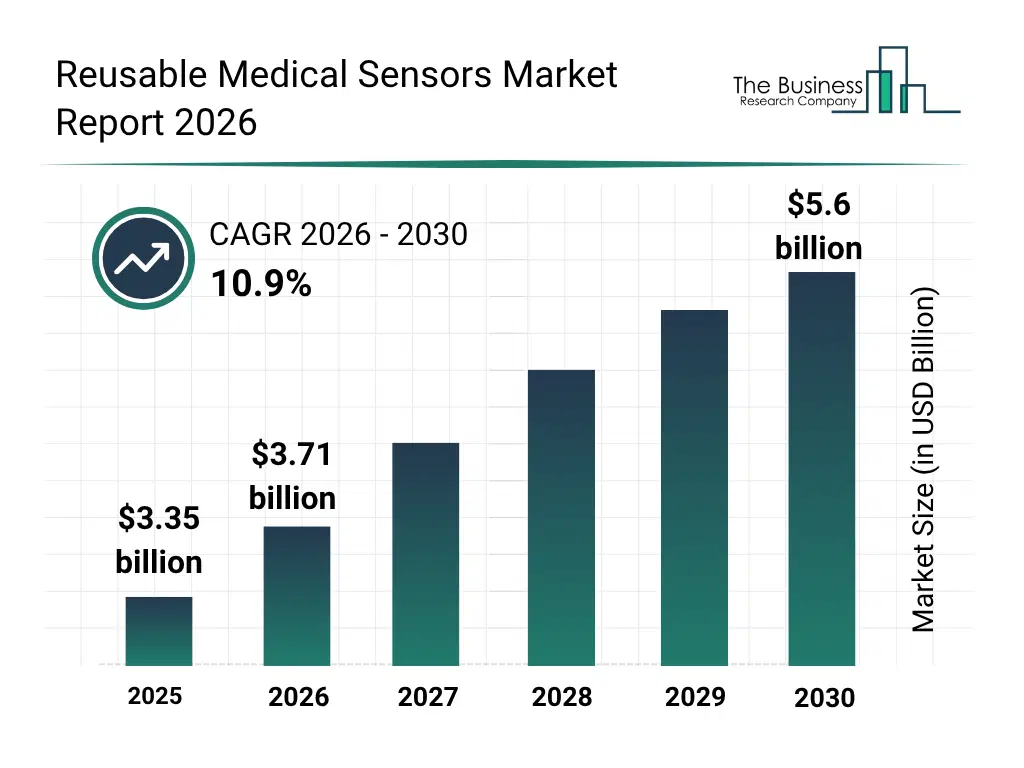
What Is The Reusable Medical Sensors Market Size and Share 2026?
The reusable medical sensors market size has grown rapidly in recent years. It will grow from $3.35 billion in 2025 to $3.71 billion in 2026 at a compound annual growth rate (CAGR) of 10.7%. The growth in the historic period can be attributed to increasing adoption of basic patient monitoring devices in hospitals, rising prevalence of chronic diseases requiring continuous monitoring, expansion of hospital-based diagnostic infrastructure, growing awareness of early disease detection and vital sign monitoring, improvements in electronic sensor miniaturization and durability.What Is The Reusable Medical Sensors Market Growth Forecast?
The reusable medical sensors market size is expected to see rapid growth in the next few years. It will grow to $5.6 billion in 2030 at a compound annual growth rate (CAGR) of 10.9%. The growth in the forecast period can be attributed to growing demand for remote and home-based healthcare monitoring, increasing integration of AI and predictive analytics in patient monitoring, rising adoption of connected wearable medical devices, expansion of telemedicine and digital health ecosystems, increasing focus on cost-efficient reusable medical technologies. Major trends in the forecast period include real-time remote patient monitoring expansion through wearable reusable sensors, increasing integration of AI-driven predictive health analytics in sensor systems, rising adoption of multi-parameter smart biosensing devices for chronic disease management, growing demand for low-power and energy-efficient reusable medical sensing technologies, enhanced interoperability of medical sensors with hospital it and cloud platforms.
Global Reusable Medical Sensors Market Segmentation
1) By Product Type: Electrocardiogram Sensors; Pulse Oximeters; Blood Glucose Monitors; Temperature Sensors; Respiration Sensors 2) By Material Type: Silicone Based Sensors; Plastic Based Sensors; Hybrid Material Sensors 3) By Distribution Channel: Direct Sales; Distributors And Wholesalers; Online Sales 4) By Application: Patient Monitoring; Chronic Disease Management; Emergency Care; Wearable Health Devices; Telemedicine 5) By End User: Hospitals And Healthcare Institutions; Home Health Care Settings; Rehabilitation Centers; Research And Clinical Laboratories; Individual Consumers Subsegments: 1) By Electrocardiogram Sensors: Resting Electrocardiogram Sensors; Stress Test Electrocardiogram Sensors; Holter Monitoring Electrocardiogram Sensors; Wireless Electrocardiogram Sensors; Wearable Electrocardiogram Sensors 2) By Pulse Oximeters: Fingertip Pulse Oximeters; Handheld Pulse Oximeters; Bedside Pulse Oximeters; Wrist Worn Pulse Oximeters; Pediatric Pulse Oximeters 3) By Blood Glucose Monitors: Continuous Blood Glucose Monitors; Self Monitoring Blood Glucose Monitors; Wearable Blood Glucose Monitors; Portable Blood Glucose Monitors; Smart Blood Glucose Monitors 4) By Temperature Sensors: Infrared Temperature Sensors; Digital Temperature Sensors; Wearable Temperature Sensors; Skin Contact Temperature Sensors; Implantable Temperature Sensors 5) By Respiration Sensors: Chest Strap Respiration Sensors; Nasal Respiration Sensors; Wearable Respiration Sensors; Airflow Respiration Sensors; Thermal Respiration SensorsWhat Are The Drivers Of The Reusable Medical Sensors Market?
The expansion of remote patient monitoring (RPM) is expected to propel the growth of the reusable medical sensors market going forward. Remote patient monitoring (RPM) refers to the use of digital technologies and devices to collect patients’ health data outside of traditional healthcare settings and transmit it to healthcare providers for ongoing monitoring and management. The adoption of remote patient monitoring is rising due to the increasing need for continuous healthcare management, as it allows healthcare providers to track patients’ health in real time. Reusable medical sensors enable remote patient monitoring (RPM) by continuously capturing vital signs and transmitting real-time data to healthcare providers for timely decisions and improved chronic and post-acute care management. For instance, in August 2025, according to the Office of Inspector General, a US-based independent organization, the number of Medicare enrollees using remote patient monitoring increased significantly, reaching nearly 1 million in 2024, which represents a 27% rise compared to 2023. Therefore, the expansion of remote patient monitoring (RPM) is driving the growth of the reusable medical sensors industry. The increasing adoption of wearable medical devices is expected to propel the growth of the reusable medical sensors market going forward. Wearable medical devices are electronic health-monitoring tools worn on the body to continuously collect and transmit physiological data. The adoption of wearable medical devices is growing due to the increasing demand for continuous, real-time health monitoring that helps detect health issues early and supports better management of chronic conditions outside traditional clinical settings. Reusable medical sensors enable wearable medical devices by providing accurate, low-power, and durable physiological data collection that can be reused across multiple monitoring cycles, improving reliability and ensuring consistent real-time health tracking in clinical and home-care settings. For instance, in April 2025, according to the UK Parliament's House of Commons Library, a UK-based government administration, between 2023 and 2024, the NIHR and UKRI invested $ 15 million (£11.5 million) in 10 research projects focused on developing wearable technologies to support greater independence for people living with frailty or long-term physical disabilities. Therefore, the increasing adoption of wearable medical devices is driving the growth of the reusable medical sensors industry.Key Players In The Global Reusable Medical Sensors Market
Major companies operating in the reusable medical sensors market are Abbott Laboratories; Honeywell International Inc.; Medtronic plc; GE HealthCare Technologies Inc.; Koninklijke Philips N.V.; Baxter International Inc.; Dexcom Inc.; Shenzhen Mindray Bio-Medical Electronics Co. Ltd.; ICU Medical Inc.; Drägerwerk AG & Co KGaA; Masimo Corporation; Nihon Kohden Corporation; Fukuda Denshi Co. Ltd.; Contec Medical Systems Co. Ltd.; Edan Instruments Inc.; ChoiceMMed (Beijing Choice Electronic Technology Co. Ltd.); Nonin Medical Inc.; SCHILLER AG; BPL Medical Technologies Pvt. Ltd.; Bionet Co. Ltd.; Shenzhen YKD Technology Co. Ltd.; Infinium Medical Inc.; Shenzhen JCR Medical Technology Co. Ltd.Global Reusable Medical Sensors Market Trends and Insights
Major companies operating in the reusable medical sensors market are focusing on developing advanced wearable monitoring solutions, such as reusable ECG sensor systems to enhance long-term patient monitoring, reduce medical waste, and improve cost efficiency in continuous diagnostic care. Reusable ECG sensor systems are wearable cardiac monitoring devices with reusable electrode or sensing components that record electrocardiogram signals over multiple uses after proper cleaning or replacement, helping enable long-term heart rhythm monitoring, reduce medical waste, lower testing costs, and improve detection of intermittent cardiac abnormalities in everyday life. For instance, in July 2025, Daewoong Pharmaceutical Co., Ltd., a South Korea-based pharmaceutical and healthcare company, in collaboration with Seers Technology, a South Korea-based manufacturing company, launched mobiCARE REFRESH, a reusable system for its wearable ECG device mobiCARE. The system is designed to support long-term electrocardiogram monitoring by enabling reusable sensor components that reduce the need for full device replacement after each use cycle. It helps clinicians continuously monitor cardiac activity for up to nine days, improving the detection of intermittent heart abnormalities that may not appear in short hospital-based ECG tests.Regional Outlook
North America was the largest region in the reusable medical sensors market in 2025. Asia-Pacific is expected to be the fastest-growing region in the forecast period. The regions covered in this market report are Asia-Pacific, South East Asia, Western Europe, Eastern Europe, North America, South America, Middle East, Africa. The countries covered in this market report are Australia, Brazil, China, France, Germany, India, Indonesia, Japan, Taiwan, Russia, South Korea, UK, USA, Canada, Italy, Spain.What Defines the Reusable Medical Sensors Market?
The reusable medical sensors market consists of sales of wearable biosensors, reusable ECG sensors, pulse oximetry sensors, temperature sensors, respiratory monitoring sensors, glucose monitoring sensors, multi-parameter patient monitoring sensors, and related sensor modules and accessories. Values in this market are ‘factory gate’ values, that is, the value of goods sold by the manufacturers or creators of the goods, whether to other entities (including downstream manufacturers, wholesalers, distributors, and retailers) or directly to end customers. The value of goods in this market includes related services sold by the creators of the goods.How is Market Value Defined and Measured?
The market value is defined as the revenues that enterprises gain from the sale of goods and/or services within the specified market and geography through sales, grants, or donations in terms of the currency (in USD unless otherwise specified). The revenues for a specified geography are consumption values that are revenues generated by organizations in the specified geography within the market, irrespective of where they are produced. It does not include revenues from resales along the supply chain, either further along the supply chain or as part of other products.What Key Data and Analysis Are Included in the Reusable Medical Sensors Market Report 2026?
The reusable medical sensors market research report is one of a series of new reports from The Business Research Company that provides market statistics, including industry global market size, regional shares, competitors with the market share, detailed market segments, market trends and opportunities, and any further data you may need to thrive in the reusable medical sensors industry. The market research report delivers a complete perspective of everything you need, with an in-depth analysis of the current and future state of the industry.Reusable Medical Sensors Market Report Forecast Analysis
| Report Attribute | Details |
|---|---|
| Market Size Value In 2026 | $3.71 billion |
| Revenue Forecast In 2030 | $5.6 billion |
| Growth Rate | CAGR of 10.9% from 2026 to 2030 |
| Base Year For Estimation | 2025 |
| Actual Estimates/Historical Data | 2020-2025 |
| Forecast Period | 2026 - 2030 |
| Market Representation | Revenue in USD Billion and CAGR from 2026 to 2030 |
| Segments Covered | Product Type, Material Type, Distribution Channel, Application, End User |
| Regional Scope | Asia-Pacific, Western Europe, Eastern Europe, North America, South America, Middle East, Africa |
| Country Scope | The countries covered in the report are Australia, Brazil, China, France, Germany, India, ... |
| Key Companies Profiled | Abbott Laboratories; Honeywell International Inc.; Medtronic plc; GE HealthCare Technologies Inc.; Koninklijke Philips N.V.; Baxter International Inc.; Dexcom Inc.; Shenzhen Mindray Bio-Medical Electronics Co. Ltd.; ICU Medical Inc.; Drägerwerk AG & Co KGaA; Masimo Corporation; Nihon Kohden Corporation; Fukuda Denshi Co. Ltd.; Contec Medical Systems Co. Ltd.; Edan Instruments Inc.; ChoiceMMed (Beijing Choice Electronic Technology Co. Ltd.); Nonin Medical Inc.; SCHILLER AG; BPL Medical Technologies Pvt. Ltd.; Bionet Co. Ltd.; Shenzhen YKD Technology Co. Ltd.; Infinium Medical Inc.; Shenzhen JCR Medical Technology Co. Ltd. |
| Customization Scope | Request for Customization |
| Pricing And Purchase Options | Explore Purchase Options |