
Reusable Rocket Component Testing Market Report 2026
Global Outlook – By Component Type (Engines, Fuel Tanks, Avionics, Landing Gear, Other Component Types), By Testing Type (Structural Testing, Propulsion Testing, Environmental Testing, Other Testing Types), By Application (Commercial, Military, Scientific), By End-User (Space Agencies, Private Space Companies, Research Institutions) – Market Size, Trends, Strategies, and Forecast to 2030
Reusable Rocket Component Testing Market Overview
• Reusable Rocket Component Testing market size has reached to $1.39 billion in 2025 • Expected to grow to $2.72 billion in 2030 at a compound annual growth rate (CAGR) of 14.2% • Growth Driver: Increasing Number Of Space Missions Fueling The Growth Of The Market Due To Rising Demand For Satellite-Based Communication Services • Market Trend: Advanced Thrust Control Enables Precision Landing • North America was the largest region in 2025.What Is Covered Under Reusable Rocket Component Testing Market?
Reusable rocket component testing refers to the comprehensive process of assessing and validating the durability, performance, and reliability of individual rocket parts that are designed to be reused across multiple flights. This rigorous testing ensures that these components can withstand repeated cycles without significant degradation or failure. The main purpose of this testing is to verify the reliability and longevity of reusable components, reducing costs and increasing flight frequency in space missions. The main types of components in reusable rocket component testing are engines, fuel tanks, avionics, landing gear, and others. Engine component refers to the essential parts that make up a rocket engine, which together generate the thrust needed to propel the spacecraft. It includes various testing types, such as structural testing, propulsion testing, environmental testing, and others, and is used for various applications, such as commercial, military, and scientific. It caters to various end users, including space agencies, private space companies, and research institutions.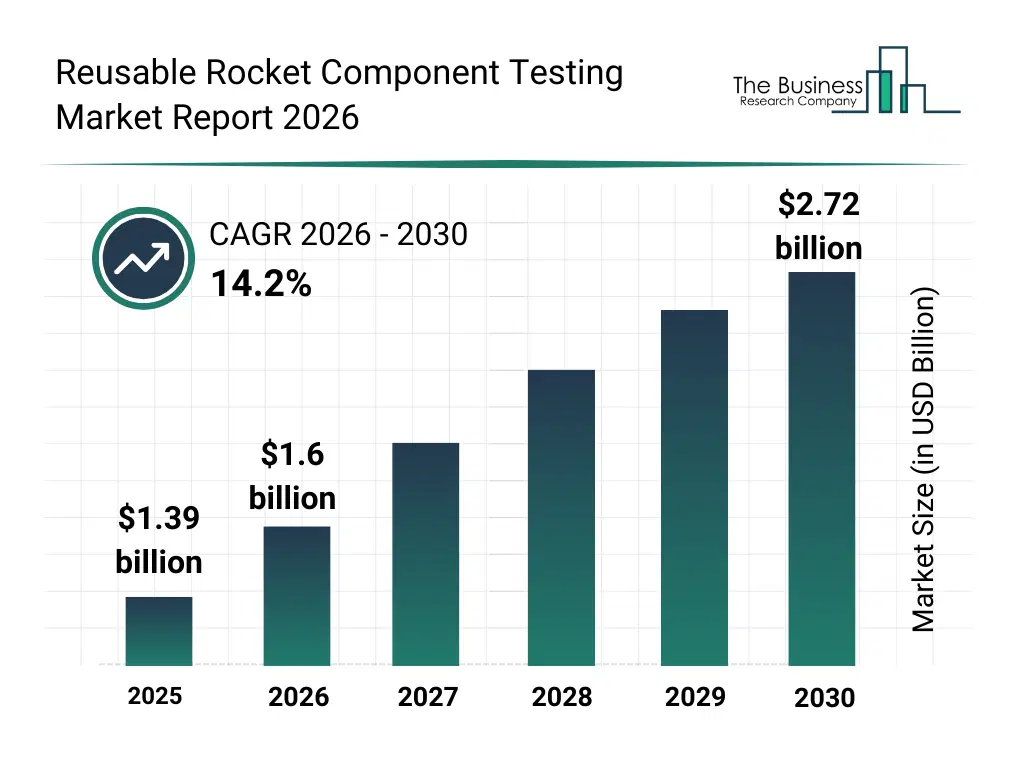
What Is The Reusable Rocket Component Testing Market Size and Share 2026?
The reusable rocket component testing market size has grown rapidly in recent years. It will grow from $1.39 billion in 2025 to $1.6 billion in 2026 at a compound annual growth rate (CAGR) of 15.1%. The growth in the historic period can be attributed to growing adoption of reusable rocket architectures increasing demand for component durability testing, rising use of thermal resistance analysis to validate heat-shield and engine performance, increasing reliance on vibration and shock testing to ensure structural integrity across multiple flights, early integration of non-destructive evaluation methods for detecting micro-damage in reusable parts, expansion of post-flight inspection and diagnostics as reusable launch frequency increased.What Is The Reusable Rocket Component Testing Market Growth Forecast?
The reusable rocket component testing market size is expected to see rapid growth in the next few years. It will grow to $2.72 billion in 2030 at a compound annual growth rate (CAGR) of 14.2%. The growth in the forecast period can be attributed to rising demand for advanced reusability performance evaluation to extend component flight life, increasing adoption of ai-enabled diagnostics to predict component degradation before failure, growing need for enhanced avionics and software testing for reusable booster systems, expansion of testing requirements for next-generation thermal protection systems and landing gear, technological advancements enabling automated, high-fidelity testing environments to accelerate reuse certification. Major trends in the forecast period include increased focus on lifecycle wear-and-fatigue characterization, growth in rapid turnaround post-flight inspection services, rising adoption of non-destructive evaluation and advanced nde techniques, expansion of avionics and software-in-loop reusability testing, standardization of reusability metrics and certification protocols.
Global Reusable Rocket Component Testing Market Segmentation
1) By Component Type: Engines, Fuel Tanks, Avionics, Landing Gear, Other Component Types 2) By Testing Type: Structural Testing, Propulsion Testing, Environmental Testing, Other Testing Types 3) By Application: Commercial, Military, Scientific 4) By End-User: Space Agencies, Private Space Companies, Research Institutions Subsegments: 1) By Engine: Main Combustion Chamber, Turbopumps, Nozzles, Ignition Systems 2) By Fuel Tank: Cryogenic Tanks, Pressurant Tanks, Composite Overwrapped Pressure Vessels (COPVs), Insulation Systems 3) By Avionics: Flight Control Systems, Telemetry Systems, Navigation Systems, Power Distribution Units 4) By Landing Gear: Shock Absorbers, Retractable Legs, Actuators, Touchdown Sensors 5) By Other Component Types: Thermal Protection Systems, Fairings, Structural Frames, Separation MechanismsWhat Is Driver Of The Reusable Rocket Component Testing Market?
The increasing number of space missions is expected to propel the growth of the reusable rocket component testing market going forward. Space missions are planned operations beyond Earth’s atmosphere using spacecraft or satellites for purposes such as exploration, research, communication, observation, or defense. The number of space missions is increasing due to the growing need for satellite-based communication services, as global demand for high-speed internet, remote connectivity, and data transmission continues to rise. Reusable rocket component testing enhances space missions by ensuring the reliability and durability of critical parts across multiple launches. It reduces mission costs and turnaround times by validating components for reuse, improving operational efficiency, and improving sustainability. For instance, in January 2025, according to the report published by Space Foundation, a US-based non-profit organization, orbital launch attempts rose by 16% in 2024, reaching 259 launches, averaging one launch every 34 hours, which is five hours more frequent than in 2023. Therefore, the increasing number of space missions is driving the growth of the reusable rocket component testing industry.Key Players In The Global Reusable Rocket Component Testing Market
Major companies operating in the reusable rocket component testing market are The Boeing Company, Lockheed Martin Corporation, Northrop Grumman Corporation, Blue Origin Enterprises L.P., ArianeGroup SAS, Honda R&D Co. Ltd., Sierra Nevada Company LLC, Relativity Space Inc., iSpace (Beijing) Technology Co. Ltd., Rocket Lab USA Inc., Firefly Aerospace Inc., Gilmour Space Technologies Pty Ltd., Rocket Factory Augsburg AG, Deep Blue Aerospace Technology Co. Ltd., Pangea Aerospace SL, Equatorial Space Systems Pty Ltd., Hypersonix Launch Systems Pty Ltd., LinkSpace Technology Co. Ltd., PLD Space SL, Skyrora Ltd., Isar Aerospace GmbH.
This chart is for illustrative purposes; the full report includes a detailed competitor analysis and comprehensive overview of the top 10 companies in the market.
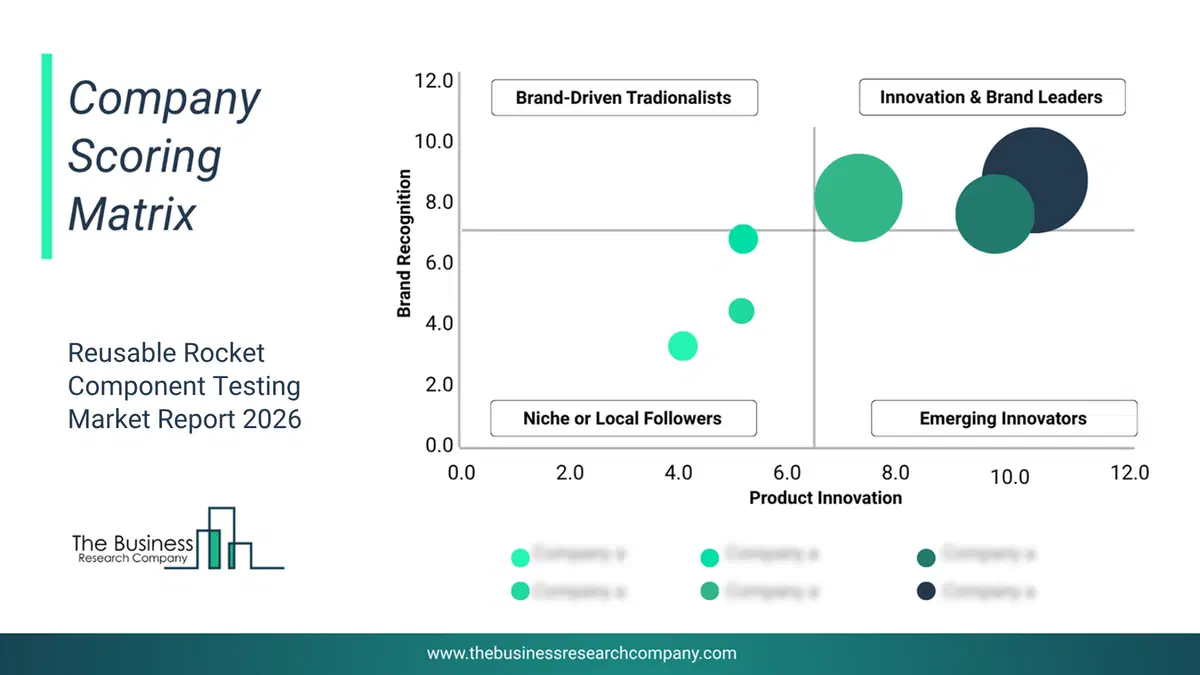
This chart maps companies by product innovation and brand strength, with bubble size indicating relative revenue, helping identify market leaders, challengers, and niche players. This is an illustrative chart; the full report provides a complete and accurate competitive analysis.
Global Reusable Rocket Component Testing Market Trends and Insights
Major companies operating in the reusable rocket component testing market are focusing on developing innovative solutions, such as reusable rocket landing tests, to validate the performance and durability of key components such as engines, landing legs, and control systems under real flight conditions. Reusable rocket landing test refers to the process of assessing a rocket's ability to safely return and land after launch, ensuring its structural integrity and functionality for multiple reuse cycles. For instance, in June 2025, Honda R&D Co. Ltd., a Japan-based research company, successfully conducted its first launch and landing test of an experimental reusable rocket. The test demonstrated advanced thrust control and precision landing capabilities, leveraging Honda's expertise in propulsion and automation technologies. The system incorporates real-time adaptive control algorithms to ensure stable descent and touchdown, significantly reducing the risk of component failure during repeated missions. This innovation aims to lower operational costs and enhance sustainability in space exploration by enabling the reuse of critical rocket components.What Are Latest Mergers And Acquisitions In The Reusable Rocket Component Testing Market? Irocket Technologies To Go Public Through Merger With BPGC Acquisition Corp.
In July 2025, BPGC Acquisition Corp., a US-based Special Purpose Acquisition Company, merged with iRocket Technologies Inc. to take the company public and support its development of next-generation reusable rocket engines and launch systems. With this merger, iRocket aims to go public, advance reusable rocket technology, and enhance global space access by reducing launch costs, increasing mission efficiency, accelerating launch cadence, and strengthening strategic capabilities for allies and partners worldwide. iRocket Technologies Inc. is a US-based aerospace company specializing in reusable rockets and next-generation launch systems designed to reduce cost per mission and increase responsiveness in space access.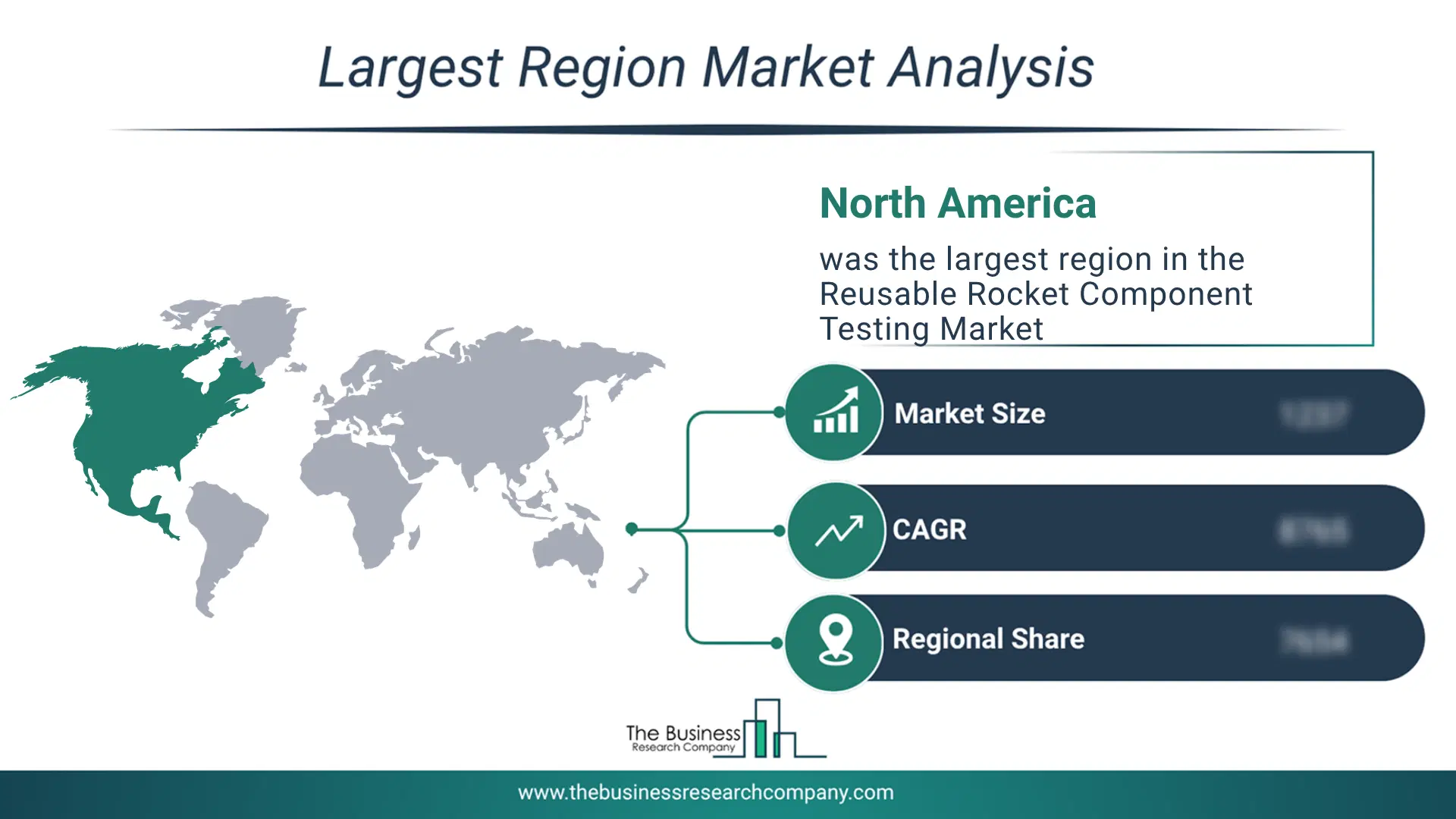
Regional Insights
North America was the largest region in the reusable rocket component testing market in 2025. The regions covered in this market report are Asia-Pacific, South East Asia, Western Europe, Eastern Europe, North America, South America, Middle East, Africa. The countries covered in this market report are Australia, Brazil, China, France, Germany, India, Indonesia, Japan, Taiwan, Russia, South Korea, UK, USA, Canada, Italy, SpainWhat Defines the Reusable Rocket Component Testing Market?
The reusable rocket component testing market consists of revenues earned by entities by providing services such as thermal resistance analysis, vibration and shock testing, non-destructive evaluation, avionics and software testing, reusability performance evaluation, and post-flight inspection and diagnostics. The market value includes the value of related goods sold by the service provider or included within the service offering. The reusable rocket component testing market also includes sales of rocket engines, thermal protection systems, landing gear, avionics, and structural components. Values in this market are ‘factory gate’ values, that is, the value of goods sold by the manufacturers or creators of the goods, whether to other entities (including downstream manufacturers, wholesalers, distributors, and retailers) or directly to end customers. The value of goods in this market includes related services sold by the creators of the goods.How is Market Value Defined and Measured?
The market value is defined as the revenues that enterprises gain from the sale of goods and/or services within the specified market and geography through sales, grants, or donations in terms of the currency (in USD unless otherwise specified). The revenues for a specified geography are consumption values that are revenues generated by organizations in the specified geography within the market, irrespective of where they are produced. It does not include revenues from resales along the supply chain, either further along the supply chain or as part of other products.
This chart presents market attractiveness based on a quantitative evaluation of growth, competition, strategic alignment, and risk, offering a clear view of opportunity areas for decision-making. This chart is for illustrative purposes; the full report contains the complete analysis.

This chart highlights the Total Addressable Market (TAM) by estimating the maximum revenue opportunity using an assumption-driven approach, supporting strategic planning and opportunity sizing across markets. The chart is illustrative; the full report provides a more comprehensive analysis.
What Key Data and Analysis Are Included in the Reusable Rocket Component Testing Market Report 2026?
The reusable rocket component testing market research report is one of a series of new reports from The Business Research Company that provides market statistics, including industry global market size, regional shares, competitors with the market share, detailed market segments, market trends and opportunities, and any further data you may need to thrive in the reusable rocket component testing industry. The market research report delivers a complete perspective of everything you need, with an in-depth analysis of the current and future state of the industry.Reusable Rocket Component Testing Market Report Forecast Analysis
| Report Attribute | Details |
|---|---|
| Market Size Value In 2026 | $1.6 billion |
| Revenue Forecast In 2030 | $2.72 billion |
| Growth Rate | CAGR of 14.2% from 2026 to 2030 |
| Base Year For Estimation | 2025 |
| Actual Estimates/Historical Data | 2020-2025 |
| Forecast Period | 2026 - 2030 |
| Market Representation | Revenue in USD Billion and CAGR from 2026 to 2030 |
| Segments Covered | Component Type, Testing Type, Application, End-User |
| Regional Scope | Asia-Pacific, Western Europe, Eastern Europe, North America, South America, Middle East, Africa |
| Country Scope | The countries covered in the reusable rocket component testing market report are Australia, Brazil, China, France, Germany, India, Indonesia, Japan, Taiwan, Russia, South Korea, UK, USA, Canada, Italy, Spain |
| Key Companies Profiled | The Boeing Company, Lockheed Martin Corporation, Northrop Grumman Corporation, Blue Origin Enterprises L.P., ArianeGroup SAS, Honda R&D Co. Ltd., Sierra Nevada Company LLC, Relativity Space Inc., iSpace (Beijing) Technology Co. Ltd., Rocket Lab USA Inc., Firefly Aerospace Inc., Gilmour Space Technologies Pty Ltd., Rocket Factory Augsburg AG, Deep Blue Aerospace Technology Co. Ltd., Pangea Aerospace SL, Equatorial Space Systems Pty Ltd., Hypersonix Launch Systems Pty Ltd., LinkSpace Technology Co. Ltd., PLD Space SL, Skyrora Ltd., Isar Aerospace GmbH. |
| Customization Scope | Request for Customization |
| Pricing And Purchase Options | Explore Purchase Options |