
Revascularization Device Market Report 2026
Global Outlook – By Product Type (Atherectomy Devices, Balloon Angioplasty Catheters, Bare Metal Stents, Drug Coated Balloons, Drug Eluting Stents, Everolimus Eluting Stents), By Material Type (Bioabsorbable Scaffold, Metallic, Cobalt Chromium, Platinum Chromium, Stainless Steel, Polymer), By Application (Coronary Interventions, Peripheral Vascular Interventions, Neurovascular Interventions, Renal Artery Interventions), By End User (Hospitals, Cardiac Catheterization Laboratories, Ambulatory Surgical Centers, Specialty Cardiovascular Clinics, Research And Academic Institutes) – Market Size, Trends, Strategies, and Forecast to 2030
Revascularization Device Market Overview
• Revascularization Device market size has reached to $3.88 billion in 2025 • Expected to grow to $6.1 billion in 2030 at a compound annual growth rate (CAGR) of 9.5% • Growth Driver: The Rise In Cardiovascular Diseases Driving The Growth Of The Market Due To Unhealthy Lifestyles • Market Trend: Advancements In Next-Generation Intermediate Catheters Enhancing Clot Retrieval Efficiency And Stroke Intervention Outcomes • North America was the largest region in 2025 and Asia-Pacific is the fastest growing region.What Is Covered Under Revascularization Device Market?
Revascularization devices refer to medical devices used to restore or improve blood flow in blocked or narrowed blood vessels. These devices are commonly used in procedures treating conditions such as coronary artery disease or peripheral artery disease. They work by physically opening the vessel or bypassing the blockage to ensure adequate oxygen-rich blood reaches tissues and organs. The main product types of revascularization devices include atherectomy devices, balloon angioplasty catheters, bare metal stents, drug coated balloons, drug eluting stents, and everolimus eluting stents. Atherectomy devices refer to minimally invasive tools used to remove plaque buildup from blood vessels and restore blood flow. These devices are manufactured using material types such as bioabsorbable scaffold, metallic, cobalt chromium, platinum chromium, stainless steel, and polymer. The various applications involved are coronary interventions, peripheral vascular interventions, neurovascular interventions, and renal artery interventions and they are utilized by end users including hospitals, cardiac catheterization laboratories, ambulatory surgical centers, specialty cardiovascular clinics, and research and academic institutes.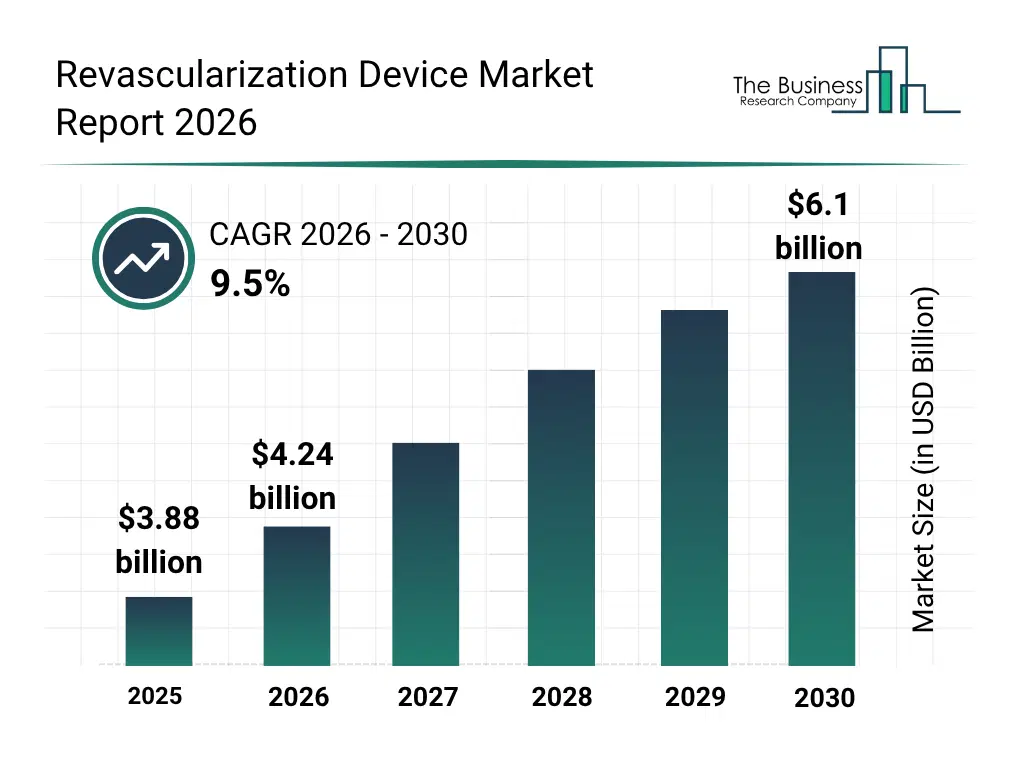
What Is The Revascularization Device Market Size and Share 2026?
The revascularization device market size has grown strongly in recent years. It will grow from $3.88 billion in 2025 to $4.24 billion in 2026 at a compound annual growth rate (CAGR) of 9.3%. The growth in the historic period can be attributed to rising prevalence of coronary artery disease, growing aging population globally, expansion of catheterization laboratories, increasing adoption of drug eluting stents, improvements in interventional cardiology techniques.What Is The Revascularization Device Market Growth Forecast?
The revascularization device market size is expected to see strongly grown in the next few years. It will grow to $6.1 billion in 2030 at a compound annual growth rate (CAGR) of 9.5%. The growth in the forecast period can be attributed to growth in precision guided vascular interventions, rising demand for minimally invasive surgeries, integration of ai assisted interventional imaging, expansion of ambulatory surgical centers, increasing focus on bioresorbable and next generation stents. Major trends in the forecast period include minimally invasive revascularization procedures expansion, bioresorbable scaffold adoption in vascular repair, advanced imaging guided vascular interventions, radial access based cardiovascular procedures growth, outpatient shift toward ambulatory vascular treatment.
Global Revascularization Device Market Segmentation
1) By Product Type: Atherectomy Devices; Balloon Angioplasty Catheters; Bare Metal Stents; Drug Coated Balloons; Drug Eluting Stents; Everolimus Eluting Stents 2) By Material Type: Bioabsorbable Scaffold; Metallic; Cobalt Chromium; Platinum Chromium; Stainless Steel; Polymer 3) By Application: Coronary Interventions; Peripheral Vascular Interventions; Neurovascular Interventions; Renal Artery Interventions 4) By End User: Hospitals; Cardiac Catheterization Laboratories; Ambulatory Surgical Centers; Specialty Cardiovascular Clinics; Research And Academic Institutes Subsegments: 1) By Atherectomy Devices: Rotational Atherectomy Devices; Directional Atherectomy Devices; Orbital Atherectomy Devices; Laser Atherectomy Devices 2) By Balloon Angioplasty Catheters: Semi Compliant Balloon Catheters; Non Compliant Balloon Catheters; Cutting Balloon Catheters; Scoring Balloon Catheters 3) By Bare Metal Stents: Cobalt Chromium Bare Metal Stents; Stainless Steel Bare Metal Stents; Nitinol Bare Metal Stents; Self Expanding Bare Metal Stents; Balloon Expandable Bare Metal Stents 4) By Drug Coated Balloons: Paclitaxel Coated Balloons; Sirolimus Coated Balloons; Dual Drug Coated Balloons; Polymer Based Drug Coated Balloons; Non Polymer Drug Coated Balloons 5) By Drug Eluting Stents: First Generation Drug Eluting Stents; Second Generation Drug Eluting Stents; Polymer Based Drug Eluting Stents; Biodegradable Polymer Drug Eluting Stents; Polymer Free Drug Eluting Stents 6) By Everolimus Eluting Stents: Durable Polymer Everolimus Eluting Stents; Polymer Free Everolimus Eluting Stents; Bioresorbable Scaffold Everolimus Eluting Stents; Thin Strut Everolimus Eluting StentsWhat Is The Driver Of The Revascularization Device Market?
The rising prevalence of cardiovascular diseases is expected to propel the growth of the revascularization device market going forward. Cardiovascular diseases (CVDs) refer to a group of disorders affecting the heart and blood vessels, including conditions such as coronary artery disease, stroke, heart failure, and hypertension. The rising prevalence of cardiovascular diseases is primarily due to unhealthy lifestyles, which negatively affect heart health and increase the risk of developing heart-related disorders. Revascularization device helps in cardiovascular diseases by restoring and improving blood flow through blocked or narrowed arteries, thereby reducing ischemia and preventing complications such as heart attack and stroke. For instance, in March 2025, according to the Joint Strategic Needs Assessment, a UK-based community health center, the number of deaths caused by cardiovascular disease (CVD) was 185 in 2023, compared to 178 recorded in 2022. Therefore, the increasing prevalence of cardiovascular diseases is driving the growth of the revascularization device industry.Key Players In The Global Revascularization Device Market
Major companies operating in the revascularization device market are Johnson & Johnson; Abbott Laboratories; Medtronic plc; Boston Scientific Corporation; Becton Dickinson and Company; Stryker Corporation; Terumo Corporation; W. L. Gore & Associates Inc.; Cook Medical LLC; Teleflex Incorporated; Asahi Intec Co. Ltd.; MicroPort Scientific Corporation; Biotronik SE & Co. KG; Penumbra Inc.; Lepu Medical Technology Co Ltd.; Merit Medical Systems Inc.; AngioDynamics Inc.; Cordis Corporation; MicroVention Inc.; OrbusNeich Medical Company Limited; Meril Life Sciences Pvt. Ltd.; Acotec Scientific Holdings Limited; Zylox-Tonbridge Medical Technology Co Ltd.; iVascular S.L.U.Global Revascularization Device Market Trends and Insights
Major companies operating in the revascularization device market are focusing on developing innovative products, such as next-generation intermediate catheters to enhance blood vessel access, improve clot retrieval efficiency, and increase procedural success rates in minimally invasive stroke interventions. Intermediate catheters are flexible, large-lumen medical devices used during endovascular procedures to navigate cerebral and peripheral vasculature, facilitate aspiration or delivery of treatment devices, and support rapid revascularization in patients experiencing acute ischemic stroke. For instance, in February 2024, Cerenovus Inc., a US-based neurovascular company, launched the Cereglide 71 Intermediate Catheter designed for revascularization in patients with acute ischemic stroke. The device features a large inner lumen to support efficient clot removal, enhanced flexibility for navigation through tortuous vessels, and optimized wall construction to balance support and deliverability. It is intended to improve procedural efficiency in mechanical thrombectomy procedures and support faster reperfusion outcomes in time-critical stroke care scenarios.What Are Latest Mergers And Acquisitions In The Revascularization Device Market?
In September 2024, Boston Scientific Corporation, a US-based medical technology company, acquired Silk Road Medical for $1.18 billion. With this acquisition, Boston Scientific aimed to strengthen its neurovascular and stroke intervention portfolio by expanding into transcarotid artery revascularization (TCAR) technologies and accelerating its presence in the carotid artery disease treatment space. Silk Road Medical Inc. is a US-based company focused on developing revascularization devices for the treatment of carotid artery disease.Regional Outlook
North America was the largest region in the revascularization device market in 2025. Asia-Pacific is expected to be the fastest-growing region in the forecast period. The regions covered in this market report are Asia-Pacific, South East Asia, Western Europe, Eastern Europe, North America, South America, Middle East, Africa. The countries covered in this market report are Australia, Brazil, China, France, Germany, India, Indonesia, Japan, Taiwan, Russia, South Korea, UK, USA, Canada, Italy, Spain.What Defines the Revascularization Device Market?
The revascularization device market consists of sales of thrombectomy devices, embolic protection devices, intravascular imaging systems, vascular closure devices, and guiding catheters. Values in this market are ‘factory gate’ values, that is the value of goods sold by the manufacturers or creators of the goods, whether to other entities (including downstream manufacturers, wholesalers, distributors and retailers) or directly to end customers. The value of goods in this market includes related services sold by the creators of the goods.How is Market Value Defined and Measured?
The market value is defined as the revenues that enterprises gain from the sale of goods and/or services within the specified market and geography through sales, grants, or donations in terms of the currency (in USD unless otherwise specified). The revenues for a specified geography are consumption values that are revenues generated by organizations in the specified geography within the market, irrespective of where they are produced. It does not include revenues from resales along the supply chain, either further along the supply chain or as part of other products.What Key Data and Analysis Are Included in the Revascularization Device Market Report 2026?
The revascularization device market research report is one of a series of new reports from The Business Research Company that provides market statistics, including industry global market size, regional shares, competitors with the market share, detailed market segments, market trends and opportunities, and any further data you may need to thrive in the revascularization device industry. The market research report delivers a complete perspective of everything you need, with an in-depth analysis of the current and future state of the industry.Revascularization Device Market Report Forecast Analysis
| Report Attribute | Details |
|---|---|
| Market Size Value In 2026 | $4.24 billion |
| Revenue Forecast In 2030 | $6.1 billion |
| Growth Rate | CAGR of 9.5% from 2026 to 2030 |
| Base Year For Estimation | 2025 |
| Actual Estimates/Historical Data | 2020-2025 |
| Forecast Period | 2026 - 2030 |
| Market Representation | Revenue in USD Billion and CAGR from 2026 to 2030 |
| Segments Covered | Product Type, Material Type, Application, End User |
| Regional Scope | Asia-Pacific, Western Europe, Eastern Europe, North America, South America, Middle East, Africa |
| Country Scope | The countries covered in the report are Australia, Brazil, China, France, Germany, India, ... |
| Key Companies Profiled | Johnson & Johnson; Abbott Laboratories; Medtronic plc; Boston Scientific Corporation; Becton Dickinson and Company; Stryker Corporation; Terumo Corporation; W. L. Gore & Associates Inc.; Cook Medical LLC; Teleflex Incorporated; Asahi Intec Co. Ltd.; MicroPort Scientific Corporation; Biotronik SE & Co. KG; Penumbra Inc.; Lepu Medical Technology Co Ltd.; Merit Medical Systems Inc.; AngioDynamics Inc.; Cordis Corporation; MicroVention Inc.; OrbusNeich Medical Company Limited; Meril Life Sciences Pvt. Ltd.; Acotec Scientific Holdings Limited; Zylox-Tonbridge Medical Technology Co Ltd.; iVascular S.L.U. |
| Customization Scope | Request for Customization |
| Pricing And Purchase Options | Explore Purchase Options |