

Reverse Osmosis (RO) Antiscalant Market Report 2026
Global Outlook – By Type (Phosphorus Antiscalants, Synthetic Polymeric Antiscalants, Natural Green Antiscalants), By Formulation (Liquid Antiscalants, Powder Or Solid Antiscalants), By Application (Seawater Desalination, Brackish Water Treatment, Municipal Water Treatment, Industrial Water Treatment, Wastewater Treatment And Reuse, Food And Beverage Processing, Pharmaceutical And Healthcare Water Purification, Power Generation, Other Applications), By End-User (Industrial, Power Plants, Petrochemicals, Chemical Manufacturing, Electronics And Semiconductors, Mining, Municipal, Commercial, Residential, Other End-Users) – Market Size, Trends, Strategies, and Forecast to 2030
Reverse Osmosis (RO) Antiscalant Market Overview
• Reverse Osmosis (RO) Antiscalant market size has reached to $4.01 billion in 2025 • Expected to grow to $5.22 billion in 2030 at a compound annual growth rate (CAGR) of 5.4% • Growth Driver: Growth In Pharmaceutical And Biotech Sectors Driving Market Due To Increasing Need For High-Purity Water • Market Trend: Grundfos Implements Smart Antiscalant Dosing System To Boost RO Efficiency And Reduce Chemical Use • Asia-Pacific was the largest region in 2025 and North America is the fastest growing region.What Is Covered Under Reverse Osmosis (RO) Antiscalant Market?
Reverse osmosis (RO) antiscalant is a specialty chemical used in reverse osmosis (RO) water treatment systems to prevent scale formation on membrane surfaces. It inhibits the crystallization and deposition of sparingly soluble salts such as calcium carbonate, calcium sulfate, and silica, thereby maintaining membrane efficiency and flow performance. By reducing scaling and fouling, RO antiscalants extend membrane lifespan, lower operational costs, and enhance overall water purification efficiency. The main types of the reverse osmosis (RO) antiscalant are phosphorus antiscalants, synthetic polymeric antiscalants, and natural green antiscalants. Phosphorus antiscalants refer to chemical compounds used to prevent scale formation on reverse osmosis membranes by inhibiting crystallization of salts. These antiscalants are available in different formulations, including liquid antiscalants and powder or solid antiscalants. They are used across various applications, such as seawater desalination, brackish water treatment, municipal water treatment, industrial water treatment, wastewater treatment and reuse, food and beverage processing, pharmaceutical and healthcare water purification, power generation, and other applications, and serve multiple end-users, including industrial, power plants, petrochemicals, chemical manufacturing, electronics and semiconductors, mining, municipal, commercial, residential, and other end-users.
What Is The Reverse Osmosis (RO) Antiscalant Market Size and Share 2026?
The reverse osmosis (RO) antiscalant market size has grown strongly in recent years. It will grow from $4.01 billion in 2025 to $4.22 billion in 2026 at a compound annual growth rate (CAGR) of 5.2%. The growth in the historic period can be attributed to increasing use of RO systems, rising scaling issues in water treatment, adoption of phosphorus-based antiscalants, growth of municipal and industrial water infrastructure, demand for higher membrane lifespan.What Is The Reverse Osmosis (RO) Antiscalant Market Growth Forecast?
The reverse osmosis (RO) antiscalant market size is expected to see strong growth in the next few years. It will grow to $5.22 billion by 2030 at a compound annual growth rate (CAGR) of 5.4%. The growth in the forecast period can be attributed to growing adoption of synthetic polymeric and natural green antiscalants, expansion of seawater desalination projects, increasing industrial water treatment applications, rising focus on environmental compliance, development of advanced antiscalant formulations for complex water chemistries. Major trends in the forecast period include increasing adoption of green and biodegradable antiscalants, rising demand for liquid antiscalant formulations, growing integration of ro antiscalants in industrial water treatment, expansion of antiscalant use in seawater desalination plants, rising focus on scale prevention in pharmaceutical and food & beverage water systems.
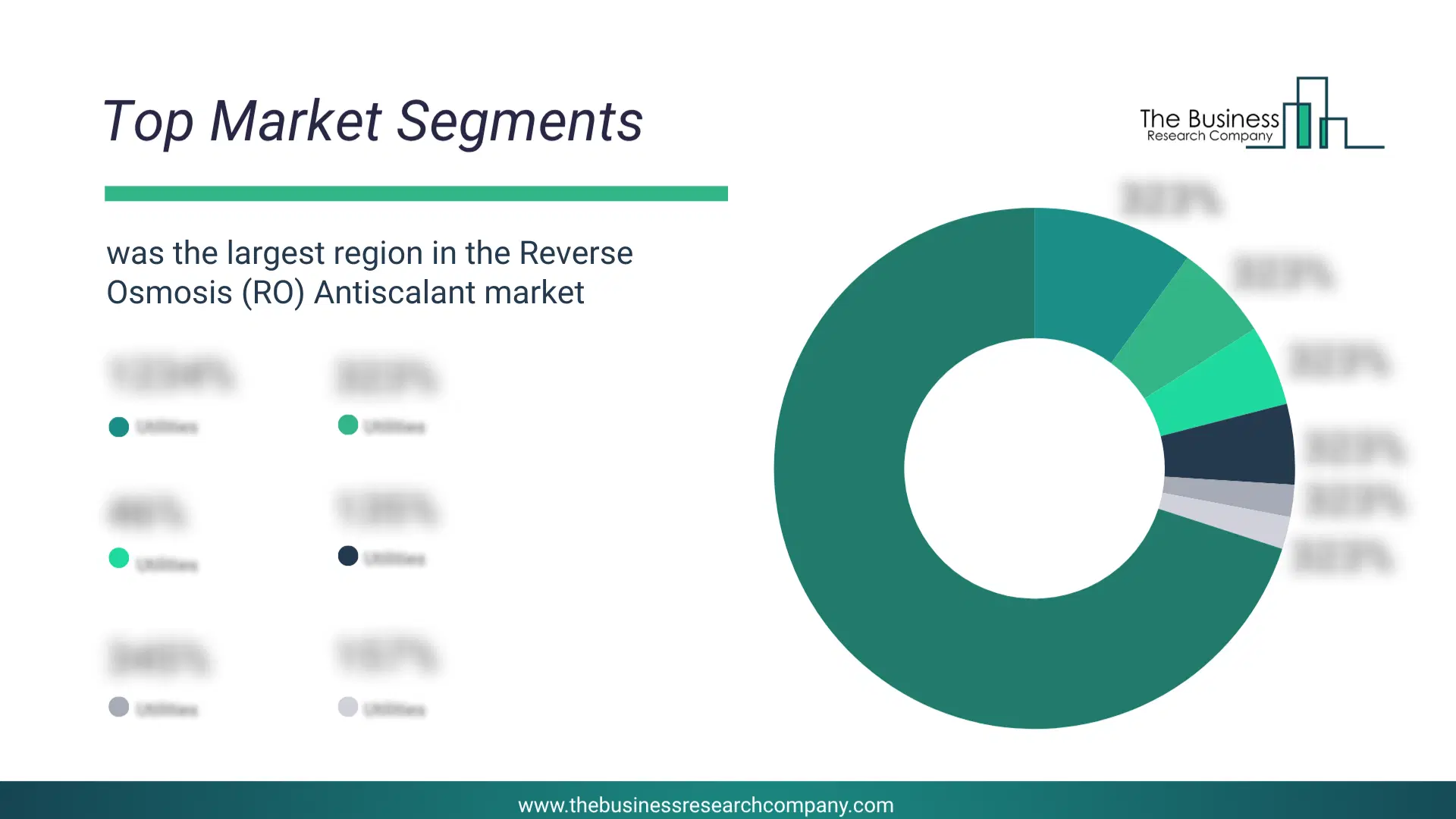
Global Reverse Osmosis (RO) Antiscalant Market Segmentation
1) By Type: Phosphorus Antiscalants, Synthetic Polymeric Antiscalants, Natural Green Antiscalants 2) By Formulation: Liquid Antiscalants, Powder Or Solid Antiscalants 3) By Application: Seawater Desalination, Brackish Water Treatment, Municipal Water Treatment, Industrial Water Treatment, Wastewater Treatment And Reuse, Food And Beverage Processing, Pharmaceutical And Healthcare Water Purification, Power Generation, Other Applications 4) By End-User: Industrial, Power Plants, Petrochemicals, Chemical Manufacturing, Electronics And Semiconductors, Mining, Municipal, Commercial, Residential, Other End-Users Subsegments: 1) By Phosphorus Antiscalants: Amino Phosphonates, Phosphonic Acid Derivatives, Phosphate-based Antiscalants 2) By Synthetic Polymeric Antiscalants: Polyacrylic Acid (PAA), Polycarboxylates, Copolymers 3) By Natural Green Antiscalants: Biodegradable Plant-based Antiscalants, Organic Acid-based Antiscalants, Environmentally Friendly Chelating AgentsWhat Is The Driver Of The Reverse Osmosis (RO) Antiscalant Market?
The growth in the pharmaceutical and biotech sectors is expected to propel the growth of the reverse osmosis (RO) antiscalant market going forward. The pharmaceutical and biotech sectors comprise companies involved in drug discovery, development, manufacturing, and biologics production. The pharmaceutical and biotech sectors are growing primarily due to increasing R&D investments, as companies intensify efforts to develop innovative drugs and biologics. RO antiscalants are used in these sectors to prevent scaling in reverse osmosis systems that produce ultra-pure water for formulation, equipment cleaning, and processing, thereby ensuring consistent water quality, protecting membrane integrity, and maintaining efficient operations. For instance, in October 2025, according to official UK government statistics, life sciences manufacturing turnover reached $61.57 billion (£46.5 billion) in 2023–2024, accounting for 32% of total sector turnover. Therefore, the growth in the pharmaceutical and biotech sectors is driving the growth of the reverse osmosis (RO) antiscalant industry.Key Players In The Global Reverse Osmosis (RO) Antiscalant Market
Major companies operating in the reverse osmosis (RO) antiscalant market are BASF SE, Dow Chemicals, Ecolab Inc., Veolia, SNF Floerger, Gradiant, DuPont, Kurita Water Industries Ltd., Univar Solutions LLC, Kemira Oyg, Genoasis, Genesys International Ltd., Avista Membrane Solutions, Solenis, Shandong IRO Water Treatment Co., Ltd., ACURO ORGANICS LIMITED, Jayem Engineers, GreenFission Chemicals Private Limited, Radik Chemicals, BioKrishi Technologies Pvt. Ltd., Candour Water Solutions'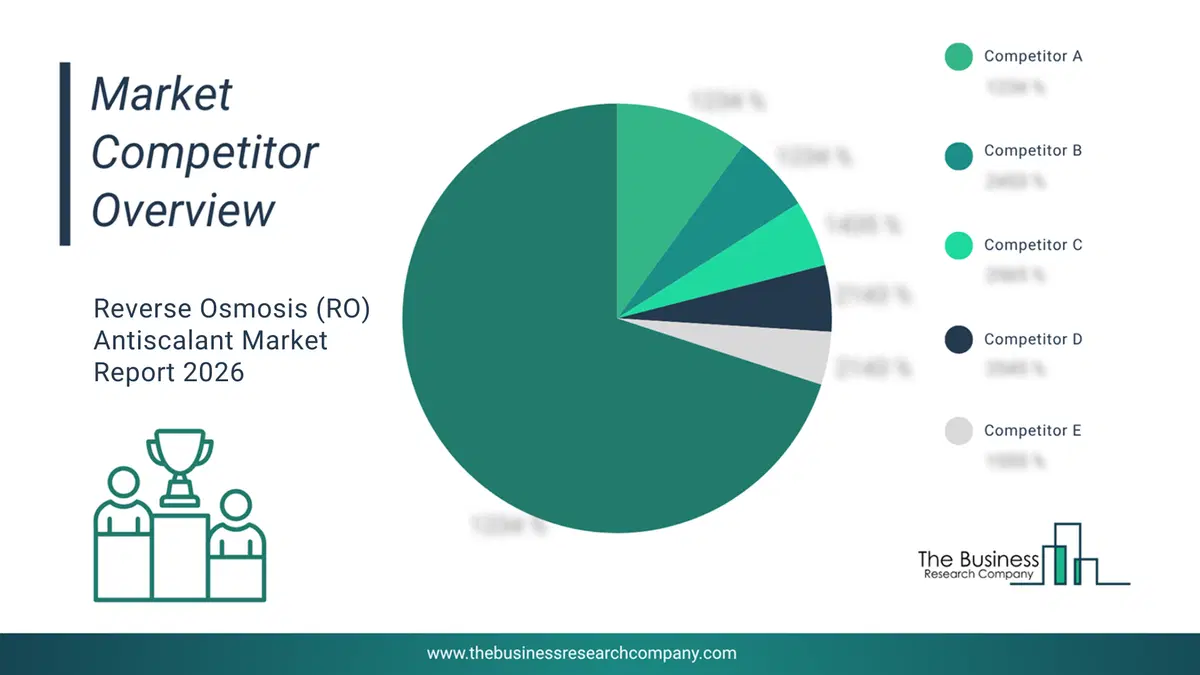
This chart is for illustrative purposes; the full report includes a detailed competitor analysis and comprehensive overview of the top 10 companies in the market.
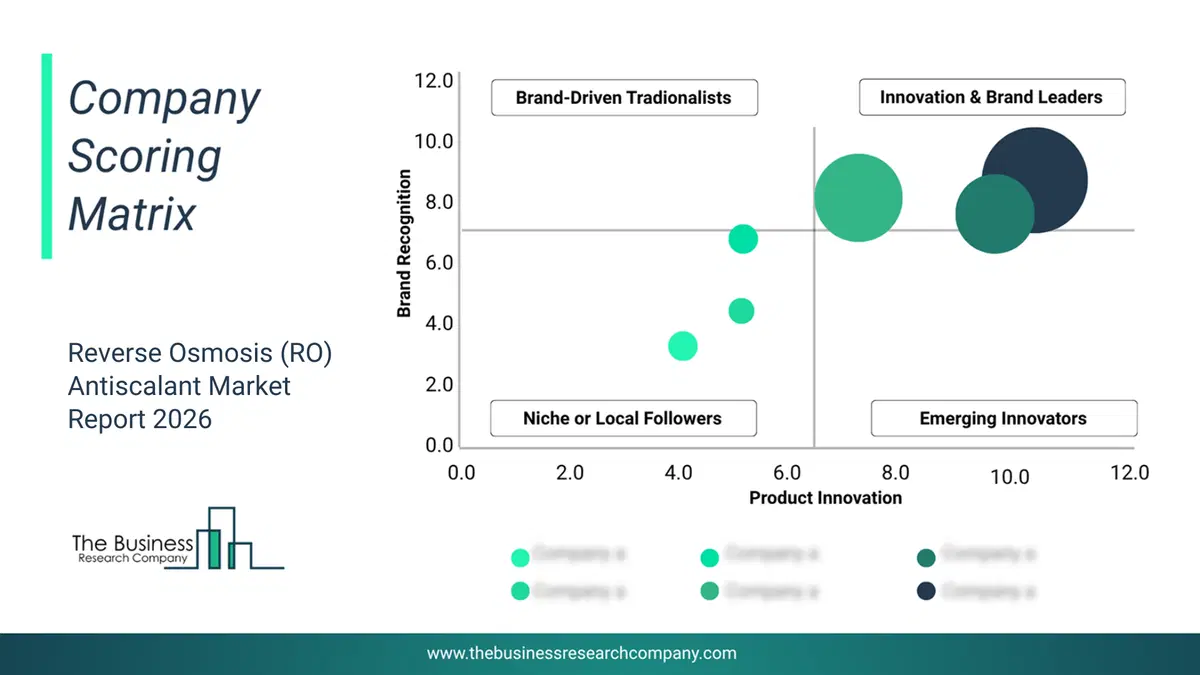
This chart maps companies by product innovation and brand strength, with bubble size indicating relative revenue, helping identify market leaders, challengers, and niche players. This is an illustrative chart; the full report provides a complete and accurate competitive analysis.
Global Reverse Osmosis (RO) Antiscalant Market Trends and Insights
Major companies operating in the reverse osmosis (RO) antiscalant market are focusing on developing advanced solutions such as smart antiscalant dosing systems to enhance efficiency and reduce chemical and energy consumption. Smart antiscalant dosing systems utilize real-time data analytics and automated controls to adjust chemical dosing based on water quality and operational conditions, thereby minimizing waste and optimizing system performance. For instance, in 2025, Grundfos, a Denmark-based company, implemented its Smart Filtration Suite featuring the SmartRO algorithm at a desalination plant in Vadodara, India. The system autonomously determines optimal dosing levels through integrated data analytics, an antiscalant controller, and an optimization module operating in automated mode. This solution reduced energy consumption by 7% and chemical usage by 68%, while also lowering pump energy requirements, demonstrating significant improvements in operational efficiency. 7% andWhat Are Latest Mergers And Acquisitions In The Reverse Osmosis (RO) Antiscalant Market?
In February 2025, Solenis, a US-based provider of specialty chemicals and water treatment solutions, acquired NCH Corporation for an undisclosed amount. Through this acquisition, Solenis aims to expand its global footprint, strengthen its technological capabilities, and diversify its portfolio in industrial and water treatment applications. NCH Corporation is a US-based company that provides reverse osmosis (RO) antiscalants through its water treatment division.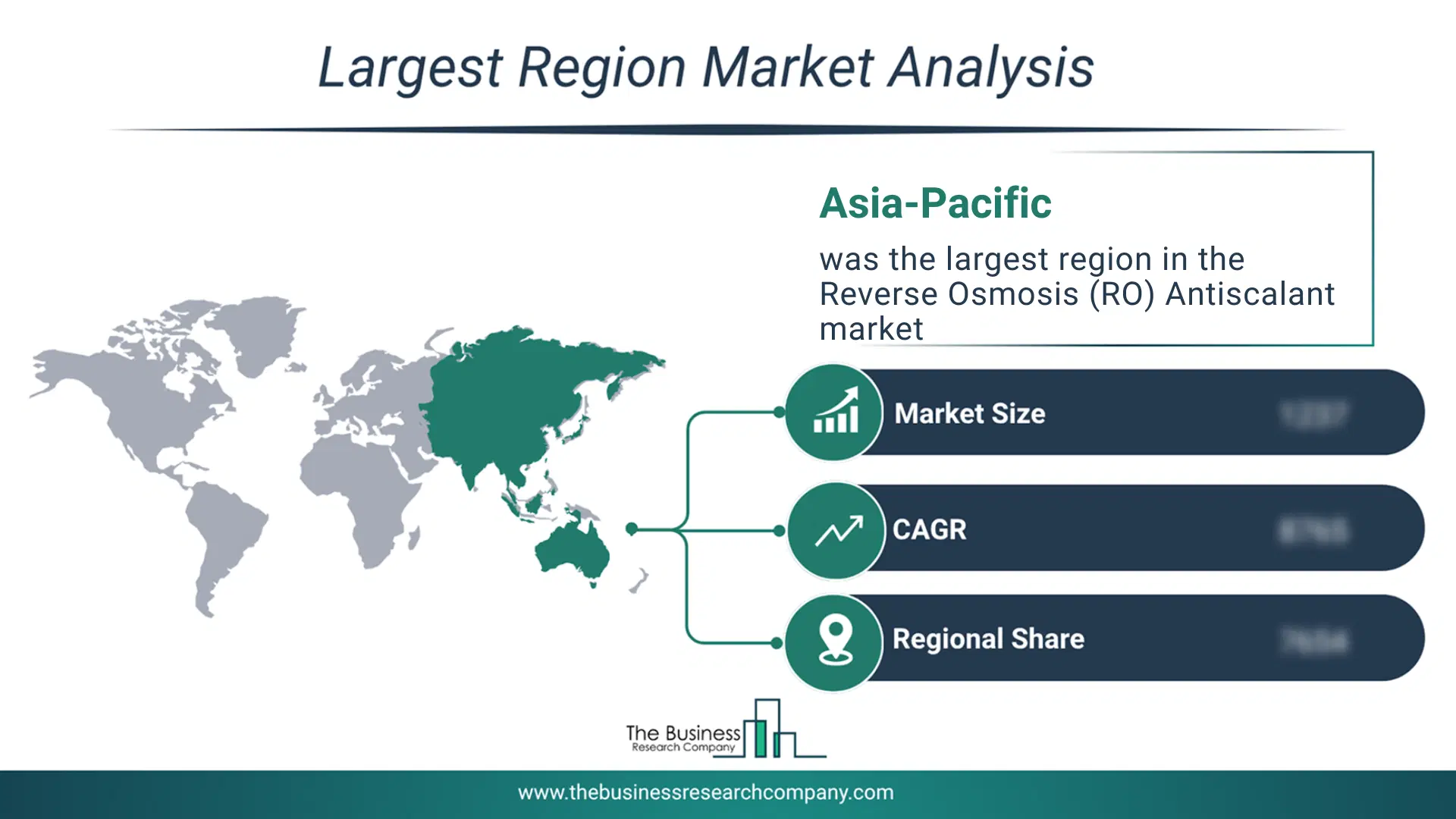
Regional Insights
Asia-Pacific was the largest region in the reverse osmosis (RO) antiscalant market in 2025. North America is expected to be the fastest-growing region in the forecast period. The regions covered in this market report are Asia-Pacific, South East Asia, Western Europe, Eastern Europe, North America, South America, Middle East, Africa. The countries covered in this market report are Australia, Brazil, China, France, Germany, India, Indonesia, Japan, Taiwan, Russia, South Korea, UK, USA, Canada, Italy, Spain.What Defines the Reverse Osmosis (RO) Antiscalant Market?
The reverse osmosis (RO) Antiscalant market consists of sales of organophosphonate antiscalants, polyacrylate antiscalants, sulfonated copolymer antiscalants, silica control antiscalants, sulfate scale inhibitors, carbonate scale inhibitors, liquid RO antiscalant solutions, and concentrated RO antiscalant formulations. Values in this market are ‘factory gate’ values, that is, the value of goods sold by the manufacturers or creators of the goods, whether to other entities (including downstream manufacturers, wholesalers, distributors, and retailers) or directly to end customers. The value of goods in this market includes related services sold by the creators of the goods.How is Market Value Defined and Measured?
The market value is defined as the revenues that enterprises gain from the sale of goods and/or services within the specified market and geography through sales, grants, or donations in terms of the currency (in USD unless otherwise specified). The revenues for a specified geography are consumption values that are revenues generated by organizations in the specified geography within the market, irrespective of where they are produced. It does not include revenues from resales along the supply chain, either further along the supply chain or as part of other products.
This chart presents market attractiveness based on a quantitative evaluation of growth, competition, strategic alignment, and risk, offering a clear view of opportunity areas for decision-making. This chart is for illustrative purposes; the full report contains the complete analysis.

This chart highlights the Total Addressable Market (TAM) by estimating the maximum revenue opportunity using an assumption-driven approach, supporting strategic planning and opportunity sizing across markets. The chart is illustrative; the full report provides a more comprehensive analysis.
What Key Data and Analysis Are Included in the Reverse Osmosis (RO) Antiscalant Market Report 2026?
The reverse osmosis (ro) antiscalant market research report is one of a series of new reports from The Business Research Company that provides market statistics, including industry global market size, regional shares, competitors with the market share, detailed market segments, market trends and opportunities, and any further data you may need to thrive in the reverse osmosis (ro) antiscalant industry. The market research report delivers a complete perspective of everything you need, with an in-depth analysis of the current and future state of the industry.Reverse Osmosis (RO) Antiscalant Market Report Forecast Analysis
| Report Attribute | Details |
|---|---|
| Market Size Value In 2026 | $4.22 billion |
| Revenue Forecast In 2030 | $5.22 billion |
| Growth Rate | CAGR of 5.2% from 2026 to 2030 |
| Base Year For Estimation | 2025 |
| Actual Estimates/Historical Data | 2020-2025 |
| Forecast Period | 2026 - 2030 |
| Market Representation | Revenue in USD Billion and CAGR from 2026 to 2030 |
| Segments Covered | Type, Formulation, Application, End-User |
| Regional Scope | Asia-Pacific, Western Europe, Eastern Europe, North America, South America, Middle East, Africa |
| Country Scope | The countries covered in this market report are Australia, Brazil, China, France, Germany, India, Indonesia, Japan, Taiwan, Russia, South Korea, UK, USA, Canada, Italy, Spain |
| Key Companies Profiled | BASF SE, Dow Chemicals, Ecolab Inc., Veolia, SNF Floerger, Gradiant, DuPont, Kurita Water Industries Ltd., Univar Solutions LLC, Kemira Oyg, Genoasis, Genesys International Ltd., Avista Membrane Solutions, Solenis, Shandong IRO Water Treatment Co., Ltd., ACURO ORGANICS LIMITED, Jayem Engineers, GreenFission Chemicals Private Limited, Radik Chemicals, BioKrishi Technologies Pvt. Ltd., Candour Water Solutions' |
| Customization Scope | Request for Customization |
| Pricing And Purchase Options | Explore Purchase Options |