
Reversible Inhibitors Of Monoamine (RIMA) Antidepressants Market Report 2026
Global Outlook – By Type (Selective Reversible Inhibitors Of Monoamine Oxidase A, Non Selective Reversible Inhibitors Of Monoamine Oxidase A), By Indication (Dysthymia, Major Depressive Disorder, Anxiety Disorders, Social Phobia, Other Indications), By Patient Demographics (Adolescent, Adult, Geriatric), By End User (Hospitals And Clinics, Research And Academic Institutions) – Market Size, Trends, Strategies, and Forecast to 2030
Reversible Inhibitors Of Monoamine (RIMA) Antidepressants Market Overview
• Reversible Inhibitors Of Monoamine (RIMA) Antidepressants market size has reached to $5.67 billion in 2025 • Expected to grow to $7.49 billion in 2030 at a compound annual growth rate (CAGR) of 5.8% • Growth Driver: Rising Prevalence Of Depression And Anxiety Disorders Fueling The Growth Of The Market Due To Increasing Demand For Safer And Better-tolerated Mental Health Treatments • North America was the largest region in 2025 and Asia-Pacific is the fastest growing region.What Is Covered Under Reversible Inhibitors Of Monoamine (RIMA) Antidepressants Market?
Reversible inhibitors of monoamine (RIMA) antidepressants are a class of psychoactive compounds that selectively and reversibly inhibit the monoamine oxidase A enzyme, increasing the availability of neurotransmitters such as serotonin, norepinephrine, and dopamine in the brain. These compounds temporarily bind to the enzyme rather than permanently deactivating it, enabling controlled modulation of monoamine metabolism with reduced long-term enzyme inhibition effects. The main types of reversible inhibitors of monoamine (RIMA) antidepressants include selective reversible inhibitors of monoamine oxidase A and non selective reversible inhibitors of monoamine oxidase A. Selective reversible inhibitors of monoamine oxidase A refer to antidepressant medications that temporarily inhibit the monoamine oxidase A enzyme, increasing the availability of neurotransmitters such as serotonin, norepinephrine, and dopamine. These therapeutics are indicated for dysthymia, major depressive disorder, anxiety disorders, social phobia, and other indications. They are used across patient demographics including adolescent, adult, and geriatric populations, and are utilized by end users including hospitals and clinics and research and academic institutions.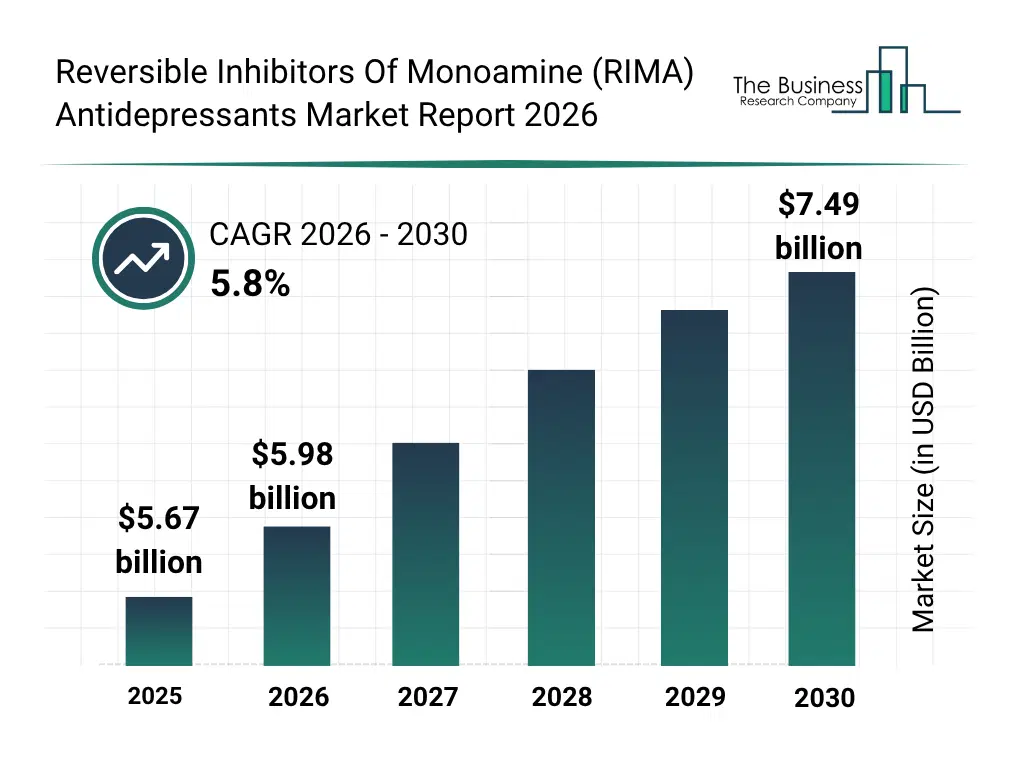
What Is The Reversible Inhibitors Of Monoamine (RIMA) Antidepressants Market Size and Share 2026?
The reversible inhibitors of monoamine (RIMA) antidepressants market size has grown strongly in recent years. It will grow from $5.67 billion in 2025 to $5.98 billion in 2026 at a compound annual growth rate (CAGR) of 5.5%. The growth in the historic period can be attributed to rising prevalence of depression and anxiety disorders, increasing awareness of mental health treatment, expansion of antidepressant pharmacotherapy adoption, development of selective monoamine oxidase inhibitors, improvements in psychiatric diagnosis and screening.What Is The Reversible Inhibitors Of Monoamine (RIMA) Antidepressants Market Growth Forecast?
The reversible inhibitors of monoamine (RIMA) antidepressants market size is expected to see strongly grown in the next few years. It will grow to $7.49 billion in 2030 at a compound annual growth rate (CAGR) of 5.8%. The growth in the forecast period can be attributed to growth in precision medicine for mental health disorders, integration of digital therapeutics with pharmacological treatment, increasing demand for safer reversible antidepressant therapies, expansion of telepsychiatry services, advancements in neurobiology and neurotransmitter research. Major trends in the forecast period include personalized psychiatry and precision psychopharmacology adoption, digital mental health integration with antidepressant therapy monitoring, biomarker-driven neurochemical treatment optimization, expansion of outpatient psychiatric care models, increased focus on reversible enzyme targeting drug safety.
Global Reversible Inhibitors Of Monoamine (RIMA) Antidepressants Market Segmentation
1) By Type: Selective Reversible Inhibitors Of Monoamine Oxidase A; Non Selective Reversible Inhibitors Of Monoamine Oxidase A 2) By Indication: Dysthymia; Major Depressive Disorder; Anxiety Disorders; Social Phobia; Other Indications 3) By Patient Demographics: Adolescent; Adult; Geriatric 4) By End User: Hospitals And Clinics; Research And Academic Institutions Subsegments: 1) By Selective Reversible Inhibitors Of Monoamine Oxidase A: Pirlindole; Moclobemide; Metralindole; Brofaromine 2) By Non Selective Reversible Inhibitors Of Monoamine Oxidase A: Multimodal Action Monoamine Oxidase Inhibitors; Dual Reversible Inhibitors Of Monoamine Oxidase A And B; Natural Reversible Inhibitors Of Monoamine Oxidase A; Investigational Reversible Inhibitors Of Monoamine Oxidase A CompoundsWhat Are The Drivers Of The Reversible Inhibitors Of Monoamine (RIMA) Antidepressants Market?
The rising prevalence of depression and anxiety disorders is expected to propel the growth of the reversible inhibitors of monoamine (RIMA) antidepressants market going forward. Prevalence of depression and anxiety disorders refers to the proportion of a specific population that is affected by these mental health conditions at a given point in time or over a defined period. The rising prevalence of depression and anxiety is largely driven by a combination of increasing social and economic stressors. The RIMA addresses the rising prevalence of mental health disorders by offering safer, more tolerable antidepressant options that eliminate the strict dietary constraints of older therapies. For instance, in May 2024, according to American Psychiatric Association, an US-based non-profit organization, in 2024 annual mental health poll reveals a steady increase in anxiety among U.S. adults, with 43% of participants reporting that they felt more anxious in 2024 than in the prior year, a rise from 37% in 2023 and 32% in 2022. Therefore, the rising prevalence of depression and anxiety disorders are driving the growth of reversible inhibitors of monoamine (RIMA) antidepressants industry. The rising healthcare expenditure is expected to propel the growth of the reversible inhibitors of monoamine (RIMA) antidepressants market going forward. Healthcare expenditure refers to the total amount spent on healthcare goods and services, including medical treatments, hospital care, medications, and mental health services. The rising healthcare expenditure is largely driven by increasing investments in healthcare infrastructure and growing awareness regarding psychiatric disorders. Increasing healthcare expenditure supports the adoption of reversible inhibitors of monoamine (RIMA) antidepressants by increasing access to advanced mental health treatments, improving psychiatric care services, and boosting spending on effective antidepressant therapies. For instance, in April 2025, according to the American Medical Association, a US-based professional organization representing physicians and medical students, U.S. healthcare spending increased by 7.5% in 2023, reaching $4.9 trillion, or $14,570 per person, compared to a 4.6% growth rate in 2022. Therefore, the rising healthcare expenditure is driving the growth of the reversible inhibitors of monoamine (RIMA) antidepressants industry. The growing focus on personalized and precision medicine is expected to propel the growth of the reversible inhibitors of monoamine (RIMA) antidepressants market going forward. Personalized and precision medicine refers to a medical approach that tailors treatment strategies based on an individual’s genetic profile, lifestyle, and specific disease characteristics. The growing focus on personalized and precision medicine is driven by advancements in genomic technologies and increasing demand for targeted therapies with improved treatment outcomes and fewer side effects. RIMA antidepressants support personalized mental health treatment by offering selective and reversible inhibition of monoamine oxidase-A, enabling improved tolerability and individualized therapeutic approaches for patients with depressive disorders. For instance, in February 2024, according to the Personalized Medicine Coalition, a US-based professional membership organization, the FDA approved 16 new personalized treatments for patients with rare diseases in 2023, compared to six approvals in 2022. Therefore, the growing focus on personalized and precision medicine is driving the growth of the reversible inhibitors of monoamine (RIMA) antidepressants industry.Key Players In The Global Reversible Inhibitors Of Monoamine (RIMA) Antidepressants Market
Major companies operating in the reversible inhibitors of monoamine (rima) antidepressants market are AbbVie Inc.; Roche Holding AG; Viatris Inc.; H. Lundbeck A/S; Teva Pharmaceutical Industries Ltd.; Bausch Health Companies Inc.; Sun Pharmaceutical Industries Limited; Cipla Limited; Torrent Pharmaceuticals Ltd.; Intas Pharmaceuticals Limited; Apotex Inc.; Alembic Pharmaceuticals Limited; Lunan Pharmaceutical Group Corporation; Micro Labs Limited; Fabre-Kramer Pharmaceuticals Inc.Regional Outlook
North America was the largest region in the reversible inhibitors of monoamine (RIMA) antidepressants market in 2025. Asia-Pacific is expected to be the fastest-growing region in the forecast period. The regions covered in this market report are Asia-Pacific, South East Asia, Western Europe, Eastern Europe, North America, South America, Middle East, Africa. The countries covered in this market report are Australia, Brazil, China, France, Germany, India, Indonesia, Japan, Taiwan, Russia, South Korea, UK, USA, Canada, Italy, Spain.What Defines the Reversible Inhibitors Of Monoamine (RIMA) Antidepressants Market?
The reversible inhibitors of monoamine (RIMA) antidepressants market consists of sales of moclobemide, toloxatone, brofaromine, befloxatone, and pirlindole. Values in this market are ‘factory gate’ values, that is the value of goods sold by the manufacturers or creators of the goods, whether to other entities (including downstream manufacturers, wholesalers, distributors and retailers) or directly to end customers. The value of goods in this market includes related services sold by the creators of the goodsHow is Market Value Defined and Measured?
The market value is defined as the revenues that enterprises gain from the sale of goods and/or services within the specified market and geography through sales, grants, or donations in terms of the currency (in USD unless otherwise specified). The revenues for a specified geography are consumption values that are revenues generated by organizations in the specified geography within the market, irrespective of where they are produced. It does not include revenues from resales along the supply chain, either further along the supply chain or as part of other products.What Key Data and Analysis Are Included in the Reversible Inhibitors Of Monoamine (RIMA) Antidepressants Market Report 2026?
The reversible inhibitors of monoamine (rima) antidepressants market research report is one of a series of new reports from The Business Research Company that provides market statistics, including industry global market size, regional shares, competitors with the market share, detailed market segments, market trends and opportunities, and any further data you may need to thrive in the reversible inhibitors of monoamine (rima) antidepressants industry. The market research report delivers a complete perspective of everything you need, with an in-depth analysis of the current and future state of the industry.Reversible Inhibitors Of Monoamine (RIMA) Antidepressants Market Report Forecast Analysis
| Report Attribute | Details |
|---|---|
| Market Size Value In 2026 | $5.98 billion |
| Revenue Forecast In 2030 | $7.49 billion |
| Growth Rate | CAGR of 5.8% from 2026 to 2030 |
| Base Year For Estimation | 2025 |
| Actual Estimates/Historical Data | 2020-2025 |
| Forecast Period | 2026 - 2030 |
| Market Representation | Revenue in USD Billion and CAGR from 2026 to 2030 |
| Segments Covered | Type, Indication, Patient Demographics, End User |
| Regional Scope | Asia-Pacific, Western Europe, Eastern Europe, North America, South America, Middle East, Africa |
| Country Scope | The countries covered in the report are Australia, Brazil, China, France, Germany, India, ... |
| Key Companies Profiled | AbbVie Inc.; Roche Holding AG; Viatris Inc.; H. Lundbeck A/S; Teva Pharmaceutical Industries Ltd.; Bausch Health Companies Inc.; Sun Pharmaceutical Industries Limited; Cipla Limited; Torrent Pharmaceuticals Ltd.; Intas Pharmaceuticals Limited; Apotex Inc.; Alembic Pharmaceuticals Limited; Lunan Pharmaceutical Group Corporation; Micro Labs Limited; Fabre-Kramer Pharmaceuticals Inc. |
| Customization Scope | Request for Customization |
| Pricing And Purchase Options | Explore Purchase Options |