
Rheology Modifiers Market Report 2026
Global Outlook – By Type (Organic, Inorganic), By Application (Paints And Coatings, Cosmetics And Personal Care, Adhesives And Sealants, Pharmaceuticals, Home Care, Oil And Gas, Construction, Inks, Other Applications), By Distribution Channel (Direct, Indirect ) – Market Size, Trends, Strategies, and Forecast to 2030
Rheology Modifiers Market Overview
• Rheology Modifiers market size has reached to $8.89 billion in 2025 • Expected to grow to $11.53 billion in 2030 at a compound annual growth rate (CAGR) of 5.4% • Growth Driver: The Interplay Between The Expanding Paints And Coatings Industry And Rheology Modifiers Market Growth • Market Trend: Biodegradable Technology Revolutionizes Rheology Modifiers For Enhanced Performance • Asia-Pacific was the largest region in 2025 and Asia-Pacific is the fastest growing region.Market Gains By 2030 – Top Opportunities By Segment
Market Gain identifies the most promising market opportunities by highlighting the segments or products expected to generate the highest incremental revenue growth over the next five years.
What Is Covered Under Rheology Modifiers Market?
Rheology modifiers, also known as viscosity modifiers, are substances that are added to a material to change its flow behavior or viscosity. They are commonly used in various industries such as paints and coatings, adhesives, cosmetics, and food processing. The main types of rheology modifiers are organic and inorganic. Inorganic substances are compounds that do not contain carbon-hydrogen bonds and are typically derived from minerals or non-living sources. Inorganic rheology modifiers encompass a range of materials, including clays, silica, talc, and various metal oxides. These substances can interact with the formulation matrix to form structures or networks that influence the flow behavior of the material. These are used for various applications such as paints and coatings, cosmetics and personal care, adhesives and sealants, pharmaceuticals, home care, oil and gas, construction, inks, and others, and are distributed by different distribution channels such as direct and indirect.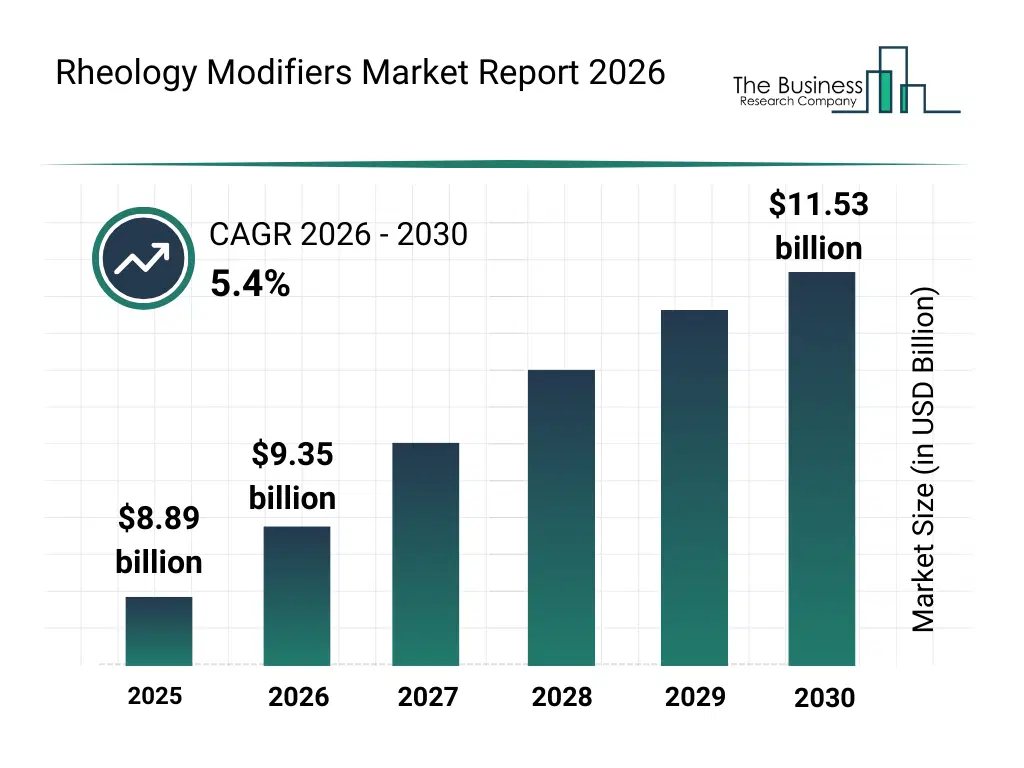
What Is The Rheology Modifiers Market Size and Share 2026?
The rheology modifiers market size has grown strongly in recent years. It will grow from $8.89 billion in 2025 to $9.35 billion in 2026 at a compound annual growth rate (CAGR) of 5.2%. The growth in the historic period can be attributed to expansion of construction and coatings industry, growth of cosmetic and personal care products, increasing demand for formulation consistency, rising use of additives in industrial applications, availability of diverse thickening agents.What Is The Rheology Modifiers Market Growth Forecast?
The rheology modifiers market size is expected to see strong growth in the next few years. It will grow to $11.53 billion in 2030 at a compound annual growth rate (CAGR) of 5.4%. The growth in the forecast period can be attributed to increasing adoption of sustainable formulation ingredients, rising demand for high-performance coatings, expansion of specialty chemical applications, growing focus on bio-based rheology modifiers, increasing investments in formulation innovation. Major trends in the forecast period include increasing demand for advanced viscosity control solutions, rising use in water-based formulations, growing adoption in paints and coatings, expansion of clean-label cosmetic products, enhanced focus on formulation stability.
Global Rheology Modifiers Market Segmentation
1) By Type: Organic, Inorganic 2) By Application: Paints And Coatings, Cosmetics And Personal Care, Adhesives And Sealants, Pharmaceuticals, Home Care, Oil And Gas, Construction, Inks, Other Applications 3) By Distribution Channel: Direct, Indirect Subsegments: 1) By Organic: Cellulose Derivatives, Acrylic Polymers, Natural Gums, Associative Thickeners 2) By Inorganic: Clay-Based Thickeners, Silica-Based Thickeners, Other Inorganic Modifiers The top segments in the rheology modifiers market will be: • Organic will reach $8.05 Billion by 2030. • Inorganic will reach $3.73 Billion by 2030.What Is The Driver Of The Rheology Modifiers Market?
The expanding paints and coatings industry is expected to propel the growth of the rheology modifiers market going forward. The paints and coatings industry refers to the sector involved in the production, distribution, and application of paints, coatings, and related products. Rheology modifiers are added to paint and coating formulations to improve their rheological properties. These modifiers help control the viscosity, thixotropy, and sag resistance of the formulations, ensuring that the coatings are easy to apply and provide a consistent finish. For instance, in January 2024, according to the World Paint and Coatings Industry Association, a Belgium-based international non-profit organization, in 2023, the global paint and coatings market reached a value of $185.5 billion, marking a 3.2% increase compared to 2022. Therefore, the expanding paints and coatings industry is expected to propel the growth of the rheology modifiers industry.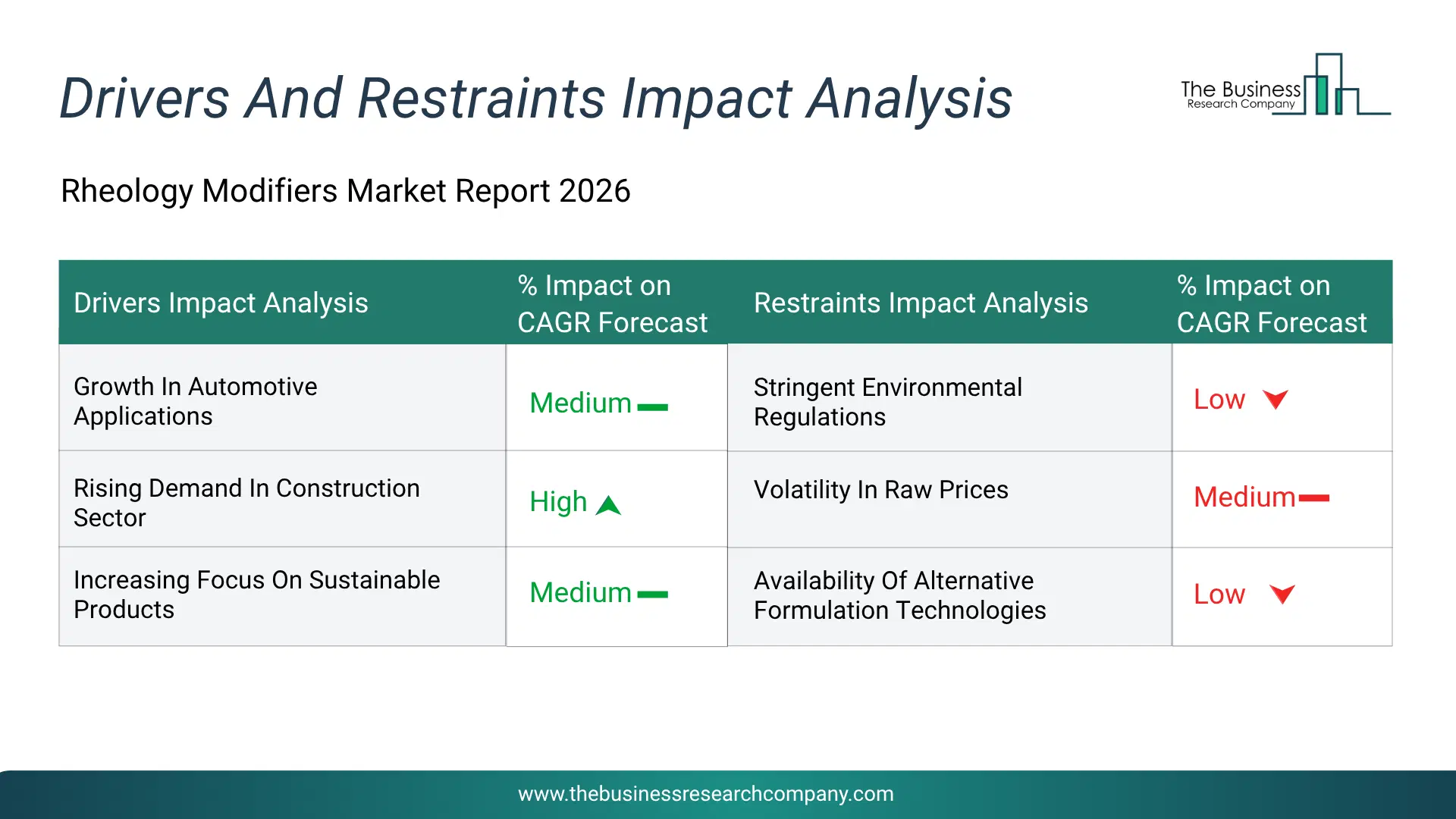
Infographic Chart Showing Key Market Drivers Analysis And Restraints For Rheology Modifiers Market
The chart presents an impact analysis of key drivers and restraints, quantifying their relative influence on the market's growth rate and helping assess the balance between growth enablers and limiting factors. This chart offers a high-level perspective; the full report contains more detailed insights.
How Will The Drivers Impact Growth In The Global Rheology Modifiers Market?
• Growth In Automotive Applications (Medium) – During the forecast period, the growth in automotive applications is expected to become a key growth driver for the rheology modifiers market by 2030. Growth in automotive applications is a significant driver for the rheology modifiers market because these additives play a crucial role in enhancing the performance of automotive coatings, adhesives, sealants, and lubricants. Rheology modifiers help control viscosity, improve flow characteristics, and ensure uniform application of coatings on vehicle surfaces. As automotive manufacturers increasingly focus on lightweight materials and advanced coating technologies, the demand for high-performance rheology modifiers continues to rise. These additives also contribute to improved durability, scratch resistance, and corrosion protection of automotive components. The growing production of passenger vehicles, electric vehicles, and commercial vehicles further expands the need for specialty formulations. Additionally, manufacturers seek materials that improve production efficiency while maintaining product quality. • Rising Demand In Construction Sector (High) – During the forecast period, the rising demand in construction sector is expected to emerge as a major factor driving the expansion of the rheology modifiers market by 2030. Rising demand in construction sector acts as a major growth driver for the rheology modifiers market due to their extensive use in paints, coatings, sealants, cementitious products, and construction adhesives. Rheology modifiers help improve workability, consistency, sag resistance, and application properties of construction materials. With increasing urbanization and infrastructure development projects worldwide, the demand for high-performance building materials continues to grow. These additives ensure better stability and durability of coatings used on residential, commercial, and industrial structures. They also enhance water retention and ease of application in construction formulations. Growing investments in renovation and sustainable building projects further stimulate product adoption. • Increasing Focus On Sustainable Products (Medium) – During the forecast period, the increasing focus on sustainable products is expected to act as a key growth catalyst for the rheology modifiers market by 2030. Increasing focus on sustainable products is driving the rheology modifiers market as industries actively seek environmentally responsible formulation solutions. Manufacturers are developing bio-based and low-VOC rheology modifiers to comply with evolving environmental regulations and sustainability goals. These products help reduce environmental impact while maintaining desirable performance characteristics in paints, coatings, personal care products, and industrial applications. Consumer preference for eco-friendly products is encouraging companies to reformulate existing products using sustainable ingredients. Industries are also investing in greener production technologies to improve their environmental footprint. The shift toward circular economy practices and renewable raw materials further boosts demand for sustainable rheology modifiers.How Will The Restraints Impact Growth In The Global Rheology Modifiers Market?
• Stringent Environmental Regulations (Medium) – During the forecast period, the stringent environmental regulations act as a significant restraint on the rheology modifiers market by increasing compliance requirements for manufacturers. Regulatory authorities across various regions impose strict standards regarding chemical composition, emissions, toxicity, and environmental impact of industrial additives. Companies are often required to reformulate products, conduct extensive testing, and obtain certifications before commercialization, which increases operational costs and product development timelines. Compliance with changing environmental policies can also limit the use of certain raw materials and conventional formulations. Small and medium-sized manufacturers may face greater financial and technical challenges in meeting these regulatory expectations. Additionally, delays in regulatory approvals can slow product launches and market expansion efforts. These factors collectively create obstacles to market growth and profitability. • Volatility In Raw Prices (High) – During the forecast period, the volatility in raw prices restrains the growth of the rheology modifiers market by creating uncertainty in production costs and supply chain management. Many rheology modifiers are manufactured using petroleum-based chemicals, specialty polymers, and other raw materials whose prices are influenced by fluctuations in crude oil markets, geopolitical events, and supply-demand imbalances. Sudden increases in raw material costs can significantly reduce profit margins for manufacturers and make pricing strategies more difficult. Frequent price changes may also affect long-term contracts and purchasing decisions among end users. In addition, supply disruptions can lead to shortages of essential ingredients, impacting production schedules and product availability. Manufacturers often face challenges in transferring increased costs to customers in highly competitive markets. As a result, raw material price instability remains a key factor limiting the consistent growth of the rheology modifiers market. • Availability Of Alternative Formulation Technologies (Medium) – During the forecast period, the availability of alternative formulation technologies restrains the growth of the rheology modifiers market by providing manufacturers with substitute solutions for controlling viscosity, stability, and flow properties in various applications. Advances in formulation chemistry have enabled the use of multifunctional additives and novel ingredient combinations that can reduce or eliminate the need for conventional rheology modifiers. End users may adopt these alternatives to simplify formulations, lower production costs, or improve product performance. The availability of substitute technologies increases competitive pressure on rheology modifier manufacturers and limits pricing flexibility. It also reduces demand in certain application segments where alternative solutions offer comparable functionality. These factors can slow product adoption and restrict market expansion. Consequently, the growing availability of alternative formulation technologies acts as a restraint on the rheology modifiers market.Key Players In The Global Rheology Modifiers Market
Major companies operating in the rheology modifiers market are BASF SE, Arkema S.A., Evonik Industries AG, Clariant AG, Dow Inc., Ashland Global Holdings Inc., Lubrizol Corporation, Solvay S.A., Croda International Plc, Cabot Corporation, Elementis plc, BYK-Chemie GmbH, Nouryon Chemicals Holding B.V., Huntsman Corporation, Wacker Chemie AG, LANXESS AG, Shin-Etsu Chemical Co., Ltd., Mitsubishi Chemical Group Corporation, Allnex Belgium SA/NV, Celanese Corporation
This chart is for illustrative purposes; the full report includes a detailed competitor analysis and comprehensive overview of the top 10 companies in the market.
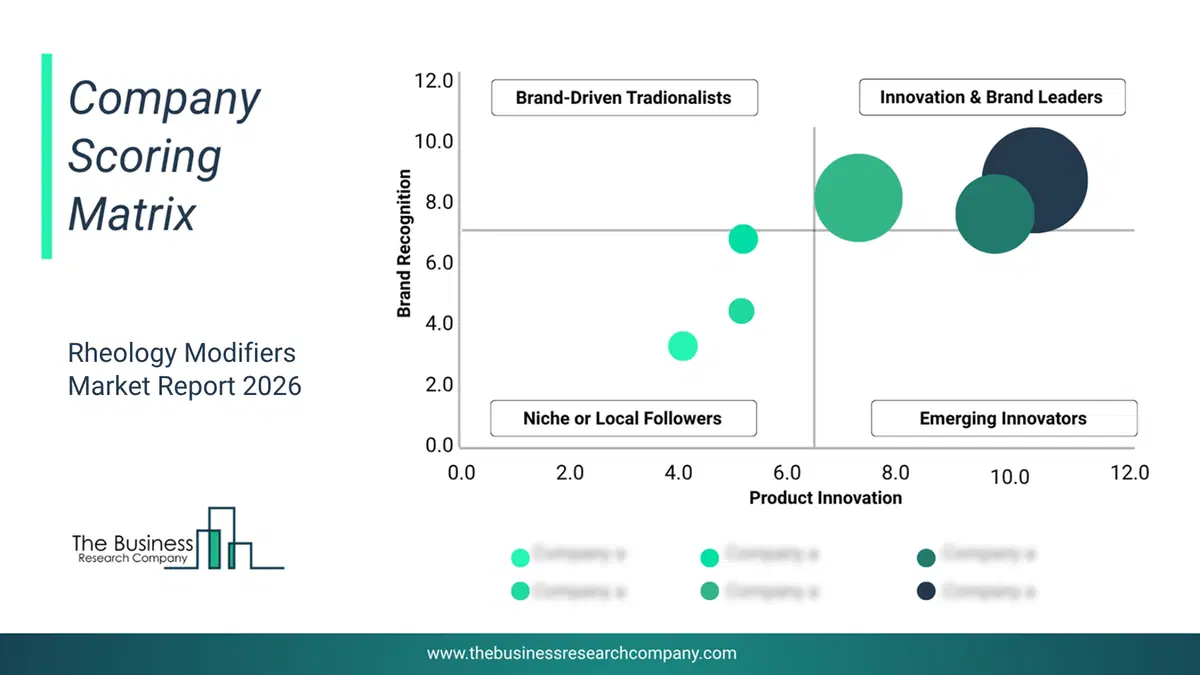
This chart maps companies by product innovation and brand strength, with bubble size indicating relative revenue, helping identify market leaders, challengers, and niche players. This is an illustrative chart; the full report provides a complete and accurate competitive analysis.
Global Rheology Modifiers Market Trends and Insights
Major companies operating in the rheology modifier market are focused on sustainable solutions such as biodegradable rheology modifiers to gain a competitive advantage. A biodegradable rheology modifier refers to a substance that alters the flow and viscosity of materials while being environmentally friendly, as it can break down naturally without leaving harmful residues. For instance, in February 2023, Clariant AG, a Switzerland-based chemicals company, launched Aristoflex Eco T, a biodegradable rheology modifier designed for use in skincare formulations. It is derived from Tara gum, sourced from the Tara Spinosa plant in the Peruvian Andes. It offers a luxurious texture and stability comparable to traditional synthetic polymers while being environmentally friendly. This innovative ingredient enables formulators to create high-performance products such as facial creams, body lotions, and sun care items, meeting the growing demand for sustainable and effective skincare solutions.What Are Latest Mergers And Acquisitions In The Rheology Modifiers Market?
In July 2024, Tate & Lyle PLC, a UK-based food and beverage company, acquired CP Kelco for $1.8 billion. This acquisition is part of Tate & Lyle's strategic shift towards healthier, clean-label ingredients amid growing consumer concerns about sugar and long ingredient lists in food products. CP Kelco, a US-based manufacturer of specialty ingredients, including rheology modifiers.
Regional Insights
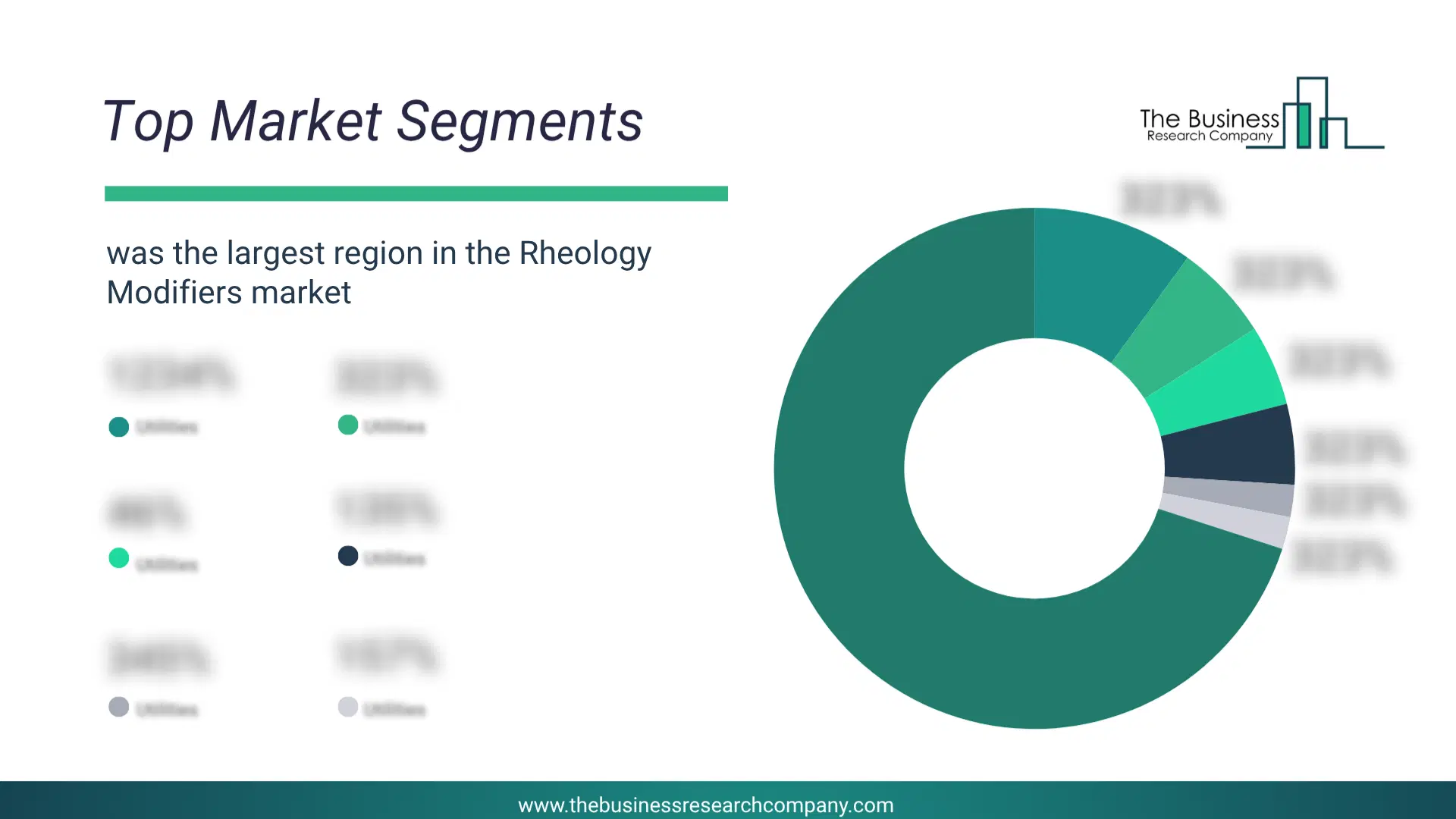
Asia-Pacific was the largest region in the rheology modifiers market in 2025 and is expected to be the fastest-growing region in the forecast period. The regions covered in this market report are Asia-Pacific, South East Asia, Western Europe, Eastern Europe, North America, South America, Middle East, Africa The countries covered in this market report are Australia, Brazil, China, France, Germany, India, Indonesia, Japan, Taiwan, Russia, South Korea, UK, USA, Canada, Italy, SpainWhat Defines the Rheology Modifiers Market?
The rheology modifiers market consists of sales of synthetic thickeners, associate thickeners, clay-based modifiers, silica-based modifiers, and others. Values in this market are ‘factory gate’ values, that is the value of goods sold by the manufacturers or creators of the goods, whether to other entities (including downstream manufacturers, wholesalers, distributors and retailers) or directly to end customers. The value of goods in this market includes related services sold by the creators of the goods.How is Market Value Defined and Measured?
The market value is defined as the revenues that enterprises gain from the sale of goods and/or services within the specified market and geography through sales, grants, or donations in terms of the currency (in USD unless otherwise specified). The revenues for a specified geography are consumption values that are revenues generated by organizations in the specified geography within the market, irrespective of where they are produced. It does not include revenues from resales along the supply chain, either further along the supply chain or as part of other products.
This chart presents market attractiveness based on a quantitative evaluation of growth, competition, strategic alignment, and risk, offering a clear view of opportunity areas for decision-making. This chart is for illustrative purposes; the full report contains the complete analysis.

This chart highlights the Total Addressable Market (TAM) by estimating the maximum revenue opportunity using an assumption-driven approach, supporting strategic planning and opportunity sizing across markets. The chart is illustrative; the full report provides a more comprehensive analysis.
What Key Data and Analysis Are Included in the Rheology Modifiers Market Report 2026?
The rheology modifiers market research report is one of a series of new reports from The Business Research Company that provides market statistics, including industry global market size, regional shares, competitors with the market share, detailed market segments, market trends and opportunities, and any further data you may need to thrive in the rheology modifiers industry. The market research report delivers a complete perspective of everything you need, with an in-depth analysis of the current and future state of the industry.Rheology Modifiers Market Report Forecast Analysis
| Report Attribute | Details |
|---|---|
| Market Size Value In 2026 | $9.35 billion |
| Revenue Forecast In 2030 | $11.53 billion |
| Growth Rate | CAGR of 5.2% from 2026 to 2030 |
| Base Year For Estimation | 2025 |
| Actual Estimates/Historical Data | 2020-2025 |
| Forecast Period | 2026 - 2030 |
| Market Representation | Revenue in USD Billion and CAGR from 2026 to 2030 |
| Segments Covered | Type, Application, Distribution Channel |
| Regional Scope | Asia-Pacific, Western Europe, Eastern Europe, North America, South America, Middle East, Africa |
| Country Scope | The countries covered in the report are Australia, Brazil, China, France, Germany, India, ... |
| Key Companies Profiled | BASF SE, Arkema S.A., Evonik Industries AG, Clariant AG, Dow Inc., Ashland Global Holdings Inc., Lubrizol Corporation, Solvay S.A., Croda International Plc, Cabot Corporation, Elementis plc, BYK-Chemie GmbH, Nouryon Chemicals Holding B.V., Huntsman Corporation, Wacker Chemie AG, LANXESS AG, Shin-Etsu Chemical Co., Ltd., Mitsubishi Chemical Group Corporation, Allnex Belgium SA/NV, Celanese Corporation |
| Customization Scope | Request for Customization |
| Pricing And Purchase Options | Explore Purchase Options |