
Rheumatic Disorders Treatment Market Report 2026
Global Outlook – By Treatment Type (Monoclonal Antibodies, Biosimilars, Small Molecules, Fusion Proteins), By Route Of Administration Type (Oral, Parenteral, Topical), By Indication Type (Rheumatoid Arthritis, Osteoarthritis, Psoriatic Arthritis, Ankylosing Spondylitis, Gout, Systemic Lupus Erythematosus), By End User Type (Hospitals, Specialty Clinics (Rheumatology Centers), Homecare Settings, Ambulatory Care Centers) – Market Size, Trends, Strategies, and Forecast to 2030
Rheumatic Disorders Treatment Market Overview
• Rheumatic Disorders Treatment market size has reached to $48.6 billion in 2025 • Expected to grow to $68.91 billion in 2030 at a compound annual growth rate (CAGR) of 7.1% • Growth Driver: Rising Global Prevalence Of Autoimmune Diseases Fueling The Growth Of The Market Due To Increasing Demand For Long-term Inflammation And Immune System Management Therapies • Market Trend: Advancements in Implantable Neurostimulation Technologies Transforming Treatment Pathways • North America was the largest region in 2025 and Asia-Pacific is the fastest growing region.What Is Covered Under Rheumatic Disorders Treatment Market?
Rheumatic disorders treatment refers to the therapies and medical interventions used to manage diseases affecting the joints, muscles, connective tissues, and immune system, such as rheumatoid arthritis, osteoarthritis, lupus, gout, and ankylosing spondylitis. The purpose of these treatments is to reduce pain and inflammation, slow disease progression, improve mobility and joint function, and enhance the patient’s overall quality of life. The main treatment types of rheumatic disorders treatment include monoclonal antibodies, biosimilars, small molecules, and fusion proteins. Monoclonal antibodies refer to biologic therapies designed to specifically target immune pathways involved in inflammation and autoimmune activity in rheumatic disorders. These therapies are categorized by route of administration including oral, parenteral, and topical. The various indications involved are rheumatoid arthritis, osteoarthritis, psoriatic arthritis, ankylosing spondylitis, gout, and systemic lupus erythematosus, and they are used by several end user types such as hospitals, specialty clinics (rheumatology centers), homecare settings, and ambulatory care centers.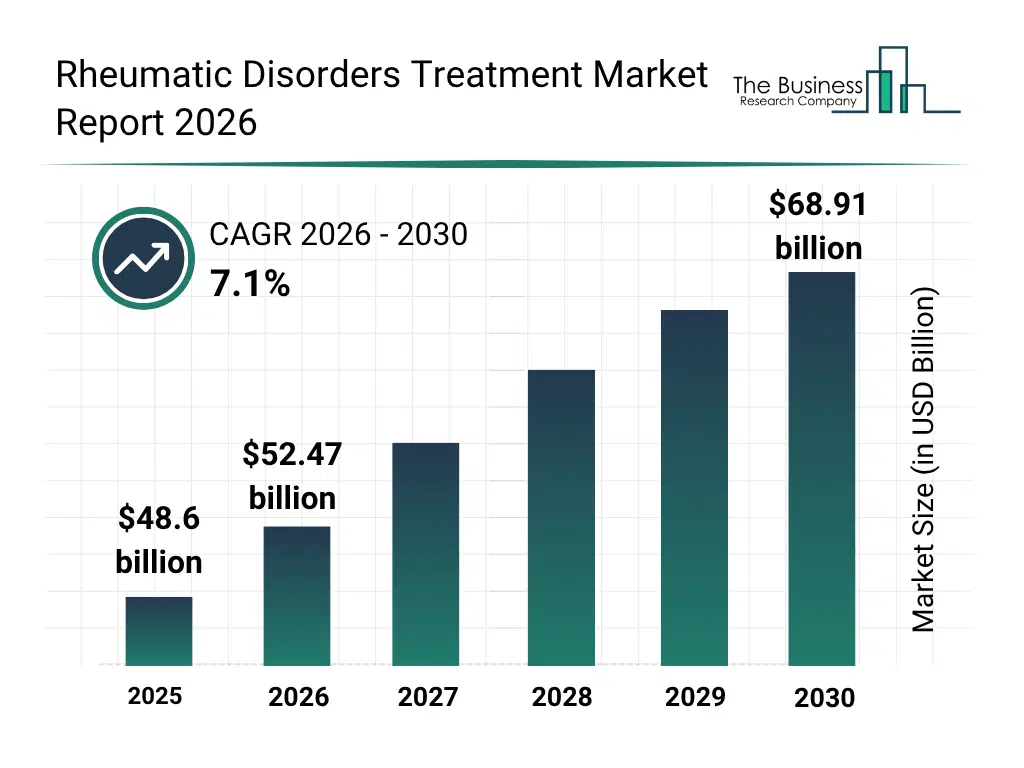
What Is The Rheumatic Disorders Treatment Market Size and Share 2026?
The rheumatic disorders treatment market size has grown strongly in recent years. It will grow from $48.6 billion in 2025 to $52.47 billion in 2026 at a compound annual growth rate (CAGR) of 8.0%. The growth in the historic period can be attributed to rising prevalence of autoimmune and rheumatic disorders globally, increasing adoption of biologic therapies for chronic inflammation management, growth in clinical diagnosis and early disease detection, expansion of healthcare infrastructure and specialty rheumatology clinics, increasing awareness of long-term joint health and mobility disorders.What Is The Rheumatic Disorders Treatment Market Growth Forecast?
The rheumatic disorders treatment market size is expected to see strong growth in the next few years. It will grow to $68.91 billion in 2030 at a compound annual growth rate (CAGR) of 7.1%. The growth in the forecast period can be attributed to advancements in precision medicine and targeted immunotherapy, rising integration of AI-enabled diagnostic and treatment systems, growth in biosimilar adoption to improve treatment affordability, expansion of remote healthcare monitoring and tele-rheumatology services, increasing investment in regenerative medicine and disease-modifying therapies. Major trends in the forecast period include AI-driven personalized treatment planning for rheumatic disease management, increasing adoption of biologic and biosimilar therapies for long-term disease control, integration of remote patient monitoring and wearable devices for chronic rheumatic care, growing use of targeted small molecule therapies for autoimmune modulation, expansion of digital health platforms for rheumatology disease tracking and management.
Global Rheumatic Disorders Treatment Market Segmentation
1) By Treatment Type: Monoclonal Antibodies; Biosimilars; Small Molecules; Fusion Proteins 2) By Route Of Administration Type: Oral; Parenteral; Topical 3) By Indication Type: Rheumatoid Arthritis; Osteoarthritis; Psoriatic Arthritis; Ankylosing Spondylitis; Gout; Systemic Lupus Erythematosus 4) By End User Type: Hospitals; Specialty Clinics (Rheumatology Centers); Homecare Settings; Ambulatory Care Centers Subsegments: 1) By Monoclonal Antibodies: Tumor Necrosis Factor Inhibitors; Interleukin Inhibitors; B Cell Depleting Antibodies; Interleukin Receptor Antagonists; Costimulatory Blockade Agents 2) By Biosimilars: Monoclonal Antibody Biosimilars; Tumor Necrosis Factor Inhibitor Biosimilars; Interleukin Inhibitor Biosimilars; Fusion Protein Biosimilars; Pegylated Protein Biosimilars 3) By Small Molecules: Janus Kinase Inhibitors; Phosphodiesterase Inhibitors; Cyclooxygenase Inhibitors; Non Steroidal Anti Inflammatory Drugs; Immunomodulatory Small Molecules 4) By Fusion Proteins: Tumor Necrosis Factor Receptor Fusion Proteins; Cytokine Trap Fusion Proteins; Immune Checkpoint Fusion Proteins; Interleukin Receptor Fusion Proteins; Recombinant Immunoglobulin Fusion ProteinsWhat Is The Driver Of The Rheumatic Disorders Treatment Market?
The rising global prevalence of autoimmune diseases is expected to propel the growth of the rheumatic disorders treatment market going forward. Autoimmune diseases refer to chronic conditions in which the immune system mistakenly attacks healthy body tissues, leading to long-term inflammation, organ or joint damage, and progressive disability. The prevalence of autoimmune diseases is increasing due to improved diagnostic techniques and earlier clinical detection, which leads to higher reported case counts across populations. Treatment of rheumatic disorders in autoimmune diseases helps reduce inflammation, relieve pain, prevent joint and tissue damage, and improve overall immune system regulation. For instance, in January 2024, according to the Centers for Disease Control and Prevention (CDC), a US-based public health agency, about 21.3% of U.S. adults in 2023 were affected by doctor-diagnosed arthritis (approximately 53.2 million people), compared with 21.2% in 2022. Therefore, the rising global prevalence of autoimmune diseases is driving the growth of the rheumatic disorders treatment industry.Key Players In The Global Rheumatic Disorders Treatment Market
Major companies operating in the rheumatic disorders treatment market are Johnson & Johnson; Eli Lilly and Company; F. Hoffmann-La Roche AG; Merck & Co. Inc.; Pfizer Inc.; AbbVie Inc.; AstraZeneca PLC; Novartis AG; Sanofi S.A.; Bristol Myers Squibb Company; Amgen Inc.; UCB S.A.; Boehringer Ingelheim International GmbH; Teva Pharmaceutical Industries Limited; Viatris Inc.; Sandoz Group AG; Sun Pharmaceutical Industries Limited; Dr. Reddy’s Laboratories Limited; Samsung Bioepis; Celltrion; Biocon Biologics Limited; Lupin Limited; Zydus Lifesciences Limited; Aurobindo Pharma LimitedGlobal Rheumatic Disorders Treatment Market Trends and Insights
Major companies operating in the rheumatic disorders treatment market are focusing on developing advanced solutions, such as implantable vagus nerve stimulation systems, to regulate immune system activity by stimulating neural pathways that reduce inflammatory signaling in chronic autoimmune conditions like rheumatoid arthritis. These systems offer a non-pharmaceutical treatment approach that reduces dependence on long-term biologics and immunosuppressive drugs while improving disease control in patients with inadequate response to conventional therapies. For instance, in July 2025, SetPoint Medical, a US-based medical technology company, launched the SetPoint System for the treatment of moderate-to-severe rheumatoid arthritis. The system features an implantable vagus nerve stimulation device that delivers automated daily neuromodulation, a drug-free mechanism that regulates immune response through the vagus nerve, and a targeted approach to suppress inflammatory cytokine activity associated with joint damage.What Are Latest Mergers And Acquisitions In The Rheumatic Disorders Treatment Market?
In October 2023, Amgen Inc., a US-based biotechnology company, acquired Horizon Therapeutics plc for approximately $27.8 billion. This acquisition was strategically aimed at strengthening Amgen’s immunology and inflammation portfolio by adding established therapies such as TEPEZZA and KRYSTEXXA, which are directly used in autoimmune and rheumatic-related conditions including gout and thyroid eye disease. Horizon Therapeutics plc is an Ireland-based biopharmaceutical company specializing in rare autoimmune and inflammatory disease therapies.Regional Outlook
North America was the largest region in the rheumatic disorders treatment market in 2025. Asia-Pacific is expected to be the fastest-growing region in the forecast period. The regions covered in this market report are Asia-Pacific, South East Asia, Western Europe, Eastern Europe, North America, South America, Middle East, Africa. The countries covered in this market report are Australia, Brazil, China, France, Germany, India, Indonesia, Japan, Taiwan, Russia, South Korea, UK, USA, Canada, Italy, Spain.What Defines the Rheumatic Disorders Treatment Market?
The rheumatic disorders treatment market consists of revenues earned by entities by providing services such as rheumatology consultation services, diagnostic and laboratory testing, biologic and drug therapy administration, physical and occupational therapy, pain management services, joint injection procedures, rehabilitation programs, autoimmune disease monitoring, tele-rheumatology services, and surgical treatment services for severe joint damage.The market value includes the value of related goods sold by the service provider or included within the service offering. The rheumatic disorders treatment market also includes sales of disease-modifying antirheumatic drugs (DMARDs), biologic therapies, corticosteroids, nonsteroidal anti-inflammatory drugs (NSAIDs), analgesics, immunosuppressants, orthopedic braces and supports, mobility aids, and rehabilitation equipment. Values in this market are ‘factory gate’ values, that is the value of goods sold by the manufacturers or creators of the goods, whether to other entities (including downstream manufacturers, wholesalers, distributors and retailers) or directly to end customers. The value of goods in this market includes related services sold by the creators of the goods.How is Market Value Defined and Measured?
The market value is defined as the revenues that enterprises gain from the sale of goods and/or services within the specified market and geography through sales, grants, or donations in terms of the currency (in USD unless otherwise specified). The revenues for a specified geography are consumption values that are revenues generated by organizations in the specified geography within the market, irrespective of where they are produced. It does not include revenues from resales along the supply chain, either further along the supply chain or as part of other products.What Key Data and Analysis Are Included in the Rheumatic Disorders Treatment Market Report 2026?
The rheumatic disorders treatment market research report is one of a series of new reports from The Business Research Company that provides market statistics, including industry global market size, regional shares, competitors with the market share, detailed market segments, market trends and opportunities, and any further data you may need to thrive in the rheumatic disorders treatment industry. The market research report delivers a complete perspective of everything you need, with an in-depth analysis of the current and future state of the industry.Rheumatic Disorders Treatment Market Report Forecast Analysis
| Report Attribute | Details |
|---|---|
| Market Size Value In 2026 | $52.47 billion |
| Revenue Forecast In 2030 | $68.91 billion |
| Growth Rate | CAGR of 7.1% from 2026 to 2030 |
| Base Year For Estimation | 2025 |
| Actual Estimates/Historical Data | 2020-2025 |
| Forecast Period | 2026 - 2030 |
| Market Representation | Revenue in USD Billion and CAGR from 2026 to 2030 |
| Segments Covered | Treatment Type, Route Of Administration Type, Indication Type, End User Type |
| Regional Scope | Asia-Pacific, Western Europe, Eastern Europe, North America, South America, Middle East, Africa |
| Country Scope | The countries covered in the report are Australia, Brazil, China, France, Germany, India, ... |
| Key Companies Profiled | Johnson & Johnson; Eli Lilly and Company; F. Hoffmann-La Roche AG; Merck & Co. Inc.; Pfizer Inc.; AbbVie Inc.; AstraZeneca PLC; Novartis AG; Sanofi S.A.; Bristol Myers Squibb Company; Amgen Inc.; UCB S.A.; Boehringer Ingelheim International GmbH; Teva Pharmaceutical Industries Limited; Viatris Inc.; Sandoz Group AG; Sun Pharmaceutical Industries Limited; Dr. Reddy’s Laboratories Limited; Samsung Bioepis; Celltrion; Biocon Biologics Limited; Lupin Limited; Zydus Lifesciences Limited; Aurobindo Pharma Limited |
| Customization Scope | Request for Customization |
| Pricing And Purchase Options | Explore Purchase Options |