
Ribonucleic Acid (RNA) Pesticide Market Report 2026
Global Outlook – By Product Type ( Ribonucleic Acid Interference Pesticides, Double Stranded Ribonucleic Acid, Small Interfering Ribonucleic Acid), By Target Organism ( Insects, Pathogenic Fungi, Weeds, Viruses), By Crop Type ( Cereal Crops, Fruits And Vegetables, Row Crops, Ornamental Plants), By Application ( Agricultural Pesticides, Horticultural Pesticides, Forestry Pesticides, Plant Disease Management, Insect Pest Control), By End User ( Farmers, Agricultural Companies, Research Institutions, Government Agencies) – Market Size, Trends, Strategies, and Forecast to 2030
Ribonucleic Acid (RNA) Pesticide Market Report 2026 Market Overview
• Ribonucleic Acid (RNA) Pesticide Market Report 2026 market size has reached to $1.16 billion in 2025 • Expected to grow to $1.82 billion in 2030 at a compound annual growth rate (CAGR) of 9.4% • Growth Driver: Surge In Demand For Sustainable Agriculture Solutions Fueling The Growth Of The Market Due To Increasing Adoption Of Organic Farming • North America was the largest region in 2025 and Asia-Pacific is the fastest growing region.What Is Covered Under Ribonucleic Acid (RNA) Pesticide Market?
Ribonucleic acid (RNA) pesticides refer to a next-generation agricultural biotechnology-based pest control approach that utilizes RNA interference (RNAi) technology to silence specific genes in target pests. This pesticide enables highly selective pest management by disrupting essential biological functions without affecting non-target organisms. The main product types of ribonucleic acid (RNA) pesticide include ribonucleic acid interference pesticides, double stranded ribonucleic acid, and small interfering ribonucleic acid. Ribonucleic acid interference pesticides refer to biological crop protection products that use RNA mechanisms to suppress target genes in pests and pathogens. These products are designed for target organisms including insects, pathogenic fungi, weeds, and viruses and are used across crop types such as cereal crops, fruits and vegetables, row crops, and ornamental plants. The key applications of agricultural pesticides, horticultural pesticides, forestry pesticides, plant disease management, and insect pest control, while the end-users farmers, agricultural companies, research institutions, and government agencies.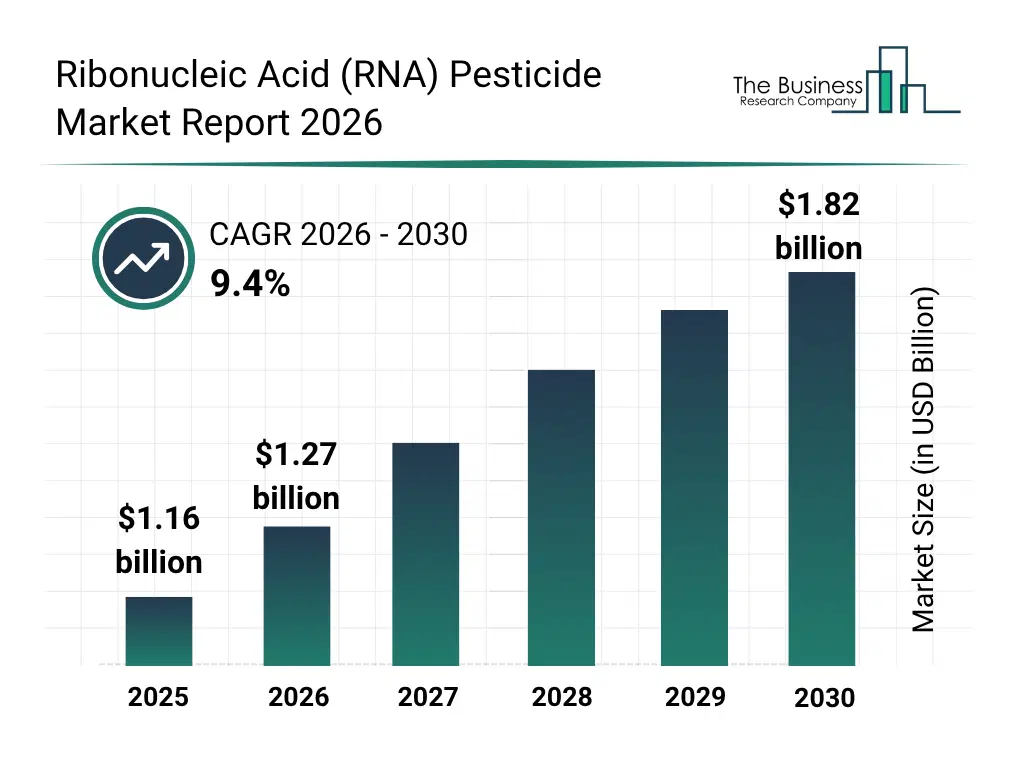
What Is The Ribonucleic Acid (RNA) Pesticide Market Size and Share 2026?
The ribonucleic acid (RNA) pesticide market size has grown strongly in recent years. It will grow from $1.16 billion in 2025 to $1.27 billion in 2026 at a compound annual growth rate (CAGR) of 9.8%. The growth in the historic period can be attributed to increasing demand for environmentally safer pesticides, growth in integrated pest management practices, advancements in RNA interference research, rising concerns regarding chemical pesticide toxicity, increasing agricultural biotechnology investments.What Is The Ribonucleic Acid (RNA) Pesticide Market Growth Forecast?
The ribonucleic acid (RNA) pesticide market size is expected to see strong growth in the next few years. It will grow to $1.82 billion in 2030 at a compound annual growth rate (CAGR) of 9.4%. The growth in the forecast period can be attributed to increasing commercialization of RNAi pesticide platforms, expansion of precision agriculture adoption, rising demand for sustainable crop protection technologies, increasing regulatory support for biological pesticides, growing development of advanced RNA delivery technologies. Major trends in the forecast period include growing adoption of RNAi-based bio-pesticide formulations, increasing development of species-specific pest targeting technologies, rising investment in biological crop protection solutions, expansion of nano-enabled RNA delivery systems, increasing focus on resistance management strategies in pest control.
Global Ribonucleic Acid (RNA) Pesticide Market Segmentation
1) By Product Type: Ribonucleic Acid Interference Pesticides, Double Stranded Ribonucleic Acid, Small Interfering Ribonucleic Acid 2) By Target Organism: Insects, Pathogenic Fungi, Weeds, Viruses 3) By Crop Type: Cereal Crops, Fruits And Vegetables, Row Crops, Ornamental Plants 4) By Application: Agricultural Pesticides, Horticultural Pesticides, Forestry Pesticides, Plant Disease Management, Insect Pest Control 5) By End User: Farmers, Agricultural Companies, Research Institutions, Government Agencies Subsegments: 1) By Ribonucleic Acid Interference Pesticides: Spray Based Ribonucleic Acid Pesticides, Seed Treatment Ribonucleic Acid Pesticides, Foliar Applied Ribonucleic Acid Pesticides, Soil Applied Ribonucleic Acid Pesticides 2) By Double Stranded Ribonucleic Acid: Synthetic Double Stranded Ribonucleic Acid, Biologically Derived Double Stranded Ribonucleic Acid, Encapsulated Double Stranded Ribonucleic Acid, Nanoformulated Double Stranded Ribonucleic Acid 3) By Small Interfering Ribonucleic Acid: Synthetic Small Interfering Ribonucleic Acid, Modified Small Interfering Ribonucleic Acid, Lipid Based Small Interfering Ribonucleic Acid, Polymer Based Small Interfering Ribonucleic AcidWhat Are The Drivers Of The Ribonucleic Acid (RNA) Pesticide Market?
The rising demand for sustainable agriculture solutions is expected to propel the growth of the ribonucleic acid (RNA) pesticide market going forward. Sustainable agriculture solutions refer to environmentally responsible farming practices and technologies that enhance crop productivity while minimizing ecological impact. The demand for sustainable agriculture solutions is increasing due to growing concerns regarding chemical pesticide residues, which are driving a shift toward safer, eco-friendly farming practices that ensure long-term food safety and environmental balance. RNA pesticides support sustainable agriculture by providing targeted pest control, reducing off-target effects, and minimizing environmental contamination compared to conventional pesticides, which improves crop protection efficiency and environmental sustainability. For instance, in May 2025, according to Gov.UK, a UK-based government agency, total organically farmed land in the UK reached 503 thousand hectares in 2024, up 1.0% from 498 thousand hectares in 2023, reflecting the growing adoption of sustainable agricultural practices. Therefore, the rising demand for sustainable agriculture solutions is driving the growth of the ribonucleic acid (RNA) pesticide industry. The increasing government funding for agriculture is expected to propel the growth of the ribonucleic acid (RNA) pesticide market going forward. Agriculture funding refers to financial support, subsidies, grants, and policy-driven investments provided by governments to enhance farm productivity, promote sustainable crop protection practices, improve rural infrastructure, and encourage the adoption of advanced agricultural inputs and technologies. The rise in government funding is driven by the need to ensure food security for a growing population, reduce dependence on chemical pesticides, support climate-resilient farming practices, and improve farmer income through higher yield efficiency. RNA pesticides support government agricultural priorities by enabling targeted pest control through gene-silencing mechanisms, reducing environmental toxicity compared to conventional chemical pesticides, improving crop safety, and supporting integrated pest management programs aligned with sustainable agriculture policies. For instance, in November 2025, according to the Department of Agriculture, Fisheries, and Forestry, an Australia-based government agency, total Australian agricultural R&D funding in 2024-25 reached $3.0 billion. This is broadly in line with the real level of funding in 2023-24. Therefore, increasing government funding for agriculture is driving the growth of the ribonucleic acid (RNA) pesticide industry. The growth in precision agriculture technologies is expected to propel the growth of the ribonucleic acid (RNA) pesticide market going forward. Precision agriculture is a farm management approach that uses GPS, drones, sensors, satellite imaging, and data analytics to optimize input application, improving agricultural productivity and sustainability. The growth in precision agriculture technologies is driven by rising demand for higher crop yields from limited arable land, leading to the adoption of data-driven farming methods that optimize resource use and improve productivity. RNA pesticides align strongly with precision agriculture practices as they enable sequence-specific pest control through RNA interference mechanisms, allowing farmers to target particular pests without broadly affecting beneficial organisms, thereby improving efficiency, reducing chemical residue, and supporting site-specific application strategies enabled by smart farming systems. For instance, in December 2024, according to the United States Department of Agriculture, a US-based government department, precision agriculture technology has been adopted by 68% of large crop farms, defined as farms generating more than $1 million in annual income. Therefore, growth in precision agriculture technologies is driving the growth of the ribonucleic acid (RNA) pesticide industry.Key Players In The Global Ribonucleic Acid (RNA) Pesticide Market
Major companies operating in the ribonucleic acid (RNA) pesticide market report are BASF SE, Bayer AG, Corteva Agriscience LLC, Sumitomo Chemical Co. Ltd., Syngenta AG, FMC Corporation, Nufarm Limited, AgroSpheres Inc., Pebble Labs Inc., Futureco Bioscience S.A., Renaissance BioScience Corp., Tropic Biosciences UK Ltd., PlantArcBio Ltd., AgriRNA Biosciences Inc., Xiaomo Biotech Co. Ltd., Terrana Biosciences
This chart is for illustrative purposes; the full report includes a detailed competitor analysis and comprehensive overview of the top 10 companies in the market.
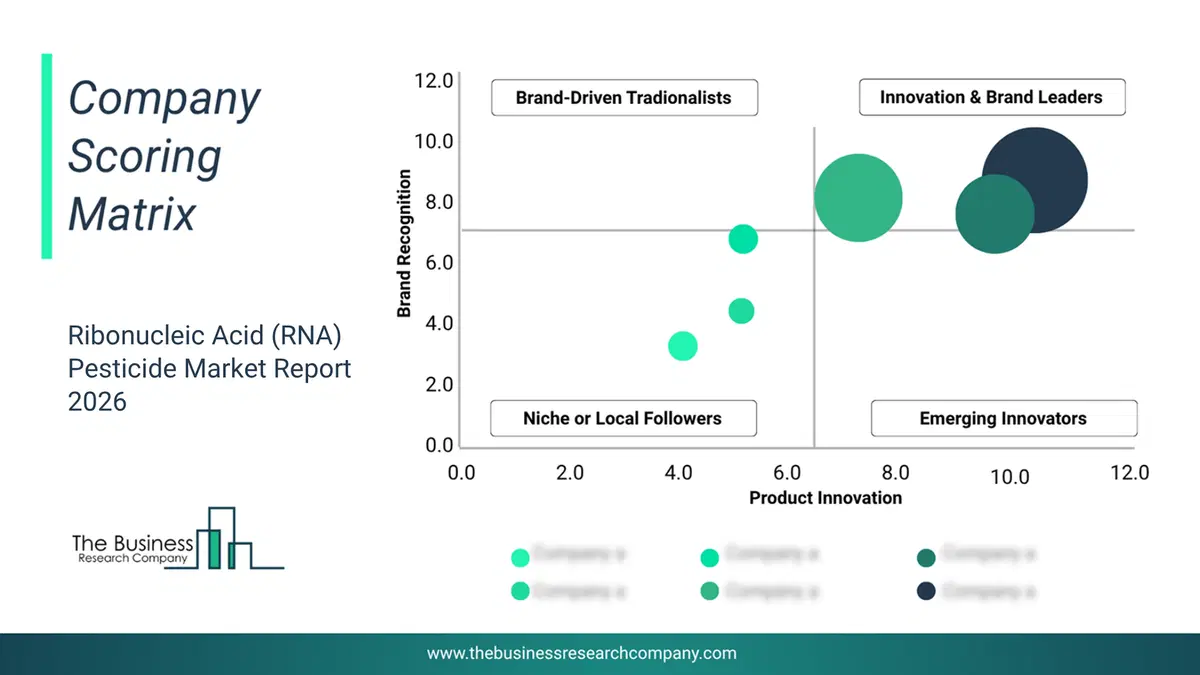
This chart maps companies by product innovation and brand strength, with bubble size indicating relative revenue, helping identify market leaders, challengers, and niche players. This is an illustrative chart; the full report provides a complete and accurate competitive analysis.
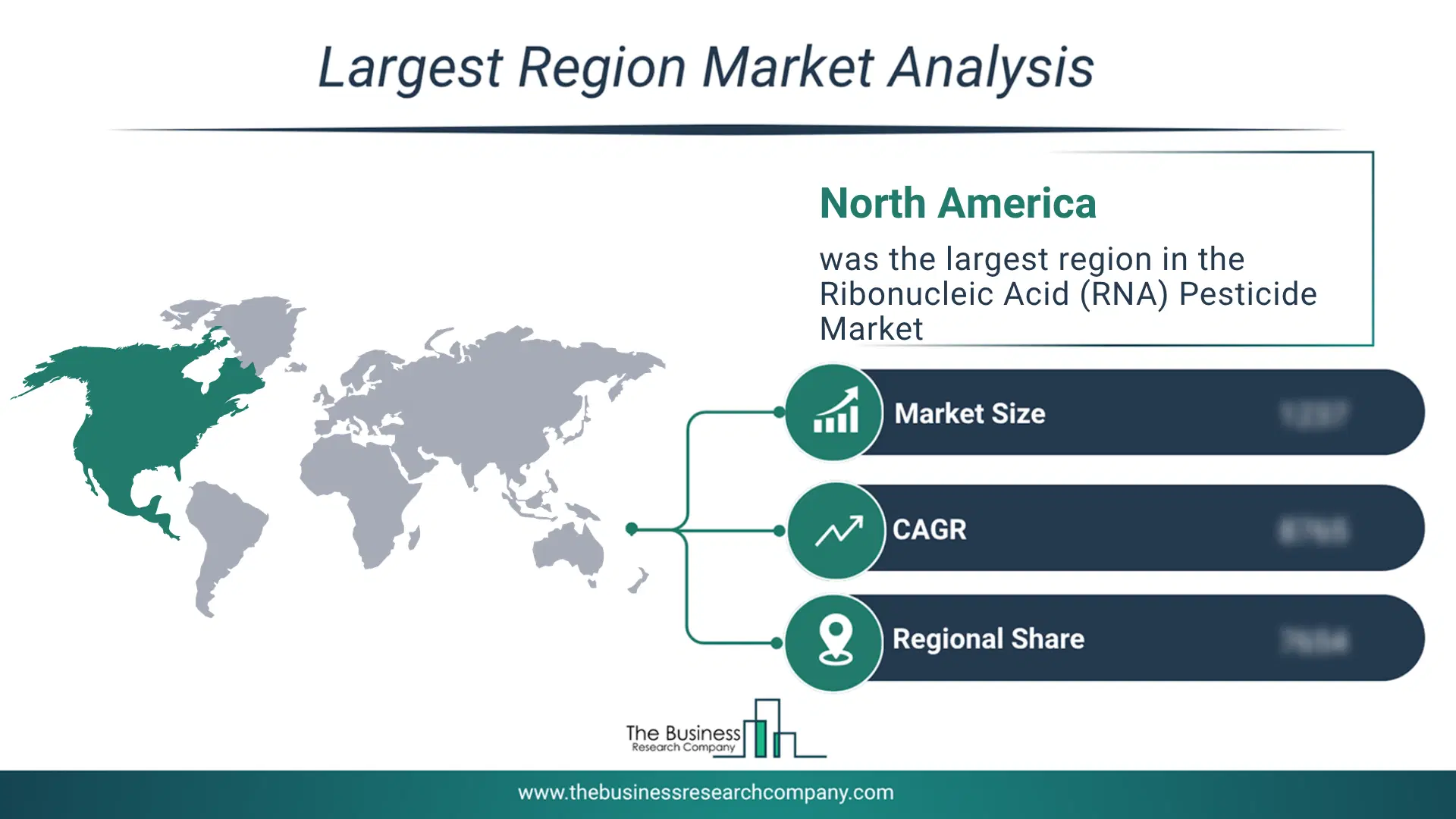
Regional Outlook
North America was the largest region in the ribonucleic acid (RNA) pesticide market in 2025. Asia-Pacific is expected to be the fastest-growing region in the forecast period. The regions covered in this market report are Asia-Pacific, South East Asia, Western Europe, Eastern Europe, North America, South America, Middle East, Africa. The countries covered in this market report are Australia, Brazil, China, France, Germany, India, Indonesia, Japan, Taiwan, Russia, South Korea, UK, USA, Canada, Italy, Spain.What Defines the Ribonucleic Acid (RNA) Pesticide Market?
The ribonucleic acid (RNA) pesticide market consists of sales of RNA-based insecticides, RNA biopesticides, and sprayable RNA pesticides. Values in this market are ‘factory gate’ values, that is, the value of goods sold by the manufacturers or creators of the goods, whether to other entities (including downstream manufacturers, wholesalers, distributors, and retailers) or directly to end customers. The value of goods in this market includes related services sold by the creators of the goods.How is Market Value Defined and Measured?
The market value is defined as the revenues that enterprises gain from the sale of goods and/or services within the specified market and geography through sales, grants, or donations in terms of the currency (in USD unless otherwise specified). The revenues for a specified geography are consumption values that are revenues generated by organizations in the specified geography within the market, irrespective of where they are produced. It does not include revenues from resales along the supply chain, either further along the supply chain or as part of other products.
This chart presents market attractiveness based on a quantitative evaluation of growth, competition, strategic alignment, and risk, offering a clear view of opportunity areas for decision-making. This chart is for illustrative purposes; the full report contains the complete analysis.

This chart highlights the Total Addressable Market (TAM) by estimating the maximum revenue opportunity using an assumption-driven approach, supporting strategic planning and opportunity sizing across markets. The chart is illustrative; the full report provides a more comprehensive analysis.
What Key Data and Analysis Are Included in the Ribonucleic Acid (RNA) Pesticide Market Report 2026?
The ribonucleic acid (rna) pesticide market research report is one of a series of new reports from The Business Research Company that provides market statistics, including industry global market size, regional shares, competitors with the market share, detailed market segments, market trends and opportunities, and any further data you may need to thrive in the ribonucleic acid (rna) pesticide industry. The market research report delivers a complete perspective of everything you need, with an in-depth analysis of the current and future state of the industry.Ribonucleic Acid (RNA) Pesticide Market Report Forecast Analysis
| Report Attribute | Details |
|---|---|
| Market Size Value In 2026 | $1.27 billion |
| Revenue Forecast In 2030 | $1.82 billion |
| Growth Rate | CAGR of 9.4% from 2026 to 2030 |
| Base Year For Estimation | 2025 |
| Actual Estimates/Historical Data | 2020-2025 |
| Forecast Period | 2026 - 2030 |
| Market Representation | Revenue in USD Billion and CAGR from 2026 to 2030 |
| Segments Covered | Product Type, Target Organism, Crop Type, Application, End User |
| Regional Scope | Asia-Pacific, Western Europe, Eastern Europe, North America, South America, Middle East, Africa |
| Country Scope | The countries covered in the report are Australia, Brazil, China, France, Germany, India, Indonesia, Japan, Taiwan, Russia, South Korea, UK, USA, Canada, Italy, Spain. |
| Key Companies Profiled | BASF SE, Bayer AG, Corteva Agriscience LLC, Sumitomo Chemical Co. Ltd., Syngenta AG, FMC Corporation, Nufarm Limited, AgroSpheres Inc., Pebble Labs Inc., Futureco Bioscience S.A., Renaissance BioScience Corp., Tropic Biosciences UK Ltd., PlantArcBio Ltd., AgriRNA Biosciences Inc., Xiaomo Biotech Co. Ltd., Terrana Biosciences |
| Customization Scope | Request for Customization |
| Pricing And Purchase Options | Explore Purchase Options |