
Rice Dryer Market Report 2026
Global Outlook – By Product Type (Continuous Rice Dryers, Batch Rice Dryers, Mobile Rice Dryers, Static Rice Dryers), By Technology (Conventional Heating, Infrared Drying, Solar Drying, Heat Pump Drying), By Capacity (Small Capacity (Up To 100 Kilograms Per Hour), Medium Capacity (100 Kilograms Per Hour To 500 Kilograms Per Hour), Large Capacity (Above 500 Kilograms Per Hour)), By Fuel Type (Electric, Diesel, Natural Gas, Biomass), By End User Application (Commercial Applications, Agricultural Cooperatives, Rice Processing Units, Smallholder Farmers) – Market Size, Trends, Strategies, and Forecast to 2030
Rice Dryer Market Overview
• Rice Dryer market size has reached to $1.1 billion in 2025 • Expected to grow to $1.46 billion in 2030 at a compound annual growth rate (CAGR) of 5.7% • Growth Driver: Surge In Rice Production Fueling The Growth Of The Market Due To Growing Need For Efficient Drying, Storage, And Quality Preservation Of Harvested Rice • Market Trend: Advancing Intelligent Moisture-Controlled Drying Systems For Agricultural Efficiency • Asia-Pacific was the largest region and fastest growing region.What Is Covered Under Rice Dryer Market?
A rice dryer is an agricultural processing system designed to reduce the moisture content of harvested rice to safe storage and milling levels through controlled drying methods. It uses regulated heat, airflow, and moisture removal mechanisms to ensure uniform drying while preserving grain quality and minimizing spoilage or cracking. Rice dryers improve post-harvest efficiency, enhance product stability, and support large-scale rice handling and storage operations. The main product types of rice dryer include continuous rice dryers, batch rice dryers, mobile rice dryers, and static rice dryers. Continuous rice dryers refer to grain drying systems that continuously process paddy rice through controlled heating and airflow to reduce moisture content efficiently during large-scale operations. These dryers utilize technologies such as conventional heating, infrared drying, solar drying, and heat pump drying and are available in capacities including small capacity (up to 100 kilograms per hour), medium capacity (100 kilograms per hour to 500 kilograms per hour), and large capacity (above 500 kilograms per hour). They operate using electric, diesel, natural gas, and biomass fuels and are utilized for end users applications such as commercial applications, agricultural cooperatives, rice processing units, and smallholder farmers.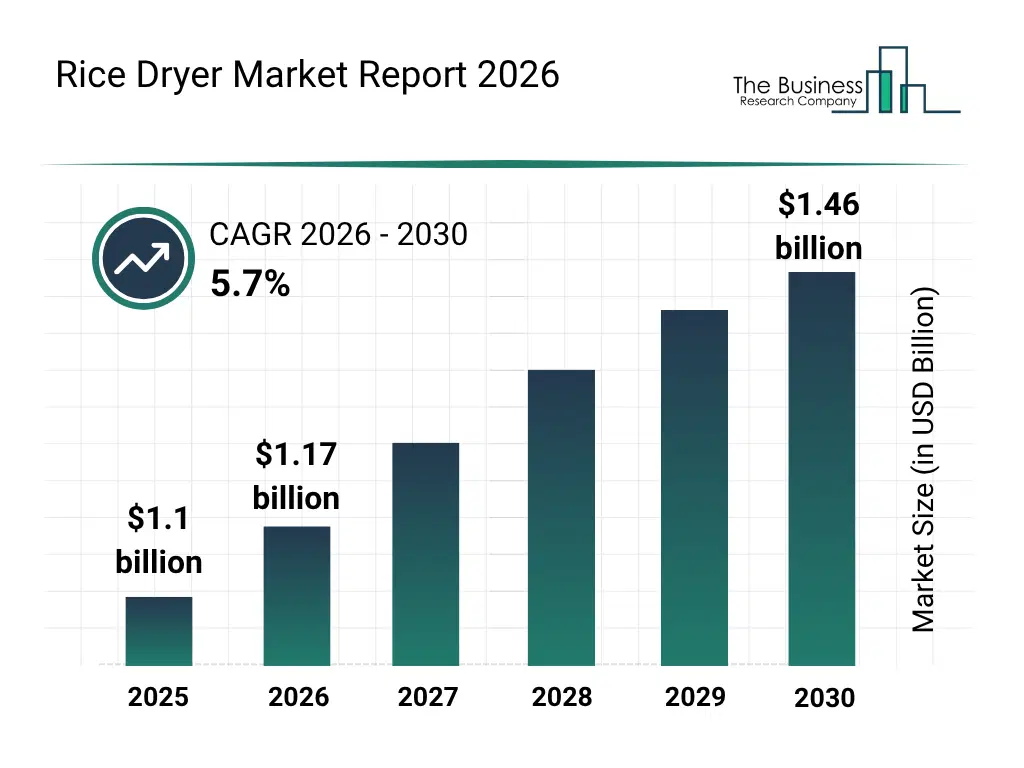
What Is The Rice Dryer Market Size and Share 2026?
The rice dryer market size has grown strongly in recent years. It will grow from $1.1 billion in 2025 to $1.17 billion in 2026 at a compound annual growth rate (CAGR) of 6.1%. The growth in the historic period can be attributed to increasing need for reducing post harvest losses, growing expansion of rice processing facilities, rising demand for improved grain quality preservation, increasing adoption of mechanized agricultural processing equipment, growing focus on efficient rice storage and handling operations.What Is The Rice Dryer Market Growth Forecast?
The rice dryer market size is expected to see strong growth in the next few years. It will grow to $1.46 billion in 2030 at a compound annual growth rate (CAGR) of 5.7%. The growth in the forecast period can be attributed to expanding commercial rice production activities, rising demand for energy efficient drying technologies, increasing investments in modern agricultural infrastructure, growing adoption of automated grain processing systems, increasing requirement for large scale post harvest management solutions. Major trends in the forecast period include increasing adoption of energy efficient rice drying systems, growing demand for automated moisture control in grain drying, rising deployment of advanced drying technologies for quality preservation, expanding use of sustainable rice processing and storage solutions, increasing development of high capacity rice drying equipment.
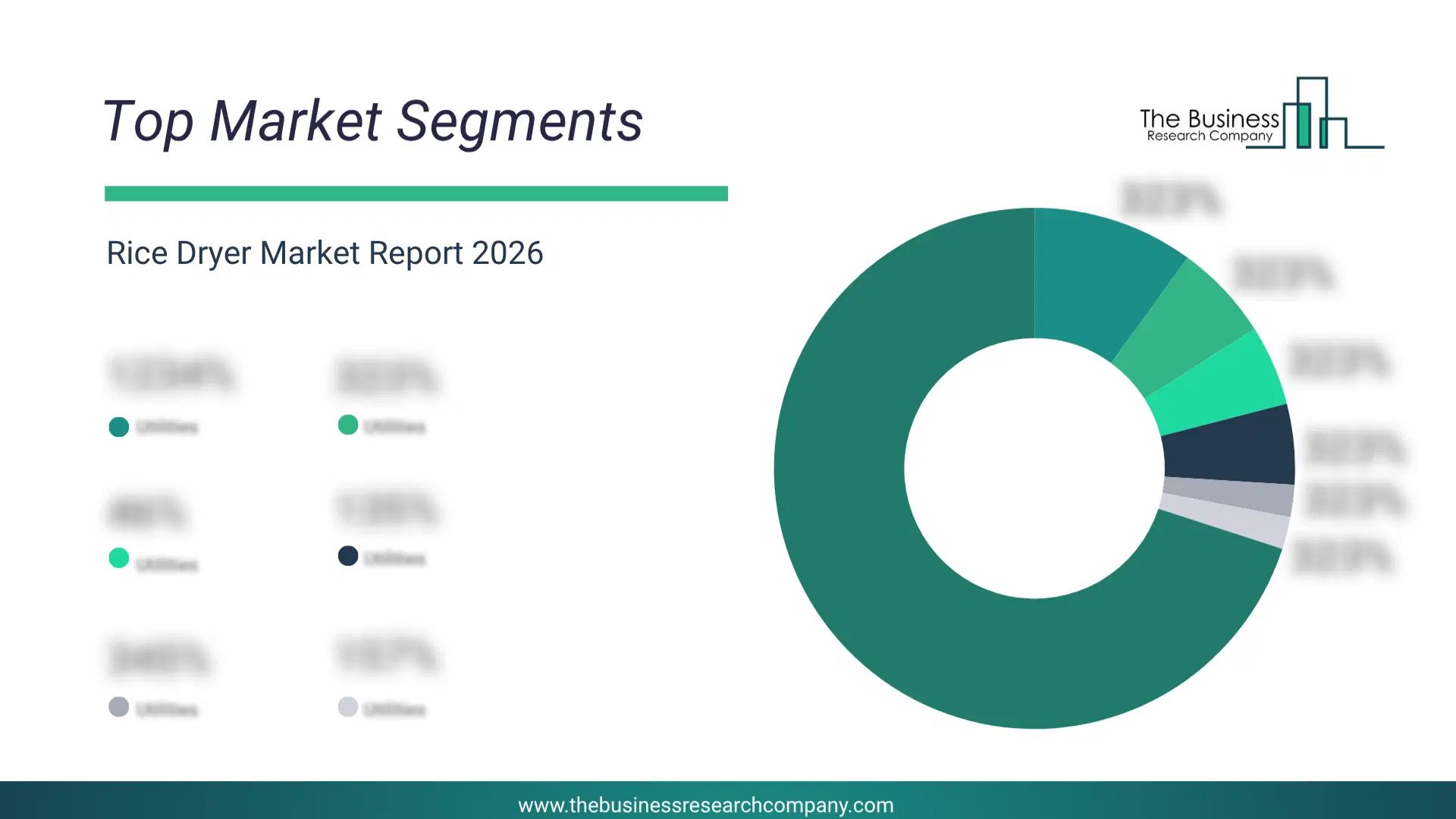
Global Rice Dryer Market Segmentation
2) By Technology: Conventional Heating, Infrared Drying, Solar Drying, Heat Pump Drying 3) By Capacity: Small Capacity (Up To 100 Kilograms Per Hour), Medium Capacity (100 Kilograms Per Hour To 500 Kilograms Per Hour), Large Capacity (Above 500 Kilograms Per Hour) 4) By Fuel Type: Electric, Diesel, Natural Gas, Biomass 5) By End User Application: Commercial Applications, Agricultural Cooperatives, Rice Processing Units, Smallholder Farmers Subsegments: 1) By Continuous Rice Dryers: Flatbed Continuous Dryers, Mixed Flow Continuous Dryers, Cross Flow Continuous Dryers, Recirculating Continuous Dryers, Vertical Continuous Dryers 2) By Batch Rice Dryers: Flatbed Batch Dryers, Cabinet Batch Dryers, Bin Batch Dryers, Recirculating Batch Dryers, Tower Batch Dryers 3) By Mobile Rice Dryers: Trailer Mounted Dryers, Portable Flatbed Dryers, Skid Mounted Dryers, Compact Transportable Dryers, Wheeled Grain Dryers 4) By Static Rice Dryers: Fixed Bed Dryers, Silo Static Dryers, Bin Static Dryers, Layer Drying Systems, Natural Air Static DryersWhat Is The Driver Of The Rice Dryer Market?
The rising global rice production volumes are expected to propel the growth of the rice dryer market going forward. Rice production volume is the total milled rice output from all producing regions, expressed in million metric tons, which determines the scale of required post-harvest processing investments. Global rice production is rising due to the adoption of high-yielding rice varieties, which enable farmers to produce more rice from the same area of land. Rice dryers support rising rice production by providing uniform moisture reduction across large batches, preserving grain quality and minimizing cracking, thereby maximizing marketable yields. For instance, in February 2024, according to the United States Department of Agriculture (USDA), a US-based federal agency, the total rice planted area in the United States rose from approximately 2.22 million acres in 2022 to 2.89 million acres in 2023, an increase of around 30 percent, while harvested area grew from approximately 2.17 million acres to 2.85 million acres, up 32 percent over the same period. Therefore, the rising global rice production volumes are driving the growth of the rice dryer industry.Key Players In The Global Rice Dryer Market
Major companies operating in the rice dryer market are Akyürek Technology Sanayi ve Ticaret A.Ş., Alvan Blanch Development Company Limited, Bühler AG, Chief Industries Inc., Fratelli Pedrotti S.r.l., Henan Haokebang Machinery Equipment Co. Ltd., Hunan Nongyou Machinery Group Co. Ltd., Iseki & Co. Ltd., Kaneko Agricultural Machinery Co. Ltd., Mathews Company, Mecmar S.p.A., Mepu Oy, PETKUS Technologie GmbH, Rishikesh Engineers, S. K. Engineers, Satake Corporation, Shivvers Manufacturing Inc., SKF Boilers and Driers Pvt. Ltd., Stela Laxhuber GmbH, Sukup Manufacturing Co., SUNCUE Company Ltd., Yamamoto Co. Ltd., Zhengzhou Wangu Machinery Co. Ltd.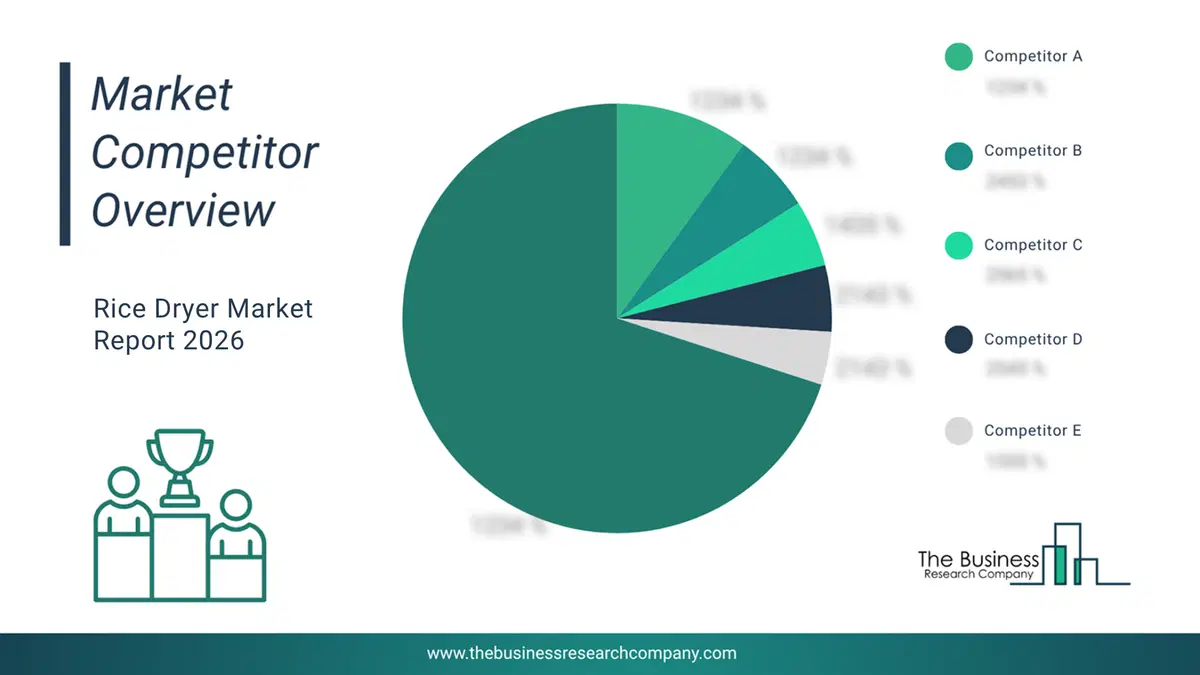
This chart is for illustrative purposes; the full report includes a detailed competitor analysis and comprehensive overview of the top 10 companies in the market.
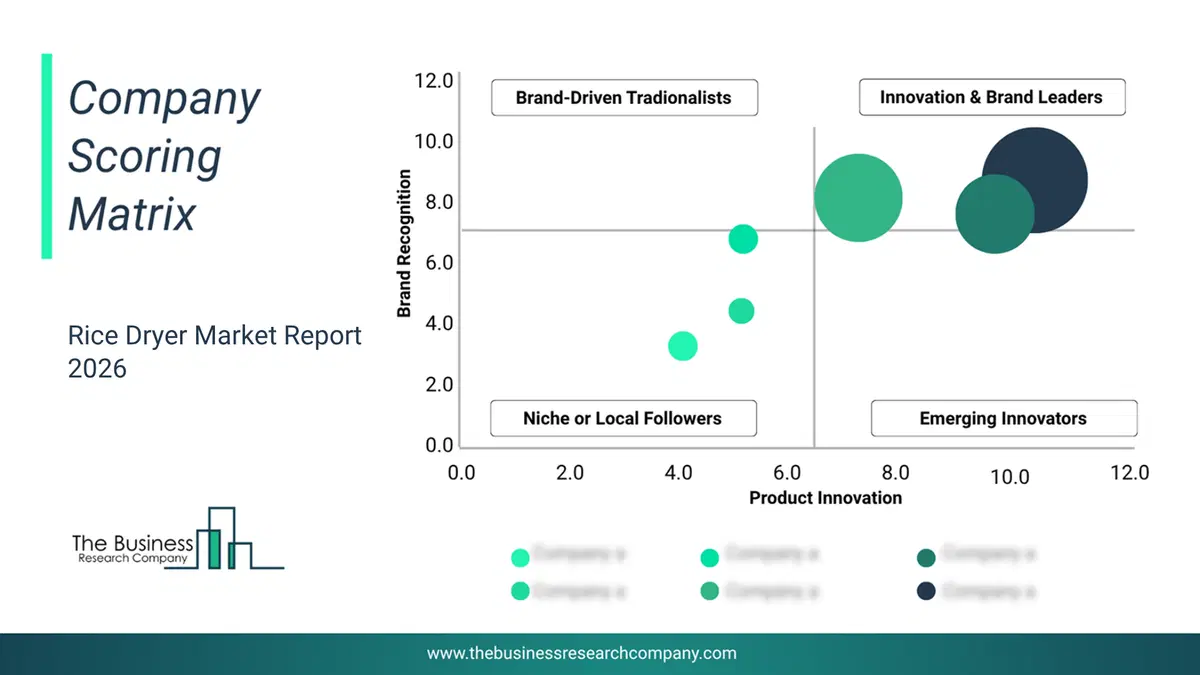
This chart maps companies by product innovation and brand strength, with bubble size indicating relative revenue, helping identify market leaders, challengers, and niche players. This is an illustrative chart; the full report provides a complete and accurate competitive analysis.
Global Rice Dryer Market Trends and Insights
Major companies operating in the rice dryer market are focusing on developing innovative solutions, such as air-source heat pump drying technology, to enhance energy efficiency, reduce operating costs, and improve the quality and consistency of dried rice while minimizing environmental impact. Air-source heat pump drying technology is a drying method that uses a heat pump to extract heat from ambient air, upgrade it to a higher temperature, and circulate it to efficiently remove moisture from materials. For instance, in December 2024, COFCO Technology & Industry, a China-based grain processing and agricultural engineering company, introduced Air Source Heat Pump Dryers for grain post-harvest centers. The system utilizes clean energy to dry paddy and other grains through an automated process that integrates grain intake, drying, storage, and distribution. It features intelligent moisture management, online operational monitoring, remote process control, and minimal manual intervention. The solution can operate continuously around the clock and process up to 360 tons of grain per day while improving drying efficiency and maintaining grain quality. The technology helps rice processors reduce energy consumption, lower post-harvest losses, and support sustainable grain handling operations.What Are Latest Mergers And Acquisitions In The Rice Dryer Market?
In April 2025, KRBL Limited, an India-based food company and rice miller and basmati rice exporter, partnered with Bühler Group to implement its Eco Dry paddy drying technology across KRBL’s processing facilities. Through this collaboration, KRBL has integrated Bühler’s Eco Dry dryers into its 6-pass and 7-pass production lines to improve drying efficiency, reduce energy consumption, and enhance overall grain quality for domestic and global markets. Bühler Group is a Switzerland-based industrial technology company that provides advanced food processing and milling solutions, including energy-efficient and precision-driven rice drying systems.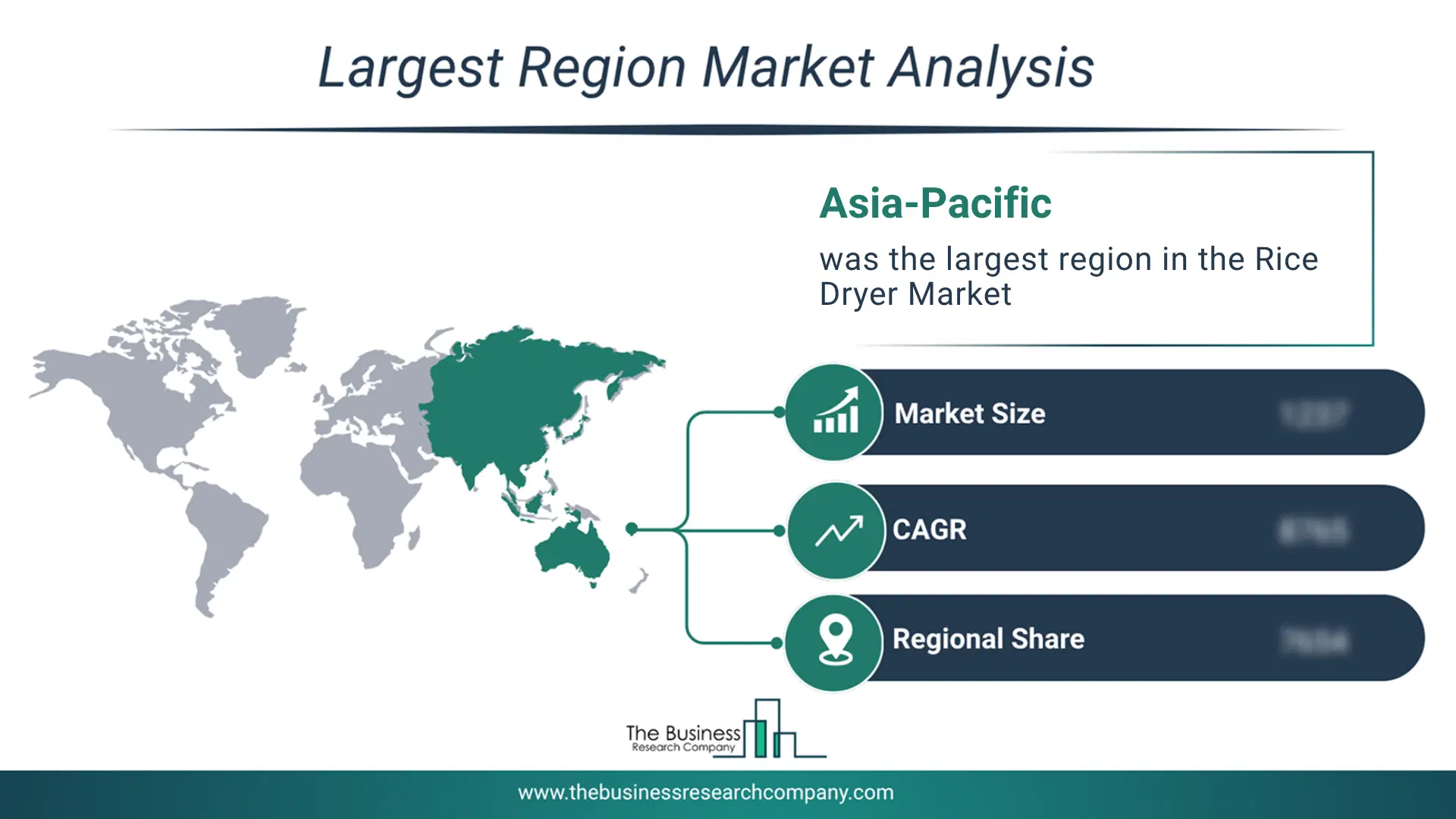
Regional Outlook/Insights
Asia-Pacific was the largest region in the rice dryer market in 2025. Asia-Pacific is expected to be the fastest-growing region in the forecast period. The regions covered in this market report are Asia-Pacific, South East Asia, Western Europe, Eastern Europe, North America, South America, Middle East, Africa. The countries covered in this market report are Australia, Brazil, China, France, Germany, India, Indonesia, Japan, Taiwan, Russia, South Korea, UK, USA, Canada, Italy, Spain.What Defines the Rice Dryer Market?
The rice dryer market consists of sales of mixed flow rice dryer, recirculating rice dryer, and fluidized bed rice dryer. Values in this market are ‘factory gate’ values, that is, the value of goods sold by the manufacturers or creators of the goods, whether to other entities (including downstream manufacturers, wholesalers, distributors, and retailers) or directly to end customers. The value of goods in this market includes related services sold by the creators of the goods.How is Market Value Defined and Measured?
The market value is defined as the revenues that enterprises gain from the sale of goods and/or services within the specified market and geography through sales, grants, or donations in terms of the currency (in USD unless otherwise specified). The revenues for a specified geography are consumption values that are revenues generated by organizations in the specified geography within the market, irrespective of where they are produced. It does not include revenues from resales along the supply chain, either further along the supply chain or as part of other products.
This chart presents market attractiveness based on a quantitative evaluation of growth, competition, strategic alignment, and risk, offering a clear view of opportunity areas for decision-making. This chart is for illustrative purposes; the full report contains the complete analysis.

This chart highlights the Total Addressable Market (TAM) by estimating the maximum revenue opportunity using an assumption-driven approach, supporting strategic planning and opportunity sizing across markets. The chart is illustrative; the full report provides a more comprehensive analysis.
What Key Data and Analysis Are Included in the Rice Dryer Market Report 2026?
The rice dryer market research report is one of a series of new reports from The Business Research Company that provides rice dryer market statistics, including rice dryer industry global market size, regional shares, competitors with a rice dryer market share, detailed rice dryer market segments, market trends and opportunities, and any further data you may need to thrive in the rice dryer industry. This rice dryer market research report delivers a complete perspective of everything you need, with an in-depth analysis of the current and future scenario of the industry.Rice Dryer Market Report Forecast Analysis
| Report Attribute | Details |
|---|---|
| Market Size Value In 2026 | $1.17 billion |
| Revenue Forecast In 2030 | $1.46 billion |
| Growth Rate | CAGR of 5.7% from 2026 to 2030 |
| Base Year For Estimation | 2025 |
| Actual Estimates/Historical Data | 2020-2025 |
| Forecast Period | 2026 - 2030 |
| Market Representation | Revenue in USD Billion and CAGR from 2026 to 2030 |
| Segments Covered | Product Type, Technology, Capacity, Fuel Type, End User Application |
| Regional Scope | Asia-Pacific, Western Europe, Eastern Europe, North America, South America, Middle East, Africa |
| Country Scope | The countries covered in the report are Australia, Brazil, China, France, Germany, India, Indonesia, Japan, Taiwan, Russia, South Korea, UK, USA, Canada, Italy, Spain. |
| Key Companies Profiled | Akyürek Technology Sanayi ve Ticaret A.Ş., Alvan Blanch Development Company Limited, Bühler AG, Chief Industries Inc., Fratelli Pedrotti S.r.l., Henan Haokebang Machinery Equipment Co. Ltd., Hunan Nongyou Machinery Group Co. Ltd., Iseki & Co. Ltd., Kaneko Agricultural Machinery Co. Ltd., Mathews Company, Mecmar S.p.A., Mepu Oy, PETKUS Technologie GmbH, Rishikesh Engineers, S. K. Engineers, Satake Corporation, Shivvers Manufacturing Inc., SKF Boilers and Driers Pvt. Ltd., Stela Laxhuber GmbH, Sukup Manufacturing Co., SUNCUE Company Ltd., Yamamoto Co. Ltd., Zhengzhou Wangu Machinery Co. Ltd. |
| Customization Scope | Request for Customization |
| Pricing And Purchase Options | Explore Purchase Options |