

Rice Harvester Market Report 2026
Global Outlook – By Product Type (Self Propelled Rice Harvesters, Tractor Mounted Rice Harvesters, Walk Behind Rice Harvesters), By Engine Power (Below 100 Horsepower, 100 Horsepower To 200 Horsepower, Above 200 Horsepower), By Harvesting Capacity (Up To 1 Ton Per Hour, 1 Ton Per Hour To 2 Tons Per Hour, Above 2 Tons Per Hour), By Distribution Channel (Direct Sales, Authorized Dealers Or Distributors, Online Sales Platforms), By End User (Individual Farmers, Agricultural Cooperatives, Contract Farming Service Providers, Commercial Agribusinesses) – Market Size, Trends, Strategies, and Forecast to 2030
Rice Harvester Market Overview
• Rice Harvester market size has reached to $3.24 billion in 2025 • Expected to grow to $4.41 billion in 2030 at a compound annual growth rate (CAGR) of 6.3% • Growth Driver: Surge In Agricultural Mechanization Fueling The Growth Of The Market Due To Increasing Labor Shortages And Rising Farm Wage Costs • Market Trend: Advancements In Autonomous Harvesting Technology Enhance Efficiency In Rice Harvesters • North America was the largest region in 2025 and Asia-Pacific is the fastest growing region.What Is Covered Under Rice Harvester Market?
A rice harvester is an agricultural machine specifically designed to efficiently harvest rice crops by performing cutting, threshing, and grain separation in a single integrated operation. It is engineered to reduce manual labor, improve harvesting speed, and minimize grain losses while ensuring consistent field performance. The main product types of rice harvester include self propelled rice harvesters, tractor mounted rice harvesters, and walk behind rice harvesters. Self propelled rice harvesters refer to independently powered harvesting machines designed to cut, thresh, separate, and clean rice crops efficiently in a single operation. These harvesters are available in engine power categories including below 100 horsepower, 100 horsepower to 200 horsepower, and above 200 horsepower and offer harvesting capacities of up to 1 ton per hour, 1 ton per hour to 2 tons per hour, and above 2 tons per hour. They are distributed through direct sales, authorized dealers or distributors, and online sales platforms and serving end users including individual farmers, agricultural cooperatives, contract farming service providers, and commercial agribusinesses.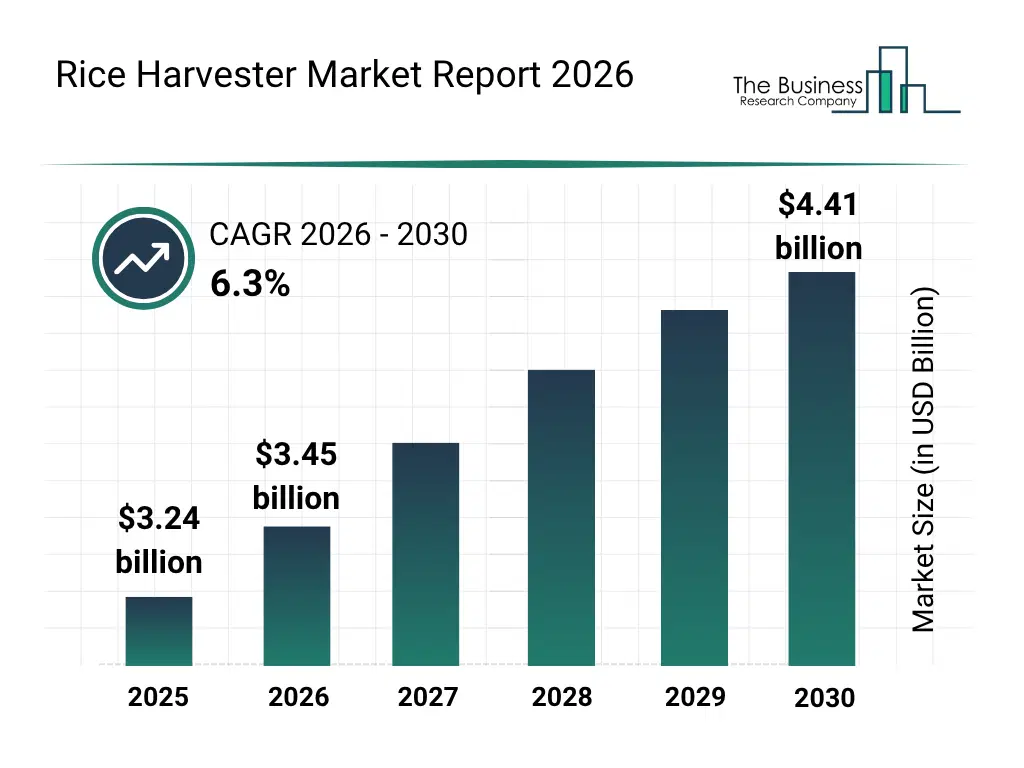
What Is The Rice Harvester Market Size and Share 2026?
The rice harvester market size has grown strongly in recent years. It will grow from $3.24 billion in 2025 to $3.45 billion in 2026 at a compound annual growth rate (CAGR) of 6.7%. The growth in the historic period can be attributed to increasing shortage of agricultural labor, growing need for faster harvesting operations, rising adoption of farm mechanization practices, increasing focus on reducing crop harvesting losses, growing expansion of commercial rice cultivation.What Is The Rice Harvester Market Growth Forecast?
The rice harvester market size is expected to see strong growth in the next few years. It will grow to $4.41 billion in 2030 at a compound annual growth rate (CAGR) of 6.3%. The growth in the forecast period can be attributed to expanding demand for autonomous agricultural machinery, rising investments in smart farming technologies, increasing adoption of precision harvesting solutions, growing requirement for high productivity farming equipment, increasing government support for agricultural mechanization. Major trends in the forecast period include increasing adoption of mechanized rice harvesting equipment, growing demand for high efficiency crop harvesting solutions, rising development of compact and multi functional rice harvesters, expanding use of advanced grain loss reduction technologies, increasing preference for high capacity agricultural machinery.
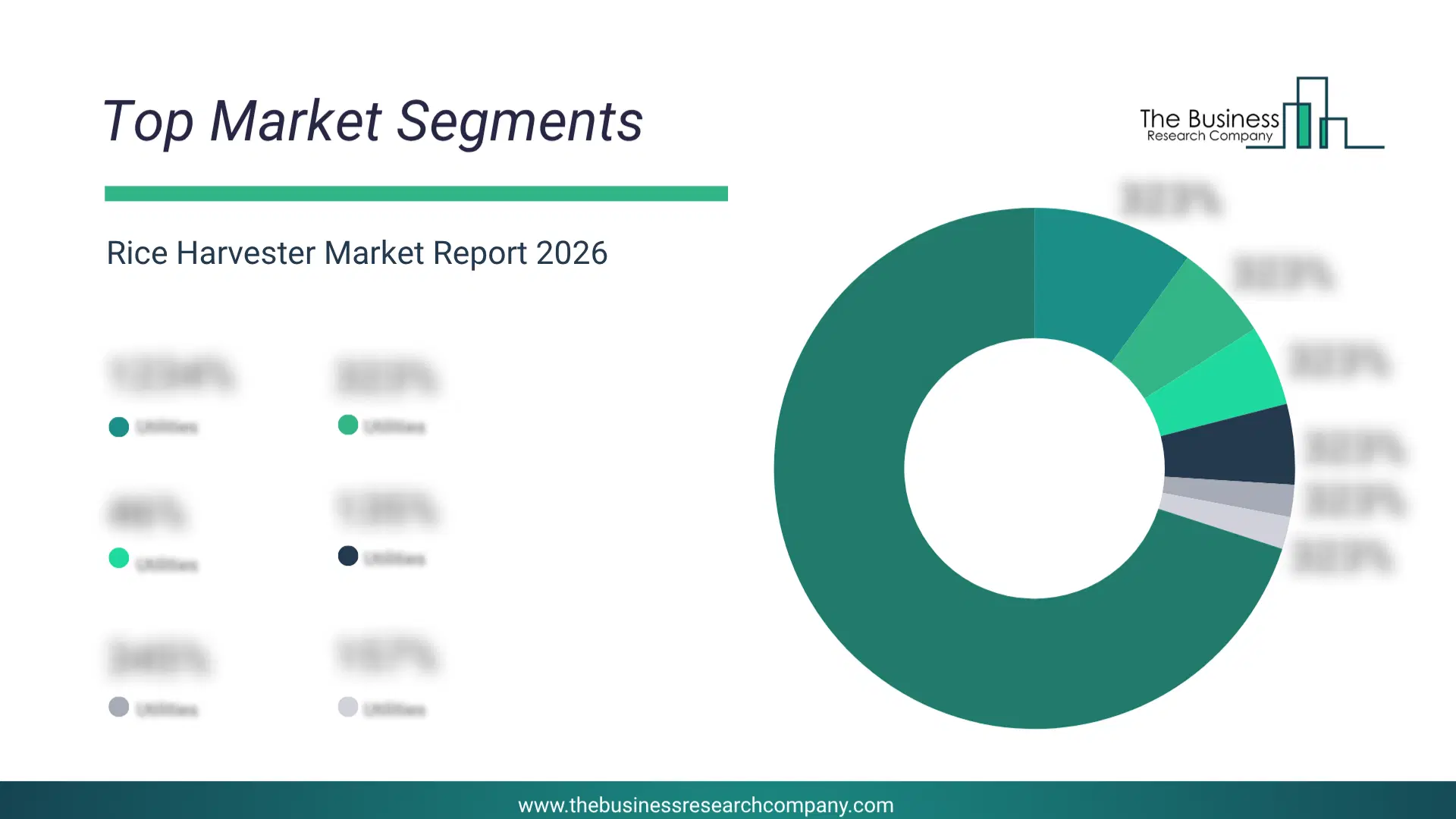
Global Rice Harvester Market Segmentation
2) By Engine Power: Below 100 Horsepower, 100 Horsepower To 200 Horsepower, Above 200 Horsepower 3) By Harvesting Capacity: Up To 1 Ton Per Hour, 1 Ton Per Hour To 2 Tons Per Hour, Above 2 Tons Per Hour 4) By Distribution Channel: Direct Sales, Authorized Dealers Or Distributors, Online Sales Platforms 5) By End User: Individual Farmers, Agricultural Cooperatives, Contract Farming Service Providers, Commercial Agribusinesses Subsegments: 1) By Self Propelled Rice Harvesters: Full Feed Self Propelled Rice Harvesters, Head Feed Self Propelled Rice Harvesters, Tracked Self Propelled Rice Harvesters, Wheeled Self Propelled Rice Harvesters 2) By Tractor Mounted Rice Harvesters: Rear Mounted Rice Harvesters, Side Mounted Rice Harvesters, Power Take Off Driven Rice Harvesters, Multi Functional Tractor Mounted Rice Harvesters 3) By Walk Behind Rice Harvesters: Manual Assisted Walk Behind Rice Harvesters, Engine Powered Walk Behind Rice Harvesters, Compact Walk Behind Rice Harvesters, Lightweight Walk Behind Rice HarvestersWhat Is The Driver Of The Rice Harvester Market?
The rising mechanization of agricultural operations is expected to propel the growth of the rice harvester market going forward. Agricultural mechanization is the use of machinery, automated systems, and advanced farming equipment to improve agricultural productivity, operational efficiency, and crop management processes. The rise in agricultural mechanization is due to increasing labor shortages and rising agricultural wage costs, which are encouraging farmers to adopt automated machinery to maintain operational efficiency and improve harvesting productivity. Rice harvesters support agricultural mechanization by enabling efficient harvesting operations, reducing crop wastage, lowering dependence on manual labor, and improving harvesting speed across commercial rice farming activities. For instance, in March 2026, according to Gov.UK, a UK-based government agency, the total amount spent by farms in England on machinery reached £2.3 billion ($2.9 billion USD) in 2023–2024. Therefore, the rising mechanization of agricultural operations is driving the growth of the rice harvester industry.Key Players In The Global Rice Harvester Market
Major companies operating in the rice harvester market are AGCO Corporation, Changfa Agricultural Equipment Co. Ltd., CLAAS KGaA mbH, CNH Industrial N.V., Daedong Corporation, Dasmesh Mechanical Works Pvt. Ltd., Deere & Company, Iseki & Co. Ltd., Jiangsu World Agricultural Machinery Co. Ltd., Kubota Corporation, Lovol Heavy Industry Co. Ltd., LS Mtron Ltd., Mahindra & Mahindra Limited, Nanning Tagrm Co. Ltd., Preet Agro Industries Pvt. Ltd., Rostselmash Group, SDF Group, Shandong Shifeng (Group) Co. Ltd., TAFE (Tractors and Farm Equipment Limited), Yanmar Holdings Co. Ltd., YTO Group, Zoomlion Heavy Industry Science and Technology Co. Ltd.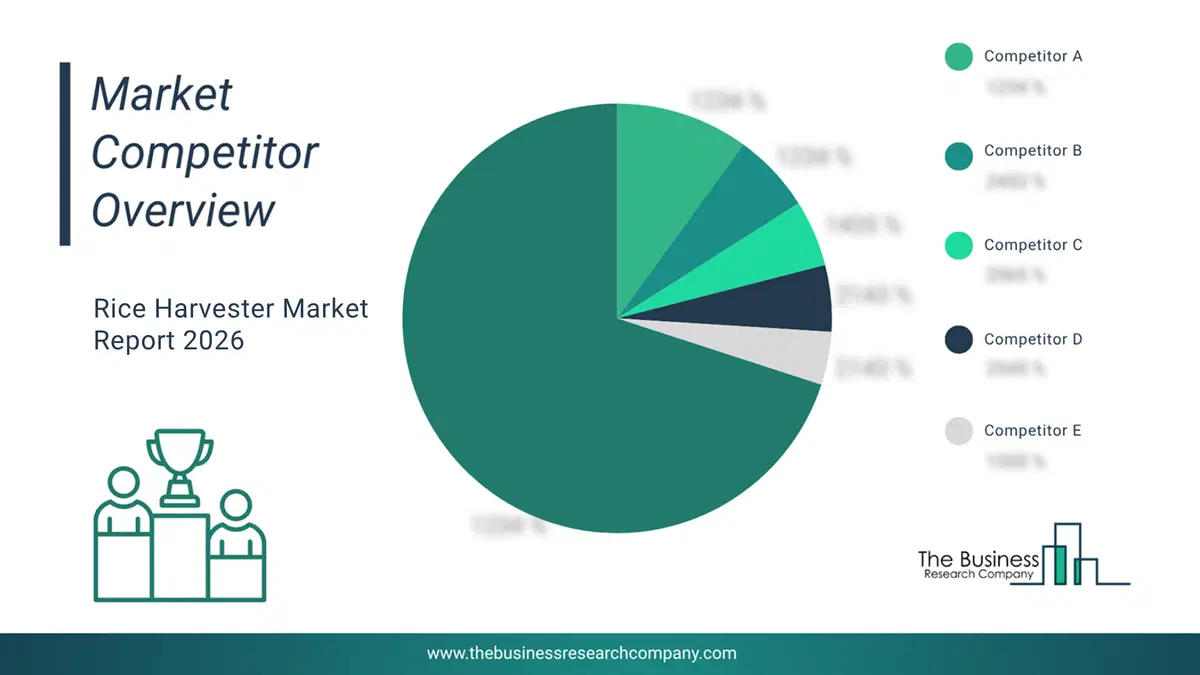
This chart is for illustrative purposes; the full report includes a detailed competitor analysis and comprehensive overview of the top 10 companies in the market.
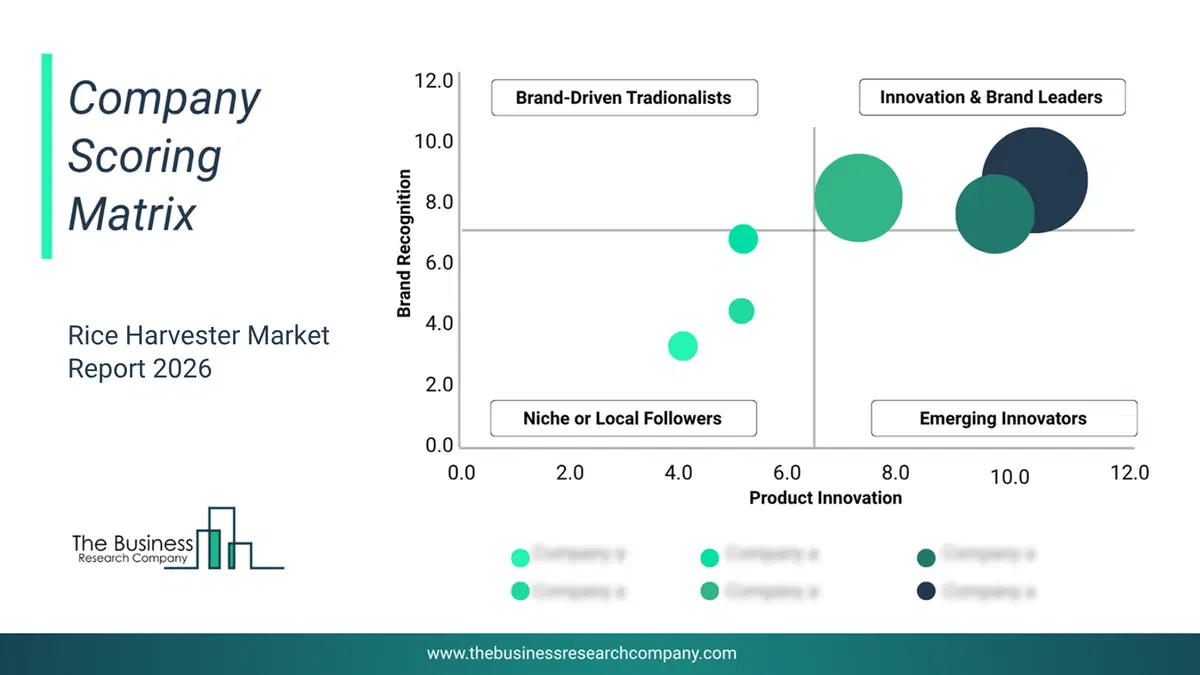
This chart maps companies by product innovation and brand strength, with bubble size indicating relative revenue, helping identify market leaders, challengers, and niche players. This is an illustrative chart; the full report provides a complete and accurate competitive analysis.
Global Rice Harvester Market Trends and Insights
Major companies operating in the rice harvester market are focusing on advancements in precision harvesting technologies, such as autonomous combine harvesters, to improve harvesting accuracy, reduce operational costs, and enhance field productivity. Autonomous combine harvesters are advanced agricultural machines equipped with intelligent navigation systems, yield monitoring sensors, automated steering, and real-time data analytics that enable efficient crop harvesting with minimal human intervention. For instance, in August 2025, Daedong, a South Korea-based agricultural machinery company, launched the DH6135-A autonomous combine harvester. The machine features Level 3 autonomous operation technology, integrated yield monitoring systems for real-time productivity analysis, and precision navigation functions that improve harvesting consistency and field efficiency. The harvester supports automated route control and smart farming data integration to enhance operational management and reduce labor dependency.What Are Latest Mergers And Acquisitions In The Rice Harvester Market?
In January 2025, Yanmar Holdings Co., Ltd., a Japan-based agricultural equipment manufacturer, completed the acquisition of CLAAS India Private Limited for an undisclosed amount. Through this acquisition, Yanmar added wheeled combine harvesters to its agricultural machinery portfolio and strengthened its manufacturing and export operations for harvesting equipment in India. CLAAS India Private Limited is an India-based manufacturer and exporter of combine harvesters, attachments, and agricultural machinery parts.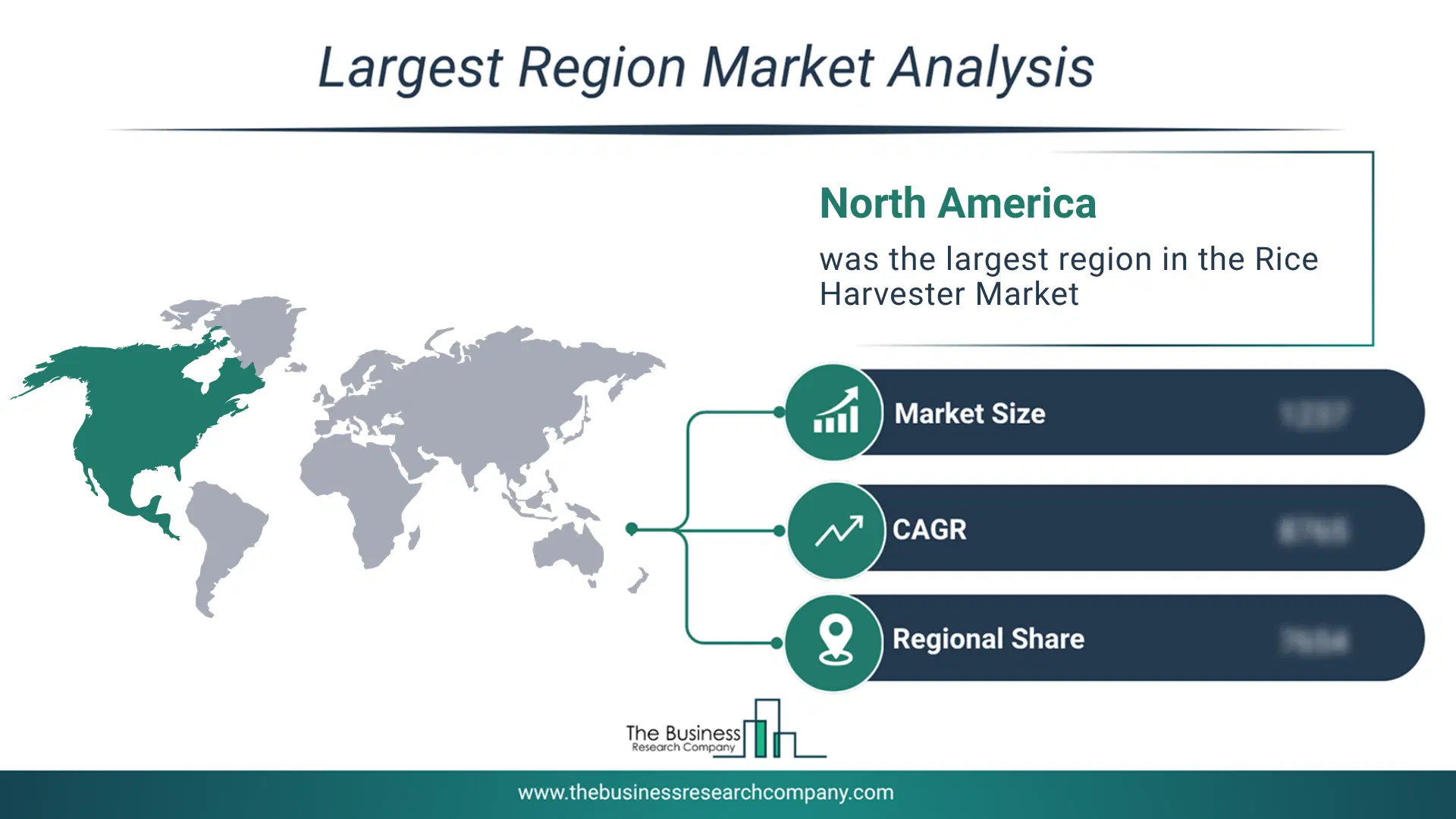
Regional Outlook/Insights
North America was the largest region in the rice harvester market in 2025. Asia-Pacific is expected to be the fastest-growing region in the forecast period. The regions covered in this market report are Asia-Pacific, South East Asia, Western Europe, Eastern Europe, North America, South America, Middle East, Africa. The countries covered in this market report are Australia, Brazil, China, France, Germany, India, Indonesia, Japan, Taiwan, Russia, South Korea, UK, USA, Canada, Italy, Spain.What Defines the Rice Harvester Market?
The rice harvester market consists of sales of combine rice harvesters, mini rice harvesters, and wheeled rice harvesters. Values in this market are ‘factory gate’ values, that is, the value of goods sold by the manufacturers or creators of the goods, whether to other entities (including downstream manufacturers, wholesalers, distributors, and retailers) or directly to end customers. The value of goods in this market includes related services sold by the creators of the goods.How is Market Value Defined and Measured?
The market value is defined as the revenues that enterprises gain from the sale of goods and/or services within the specified market and geography through sales, grants, or donations in terms of the currency (in USD unless otherwise specified). The revenues for a specified geography are consumption values that are revenues generated by organizations in the specified geography within the market, irrespective of where they are produced. It does not include revenues from resales along the supply chain, either further along the supply chain or as part of other products.
This chart presents market attractiveness based on a quantitative evaluation of growth, competition, strategic alignment, and risk, offering a clear view of opportunity areas for decision-making. This chart is for illustrative purposes; the full report contains the complete analysis.

This chart highlights the Total Addressable Market (TAM) by estimating the maximum revenue opportunity using an assumption-driven approach, supporting strategic planning and opportunity sizing across markets. The chart is illustrative; the full report provides a more comprehensive analysis.
What Key Data and Analysis Are Included in the Rice Harvester Market Report 2026?
The rice harvester market research report is one of a series of new reports from The Business Research Company that provides rice harvester market statistics, including rice harvester industry global market size, regional shares, competitors with a rice harvester market share, detailed rice harvester market segments, market trends and opportunities, and any further data you may need to thrive in the rice harvester industry. This rice harvester market research report delivers a complete perspective of everything you need, with an in-depth analysis of the current and future scenario of the industry.Rice Harvester Market Report Forecast Analysis
| Report Attribute | Details |
|---|---|
| Market Size Value In 2026 | $3.45 billion |
| Revenue Forecast In 2030 | $4.41 billion |
| Growth Rate | CAGR of 6.3% from 2026 to 2030 |
| Base Year For Estimation | 2025 |
| Actual Estimates/Historical Data | 2020-2025 |
| Forecast Period | 2026 - 2030 |
| Market Representation | Revenue in USD Billion and CAGR from 2026 to 2030 |
| Segments Covered | Product Type, Engine Power, Harvesting Capacity, Distribution Channel, End User |
| Regional Scope | Asia-Pacific, Western Europe, Eastern Europe, North America, South America, Middle East, Africa |
| Country Scope | The countries covered in the report are Australia, Brazil, China, France, Germany, India, Indonesia, Japan, Taiwan, Russia, South Korea, UK, USA, Canada, Italy, Spain. |
| Key Companies Profiled | AGCO Corporation, Changfa Agricultural Equipment Co. Ltd., CLAAS KGaA mbH, CNH Industrial N.V., Daedong Corporation, Dasmesh Mechanical Works Pvt. Ltd., Deere & Company, Iseki & Co. Ltd., Jiangsu World Agricultural Machinery Co. Ltd., Kubota Corporation, Lovol Heavy Industry Co. Ltd., LS Mtron Ltd., Mahindra & Mahindra Limited, Nanning Tagrm Co. Ltd., Preet Agro Industries Pvt. Ltd., Rostselmash Group, SDF Group, Shandong Shifeng (Group) Co. Ltd., TAFE (Tractors and Farm Equipment Limited), Yanmar Holdings Co. Ltd., YTO Group, Zoomlion Heavy Industry Science and Technology Co. Ltd. |
| Customization Scope | Request for Customization |
| Pricing And Purchase Options | Explore Purchase Options |