
Rice Seed Treatment Market Report 2026
Global Outlook – By Treatment Type (Chemical Seed Treatment, Biological Seed Treatment, Physical Seed Treatment), By Method (Seed Coating, Seed Dressing, Seed Pelleting), By Function (Disease Protection, Pest Protection, Improved Germination), By Distribution Channel (Direct Sales, Agro Dealers And Distributors, Online Platforms, Cooperative Networks), By End Use (Commercial Farming, Small Scale Farming, Research Institutions) – Market Size, Trends, Strategies, and Forecast to 2035
Rice Seed Treatment Market Overview
• Rice Seed Treatment market size has reached to $1.2 billion in 2025 • Expected to grow to $1.58 billion in 2030 at a compound annual growth rate (CAGR) of 5.8% • Growth Driver: Surge In Rice Production Fueling The Growth Of The Market Due To Increasing Demand For Higher Crop Yield And Global Food Security • Market Trend: Advanced Seed Treatment Solutions Enhance Rice Crop Protection and Improve Early-Season Crop Health • Asia-Pacific was the largest region and fastest growing region.What Is Covered Under Rice Seed Treatment Market?
Rice seed treatment is the pre-sowing application of chemical, biological, or physical treatments to rice seeds to protect them from seed-borne and soil-borne diseases, insect pests, and unfavorable environmental conditions. Its purpose is to improve germination, strengthen early seedling growth, achieve uniform crop establishment, and enhance overall rice productivity. The main treatment types of rice seed treatment include chemical seed treatment, biological seed treatment, and physical seed treatment. Chemical seed treatment refers to the application of chemical agents to rice seeds before planting to protect them from pathogens and pests and support healthy crop establishment. These treatments are applied through seed coating, seed dressing, and seed pelleting methods and provide functions such as disease protection, pest protection, and improved germination. They are distributed through direct sales, agro dealers and distributors, online platforms, and cooperative networks, and are used end uses in commercial farming, small scale farming, and research institutions.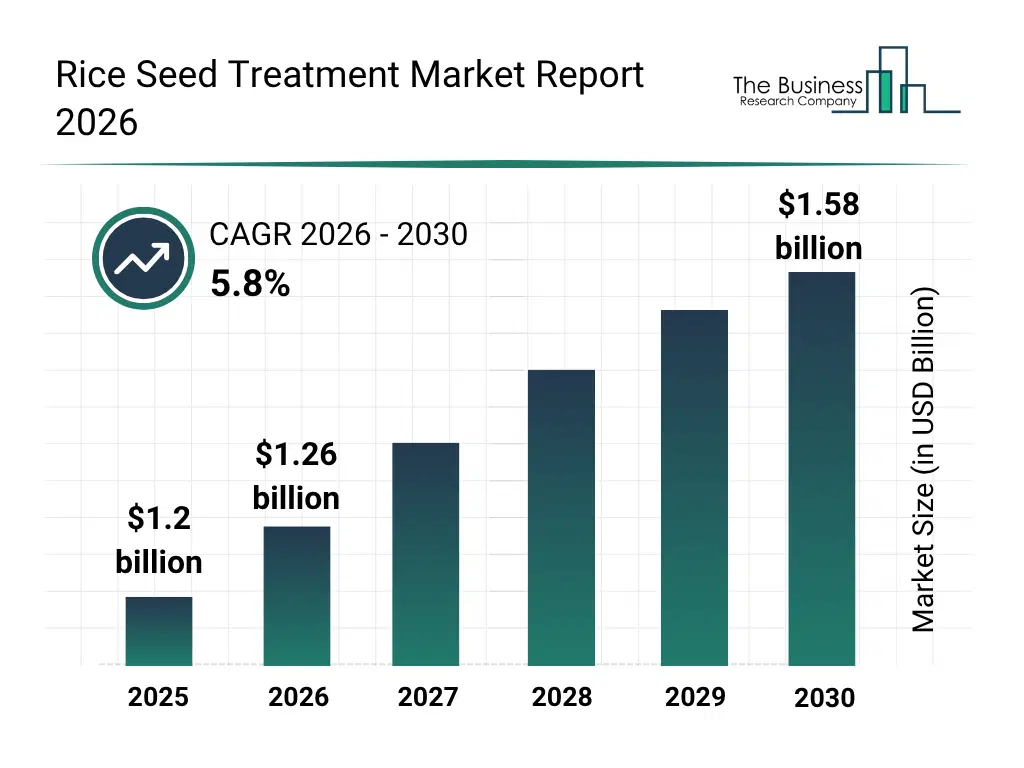
What Is The Rice Seed Treatment Market Size and Share 2026?
The rice seed treatment market size has grown strongly in recent years. It will grow from $1.2 billion in 2025 to $1.26 billion in 2026 at a compound annual growth rate (CAGR) of 5.5%. The growth in the historic period can be attributed to rising rice production and cultivation, increasing prevalence of seed-borne diseases, growing crop losses from soil-borne pests, increasing demand for improved seed germination, rising adoption of chemical seed treatment practices.What Is The Rice Seed Treatment Market Growth Forecast?
The rice seed treatment market size is expected to see strong growth in the next few years. It will grow to $1.58 billion in 2030 at a compound annual growth rate (CAGR) of 5.8%. The growth in the forecast period can be attributed to growing demand for sustainable crop protection solutions, increasing adoption of biological seed treatments, rising need for climate-resilient rice production, expansion of precision agriculture practices, increasing investment in advanced seed treatment technologies. Major trends in the forecast period include increasing adoption of biological seed treatment, development of climate-resilient seed treatments, advancements in microbial seed coatings, growing use of physical seed treatment technologies, expansion of multi-functional seed treatment formulations.Tariff Impact On Rice Seed Treatment Market
Tariffs are impacting the rice seed treatment market by increasing the cost of imported treatment chemicals, biological inputs, coating materials, specialized equipment, and agricultural technologies. Chemical and biological seed treatment segments may face greater cost pressures, particularly in Asia-Pacific and North America due to dependence on international agricultural input supply chains. Higher input costs can raise treatment expenses for commercial and small-scale farmers, while tariffs may also encourage domestic production, localized sourcing, and development of cost-effective biological and physical seed treatment alternatives.
Global Rice Seed Treatment Market Segmentation
2) By Method: Seed Coating, Seed Dressing, Seed Pelleting 3) By Function: Disease Protection, Pest Protection, Improved Germination 4) By Distribution Channel: Direct Sales, Agro Dealers And Distributors, Online Platforms, Cooperative Networks 5) By End Use: Commercial Farming, Small Scale Farming, Research Institutions Subsegments: 1) By Chemical Seed Treatment: Synthetic Chemical Treatment, Combination Chemical Treatment, Coating Based Chemical Treatment 2) By Biological Seed Treatment: Microbial Inoculant Treatment, Biocontrol Agent Treatment, Biofertilizer Treatment, Biostimulant Treatment 3) By Physical Seed Treatment: Hot Water Treatment, Magnetic Treatment, Radiation Treatment, Plasma Treatment, Mechanical TreatmentWhat Is The Driver Of The Rice Seed Treatment Market?
The growth of rice production is expected to propel the growth of the rice seed treatment market going forward. Rice production refers to the cultivation, harvesting, and processing of rice crops to meet food demand, support agricultural economies, and ensure global food security. The growth of rice production is driven by rising global food demand, as increasing population growth and changing dietary preferences are encouraging farmers to expand rice cultivation and improve productivity to ensure a stable food supply. The growth of rice production supports rice seed treatment by enhancing seed quality, protecting crops from diseases, improving germination rates, boosting yield potential, and ensuring efficient rice cultivation. For instance, in May 2026, according to the United States Department of Agriculture, a US-based federal government agency, rice yields are projected to increase by 3% in 2026/27, rising by 188 pounds per acre to 7,732 pounds, despite farmers planting 493,000 fewer rice acres. Therefore, the growth of rice production is driving the growth of the rice seed treatment industry.Key Players In The Global Rice Seed Treatment Market
Major companies operating in the rice seed treatment market are Syngenta AG, Bayer AG, Corteva Inc., BASF SE, UPL Limited, Sumitomo Chemical Co. Ltd., FMC Corporation, ADAMA Agricultural Solutions Ltd., Nufarm Limited, PI Industries Limited, Dhanuka Agritech Limited, Rallis India Limited, Bioceres Crop Solutions Corp., Verdesian Life Sciences LLC, Koppert Biological Systems B.V., Indofil Industries Limited, Crystal Crop Protection Limited, GSP Crop Science Private Limited, Clariant AG, Croda International Plc, Ashland Inc., Precision Laboratories LLC, Yara International ASA, Mitsui Chemicals Inc., Certis Belchim, Albaugh LLC, Loveland Products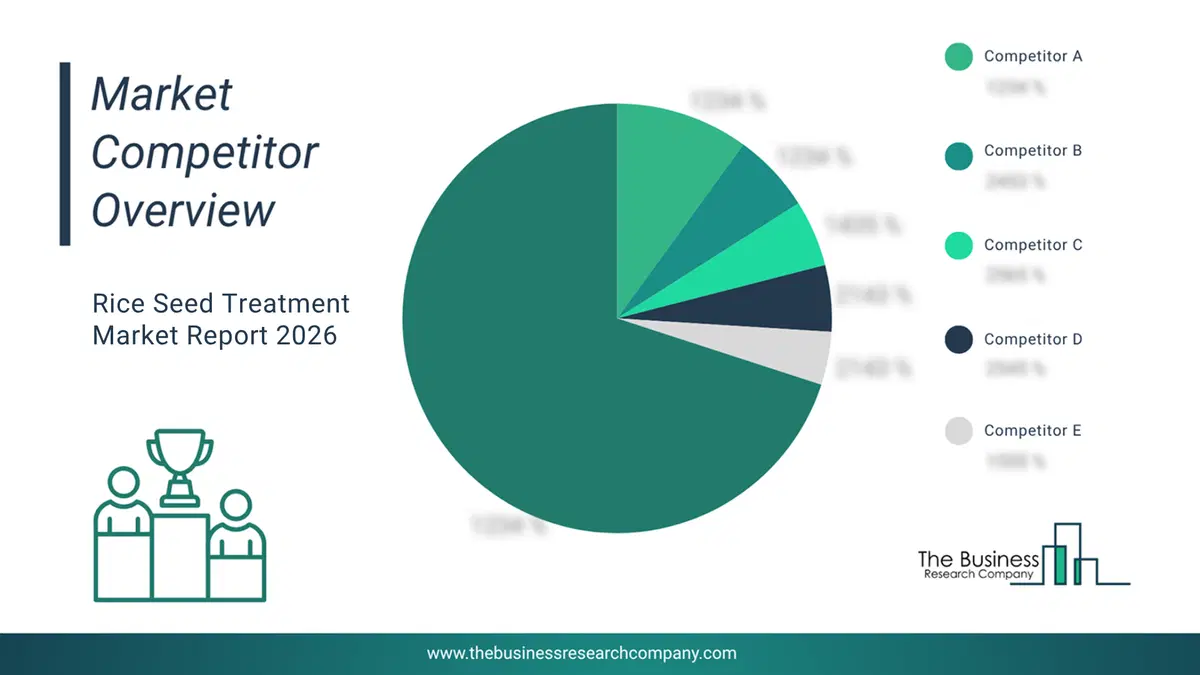
This chart is for illustrative purposes; the full report includes a detailed competitor analysis and comprehensive overview of the top 10 companies in the market.
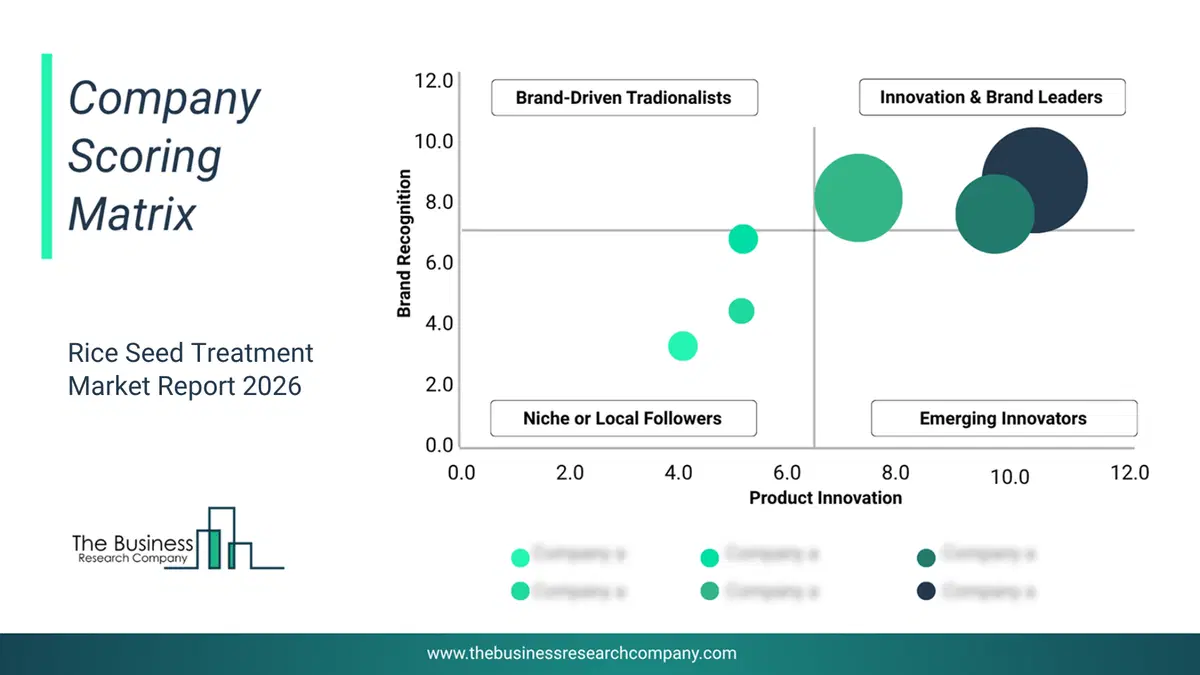
This chart maps companies by product innovation and brand strength, with bubble size indicating relative revenue, helping identify market leaders, challengers, and niche players. This is an illustrative chart; the full report provides a complete and accurate competitive analysis.
Global Rice Seed Treatment Market Trends and Insights
Major companies operating in the rice seed treatment market are focusing on developing advanced seed treatment solutions, such as seed safeners, to protect rice crops from herbicide injury, improve crop health, and support stronger early-season growth. Seed safeners refer to seed treatment technologies that enhance the crop’s ability to tolerate specific herbicides while reducing injury and supporting healthy crop development. For instance, in January 2026, UPL Corp, an India-based agricultural solutions company, announced the availability of Viludo, a new seed safener specifically designed for rice crops, featuring fenclorim as its active ingredient. The solution protects rice from bleaching injury caused by early-season clomazone applications by accelerating herbicide breakdown, with UPL field trials showing a 25% to 50% reduction in herbicide injury. Viludo is also compatible with fungicide and insecticide seed treatments and can support greater root biomass and improved canopy formation within 28–35 days after rice emergence.What Are Latest Mergers And Acquisitions In The Rice Seed Treatment Market?
In June 2026, Chaudhary Charan Singh Haryana Agricultural University (HAU), an India-based agricultural university, partnered with the Food and Agriculture Organization (FAO) under the GEF-7 Food Systems, Land Use, and Restoration Project to promote climate-resilient farming practices, particularly direct-seeded rice (DSR). With this partnership, HAU and FAO aim to promote biological seed-treatment technologies for rice through farmer training, technical guidance, and demonstration plots, supporting improved seed germination, early plant growth, soil health, and crop productivity. Food and Agriculture Organization (FAO) is a US-based United Nations specialized agency focused on food and agriculture, supporting sustainable agricultural practices, food security, and climate-resilient farming systems.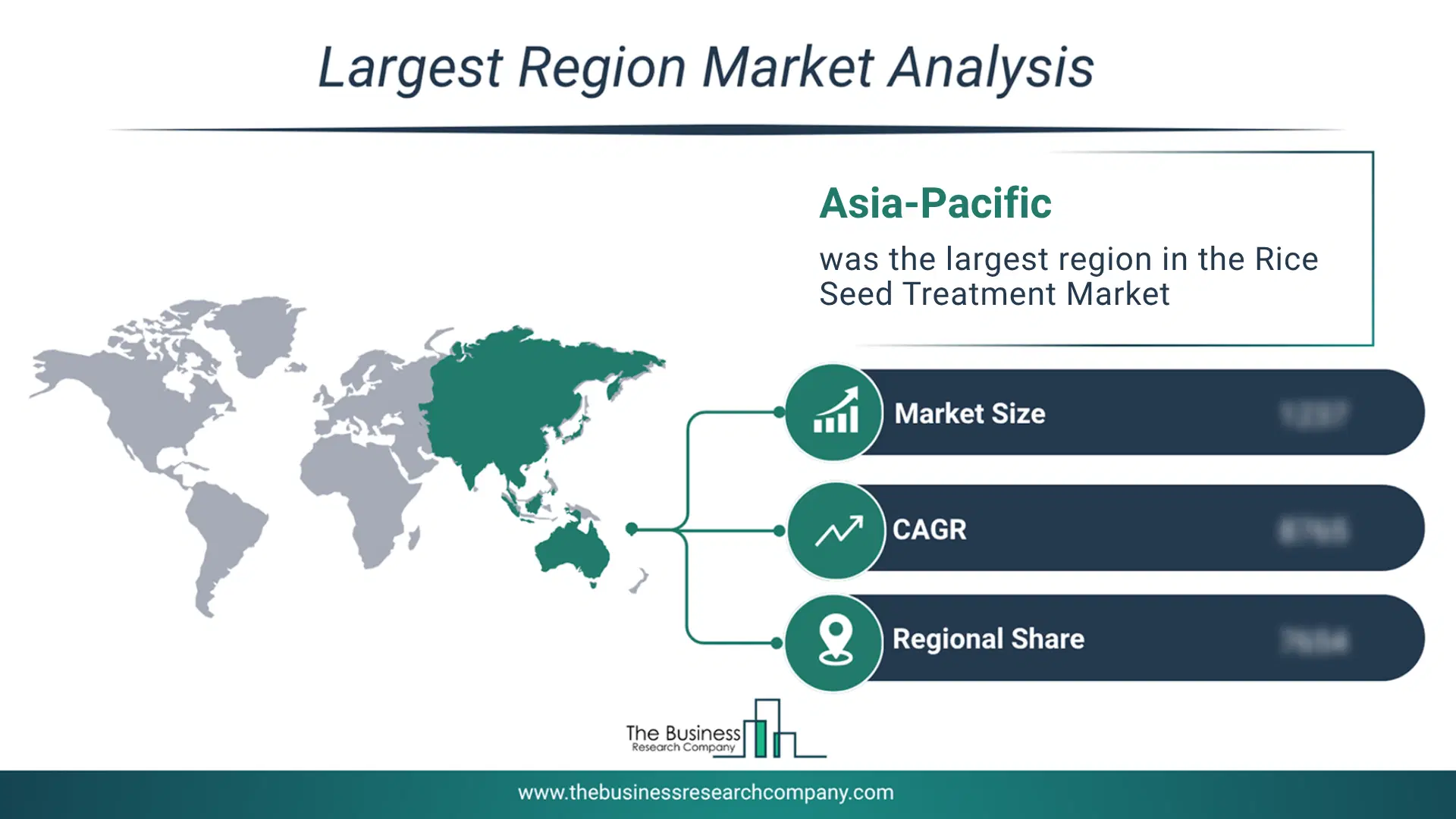
Regional Outlook/Insights
Asia-Pacific was the largest region in the rice seed treatment market in 2025. Asia-Pacific is expected to be the fastest-growing region in the forecast period. The regions covered in this market report are Asia-Pacific, South East Asia, Western Europe, Eastern Europe, North America, South America, Middle East, Africa. The countries covered in this market report are Australia, Brazil, China, France, Germany, India, Indonesia, Japan, Taiwan, Russia, South Korea, UK, USA, Canada, Italy, Spain.What Defines the Rice Seed Treatment Market?
The rice seed treatment market consists of sales of rice seed germination enhancers, rice seed growth promoters, and rice seed nutrient additives. Values in this market are ‘factory gate’ values, that is, the value of goods sold by the manufacturers or creators of the goods, whether to other entities (including downstream manufacturers, wholesalers, distributors, and retailers) or directly to end customers. The value of goods in this market includes related services sold by the creators of the goods.How is Market Value Defined and Measured?
The market value is defined as the revenues that enterprises gain from the sale of goods and/or services within the specified market and geography through sales, grants, or donations in terms of the currency (in USD unless otherwise specified). The revenues for a specified geography are consumption values that are revenues generated by organizations in the specified geography within the market, irrespective of where they are produced. It does not include revenues from resales along the supply chain, either further along the supply chain or as part of other products.
This chart presents market attractiveness based on a quantitative evaluation of growth, competition, strategic alignment, and risk, offering a clear view of opportunity areas for decision-making. This chart is for illustrative purposes; the full report contains the complete analysis.

This chart highlights the Total Addressable Market (TAM) by estimating the maximum revenue opportunity using an assumption-driven approach, supporting strategic planning and opportunity sizing across markets. The chart is illustrative; the full report provides a more comprehensive analysis.
What Key Data and Analysis Are Included in the Rice Seed Treatment Market Report 2026?
The rice seed treatment market research report is one of a series of new reports from The Business Research Company that provides market statistics, including industry global market size, regional shares, competitors with the market share, detailed market segments, market trends and opportunities, and any further data you may need to thrive in the rice seed treatment industry. The market research report delivers a complete perspective of everything you need, with an in-depth analysis of the current and future state of the industry.Rice Seed Treatment Market Report Forecast Analysis
| Report Attribute | Details |
|---|---|
| Market Size Value In 2026 | $1.26 billion |
| Revenue Forecast In 2030 | $1.58 billion |
| Growth Rate | CAGR of 5.8% from 2026 to 2035 |
| Base Year For Estimation | 2025 |
| Actual Estimates/Historical Data | 2020-2025 |
| Forecast Period | 2026 - 2030 |
| Market Representation | Revenue in USD Billion and CAGR from 2026 to 2030 |
| Segments Covered | Treatment Type, Method, Function, Distribution Channel, End Use |
| Regional Scope | Asia-Pacific, Western Europe, Eastern Europe, North America, South America, Middle East, Africa |
| Country Scope | The countries covered in the report are Australia, Brazil, China, France, Germany, India, Indonesia, Japan, Taiwan, Russia, South Korea, UK, USA, Canada, Italy, Spain. |
| Customization Scope | Request for Customization |
| Pricing And Purchase Options | Explore Purchase Options |