

Rice Thresher Market Report 2026
Global Outlook – By Type (Spike Tooth Rice Thresher, Axial Flow Rice Thresher, Hammer Mill Rice Thresher, Wire Loop Rice Thresher), By Operation Mode (Manual, Semi Automatic, Fully Automatic), By Power Source (Diesel Powered, Electric Powered), By End User (Smallholder Farmers, Commercial Farmers, Custom Hiring Centers, Agricultural Contractors) – Market Size, Trends, Strategies, and Forecast to 2035
Rice Thresher Market Overview
• Rice Thresher market size has reached to $1.39 billion in 2025 • Expected to grow to $2.03 billion in 2030 at a compound annual growth rate (CAGR) of 7.8% • Growth Driver: Surge In Rice Production Fueling The Growth Of The Market Due To Increasing Demand For Efficient Post-harvest Mechanization • Market Trend: Innovation In Rice Processing Technology For Small-Scale And Marginal Farmers • Asia-Pacific was the largest region and fastest growing region.What Is Covered Under Rice Thresher Market?
A rice thresher is an agricultural machine designed to separate rice grains from harvested stalks and panicles efficiently after harvesting. It uses mechanical threshing mechanisms to reduce manual labor, improve grain recovery, and minimize harvesting losses while increasing the speed of post-harvest processing. Rice threshers help enhance productivity, maintain grain quality, and support efficient rice production by providing faster and more consistent threshing operations compared with traditional manual methods. The main types of rice threshers include spike tooth rice threshers, axial flow rice threshers, hammer mill rice threshers, and wire loop rice threshers. Spike tooth rice threshers refer to agricultural machines that use toothed components to separate rice grains from harvested panicles through mechanical threshing. These machines operate in manual, semi automatic, and fully automatic modes. They are powered by diesel or electricity and are used end users by smallholder farmers, commercial farmers, custom hiring centers, and agricultural contractors.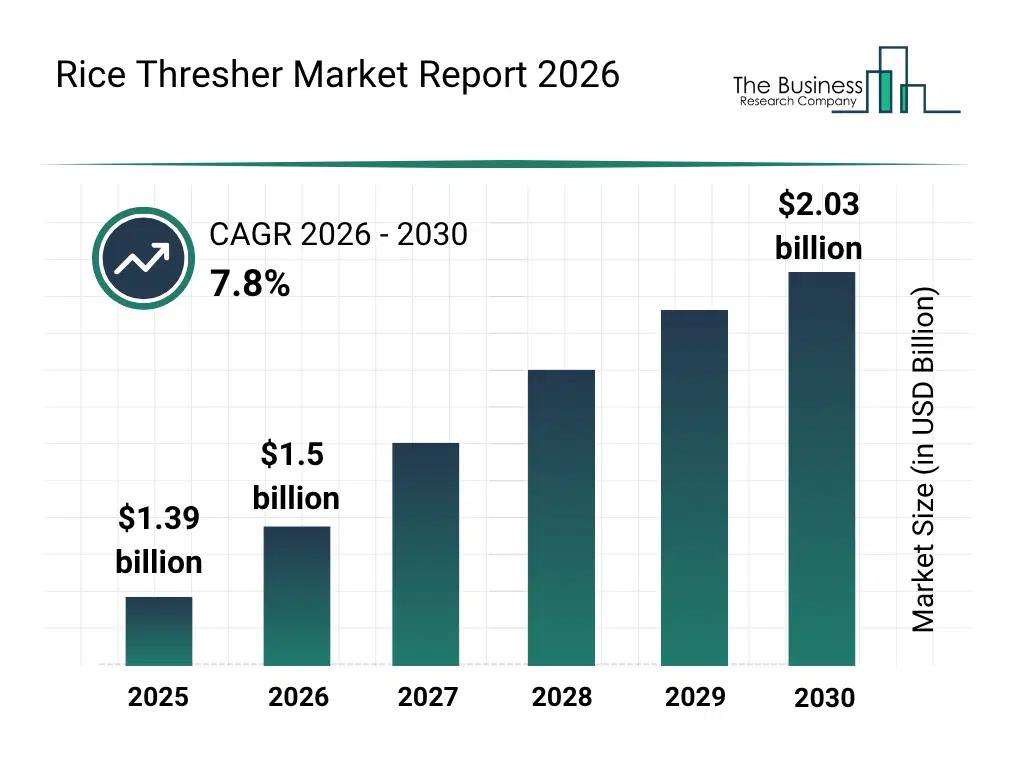
What Is The Rice Thresher Market Size and Share 2026?
The rice thresher market size has grown strongly in recent years. It will grow from $1.39 billion in 2025 to $1.5 billion in 2026 at a compound annual growth rate (CAGR) of 7.9%. The growth in the historic period can be attributed to rising rice production volumes, increasing agricultural labor shortages, growing adoption of farm mechanization, demand for faster post-harvest processing, need to reduce grain harvesting losses.What Is The Rice Thresher Market Growth Forecast?
The rice thresher market size is expected to see strong growth in the next few years. It will grow to $2.03 billion in 2030 at a compound annual growth rate (CAGR) of 7.8%. The growth in the forecast period can be attributed to increasing demand for high-capacity threshing equipment, rising adoption of electric-powered agricultural machinery, expansion of custom hiring centers, growing demand for affordable smallholder farm machinery, increasing focus on improving post-harvest grain quality. Major trends in the forecast period include mechanization of rice threshing operations, development of low-loss threshing mechanisms, compact and portable rice thresher designs, multi-crop threshing machine capabilities, improved grain cleaning and separation efficiency.Tariff Impact On Rice Thresher Market
Tariffs are impacting the rice thresher market by increasing the cost of imported agricultural machinery, engines, electric motors, metal components, and other equipment inputs used in thresher manufacturing. Diesel-powered and electric-powered threshers may face higher production and procurement costs, with regions dependent on imported machinery and components, particularly Asia-Pacific, Africa, and Latin America, experiencing greater pressure. However, tariffs can encourage domestic manufacturing, local sourcing of components, and investment in cost-efficient rice threshing technologies, potentially strengthening regional agricultural machinery supply chains.
Global Rice Thresher Market Segmentation
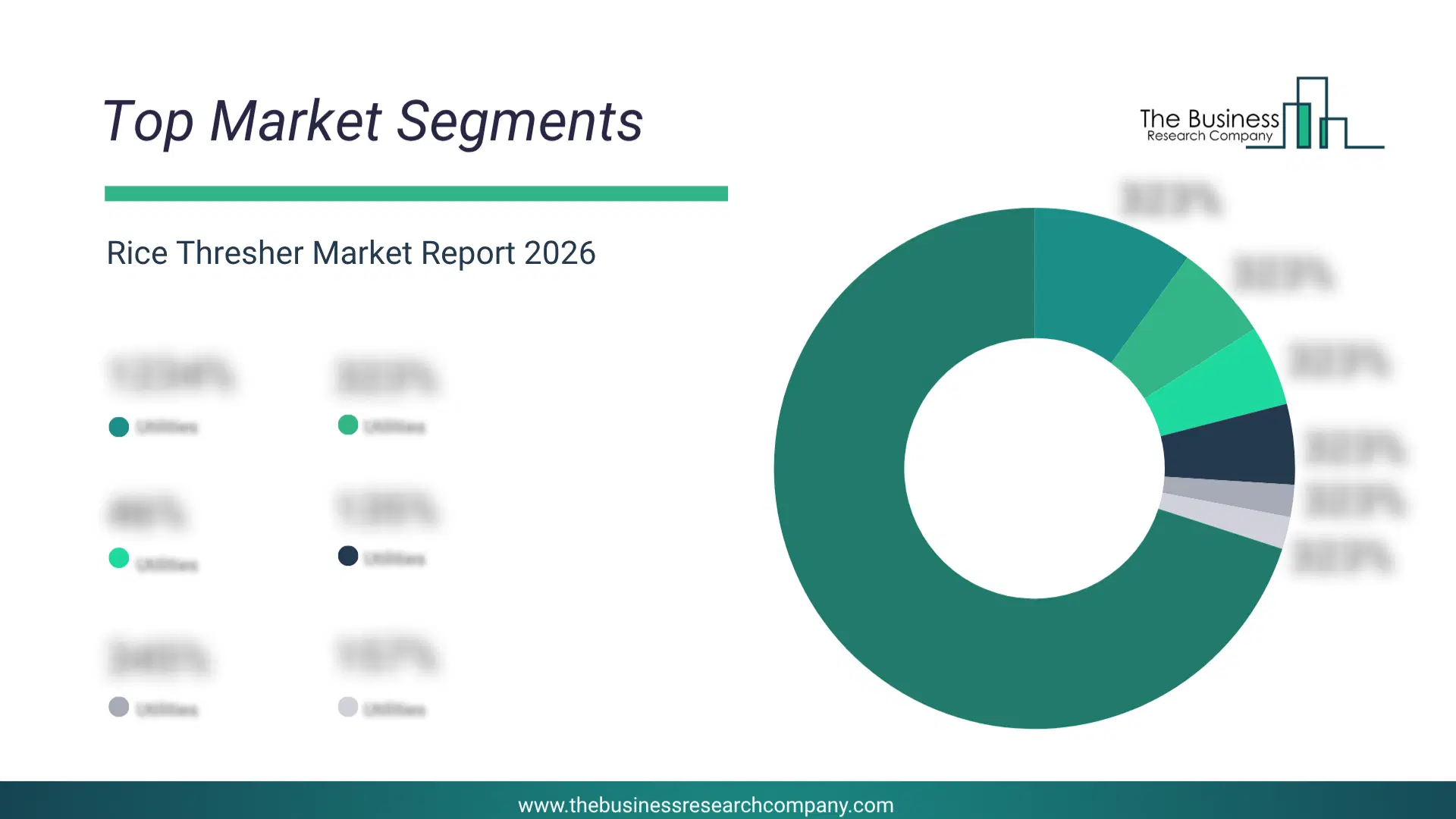
2) By Operation Mode: Manual, Semi Automatic, Fully Automatic 3) By Power Source: Diesel Powered, Electric Powered 4) By End User: Smallholder Farmers, Commercial Farmers, Custom Hiring Centers, Agricultural Contractors Subsegments: 1) By Spike Tooth Rice Thresher: Open Drum Spike Tooth Rice Thresher, Closed Drum Spike Tooth Rice Thresher, Tangential Feed Spike Tooth Rice Thresher 2) By Axial Flow Rice Thresher: Single Axial Flow Rice Thresher, Twin Axial Flow Rice Thresher, Continuous Feed Axial Flow Rice Thresher 3) By Hammer Mill Rice Thresher: Fixed Hammer Mill Rice Thresher, Swing Hammer Mill Rice Thresher 4) By Wire Loop Rice Thresher: Single Drum Wire Loop Rice Thresher, Double Drum Wire Loop Rice Thresher, Oscillating Wire Loop Rice ThresherWhat Are The Drivers Of The Rice Thresher Market?
The rising rice production is expected to propel the growth of the rice thresher market going forward. Rice production refers to the process of cultivating, harvesting, and processing rice crops to produce edible rice grains for food consumption, industrial use, and trade. The rise in rice production is driven by increasing global food demand, as population growth and higher consumption require greater rice output to ensure food security and meet domestic and international market needs. The growing rice production supports the rice thresher by increasing the demand for efficient post-harvest machinery that enables faster grain separation, minimizes crop losses, reduces labor requirements, and improves overall harvesting efficiency. For instance, in May 2026, according to the United States Department of Agriculture, a US-based federal government agency, rice yields are projected to increase by 3% in 2026/27, rising by 188 pounds per acre to 7,732 pounds, despite farmers planting 493,000 fewer rice acres. Therefore, rising rice production is driving the growth of the rice thresher industry. The rising agricultural labor shortages are expected to propel the growth of the rice thresher market going forward. Agricultural labor shortage refers to the insufficient availability of farm workers needed to carry out essential crop production activities such as planting, cultivating, and harvesting. The shortage is increasingly driven by a declining domestic workforce in agriculture, as workers shift toward non-farm employment opportunities, reducing the pool of available laborers for seasonal and year-round farm operations. Rising agricultural labor shortages are increasing demand for rice threshers by reducing reliance on manual labor, lowering labor costs, and enabling faster, more efficient post-harvest grain separation. For instance, in June 2026, according to the American Farm Bureau Federation, a US-based nonprofit agricultural organization, during the first half of fiscal year 2026, 254,688 H-2A positions were certified, representing a 16.9% increase compared with the same period of fiscal year 2025, reflecting rising demand for temporary agricultural workers amid persistent domestic farm labor shortages. Therefore, rising agricultural labor shortages are driving the growth of the rice thresher industry.Key Players In The Global Rice Thresher Market
Major companies operating in the rice thresher market are Deere & Company, Kubota Corporation, CNH Industrial N.V., Mahindra & Mahindra Limited, AGCO Corporation, CLAAS KGaA mbH, Yanmar Holdings Co. Ltd., Muthoot Agro Equipment, Tractors And Farm Equipment Limited, Cicoria S.r.l., Sifang Group Co. Ltd., Wintersteiger AG, VST Tillers Tractors Ltd., ALMACO Group, Alvan Blanch Development Company Limited, Shrachi Agrimech, Dasmesh Mechanical Works Private Limited, Jiangsu World Agricultural Machinery Co. Ltd., KS Agrotech Private Limited, PREET Group, Kartar Agro Industries Private Limited, ISEKI & Co. Ltd., Makwel Industries Pvt. Ltd.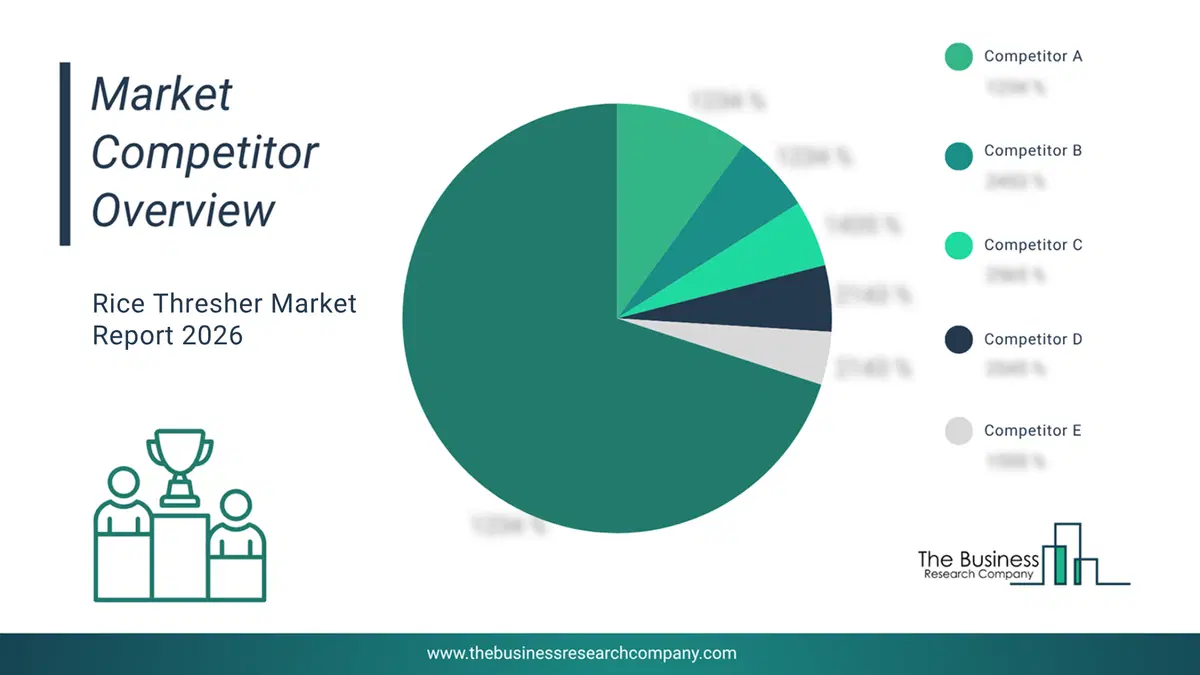
This chart is for illustrative purposes; the full report includes a detailed competitor analysis and comprehensive overview of the top 10 companies in the market.
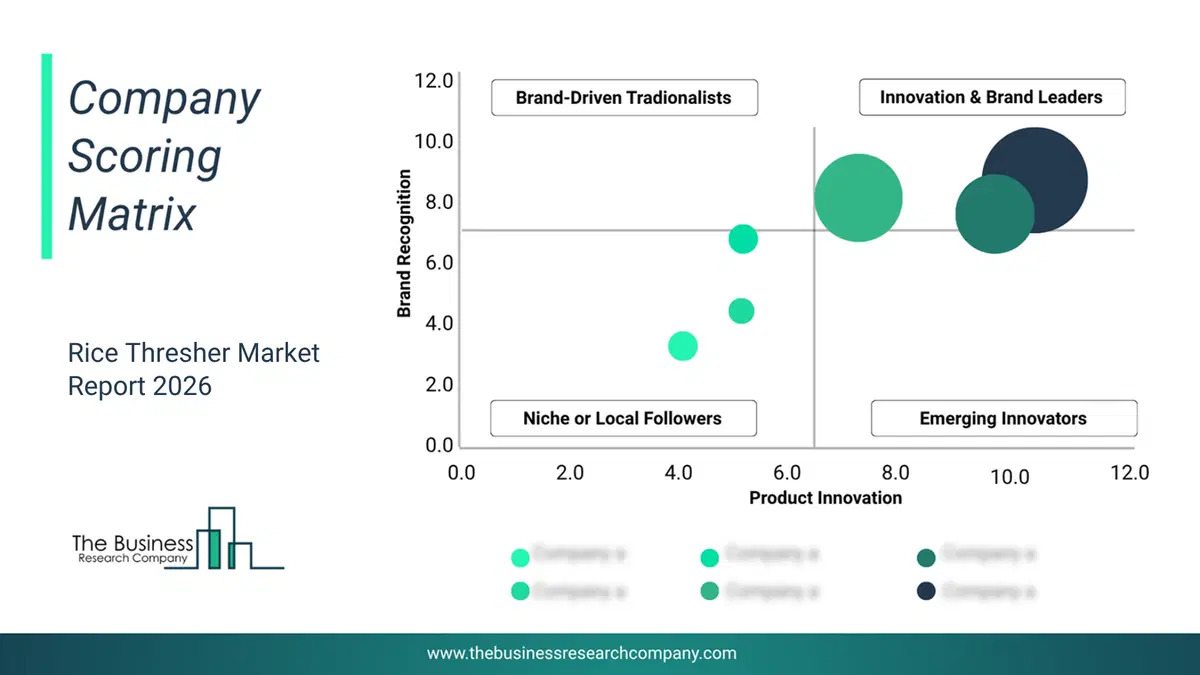
This chart maps companies by product innovation and brand strength, with bubble size indicating relative revenue, helping identify market leaders, challengers, and niche players. This is an illustrative chart; the full report provides a complete and accurate competitive analysis.
Global Rice Thresher Market Trends and Insights
Major companies operating in the rice thresher market are focusing on developing innovative products such as, dual-mode rice threshing machines to improve threshing efficiency, reduce labor dependency, and minimize post-harvest grain losses. Dual-mode rice threshing machines are machines that operate using both electric motor and manual hand-power mechanisms, helping farmers continue threshing during power shortages while reducing labor, effort, and processing time. For instance, in March 2026, Vigyan Ashram, an India-based rural technology and design innovation organization, developed a rice thresher machine in collaboration with Shree Bairavnath Vidyamandir, an India-based educational institution, to reduce manual labor, threshing time, and processing costs for small-scale and marginal farmers. The machine features a rotating threshing drum with beating spikes, sieve arrangements for separating paddy grains from straw and husk, and a pulley-driven system powered by a 1 HP electric motor. It also incorporates a hand-operated mechanism, enabling farmers to continue operation during electricity shortages. The machine can thresh approximately 500 kg of paddy in two hours in motor-operated mode and is designed to improve grain separation, reduce grain losses, and enhance overall post-harvest productivity. This innovation supports affordable rural mechanization by providing farmers with an economical, durable, and easy-to-maintain threshing solution.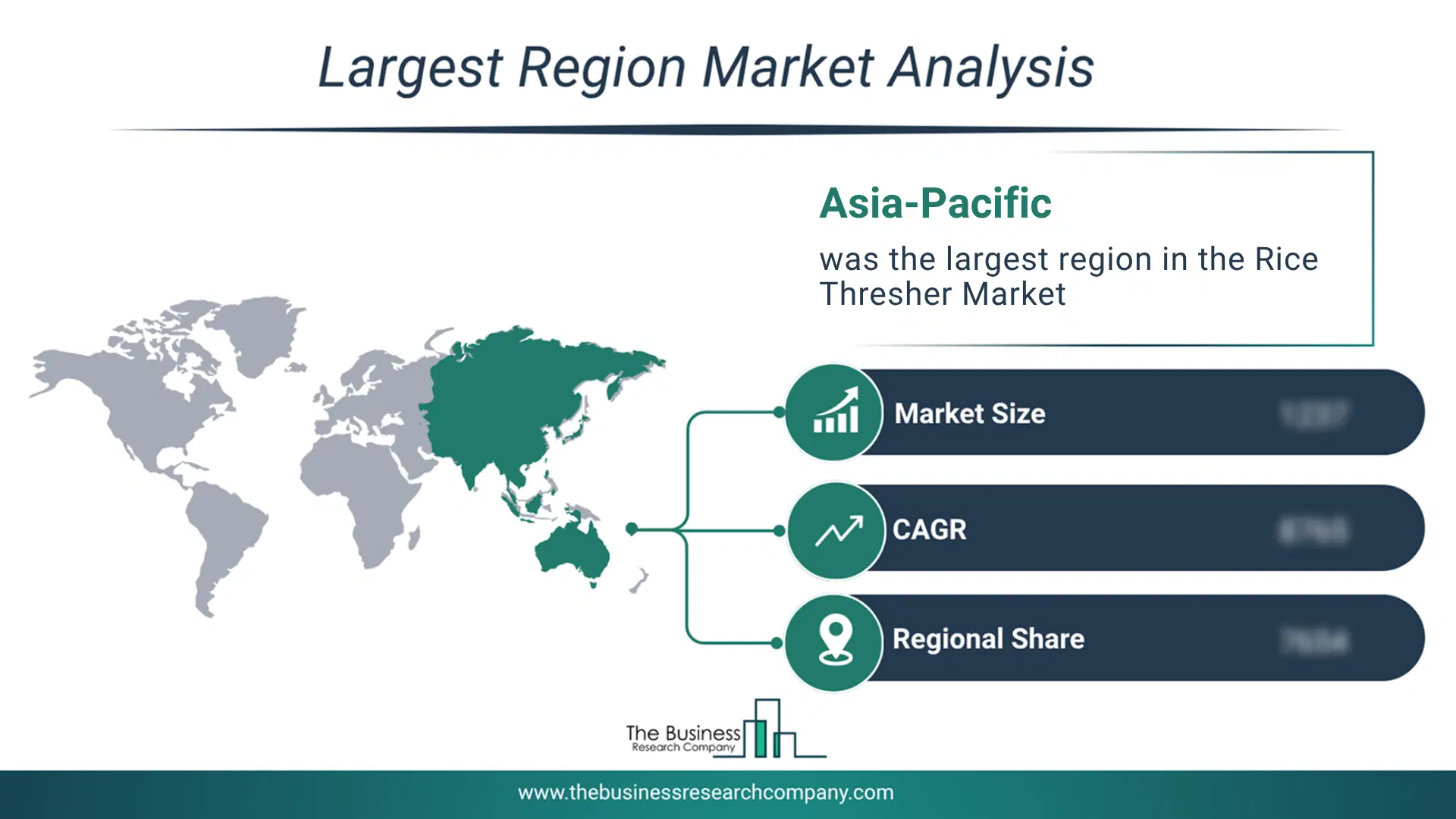
Regional Outlook/Insights
Asia-Pacific was the largest region in the rice thresher market in 2025. Asia-Pacific is expected to be the fastest-growing region in the forecast period. The regions covered in this market report are Asia-Pacific, South East Asia, Western Europe, Eastern Europe, North America, South America, Middle East, Africa. The countries covered in this market report are Australia, Brazil, China, France, Germany, India, Indonesia, Japan, Taiwan, Russia, South Korea, UK, USA, Canada, Italy, Spain.What Defines the Rice Thresher Market?
The rice thresher market consists of sales of axial-flow rice threshers, tangential-flow rice threshers, spike-tooth rice threshers, rasp-bar rice threshers, and combined rice threshing and cleaning machines. Values in this market are ‘factory gate’ values, that is, the value of goods sold by the manufacturers or creators of the goods, whether to other entities (including downstream manufacturers, wholesalers, distributors, and retailers) or directly to end customers. The value of goods in this market includes related services sold by the creators of the goods.How is Market Value Defined and Measured?
The market value is defined as the revenues that enterprises gain from the sale of goods and/or services within the specified market and geography through sales, grants, or donations in terms of the currency (in USD unless otherwise specified). The revenues for a specified geography are consumption values that are revenues generated by organizations in the specified geography within the market, irrespective of where they are produced. It does not include revenues from resales along the supply chain, either further along the supply chain or as part of other products.
This chart presents market attractiveness based on a quantitative evaluation of growth, competition, strategic alignment, and risk, offering a clear view of opportunity areas for decision-making. This chart is for illustrative purposes; the full report contains the complete analysis.

This chart highlights the Total Addressable Market (TAM) by estimating the maximum revenue opportunity using an assumption-driven approach, supporting strategic planning and opportunity sizing across markets. The chart is illustrative; the full report provides a more comprehensive analysis.
What Key Data and Analysis Are Included in the Rice Thresher Market Report 2026?
The rice thresher market research report is one of a series of new reports from The Business Research Company that provides market statistics, including industry global market size, regional shares, competitors with the market share, detailed market segments, market trends and opportunities, and any further data you may need to thrive in the rice thresher industry. The market research report delivers a complete perspective of everything you need, with an in-depth analysis of the current and future state of the industry.Rice Thresher Market Report Forecast Analysis
| Report Attribute | Details |
|---|---|
| Market Size Value In 2026 | $1.5 billion |
| Revenue Forecast In 2030 | $2.03 billion |
| Growth Rate | CAGR of 7.8% from 2026 to 2035 |
| Base Year For Estimation | 2025 |
| Actual Estimates/Historical Data | 2020-2025 |
| Forecast Period | 2026 - 2030 |
| Market Representation | Revenue in USD Billion and CAGR from 2026 to 2030 |
| Segments Covered | Type, Operation Mode, Power Source, End User |
| Regional Scope | Asia-Pacific, Western Europe, Eastern Europe, North America, South America, Middle East, Africa |
| Country Scope | The countries covered in the report are Australia, Brazil, China, France, Germany, India, Indonesia, Japan, Taiwan, Russia, South Korea, UK, USA, Canada, Italy, Spain. |
| Customization Scope | Request for Customization |
| Pricing And Purchase Options | Explore Purchase Options |