
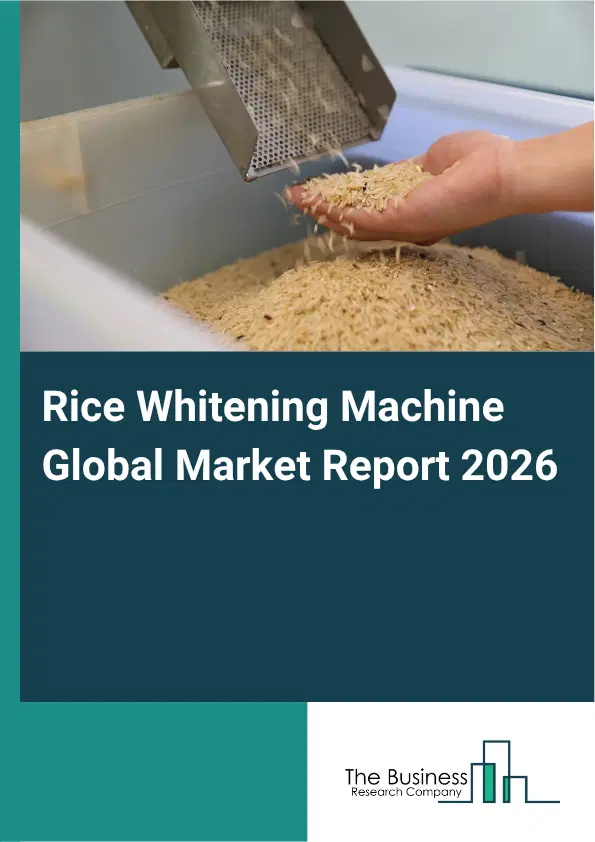
Rice Whitening Machine Market Report 2026
Global Outlook – By Type ( Vertical Rice Whitening Machine, Horizontal Rice Whitening Machine, Combined Rice Whitening Machine), By Capacity ( Small Scale Or Micro Mills (Less Than Two Tons Per Hour), Medium Scale Commercial Mills (Two To Six Tons Per Hour), Large Scale Industrial Plants), By Distribution Channel ( Direct Sales, Distributors And Dealers, Online Sales Channels, Original Equipment Manufacturer Partnerships), By Application ( Industrial, Commercial, Household), By End Use ( Food Processing Units, Rice Mills, Research Laboratories) – Market Size, Trends, Strategies, and Forecast to 2030
Rice Whitening Machine Market Report 2026 Market Overview
• Rice Whitening Machine Market Report 2026 market size has reached to $0.63 billion in 2025 • Expected to grow to $0.97 billion in 2030 at a compound annual growth rate (CAGR) of 8.8% • Growth Driver: Surge In Global Rice Production Fueling The Growth Of The Market Due To Increasing Demand For Efficient Rice Processing And Quality Enhancement • Market Trend: Innovative Milling Chamber Pressure Management Improves Grain Uniformity • Asia-Pacific was the largest region and fastest growing region.What Is Covered Under Rice Whitening Machine Market?
A rice whitening machine is an industrial rice-processing equipment designed to remove the bran layer from dehusked rice, producing polished white rice with improved appearance, texture, and shelf life. It operates through friction or abrasive action, often combined with air suction, to efficiently separate bran from the grain. A rice whitening machine ensures uniform polishing while collecting bran as a valuable byproduct for applications such as animal feed and rice bran oil production. The main types of rice whitening machine include vertical rice whitening machine, horizontal rice whitening machine, and combined rice whitening machine. Vertical rice whitening machine refers to a rice milling equipment designed to remove bran layers from rice grains using a vertical abrasive or friction mechanism for efficient polishing and whitening. These machines are categorized by capacity including small scale or micro mills (less than two tons per hour), medium scale commercial mills (two to six tons per hour), and large scale industrial plants and are distributed through direct sales, distributors and dealers, online sales channels, and original equipment manufacturer partnerships. The various applications involved are industrial, commercial, and household, and they are used by several end uses such as food processing units, rice mills, and research laboratories.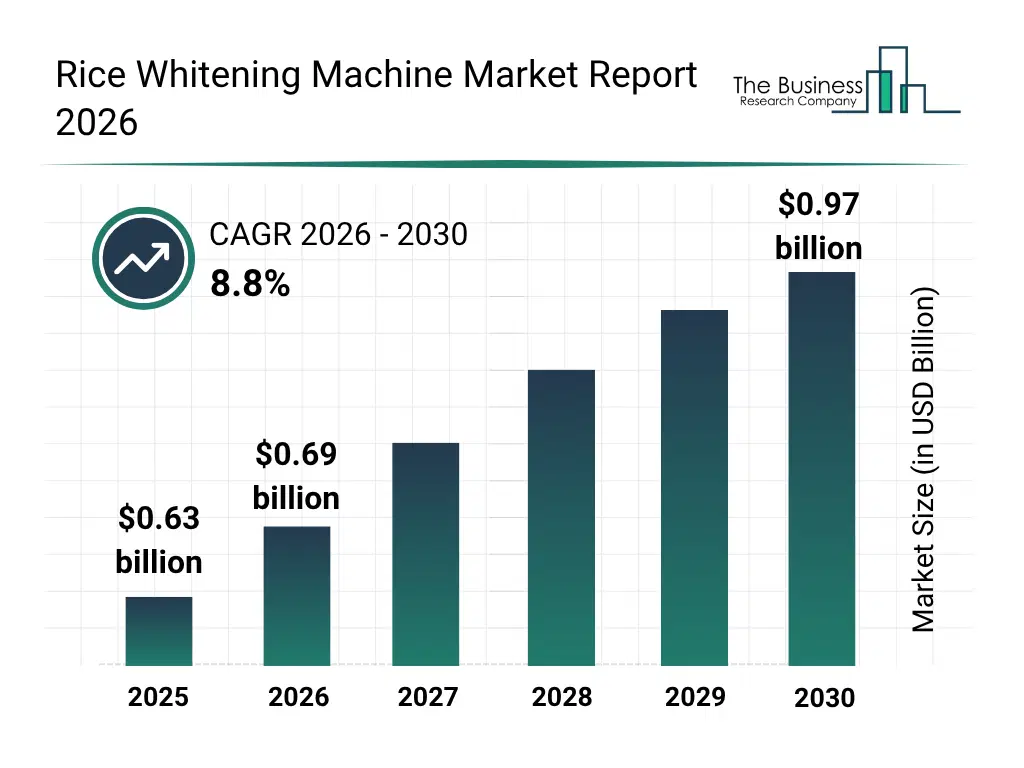
What Is The Rice Whitening Machine Market Size and Share 2026?
The rice whitening machine market size has grown strongly in recent years. It will grow from $0.63 billion in 2025 to $0.69 billion in 2026 at a compound annual growth rate (CAGR) of 9.2%. The growth in the historic period can be attributed to growth in global rice consumption, increasing mechanization in rice processing activities, rising demand for high quality polished rice, expansion of commercial rice milling facilities, increasing investments in food processing infrastructure.What Is The Rice Whitening Machine Market Growth Forecast?
The rice whitening machine market size is expected to see strong growth in the next few years. It will grow to $0.97 billion in 2030 at a compound annual growth rate (CAGR) of 8.8%. The growth in the forecast period can be attributed to growing demand for automated rice processing systems, increasing focus on operational efficiency improvement, rising investments in smart milling technologies, expansion of rice export activities, increasing demand for sustainable rice processing solutions. Major trends in the forecast period include increasing demand for high rice recovery and reduced grain breakage, growing adoption of advanced polishing and whitening technologies, rising focus on improving rice appearance and grain quality, increasing utilization of rice bran byproducts for value-added applications, expansion of large scale rice processing operations.
Global Rice Whitening Machine Market Segmentation
1) By Type: Vertical Rice Whitening Machine, Horizontal Rice Whitening Machine, Combined Rice Whitening Machine 2) By Capacity: Small Scale Or Micro Mills (Less Than Two Tons Per Hour), Medium Scale Commercial Mills (Two To Six Tons Per Hour), Large Scale Industrial Plants 3) By Distribution Channel: Direct Sales, Distributors And Dealers, Online Sales Channels, Original Equipment Manufacturer Partnerships 4) By Application: Industrial, Commercial, Household 5) By End Use: Food Processing Units, Rice Mills, Research Laboratories Subsegments: 1) By Vertical Rice Whitening Machine: Single Chamber Vertical Rice Whitening Machine, Multi Chamber Vertical Rice Whitening Machine, Abrasive Vertical Rice Whitening Machine, Friction Vertical Rice Whitening Machine, Automatic Vertical Rice Whitening Machine 2) By Horizontal Rice Whitening Machine: Single Pass Horizontal Rice Whitening Machine, Multi Pass Horizontal Rice Whitening Machine, Abrasive Horizontal Rice Whitening Machine, Friction Horizontal Rice Whitening Machine, Continuous Operation Horizontal Rice Whitening Machine 3) By Combined Rice Whitening Machine: Whitening And Polishing Combined Rice Whitening Machine, Multi Stage Combined Rice Whitening Machine, Integrated Milling And Whitening Machine, Automated Combined Rice Whitening Machine, High Capacity Combined Rice Whitening MachineWhat Are The Drivers Of The Rice Whitening Machine Market?
The increasing rice production is expected to propel the growth of the rice whitening machine market going forward. Rice production refers to the cultivation and harvesting of paddy rice, followed by post-harvest processing activities such as milling, polishing, and grading to convert raw paddy into consumable white rice. Rice production is rising as more agricultural land is allocated to rice cultivation to meet increasing food demand, resulting in higher harvested output and overall production volumes. Rice whitening machines support rice production by removing bran layers from milled rice, improving grain appearance, enhancing texture, increasing market value, and ensuring uniform quality suitable for commercial distribution. For instance, in February 2024, according to the United States Department of Agriculture (USDA), a US-based federal agency responsible for providing timely, accurate, and useful statistics in service to U.S. agriculture, the total rice planted area in the United States rose from approximately 2.22 million acres in 2022 to 2.89 million acres in 2023, an increase of around 30 percent, while harvested area grew from approximately 2.17 million acres to 2.85 million acres, up 32 percent over the same period. Therefore, increasing rice production is driving the growth of the rice whitening machine industry. The rising awareness of food safety and hygiene standards is expected to propel the growth of the rice whitening machine market going forward. Food safety and hygiene standards refer to the regulatory and operational practices designed to ensure that food products are processed, handled, and stored in a clean and contamination-free environment, minimizing the risk of physical, chemical, and biological hazards. Rising concern about foodborne illnesses is increasing awareness of food safety and hygiene standards, prompting greater demand for safe food handling, preparation, and storage practices across the food supply chain. Rice whitening machines support compliance with food safety and hygiene requirements by improving the milling process through efficient removal of bran layers, reducing impurities, minimizing microbial contamination risk, and ensuring uniform polishing under controlled and hygienic conditions. For instance, in May 2024, according to the US Food and Drug Administration, a US-based government agency, approximately 48 million Americans (1 in 6) get sick from foodborne diseases annually, along with 128,000 hospitalizations and 3,000 deaths per year, serving as a powerful catalyst for the rising awareness of food safety and hygiene standards. Therefore, rising awareness of food safety and hygiene standards is driving the growth of the rice whitening machine industry.Key Players In The Global Rice Whitening Machine Market
Major companies operating in the rice whitening machine market report are Hubei Bishan Machinery Co. Ltd, Satake Corporation, FOTMA Machinery Co Ltd, Zaccaria Equipamentos Ltd, Yangzhou Coyotech Machinery Co Ltd, Bühler Group AG, VOS Machinery Equipment Co. Ltd, Wintone Machinery Co Ltd, IROM Italia, Yamamoto Co Ltd, Hubei Yongxiang Food Processing Machinery Co Ltd, Sifly Agro Co Ltd, Hunan Sunfield Machinery Co Ltd, Hubei Pinyang Technology Co Ltd, Mill Master Machinery Pvt Ltd, G.G. Dandekar Machine Works Ltd, TW Grandeur Machinery Co Ltd, Chen San Fung Machinery Co Ltd, Victor Rice Mill Machinery Co Ltd, Zhejiang Qili Machinery Co Ltd, Dongya Machinery Co Ltd, Hunan Chenzhou Grain & Oil Machinery Co. Ltd, Savco Milling, Sukrup Machinery, PETKUS Technologie, G.S. International, Hebei Africa Machinery
This chart is for illustrative purposes; the full report includes a detailed competitor analysis and comprehensive overview of the top 10 companies in the market.
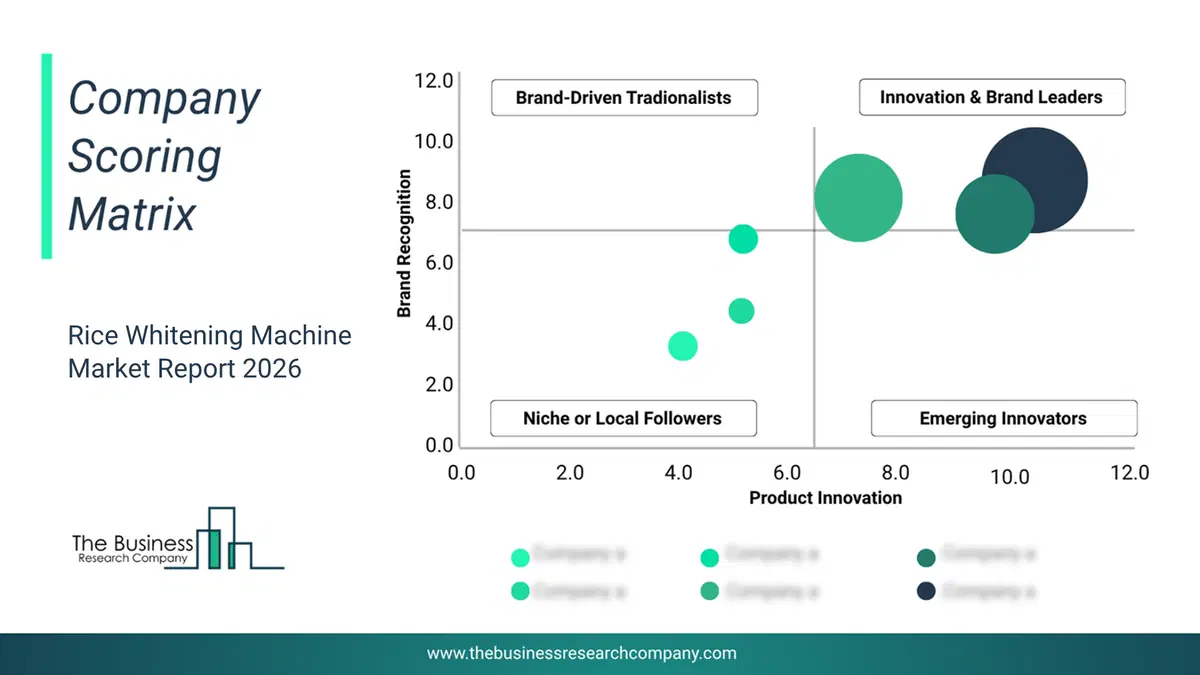
This chart maps companies by product innovation and brand strength, with bubble size indicating relative revenue, helping identify market leaders, challengers, and niche players. This is an illustrative chart; the full report provides a complete and accurate competitive analysis.
Global Rice Whitening Machine Market Trends and Insights
Major companies operating in the rice whitening machine market are focusing on advancements in processing technology, such as internal pressure-controlled milling systems, to improve rice kernel integrity, reduce breakage rates, and enhance milling yield. An internal pressure-controlled milling system refers to a rice whitening mechanism in which the pressure inside the milling chamber is automatically regulated and maintained internally, rather than being controlled mainly by external weights, manual adjustments, or purely mechanical resistance settings. For instance, in February 2024, Satake Corporation, a Japan-based manufacturer of grain processing and rice milling equipment, introduces the SSW60A/100A (SSW Series Spiral Whitener), a new-generation rice whitening machine featuring an internal pressure-controlled milling system that replaces conventional external weight-based pressure by enabling uniform pressure distribution within the milling chamber with improved whitening consistency and higher head rice yield during rice processing. Additionally, it also offers improved energy efficiency; stable and continuous feeding performance through a fixed-quantity screw feeding system; and more consistent milling output quality, making it suitable for modern high-capacity rice milling operations.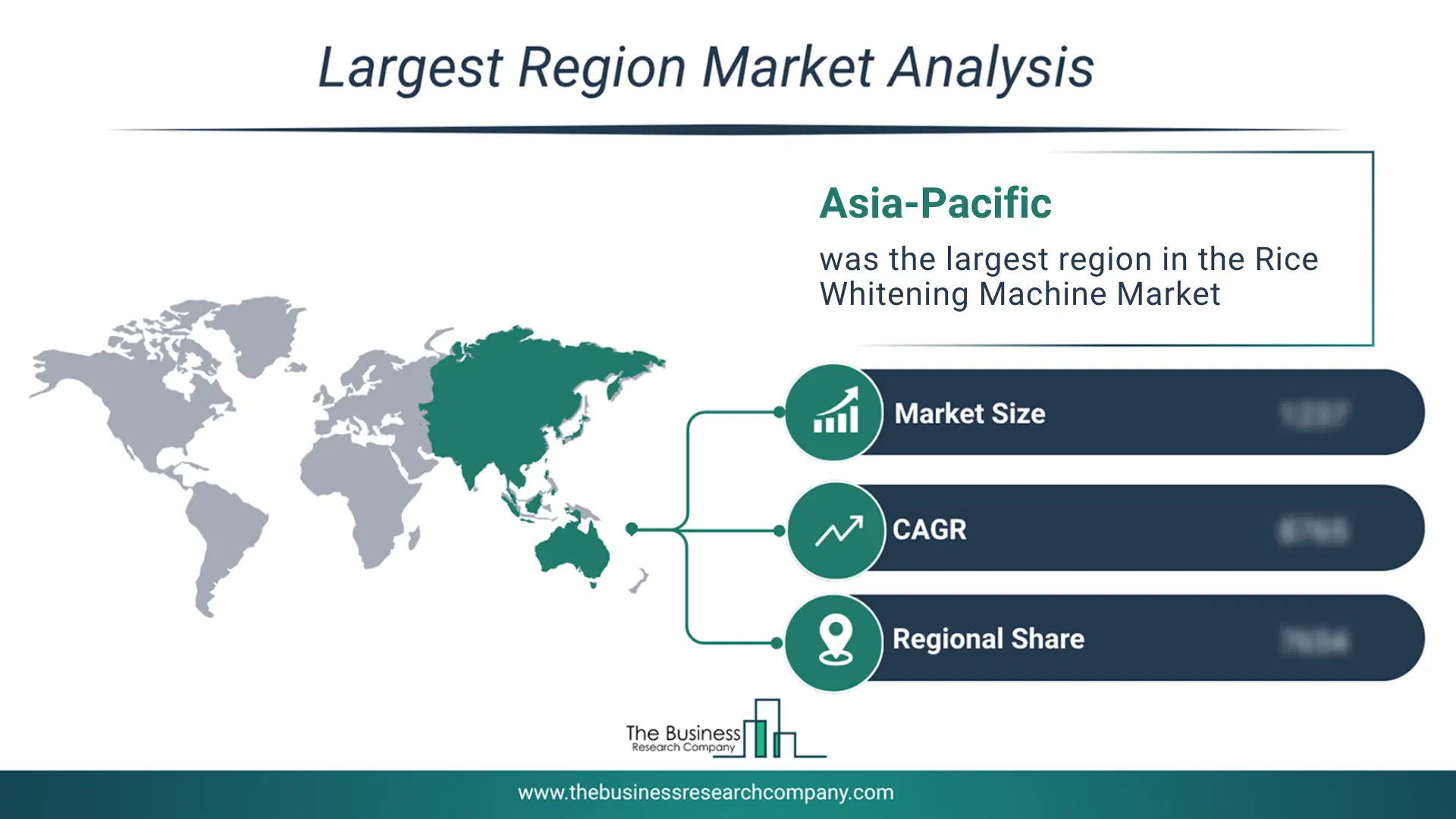
Regional Outlook
Asia-Pacific was the largest region in the rice whitening machine market in 2025. Asia-Pacific is expected to be the fastest-growing region in the forecast period. The regions covered in this market report are Asia-Pacific, South East Asia, Western Europe, Eastern Europe, North America, South America, Middle East, Africa. The countries covered in this market report are Australia, Brazil, China, France, Germany, India, Indonesia, Japan, Taiwan, Russia, South Korea, UK, USA, Canada, Italy, Spain.What Defines the Rice Whitening Machine Market?
The rice whitening machine market consists of sales of paddy husker, rice grader, pneumatic conveyor, rice colour sorter, and rice moisturizer. Values in this market are ‘factory gate’ values, that is the value of goods sold by the manufacturers or creators of the goods, whether to other entities (including downstream manufacturers, wholesalers, distributors and retailers) or directly to end customers. The value of goods in this market includes related services sold by the creators of the goods.How is Market Value Defined and Measured?
The market value is defined as the revenues that enterprises gain from the sale of goods and/or services within the specified market and geography through sales, grants, or donations in terms of the currency (in USD unless otherwise specified). The revenues for a specified geography are consumption values that are revenues generated by organizations in the specified geography within the market, irrespective of where they are produced. It does not include revenues from resales along the supply chain, either further along the supply chain or as part of other products.
This chart presents market attractiveness based on a quantitative evaluation of growth, competition, strategic alignment, and risk, offering a clear view of opportunity areas for decision-making. This chart is for illustrative purposes; the full report contains the complete analysis.

This chart highlights the Total Addressable Market (TAM) by estimating the maximum revenue opportunity using an assumption-driven approach, supporting strategic planning and opportunity sizing across markets. The chart is illustrative; the full report provides a more comprehensive analysis.
What Key Data and Analysis Are Included in the Rice Whitening Machine Market Report 2026?
The rice whitening machine market research report is one of a series of new reports from The Business Research Company that provides market statistics, including industry global market size, regional shares, competitors with the market share, detailed market segments, market trends and opportunities, and any further data you may need to thrive in the rice whitening machine industry. The market research report delivers a complete perspective of everything you need, with an in-depth analysis of the current and future state of the industry.Rice Whitening Machine Market Report Forecast Analysis
| Report Attribute | Details |
|---|---|
| Market Size Value In 2026 | $0.69 billion |
| Revenue Forecast In 2030 | $0.97 billion |
| Growth Rate | CAGR of 8.8% from 2026 to 2030 |
| Base Year For Estimation | 2025 |
| Actual Estimates/Historical Data | 2020-2025 |
| Forecast Period | 2026 - 2030 |
| Market Representation | Revenue in USD Billion and CAGR from 2026 to 2030 |
| Segments Covered | Type, Capacity, Distribution Channel, Application, End Use |
| Regional Scope | Asia-Pacific, Western Europe, Eastern Europe, North America, South America, Middle East, Africa |
| Country Scope | The countries covered in the report are Australia, Brazil, China, France, Germany, India, Indonesia, Japan, Taiwan, Russia, South Korea, UK, USA, Canada, Italy, Spain. |
| Key Companies Profiled | Hubei Bishan Machinery Co. Ltd, Satake Corporation, FOTMA Machinery Co Ltd, Zaccaria Equipamentos Ltd, Yangzhou Coyotech Machinery Co Ltd, Bühler Group AG, VOS Machinery Equipment Co. Ltd, Wintone Machinery Co Ltd, IROM Italia, Yamamoto Co Ltd, Hubei Yongxiang Food Processing Machinery Co Ltd, Sifly Agro Co Ltd, Hunan Sunfield Machinery Co Ltd, Hubei Pinyang Technology Co Ltd, Mill Master Machinery Pvt Ltd, G.G. Dandekar Machine Works Ltd, TW Grandeur Machinery Co Ltd, Chen San Fung Machinery Co Ltd, Victor Rice Mill Machinery Co Ltd, Zhejiang Qili Machinery Co Ltd, Dongya Machinery Co Ltd, Hunan Chenzhou Grain & Oil Machinery Co. Ltd, Savco Milling, Sukrup Machinery, PETKUS Technologie, G.S. International, Hebei Africa Machinery |
| Customization Scope | Request for Customization |
| Pricing And Purchase Options | Explore Purchase Options |