

Ride-Hailing Apps Market Report 2026
Global Outlook – By Service Type (E-Hailing, Carpooling Or Ride Sharing, Corporate Or Enterprise Mobility, Luxury Rides Or Premium Services, Traditional Taxi Integration), By Booking Channel (App-Based Transactions, Voice And Phone Reservations), By Vehicle Type (Cars, Motorcycles, Auto Rickshaws, Vans, Luxury Vehicles), By Application (Personal Transportation, Business Travel) – Market Size, Trends, Strategies, and Forecast to 2030
Ride-Hailing Apps Market Overview
• Ride-Hailing Apps market size has reached to $80.62 billion in 2025 • Expected to grow to $155.59 billion in 2030 at a compound annual growth rate (CAGR) of 14% • Growth Driver: Surge In Smartphone Penetration Fueling The Growth Of The Market Due To Affordable Smartphones And Expanding Mobile Internet Connectivity • Market Trend: Technological Advancements In Shared Mobility And Passenger Transport Platforms • Asia-Pacific was the largest region and fastest growing region.What Is Covered Under Ride-Hailing Apps Market?
Ride-hailing apps are digital platforms that enable users to book, manage, and pay for on-demand transportation services through mobile applications or web-based interfaces. They use location-based technologies, real-time communication, and automated matching algorithms to connect passengers with available drivers, facilitate trip management, and process electronic payments. The main service types of ride-hailing apps include e-hailing, carpooling or ride sharing, corporate or enterprise mobility, luxury rides or premium services, and traditional taxi integration. E-hailing refers to digitally enabled transportation services that allow users to request, schedule, and manage rides through mobile applications, connecting passengers with available drivers and providing trip details, fare information, and payment options. These services are accessed through booking channels such as app-based transactions and voice and phone reservations, and support vehicle types such as cars, motorcycles, auto rickshaws, vans, and luxury vehicles, with booking through app-based transactions and voice and phone reservations for applications such as personal transportation and business travel.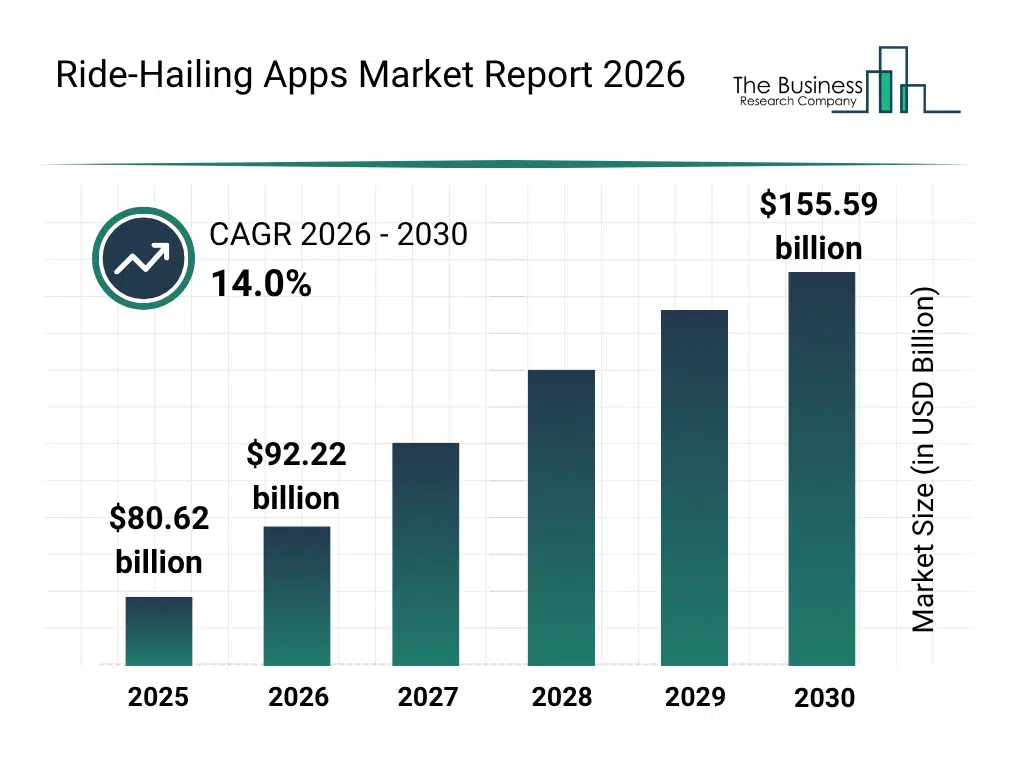
What Is The Ride-Hailing Apps Market Size and Share 2026?
The ride-hailing apps market size has grown rapidly in recent years. It will grow from $80.62 billion in 2025 to $92.22 billion in 2026 at a compound annual growth rate (CAGR) of 14.4%. The growth in the historic period can be attributed to increasing smartphone adoption, rising urban population, growing demand for convenient transportation, increasing traffic congestion in urban areas, expanding digital payment adoption.What Is The Ride-Hailing Apps Market Growth Forecast?
The ride-hailing apps market size is expected to see rapid growth in the next few years. It will grow to $155.59 billion in 2030 at a compound annual growth rate (CAGR) of 14.0%. The growth in the forecast period can be attributed to growing demand for on-demand mobility services, increasing corporate adoption of ride-hailing platforms, rising demand for scheduled and airport transportation, expanding two-wheeler ride-hailing services, increasing demand for premium and electric vehicle rides. Major trends in the forecast period include rising demand for on-demand transportation, increasing adoption of multi-modal ride booking, growing integration of scheduled ride services, expanding corporate ride-hailing services, increasing availability of premium and specialized ride options.Tariff Impact On Ride-Hailing Apps Market
Tariffs are impacting the ride-hailing apps market by increasing the cost of imported vehicles, automotive components, electronic devices, and charging equipment used by drivers and mobility operators. This can raise vehicle acquisition and operating costs across cars, motorcycles, auto rickshaws, vans, and luxury vehicles, particularly in regions dependent on imported automotive and technology components. Premium services and electric vehicle-based ride-hailing can face additional cost pressures where imported vehicles and charging equipment are widely used. However, tariffs can also encourage local vehicle manufacturing, regional component sourcing, domestic charging infrastructure, and fleet diversification, supporting greater resilience in ride-hailing ecosystems.
Global Ride Hailing Apps Market Segmentation
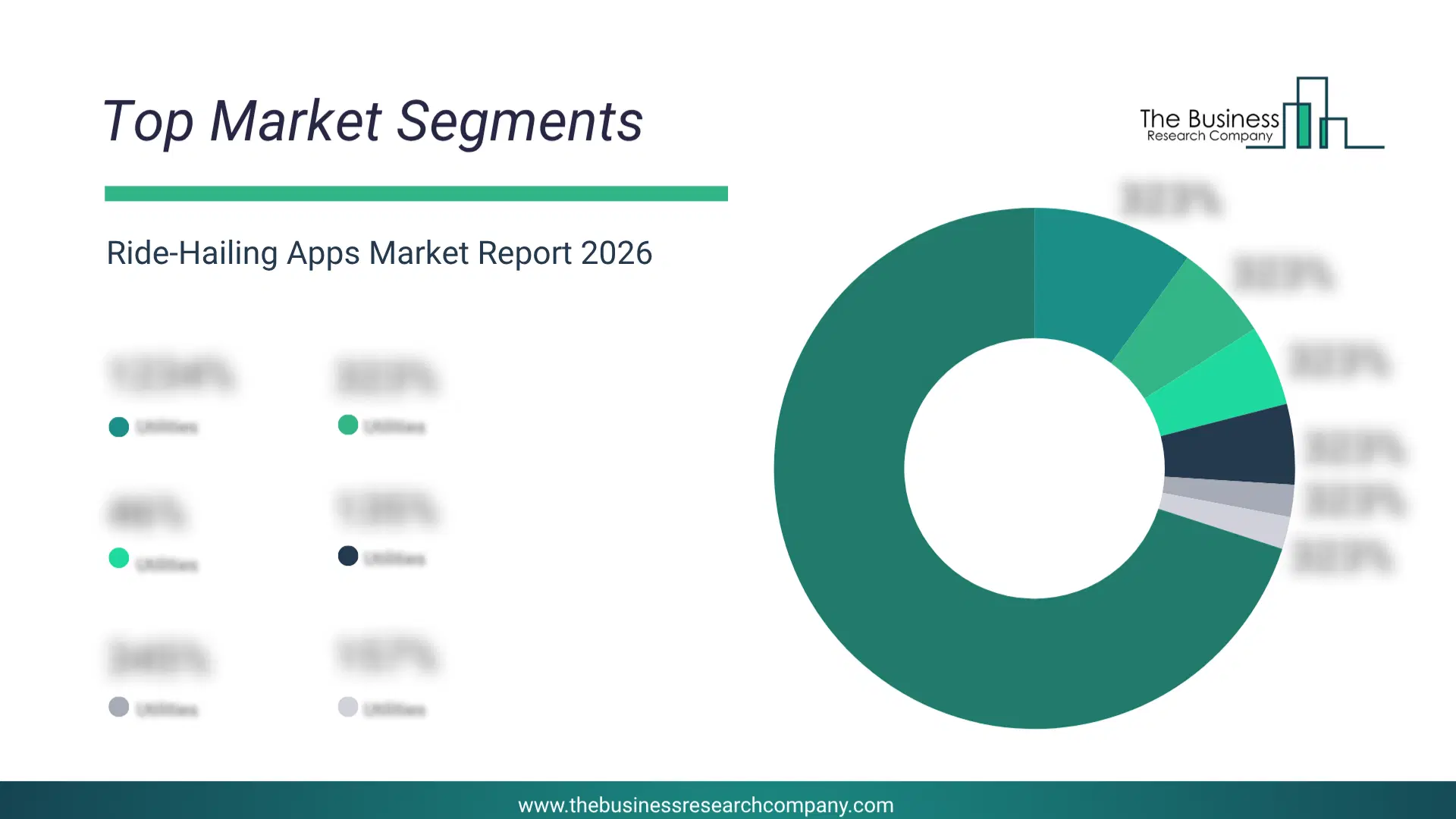
1) By Service Type: E-Hailing, Carpooling Or Ride Sharing, Corporate Or Enterprise Mobility, Luxury Rides Or Premium Services, Traditional Taxi Integration 2) By Booking Channel: App-Based Transactions, Voice And Phone Reservations 3) By Vehicle Type: Cars, Motorcycles, Auto Rickshaws, Vans, Luxury Vehicles 4) By Application: Personal Transportation, Business Travel Subsegments: 1) By E-Hailing: On Demand Ride Hailing, Scheduled Ride Hailing, Airport Ride Hailing, Intercity Ride Hailing, Two Wheeler Ride Hailing 2) By Carpooling Or Ride Sharing: Peer To Peer Ride Sharing, Dynamic Ride Sharing, Scheduled Carpooling, Long Distance Ride Sharing, Shared Commute Services 3) By Corporate Or Enterprise Mobility: Employee Commute Services, Business Travel Services, Fleet Mobility Services, Executive Transportation Services, Workforce Shuttle Services 4) By Luxury Rides Or Premium Services: Executive Sedan Services, Luxury Sport Utility Vehicle Services, Chauffeur Driven Premium Services, Very Important Person Transportation Services, Premium Electric Vehicle Services 5) By Traditional Taxi Integration: Licensed Taxi Dispatch Services, Street Hail Integration Services, Metered Taxi Booking Services, Hybrid Taxi Ride Services, Regional Taxi Network Integration ServicesWhat Is The Driver Of The Ride-Hailing Apps Market?
The increasing smartphone penetration is expected to propel the growth of the ride-hailing apps market going forward. Smartphone penetration refers to the percentage of people in a population who own or use a smartphone. Smartphone penetration is growing due to increasing internet accessibility, as more people can now easily connect to affordable and widely available mobile internet services, enabling greater adoption and regular use of smartphones. The increasing adoption of smartphones fuels the growth of ride-hailing apps by providing users with easy access to app-based ride booking, real-time tracking, GPS navigation, and secure digital payment options. For instance, In June 2026, according to the Hivemind Capital, a US-based investment company, smartphone penetration in Sub-Saharan Africa is expected to reach 87% by 2030. Therefore, the increasing smartphone penetration is driving the growth of the ride-hailing apps industry.Key Players In The Global Ride-Hailing Apps Market
Major companies operating in the ride-hailing apps market are Uber Technologies Inc., DiDi Global Inc., Grab Holdings Limited, Lyft Inc., Bolt Technology OÜ, ANI Technologies Private Limited, InDrive CA LLC, Waymo LLC, Kakao Mobility Corp., Via Transportation Inc., Roppen Transportation Services Private Limited, Maxi Mobility Spain S.L., Gett Inc., Ryde Group Ltd., Curb Mobility LLC, Heetch SAS, LeCab SAS, BiTaksi Mobil Teknoloji A.Ş., Wingz Inc., TaxiCaller Nordic AB, Yango, Comuto SA, PT GoTo Gojek Tokopedia Tbk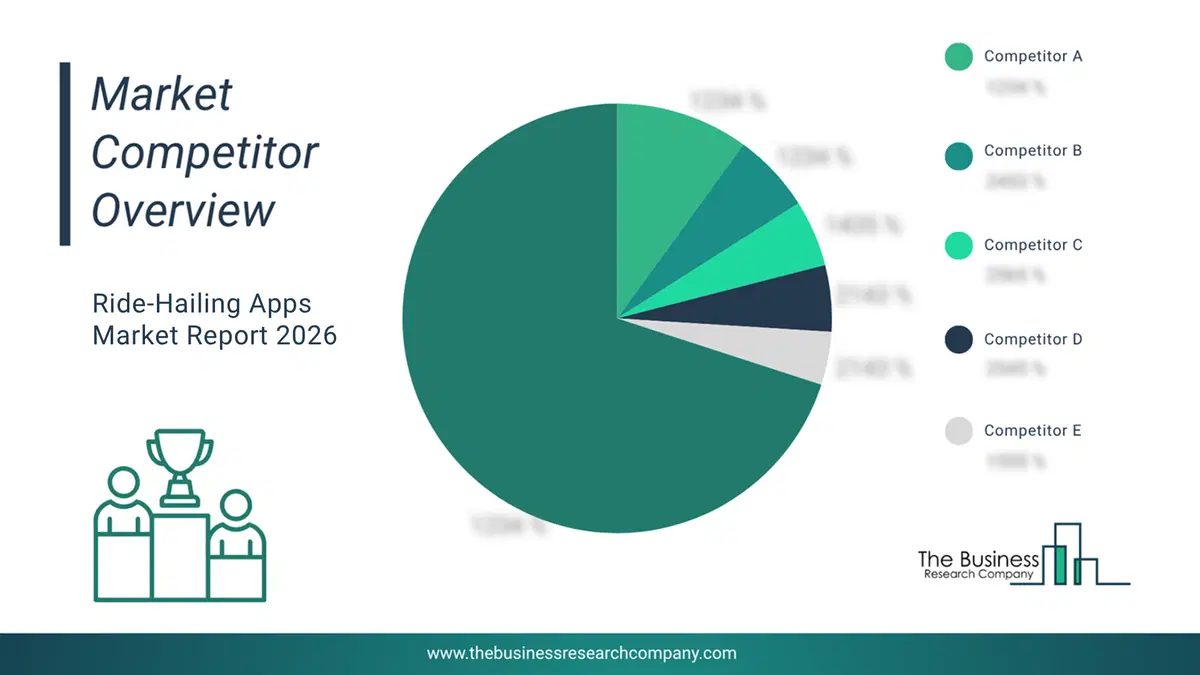
This chart is for illustrative purposes; the full report includes a detailed competitor analysis and comprehensive overview of the top 10 companies in the market.
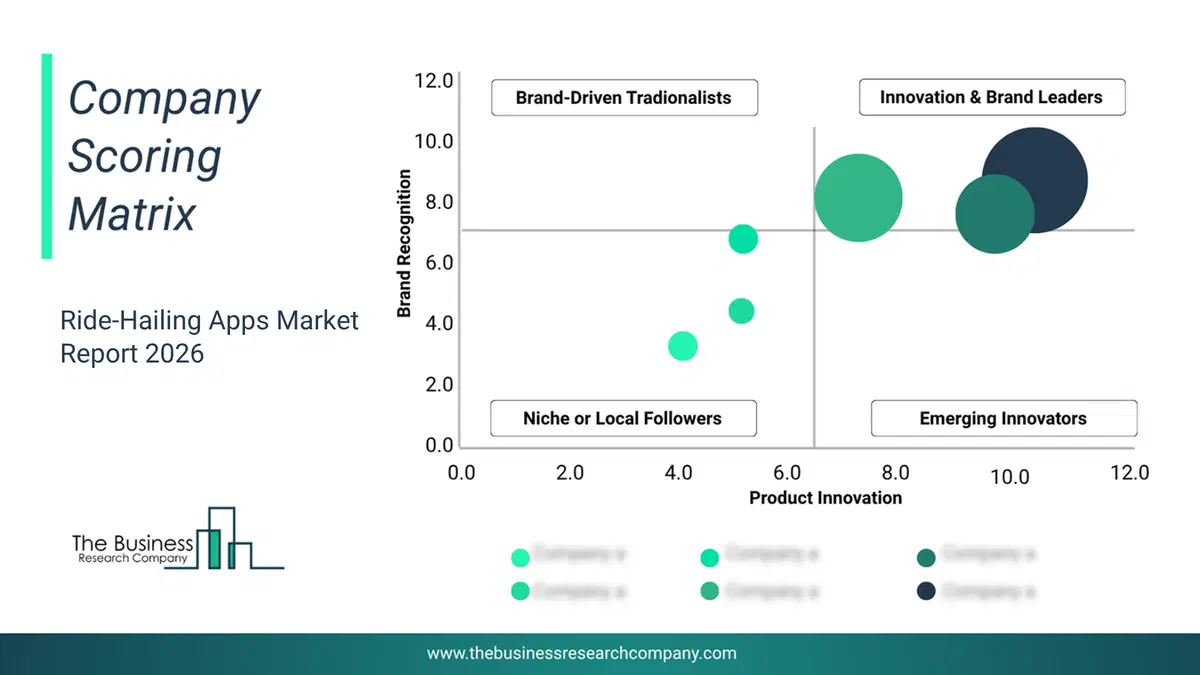
This chart maps companies by product innovation and brand strength, with bubble size indicating relative revenue, helping identify market leaders, challengers, and niche players. This is an illustrative chart; the full report provides a complete and accurate competitive analysis.
Global Ride-Hailing Apps Market Trends and Insights
Major companies operating in the ride-hailing apps market are focusing on developing innovative solutions such as, cooperative-based ride-hailing platforms, to enhance driver earnings, fare affordability, and platform transparency. Cooperative-based ride-hailing platforms are digital mobility solutions in which drivers collectively own and manage the platform, unlike traditional commission-based ride-hailing services where a central company retains ownership and deducts a percentage of each fare, helping improve driver income, reduce passenger fares, and promote equitable revenue distribution. For instance, in February 2026, Sahkar Taxi Cooperative Limited, an India-based cooperative ride-hailing company, launched Bharat Taxi, India's first cooperative-based ride-hailing platform. The platform operates on a driver-ownership model in which each driver holds five cooperative shares and pays a flat daily usage fee instead of per-ride commission. It incorporates verified driver records, in-built passenger safety features, a dedicated helpline, and complaint resolution support through Delhi Police booths. The platform is designed to offer fares up to 30% lower than conventional ride-hailing services while improving driver profitability and transparency, with an initial deployment of approximately 250,000 registered vehicles across Delhi-NCR.What Are Latest Mergers And Acquisitions In The Ride-Hailing Apps Market?
In July 2025, Lyft Inc., a US-based ride-hailing and mobility services company, acquired FREENOW for approximately $197 million (€175 million). Through this acquisition, Lyft expanded its operations into nine European countries, broadened its ride-hailing and mobility service offerings, strengthened its international market presence, and accelerated its strategy to build a leading global mobility platform. FREENOW GmbH is a Germany-based multi-mobility platform that specializes in providing ride‑hailing apps across Europe.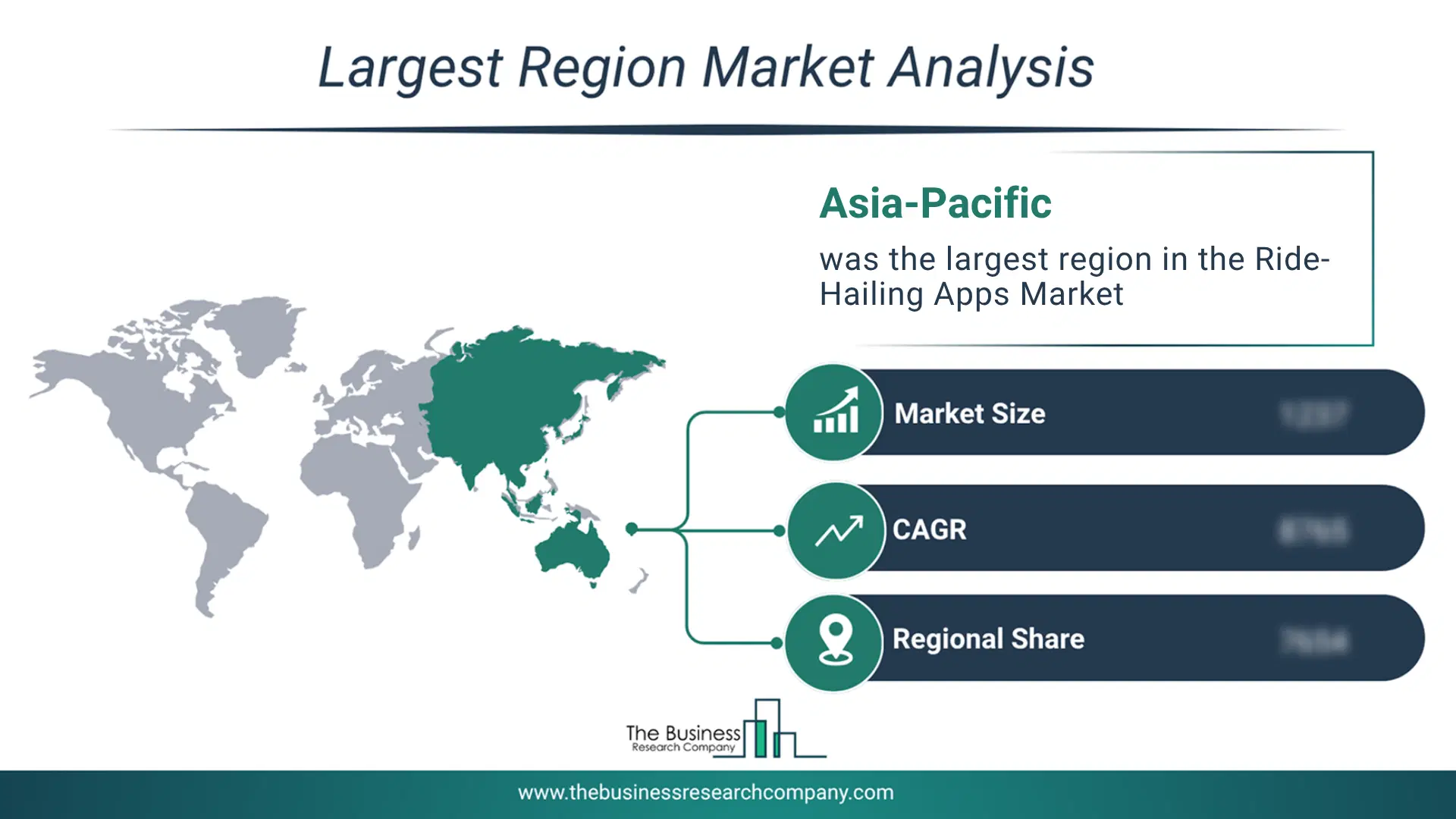
Regional Outlook
Asia-Pacific was the largest region in the ride-hailing apps market in 2025. Asia-Pacific is expected to be the fastest-growing region in the forecast period. The regions covered in this market report are Asia-Pacific, South East Asia, Western Europe, Eastern Europe, North America, South America, Middle East, Africa. The countries covered in this market report are Australia, Brazil, China, France, Germany, India, Indonesia, Japan, Taiwan, Russia, South Korea, UK, USA, Canada, Italy, Spain.What Defines the Ride-Hailing Apps Market?
The ride-hailing apps market includes revenues earned by entities by providing services such as ride booking and dispatch, driver-passenger matching, route optimization, fare calculation, payment processing, fleet management, and trip monitoring. The market value includes the value of related goods sold by the service provider or included within the service offering. Only goods and services traded between entities or sold to end consumers are included.How is Market Value Defined and Measured?
The market value is defined as the revenues that enterprises gain from the sale of goods and/or services within the specified market and geography through sales, grants, or donations in terms of the currency (in USD unless otherwise specified). The revenues for a specified geography are consumption values that are revenues generated by organizations in the specified geography within the market, irrespective of where they are produced. It does not include revenues from resales along the supply chain, either further along the supply chain or as part of other products.
This chart presents market attractiveness based on a quantitative evaluation of growth, competition, strategic alignment, and risk, offering a clear view of opportunity areas for decision-making. This chart is for illustrative purposes; the full report contains the complete analysis.

This chart highlights the Total Addressable Market (TAM) by estimating the maximum revenue opportunity using an assumption-driven approach, supporting strategic planning and opportunity sizing across markets. The chart is illustrative; the full report provides a more comprehensive analysis.
What Key Data and Analysis Are Included in the Ride-Hailing Apps Market Report 2026?
The ride-hailing apps market research report is one of a series of new reports from The Business Research Company that provides market statistics, including industry global market size, regional shares, competitors with the market share, detailed market segments, market trends and opportunities, and any further data you may need to thrive in the ride-hailing apps industry. The market research report delivers a complete perspective of everything you need, with an in-depth analysis of the current and future state of the industry.Ride-Hailing Apps Market Report Forecast Analysis
| Report Attribute | Details |
|---|---|
| Market Size Value In 2026 | $92.22 billion |
| Revenue Forecast In 2030 | $155.59 billion |
| Growth Rate | CAGR of 14.0% from 2026 to 2030 |
| Base Year For Estimation | 2025 |
| Actual Estimates/Historical Data | 2020-2025 |
| Forecast Period | 2026 - 2030 |
| Market Representation | Revenue in USD Billion and CAGR from 2026 to 2030 |
| Segments Covered | Service Type, Booking Channel, Vehicle Type, Application |
| Regional Scope | Asia-Pacific, Western Europe, Eastern Europe, North America, South America, Middle East, Africa |
| Country Scope | The countries covered in the report are Australia, Brazil, China, France, Germany, India, Indonesia, Japan, Taiwan, Russia, South Korea, UK, USA, Canada, Italy, Spain. |
| Key Companies Profiled | Uber Technologies Inc., DiDi Global Inc., Grab Holdings Limited, Lyft Inc., Bolt Technology OÜ, ANI Technologies Private Limited, InDrive CA LLC, Waymo LLC, Kakao Mobility Corp., Via Transportation Inc., Roppen Transportation Services Private Limited, Maxi Mobility Spain S.L., Gett Inc., Ryde Group Ltd., Curb Mobility LLC, Heetch SAS, LeCab SAS, BiTaksi Mobil Teknoloji A.Ş., Wingz Inc., TaxiCaller Nordic AB, Yango, Comuto SA, PT GoTo Gojek Tokopedia Tbk |
| Customization Scope | Request for Customization |
| Pricing And Purchase Options | Explore Purchase Options |