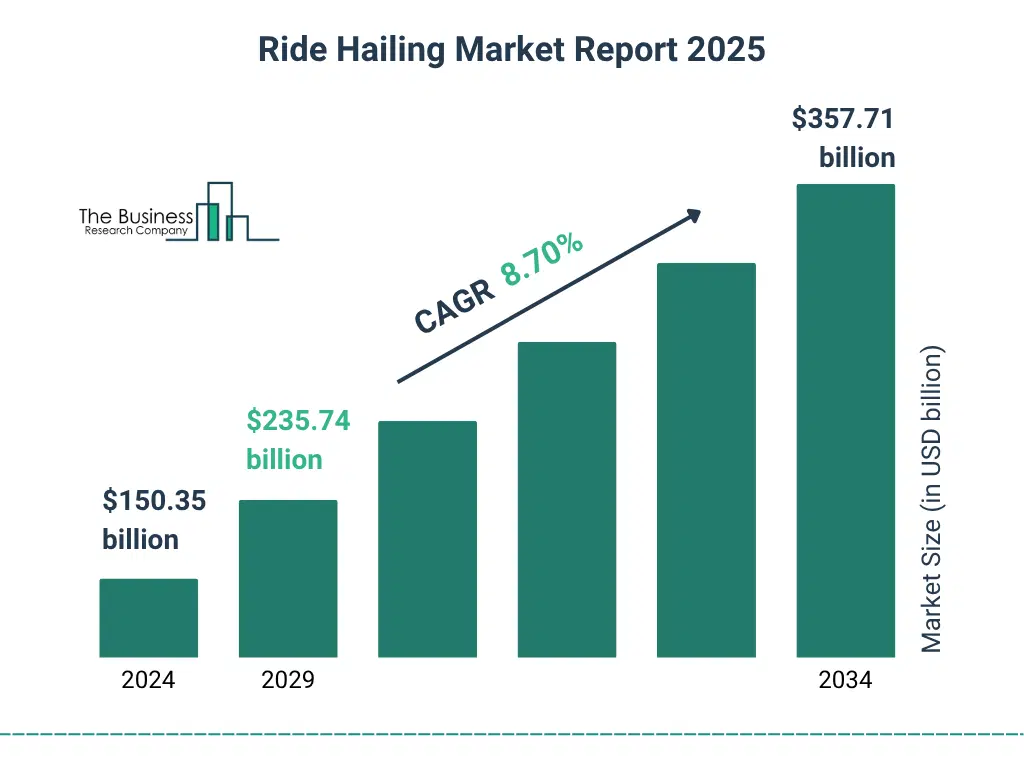
Ride Hailing Market Drivers
The key drivers of the ride hailing market include:
Increasing Usage Of Smartphones And Internet Penetration
The increasing usage of smartphones and rising internet penetration are driving the growth of the ride-hailing market during the forecast period. Smartphones enable users to access ride-hailing services through mobile apps, streamlining booking, payment, and navigation. Expanding internet connectivity, especially in emerging markets, allows more consumers to adopt these services, increasing the user base. Higher smartphone adoption also facilitates real-time tracking, route optimization, and enhanced safety features, improving user experience. For instance, in December 2023, according to Oberlo, a Lithuania-based cloud-based drop-shipping solution for online retailers and vendors, the number of global smartphone users was estimated to be 4.74 billion in 2024, marking a 2.2% annual increase. Global smartphone usage is expected to reach 5.14 billion users by 2028, growing by around 100,000 people per year. Also, Forbes, a US-based business magazine and Media Company, estimated that out of nearly 8 billion people globally, 5.35 billion or around 66%, had internet access in 2023. With the internet's expanding capabilities, user numbers are set to increase rapidly. In five years, internet users are projected to grow by 47%, rising from 5.35 billion in 2024 to 7.9 billion in 2029. Therefore, the increasing usage of smartphones and rising internet penetration will drive the growth of the ride hailing market.
Ride Hailing Market Restraints
The key restraints on the ride hailing market include:
Consumer Shift Toward Micro-Mobility
The consumer shift toward micro-mobility is expected to restrict the growth of the ride hailing market during the forecast period. Micro-mobility solutions offer a more cost-effective alternative to ride-hailing, particularly for short trips where fares can be inflated by minimum charges, surge pricing and additional fees. In urban areas, these options provide greater convenience by enabling users to navigate traffic efficiently, utilize dedicated bike lanes and reach their destinations more quickly without the wait associated with ride-hailing services. For instance, in May 2023, Bolt Technology, an Estonian-based company that provides ride-hailing and micro-mobility (e-scooters and e-bikes) services, as of February 2023, Bolt had significantly expanded its micro-mobility operations, operating in 260 cities across 25 countries and offering 245,000 shared vehicles for rental, including e-scooters and e-bikes. Therefore, the consumer shift toward micro-mobility will restrain the growth of the ride hailing market.