
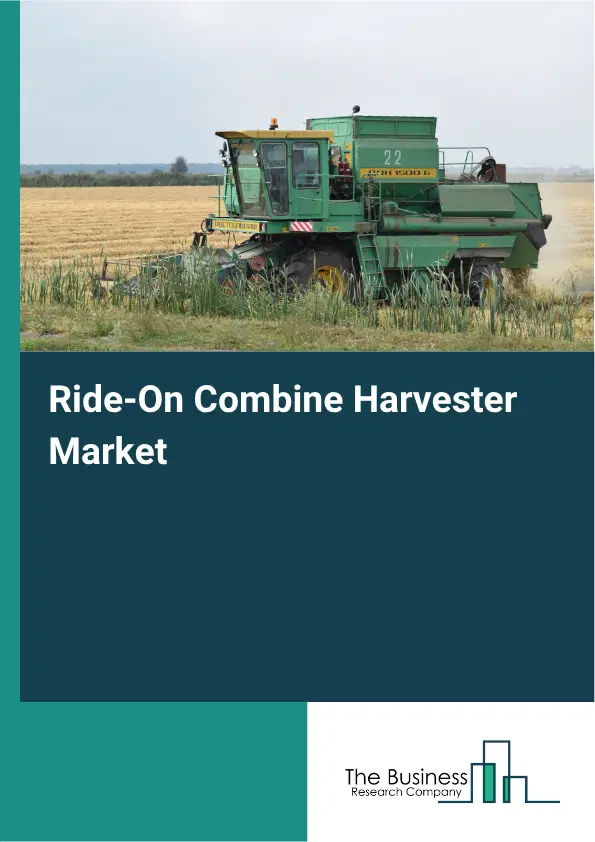
Ride-On Combine Harvester Market Report 2026
Global Outlook – By Type Of Harvesting (Grain Harvesters, Corn Harvesters, Forage Harvesters, Vegetable Harvesters, Pulse Harvesters), By Fuel Type (Diesel, Gasoline, Electric, Biofuel), By Technology Integration (Conventional, Autonomous, Precision Farming Technology, Smart Technology (Internet Of Things Enabled)), By Power Output (Below 100 Horsepower, 100 To 200 Horsepower, 200 To 300 Horsepower, Above 300 Horsepower), By End User (Individual Farmers, Agricultural Cooperatives, Commercial Farming Enterprises, Custom Harvesting Service Providers) – Market Size, Trends, Strategies, and Forecast to 2030
Ride-On Combine Harvester Market Overview
• Ride-On Combine Harvester market size has reached to $4.96 billion in 2025 • Expected to grow to $6.59 billion in 2030 at a compound annual growth rate (CAGR) of 5.7% • Growth Driver: Surge In Agricultural Mechanization Fueling The Growth Of The Market Due To Rapid Expansion Of Commercial Farming • Market Trend: Innovations In Automation And Predictive Harvesting Technology Enhance Efficiency In Ride-On Combine Harvesters • North America was the largest region in 2025 and Asia-Pacific is the fastest growing region.What Is Covered Under Ride-On Combine Harvester Market?
A ride-on combine harvester is a self-propelled agricultural machine designed to efficiently harvest grain crops by integrating reaping, threshing, separating, and cleaning functions into a single operation. It is operated directly by a driver seated within the machine and is engineered to improve harvesting speed, reduce manual labor, and enhance operational efficiency in large-scale crop collection. A ride-on combine harvester is equipped with advanced mechanical and control systems that support precise crop handling, minimize grain loss, and optimize field productivity. The main types of ride-on combine harvester include grain harvesters, corn harvesters, forage harvesters, vegetable harvesters, and pulse harvesters. Grain harvesters refer to ride-on agricultural machines designed to harvest cereal crops by performing cutting, threshing, separating, and cleaning operations in a single pass. These harvesters operate using diesel, gasoline, electric, and biofuel power sources and are integrated with technologies including conventional, autonomous, precision farming technology, and smart technology (Internet of Things enabled). They are available in power outputs including below 100 horsepower, 100 to 200 horsepower, 200 to 300 horsepower, and above 300 horsepower and are utilized by end users such as individual farmers, agricultural cooperatives, commercial farming enterprises, and custom harvesting service providers.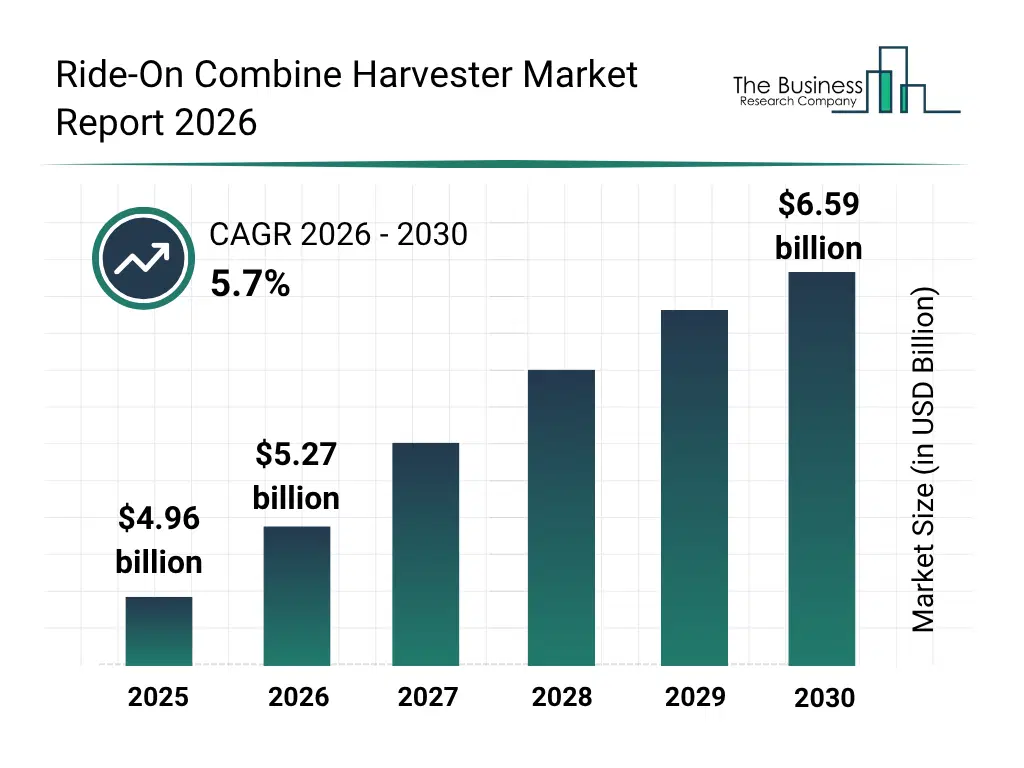
What Is The Ride-On Combine Harvester Market Size and Share 2026?
The ride-on combine harvester market size has grown strongly in recent years. It will grow from $4.96 billion in 2025 to $5.27 billion in 2026 at a compound annual growth rate (CAGR) of 6.2%. The growth in the historic period can be attributed to increasing agricultural mechanization across farming regions, growing demand for improved harvesting efficiency, rising labor shortages in agricultural operations, expanding large scale farming activities, increasing need for reduced crop harvesting losses.What Is The Ride-On Combine Harvester Market Growth Forecast?
The ride-on combine harvester market size is expected to see strong growth in the next few years. It will grow to $6.59 billion in 2030 at a compound annual growth rate (CAGR) of 5.7%. The growth in the forecast period can be attributed to rising adoption of smart harvesting equipment, increasing investment in precision farming technologies, growing demand for automated agricultural machinery, expanding commercial farming operations, increasing preference for high productivity harvesting solutions. Major trends in the forecast period include increasing adoption of high capacity ride-on combine harvesters, growing demand for precision crop harvesting solutions, rising preference for fuel efficient agricultural machinery, expanding use of multi crop harvesting equipment, increasing focus on reducing grain loss during harvesting operations.
Global Ride-On Combine Harvester Market Segmentation
2) By Fuel Type: Diesel, Gasoline, Electric, Biofuel 3) By Technology Integration: Conventional, Autonomous, Precision Farming Technology, Smart Technology (Internet Of Things Enabled) 4) By Power Output: Below 100 Horsepower, 100 To 200 Horsepower, 200 To 300 Horsepower, Above 300 Horsepower 5) By End User: Individual Farmers, Agricultural Cooperatives, Commercial Farming Enterprises, Custom Harvesting Service Providers Subsegments: 1) By Grain Harvesters: Wheat Harvesters, Rice Harvesters, Barley Harvesters, Oat Harvesters 2) By Corn Harvesters: Single Row Corn Harvesters, Multi Row Corn Harvesters, Self Propelled Corn Harvesters, Mounted Corn Harvesters 3) By Forage Harvesters: Grass Forage Harvesters, Silage Forage Harvesters, Whole Crop Forage Harvesters, Precision Chop Forage Harvesters 4) By Vegetable Harvesters: Root Vegetable Harvesters, Leafy Vegetable Harvesters, Tuber Crop Harvesters, Specialty Vegetable Harvesters 5) By Pulse Harvesters: Soybean Harvesters, Pea Harvesters, Lentil Harvesters, Chickpea HarvestersWhat Is The Driver Of The Ride-On Combine Harvester Market?
The rising mechanization in agriculture is expected to propel the growth of the ride-on combine harvester market going forward. Agricultural mechanization refers to the use of advanced machinery and equipment to enhance the efficiency, productivity, and scale of farming operations. Mechanization in agriculture is rising due to labor shortages, as machines help farmers complete farm operations efficiently while reducing dependence on manual workers. Ride-on combine harvesters promote agricultural mechanization by performing harvesting operations efficiently in a single pass, reducing labor dependence, minimizing crop losses, and enhancing productivity on large farms. For instance, in March 2026, according to Gov.UK, a UK-based government agency, the total amount spent by farms in England on machinery reached $2.66 billion (£2.3 billion) in 2023–2024. Therefore, the rising mechanization in agriculture is driving the growth of the ride-on combine harvester industry.Key Players In The Global Ride-On Combine Harvester Market
Major companies operating in the ride-on combine harvester market are Deere & Company, CNH Industrial N.V., AGCO Corporation, CLAAS KGaA mbH, Kubota Corporation, Mahindra & Mahindra Limited, Yanmar Holdings Co. Ltd., Zoomlion Heavy Industry Science and Technology Co. Ltd., SDF S.p.A., Tractors and Farm Equipment Limited, Shandong Shifeng Group Co. Ltd., YTO Group Corporation, Jiangsu World Agricultural Machinery Co. Ltd., Preet Agro Industries Pvt. Ltd., Rostselmash, Gomselmash, Balkar Combines Pvt. Ltd., Dasmesh Mechanical Works Pvt. Ltd., Malkit Agro Tech Pvt. Ltd., Standard Combine Pvt. Ltd., ISEKI & Co. Ltd., Sampo Rosenlew Oy
This chart is for illustrative purposes; the full report includes a detailed competitor analysis and comprehensive overview of the top 10 companies in the market.
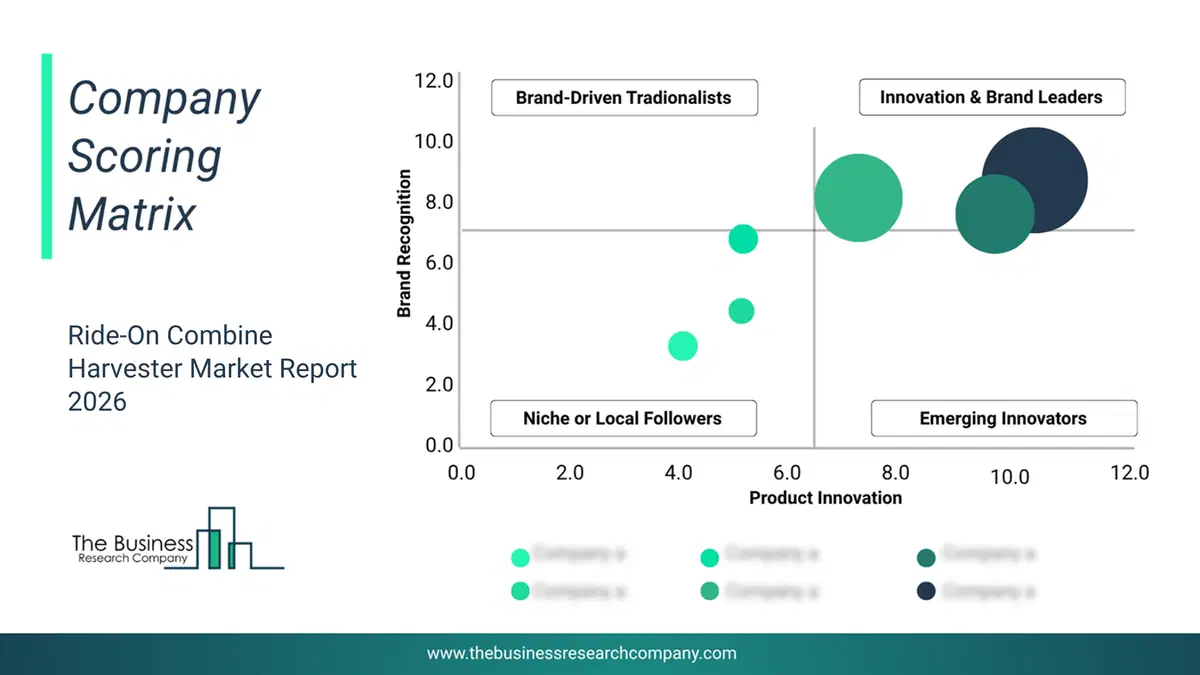
This chart maps companies by product innovation and brand strength, with bubble size indicating relative revenue, helping identify market leaders, challengers, and niche players. This is an illustrative chart; the full report provides a complete and accurate competitive analysis.
Global Ride-On Combine Harvester Market Trends and Insights
Major companies operating in the ride-on combine harvester market are focusing on developing advanced automation solutions, such as predictive ground speed automation, to improve harvesting efficiency, reduce grain losses, and optimize operator productivity. Predictive ground speed automation refers to a technology that uses cameras, satellite imagery, and real-time crop sensing to automatically adjust harvester speed based on crop conditions before entering the crop area. For instance, in February 2024, John Deere, a US-based agricultural machinery company, launched the S7 Series combines, a new family of ride-on combine harvesters featuring advanced harvesting automation technologies. The combines incorporate Predictive Ground Speed Automation and Harvest Settings Automation, which utilize forward-mounted cameras, satellite biomass maps, and real-time crop data to automatically adjust machine speed and harvesting settings for improved performance. The S7 Series also includes enhanced grain loss monitoring systems, advanced connectivity features, and upgraded operator comfort functions, helping farmers achieve higher productivity, improved grain quality, and reduced fuel consumption during harvest operations.What Are Latest Mergers And Acquisitions In The Ride-On Combine Harvester Market?
In January 2025, Yanmar Holdings Co., Ltd., a Japan-based agricultural machinery company, completed the acquisition of CLAAS India Private Limited for an undisclosed amount. Through this acquisition, Yanmar aims to strengthen its agribusiness operations by adding wheeled combine harvesters to its product portfolio and leveraging CLAAS India's manufacturing expertise to produce combine harvesters and other agricultural machinery for both the Indian and global markets. CLAAS India Private Limited is an India-based manufacturer of ride-on combine harvesters.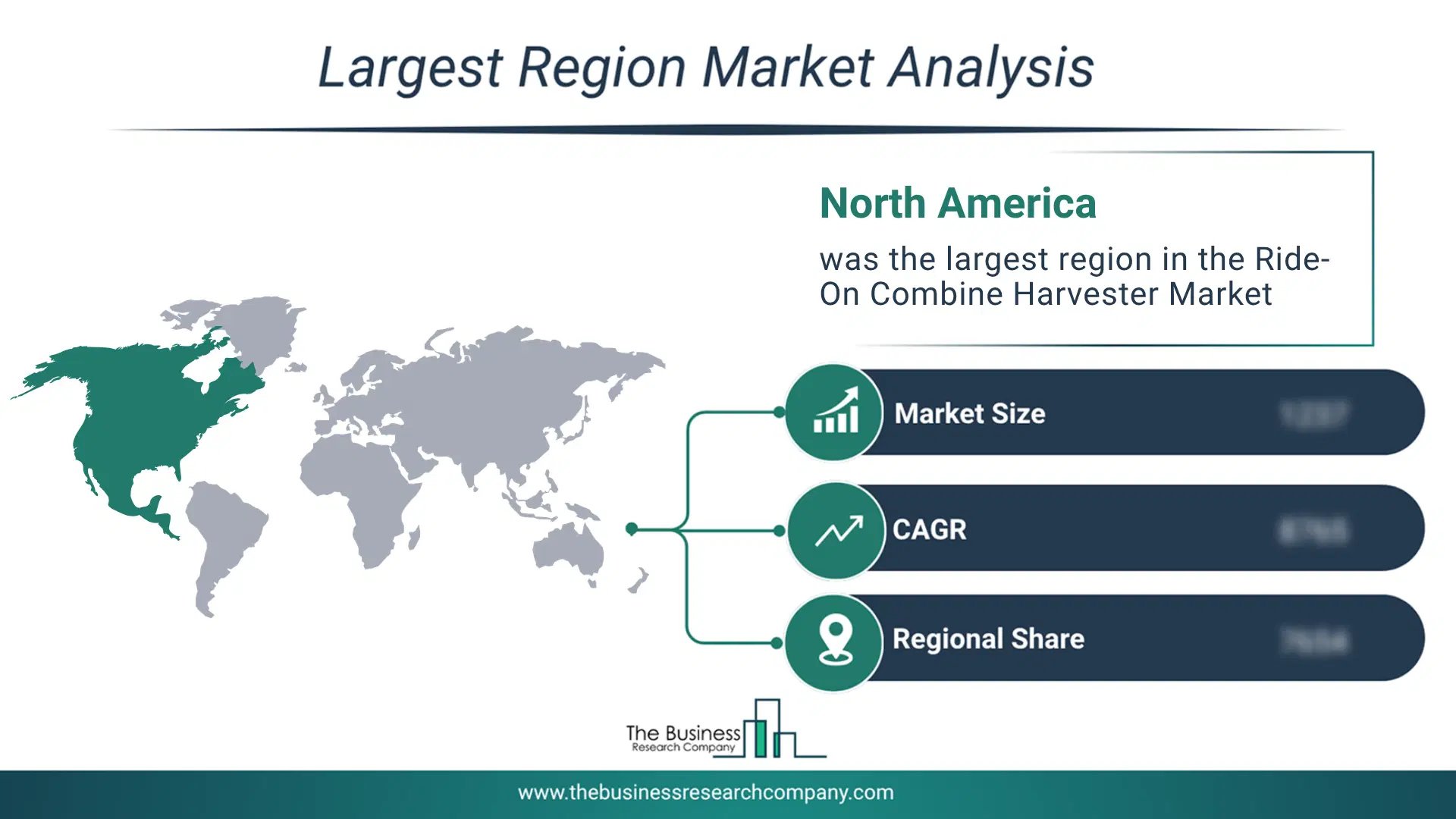
Regional Outlook/Insights
North America was the largest region in the ride-on combine harvester market in 2025. Asia-Pacific is expected to be the fastest-growing region in the forecast period. The regions covered in this market report are Asia-Pacific, South East Asia, Western Europe, Eastern Europe, North America, South America, Middle East, Africa. The countries covered in this market report are Australia, Brazil, China, France, Germany, India, Indonesia, Japan, Taiwan, Russia, South Korea, UK, USA, Canada, Italy, Spain.What Defines the Ride-On Combine Harvester Market?
The ride-on combine harvester market consists of sales of soybean harvesters, sunflower harvesters, canola harvesters, and sorghum harvesters. Values in this market are ‘factory gate’ values, that is, the value of goods sold by the manufacturers or creators of the goods, whether to other entities (including downstream manufacturers, wholesalers, distributors, and retailers) or directly to end customers. The value of goods in this market includes related services sold by the creators of the goods.How is Market Value Defined and Measured?
The market value is defined as the revenues that enterprises gain from the sale of goods and/or services within the specified market and geography through sales, grants, or donations in terms of the currency (in USD unless otherwise specified). The revenues for a specified geography are consumption values that are revenues generated by organizations in the specified geography within the market, irrespective of where they are produced. It does not include revenues from resales along the supply chain, either further along the supply chain or as part of other products.
This chart presents market attractiveness based on a quantitative evaluation of growth, competition, strategic alignment, and risk, offering a clear view of opportunity areas for decision-making. This chart is for illustrative purposes; the full report contains the complete analysis.

This chart highlights the Total Addressable Market (TAM) by estimating the maximum revenue opportunity using an assumption-driven approach, supporting strategic planning and opportunity sizing across markets. The chart is illustrative; the full report provides a more comprehensive analysis.
What Key Data and Analysis Are Included in the Ride-On Combine Harvester Market Report 2026?
The ride-on combine harvester market research report is one of a series of new reports from The Business Research Company that provides ride-on combine harvester market statistics, including ride-on combine harvester industry global market size, regional shares, competitors with a ride-on combine harvester market share, detailed ride-on combine harvester market segments, market trends and opportunities, and any further data you may need to thrive in the ride-on combine harvester industry. This ride-on combine harvester market research report delivers a complete perspective of everything you need, with an in-depth analysis of the current and future scenario of the industry.Ride-On Combine Harvester Market Report Forecast Analysis
| Report Attribute | Details |
|---|---|
| Market Size Value In 2026 | $5.27 billion |
| Revenue Forecast In 2030 | $6.59 billion |
| Growth Rate | CAGR of 5.7% from 2026 to 2030 |
| Base Year For Estimation | 2025 |
| Actual Estimates/Historical Data | 2020-2025 |
| Forecast Period | 2026 - 2030 |
| Market Representation | Revenue in USD Billion and CAGR from 2026 to 2030 |
| Segments Covered | Type Of Harvesting, Fuel Type, Technology Integration, Power Output, End User |
| Regional Scope | Asia-Pacific, Western Europe, Eastern Europe, North America, South America, Middle East, Africa |
| Country Scope | The countries covered in the report are Australia, Brazil, China, France, Germany, India, Indonesia, Japan, Taiwan, Russia, South Korea, UK, USA, Canada, Italy, Spain. |
| Key Companies Profiled | Deere & Company, CNH Industrial N.V., AGCO Corporation, CLAAS KGaA mbH, Kubota Corporation, Mahindra & Mahindra Limited, Yanmar Holdings Co. Ltd., Zoomlion Heavy Industry Science and Technology Co. Ltd., SDF S.p.A., Tractors and Farm Equipment Limited, Shandong Shifeng Group Co. Ltd., YTO Group Corporation, Jiangsu World Agricultural Machinery Co. Ltd., Preet Agro Industries Pvt. Ltd., Rostselmash, Gomselmash, Balkar Combines Pvt. Ltd., Dasmesh Mechanical Works Pvt. Ltd., Malkit Agro Tech Pvt. Ltd., Standard Combine Pvt. Ltd., ISEKI & Co. Ltd., Sampo Rosenlew Oy |
| Customization Scope | Request for Customization |
| Pricing And Purchase Options | Explore Purchase Options |