

Ride Sharing Market Report 2026
Global Outlook – By Operation (Pre-Commissioning And Commissioning; Maintenance; Decommissioning ), By Asset Type (Pipeline; Process ), By Raw Material (Plastic; Carbon Steel; Steel ), By End-Users (Oil And Gas Industry; Chemical Industry; Water Treatment Industry; Construction And Manufacturing Industry; Other End-Users) – Market Size, Trends, Strategies, and Forecast to 2030
Ride Sharing Market Overview
• Ride Sharing market size has reached to $156.01 billion in 2025 • Expected to grow to $408.64 billion in 2030 at a compound annual growth rate (CAGR) of 21.2% • Growth Driver: Smartphone Adoption Driving Growth In The Ride-Sharing Market • Market Trend: Innovative Travel Features In The Ride-Sharing Market • North America was the largest region in 2025.Market Gains By 2030 – Top Opportunities By Segment
Market Gain identifies the most promising market opportunities by highlighting the segments or products expected to generate the highest incremental revenue growth over the next five years.
What Is Covered Under Ride Sharing Market?
Ride sharing refers to the practice of two or more people traveling to and from their places of employment or attendance at postsecondary institutions in a single motor vehicle. Carpooling and vanpooling are also covered in ride sharing practices. The major types of ride sharing are car sharing, e-hailing, car rental, and station-based mobility. Car sharing refers to the process of hiring an automobile from a private owner for a brief period of time through a P2P car rental firm. Several types of membership are included in ride sharing, such as fixed ride sharing, corporate ride sharing, and dynamic ride sharing. The target audiences of ride-sharing services are corporations, families, daily commuters, and other groups. Several types of business models are involved, such as P2P, B2B, and B2C. Ride sharing is used in a variety of applications for Android, iOS, and other platforms.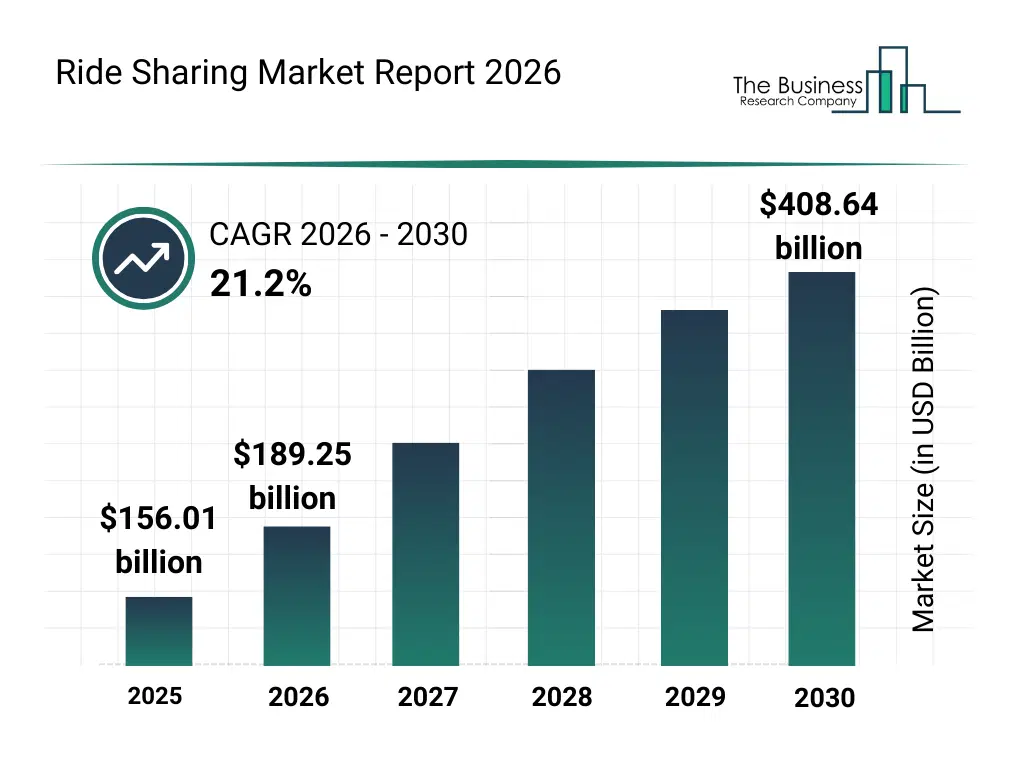
What Is The Ride Sharing Market Size and Share 2026?
The ride sharing market size has grown exponentially in recent years. It will grow from $156.01 billion in 2025 to $189.25 billion in 2026 at a compound annual growth rate (CAGR) of 21.3%. The growth in the historic period can be attributed to increasing urban traffic congestion, rising fuel costs for individual commuting, growth of smartphone penetration, increasing acceptance of shared mobility models, expansion of corporate commuting programs.What Is The Ride Sharing Market Growth Forecast?
The ride sharing market size is expected to see exponential growth in the next few years. It will grow to $408.64 billion in 2030 at a compound annual growth rate (CAGR) of 21.2%. The growth in the forecast period can be attributed to increasing adoption of multimodal mobility platforms, rising focus on reducing urban emissions, expansion of subscription-based mobility services, growing integration with public transport networks, increasing demand for flexible commuting options. Major trends in the forecast period include expansion of app-based ride matching platforms, growing adoption of dynamic ride pooling models, rising integration of digital payment systems, increased focus on cost-efficient shared mobility, enhanced use of data analytics for route optimization.
Global Ride Sharing Market Segmentation
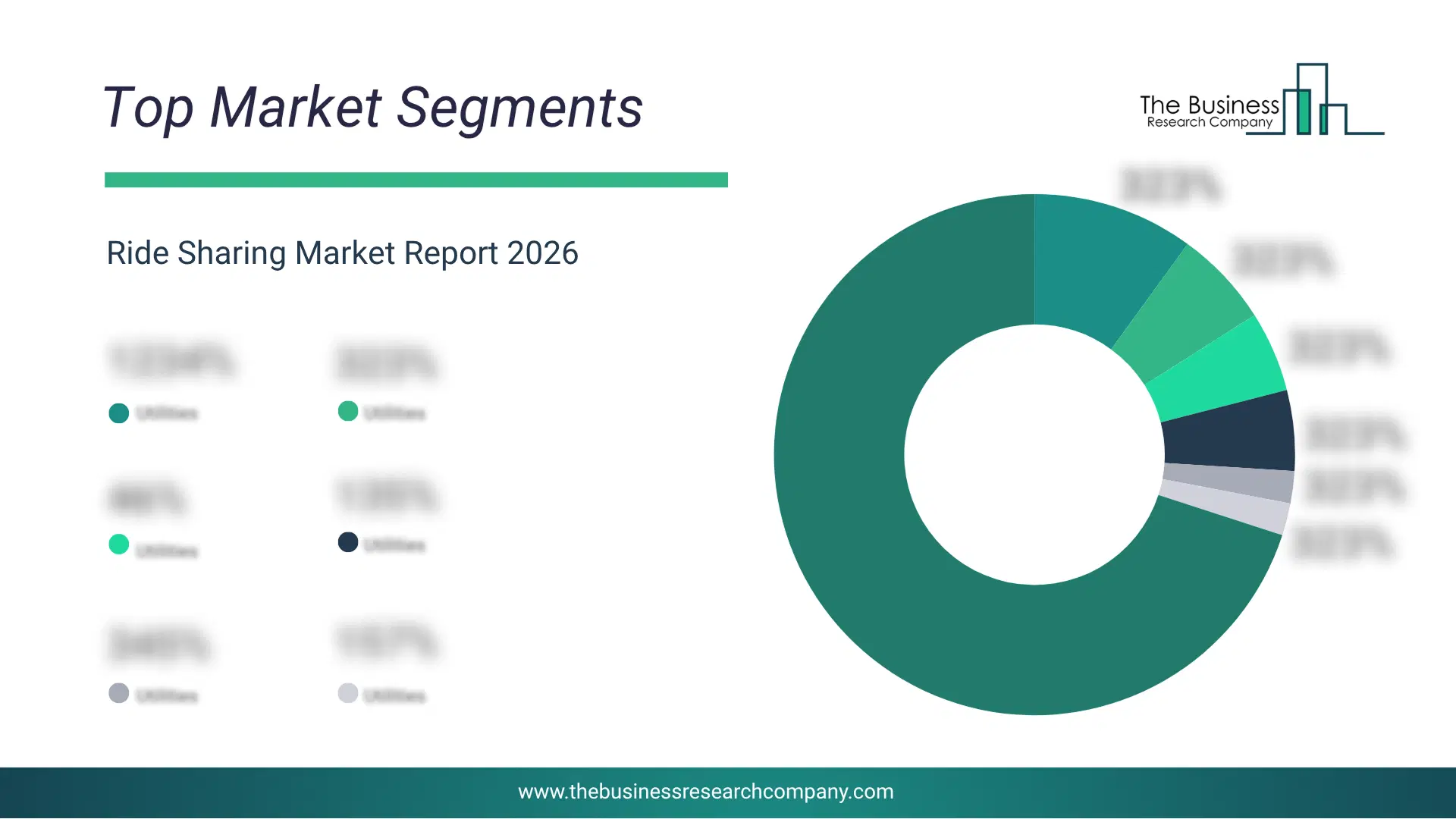
1) By Operation: Pre-Commissioning And Commissioning, Maintenance, Decommissioning 2) By Asset Type: Pipeline, Process 3) By Raw Material: Plastic, Carbon Steel, Steel 4) By End-Users: Oil And Gas Industry, Chemical Industry, Water Treatment Industry, Construction And Manufacturing Industry, Other End-Users Subsegments: 1) By Pre-Commissioning And Commissioning: Pipeline Testing And Inspection, Flushing And Cleaning Services, Hydrostatic Testing, Commissioning Support Services 2) By Maintenance: Routine Inspection And Monitoring, Pipeline Repairs And Rehabilitation, Corrosion Management, Leak Detection Services 3) By Decommissioning: Pipeline Abandonment Services, Environmental Assessment And Remediation, Dismantling And Removal Services, Waste Management Services The top segments in the ride sharing market will be: • E-Hailing will reach $214.5 Billion by 2030. • Car Rental will reach $70.52 Billion by 2030. • Car Sharing will reach $50.9 Billion by 2030. • Station-Based Mobility will reach $26.72 Billion by 2030.What Is The Driver Of The Ride Sharing Market?
An increase in the adoption of smartphone devices is expected to propel the growth of the ride sharing market going forward. A smartphone refers to a cellular telephone with an integrated computer originally associated with telephones such as an operating system, web browsing, and the ability to run software applications. Smartphone penetration significantly contributes to the success of the ride-sharing market by making these services accessible, convenient, and technologically advanced for a large and diverse user base. For instance, in March 2024, according to ConsumerAffairs, a US-based consumer news and advocacy organization, American ownership of smartphones increased to 92% in 2023 from 86% in 2022. Additionally, it was estimated that in 2024, American adults will, on average, spend more than 4.5 hours on their mobile devices each day. Therefore, an increase in the adoption of smart phones is driving the growth of the ride sharing industry.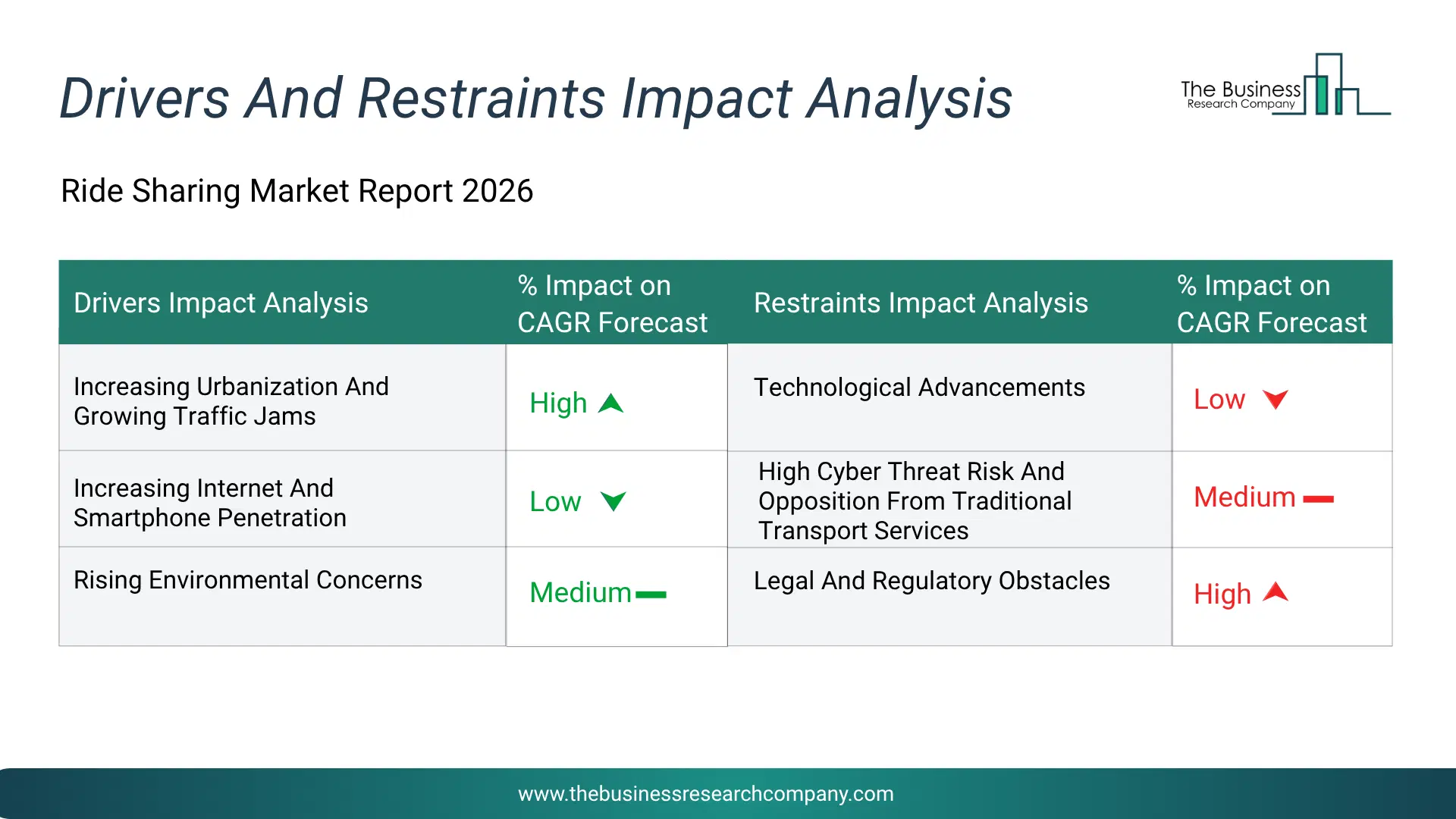
Infographic Chart Showing Key Market Drivers Analysis And Restraints For Ride Sharing Market
The chart presents an impact analysis of key drivers and restraints, quantifying their relative influence on the market's growth rate and helping assess the balance between growth enablers and limiting factors. This chart offers a high-level perspective; the full report contains more detailed insights.
How Will The Drivers Impact Growth In The Global Ride Sharing Market?
• Increasing Urbanization And Growing Traffic Jams (High) – During the forecast period, the rapid urbanization and increasing traffic congestion are expected to become major growth drivers for the ride sharing market by 2030. Expanding urban populations and rising vehicle density are creating severe transportation challenges in major metropolitan areas, encouraging commuters to adopt flexible and cost-efficient mobility alternatives. Ride-sharing platforms provide convenient on-demand transportation solutions that help reduce private vehicle dependency and optimize urban travel efficiency. Governments and city planners are also promoting shared mobility services to reduce congestion and improve transportation sustainability. • Increasing Internet And Smartphone Penetration (Low) – During the forecast period, the expansion of smartphone connectivity and digital payment ecosystems is expected to emerge as a major factor driving the growth of the ride sharing market by 2030. Increasing penetration of smartphones, mobile internet services, and digital wallets is making ride-booking applications more accessible and user-friendly across both developed and emerging economies. Advanced mobile technologies enable real-time ride tracking, seamless cashless payments, and AI-driven route optimization, significantly enhancing customer convenience and operational efficiency. The growing integration of fintech platforms within mobility applications is further accelerating consumer adoption of app-based transportation services. • Rising Environmental Concerns (Medium) – During the forecast period, the growing adoption of electric and sustainable mobility solutions is expected to act as a key growth catalyst for the ride sharing market by 2030. Ride-sharing operators are increasingly transitioning toward electric vehicle fleets to reduce fuel expenses, comply with environmental regulations, and strengthen sustainability initiatives. Governments worldwide are supporting clean transportation through investments in EV charging infrastructure, emission reduction programs, and urban green mobility policies. Additionally, environmentally conscious consumers are increasingly preferring low-emission shared transportation services, encouraging fleet modernization across the industry.How Will The Restraints Impact Growth In The Global Ride Sharing Market?
• Technological Advancements (High) – During the forecast period, the technological Advancements Acts As A Major Driver For The Ride Sharing Market Because continuous innovation in GPS, artificial intelligence, and data analytics enhances the efficiency and reliability of ride sharing platforms. Advanced algorithms improve route planning, reduce waiting times, and optimize driver-passenger matching. Integration of features such as real-time tracking, dynamic pricing, and safety tools increases user trust and satisfaction. These innovations also enable companies to operate at scale while maintaining service quality. As a result, technological progress significantly accelerates market growth and competitiveness. • High Cyber Threat Risk And Opposition From Traditional Transport Services (Low) – During the forecast period, the high cyber threat risk and opposition from traditional transport services act as significant restraints on the ride sharing market by creating both technological and competitive barriers. Increasing risks of data breaches, hacking, and misuse of customer information undermine user trust and raise concerns over digital safety. At the same time, resistance from traditional taxi unions and transport operators leads to protests, legal disputes, and lobbying against ride sharing platforms. This opposition often results in operational disruptions and stricter local restrictions. Together, these factors slow down platform adoption and increase compliance and security costs for service providers. • Legal And Regulatory Obstacles (Medium) – During the forecast period, the legal and regulatory obstacles act as major restraints for the ride sharing market by imposing complex compliance requirements across different regions. Governments often enforce varying rules related to licensing, driver verification, insurance, and fare regulations, making it difficult for companies to scale uniformly. Frequent policy changes and unclear legal frameworks create uncertainty for both operators and investors. In some regions, bans or operational caps limit service expansion and market penetration. These challenges increase operational costs and delay innovation, ultimately hindering the overall growth of the ride sharing industry.Key Players In The Global Ride Sharing Market
Major companies operating in the ride sharing market are ANI Technologies Pvt. Ltd., BlaBlaCar SA, Cabify Espana S.L.U, Careem Networks FZ LLC, Gett, Lyft Inc., Uber Technologies Inc., Didi Chuxing Technology Co., Daimler AG, Bolt Technology OU, Yandex, Beijing Xiaoju Technology Co Ltd., Via Transportation Inc., Scoop Technologies Inc., Wingz Inc., Curb Mobility LLC, PT Gojek Indonesia, Easy Taxi Serviços Ltda., Beat Mobility SA, Juno USA LP, Grab Holdings Inc., Free Now, Bolt Mobility Corp., ViaVan, Ryde Technologies Pte Ltd.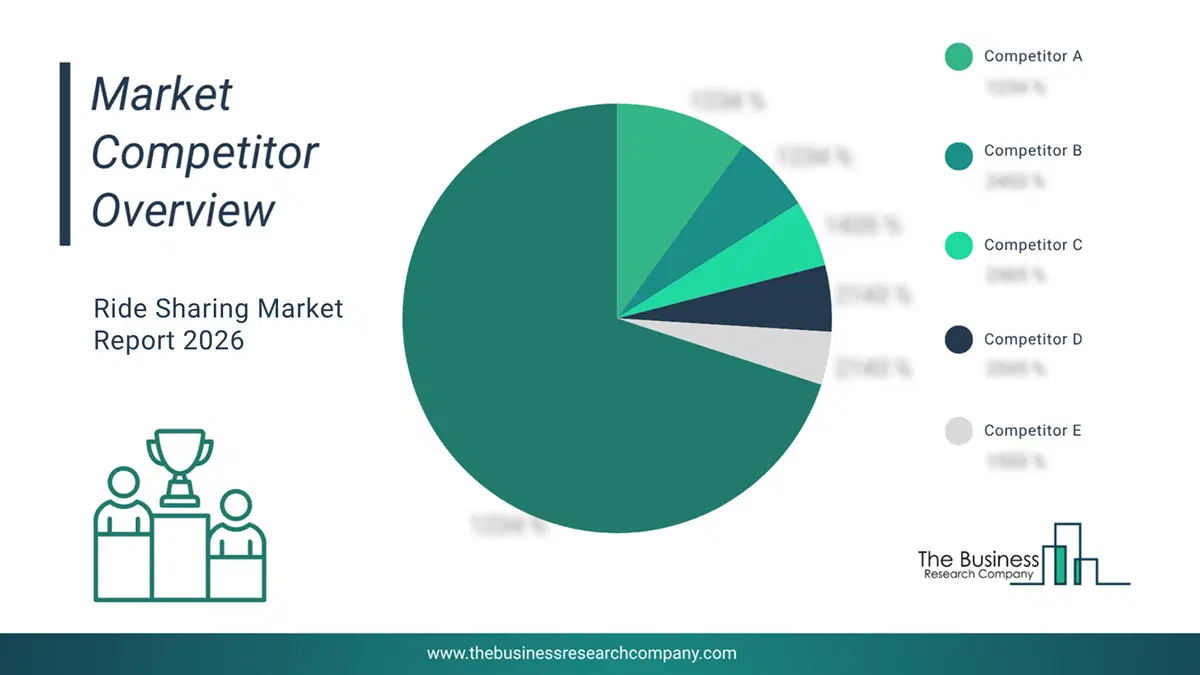
This chart is for illustrative purposes; the full report includes a detailed competitor analysis and comprehensive overview of the top 10 companies in the market.
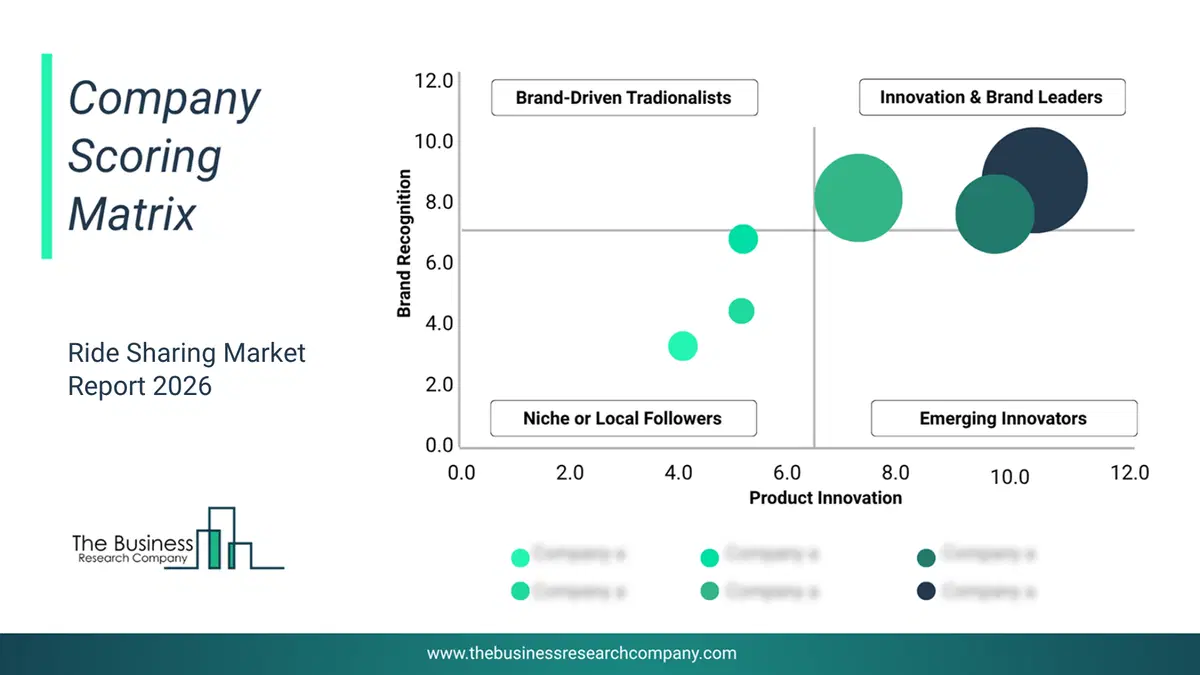
This chart maps companies by product innovation and brand strength, with bubble size indicating relative revenue, helping identify market leaders, challengers, and niche players. This is an illustrative chart; the full report provides a complete and accurate competitive analysis.
Global Ride Sharing Market Trends and Insights
Major companies operating in the ride-sharing market are developing innovative products such as travel features to meet larger customer bases, more sales, and increase revenue. Travel features refer to the distinctive characteristics, services, or functionalities offered by transportation or travel-related products and services to enhance the overall travel experience for users. For instance, in January 2023, Uber Technologies Inc., a US-based technology company, launched Uber Travel, a new travel feature. Smart Itineraries, a unique feature of the product, simplifies the ride booking process by allowing travelers to seamlessly import their trip details into the Uber app. With this capability, users can conveniently schedule rides in advance for various segments of their journey, eliminating the need to individually request rides upon arrival at airports or departure from hotels.What Are Latest Mergers And Acquisitions In The Ride Sharing Market?
In July 2025, Lyft Inc., a US-based technology company, acquired FREENOW GmbH for approximately $197 million. With this acquisition, Lyft, Inc. seeks to expand its geographic presence beyond North America by entering the European mobility market and accelerating growth of its global customer base through an established platform. FREENOW GmbH is a Germany-based technology company that specializes in providing a multi-mobility platform offering taxi, private hire vehicle, and other urban transportation services across major cities in Europe.Regional Outlook
North America was the largest region in the ride sharing market in 2025. The regions covered in this market report are Asia-Pacific, South East Asia, Western Europe, Eastern Europe, North America, South America, Middle East, Africa. The countries covered in this market report are Australia; Brazil; China; France; Germany; India; Indonesia; Japan; Taiwan; Russia; South Korea; UK; USA; Canada; Italy; Spain.What Defines the Ride Sharing Market?
The ride sharing market includes revenues earned by entities by providing services such as real-time tracking of drivers, real-time ride tracking sharing, multiple drop-off locations, and multiple payment options. The market value includes the value of related goods sold by the service provider or included within the service offering. Only goods and services traded between entities or sold to end consumers are included.How is Market Value Defined and Measured?
The market value is defined as the revenues that enterprises gain from the sale of goods and/or services within the specified market and geography through sales, grants, or donations in terms of the currency (in USD unless otherwise specified). The revenues for a specified geography are consumption values that are revenues generated by organizations in the specified geography within the market, irrespective of where they are produced. It does not include revenues from resales along the supply chain, either further along the supply chain or as part of other products.
This chart presents market attractiveness based on a quantitative evaluation of growth, competition, strategic alignment, and risk, offering a clear view of opportunity areas for decision-making. This chart is for illustrative purposes; the full report contains the complete analysis.

This chart highlights the Total Addressable Market (TAM) by estimating the maximum revenue opportunity using an assumption-driven approach, supporting strategic planning and opportunity sizing across markets. The chart is illustrative; the full report provides a more comprehensive analysis.
What Key Data and Analysis Are Included in the Ride Sharing Market Report 2026?
The ride sharing market research report is one of a series of new reports from The Business Research Company that provides market statistics, including Market Report 2026?global market size, regional shares, competitors with the market share, detailed market segments, market trends and opportunities, and any further data you may need to thrive in the ride sharing Market Report 2026? The market research report delivers a complete perspective of everything you need, with an in-depth analysis of the current and future state of the Market Report 2026?Ride Sharing Market Report Forecast Analysis
| Report Attribute | Details |
|---|---|
| Market Size Value In 2026 | $189.25 billion |
| Revenue Forecast In 2030 | $408.64 billion |
| Growth Rate | CAGR of 21.3% from 2026 to 2030 |
| Base Year For Estimation | 2025 |
| Actual Estimates/Historical Data | 2020-2025 |
| Forecast Period | 2026 - 2030 |
| Market Representation | Revenue in USD Billion and CAGR from 2026 to 2030 |
| Segments Covered | Operation, Asset Type, Raw Material, End-Users |
| Regional Scope | Asia-Pacific, Western Europe, Eastern Europe, North America, South America, Middle East, Africa |
| Country Scope | The countries covered in the report are Australia, Brazil, China, France, Germany, India, Indonesia, Japan, Taiwan, Russia, South Korea, UK, USA, Canada, Italy, Spain. |
| Key Companies Profiled | ANI Technologies Pvt. Ltd., BlaBlaCar SA, Cabify Espana S.L.U, Careem Networks FZ LLC, Gett, Lyft Inc., Uber Technologies Inc., Didi Chuxing Technology Co., Daimler AG, Bolt Technology OU, Yandex, Beijing Xiaoju Technology Co Ltd., Via Transportation Inc., Scoop Technologies Inc., Wingz Inc., Curb Mobility LLC, PT Gojek Indonesia, Easy Taxi Serviços Ltda., Beat Mobility SA, Juno USA LP, Grab Holdings Inc., Free Now, Bolt Mobility Corp., ViaVan, Ryde Technologies Pte Ltd. |
| Customization Scope | Request for Customization |
| Pricing And Purchase Options | Explore Purchase Options |