
Ring Dryers Market Report 2026
Global Outlook – By Type (Batch Operation Ring Dryers, Continuous Operation Ring Dryers), By Technology (Convection Ring Dryers, Conduction Ring Dryers, Radiant Ring Dryers, Hybrid Ring Dryers), By Capacity (Small Capacity Ring Dryers (Up To 100 Kilograms Per Hour), Medium Capacity Ring Dryers (100 Kilograms Per Hour To 500 Kilograms Per Hour), Large Capacity Ring Dryers (Above 500 Kilograms Per Hour)), By Distribution Channel (Direct Sales, Industrial Distributors, Online Industrial Marketplaces, Engineering Procurement And Construction Contracts, Other Distribution Channels), By End-User Industry (Food And Beverage, Pharmaceuticals, Chemicals, Agriculture) – Market Size, Trends, Strategies, and Forecast to 2030
Ring Dryers Market Report 2026 Market Overview
• Ring Dryers Market Report 2026 market size has reached to $1 billion in 2025 • Expected to grow to $1.59 billion in 2030 at a compound annual growth rate (CAGR) of 9.8% • Growth Driver: Expansion Of Pharmaceutical And Chemical Manufacturing Driving The Market Growth Due To Rising Demand For High-Quality Drying In Drug And Chemical Production • North America was the largest region in 2025 and Asia-Pacific is the fastest growing region.What Is Covered Under Ring Dryers Market?
A ring dryer is an industrial drying system that rapidly removes moisture from wet materials such as slurries, pastes, and powders using a high-velocity hot air stream in a closed-loop system. It combines flash drying and pneumatic conveying principles to ensure efficient drying, especially for heat-sensitive and finely divided materials. The main types of ring dryers include batch operation ring dryers and continuous operation ring dryers. Batch operation ring dryers refer to drying systems that process materials in separate batches for controlled drying operations and moisture removal. These dryers utilize technologies such as convection ring dryers, conduction ring dryers, radiant ring dryers, and hybrid ring dryers and are available in capacities including small capacity ring dryers (up to 100 kilograms per hour), medium capacity ring dryers (100 kilograms per hour to 500 kilograms per hour), and large capacity ring dryers (above 500 kilograms per hour). These products are distributed through direct sales, industrial distributors, online industrial marketplaces, engineering procurement and construction contracts, and others and are used by end-user industries including food and beverage, pharmaceuticals, chemicals, and agriculture.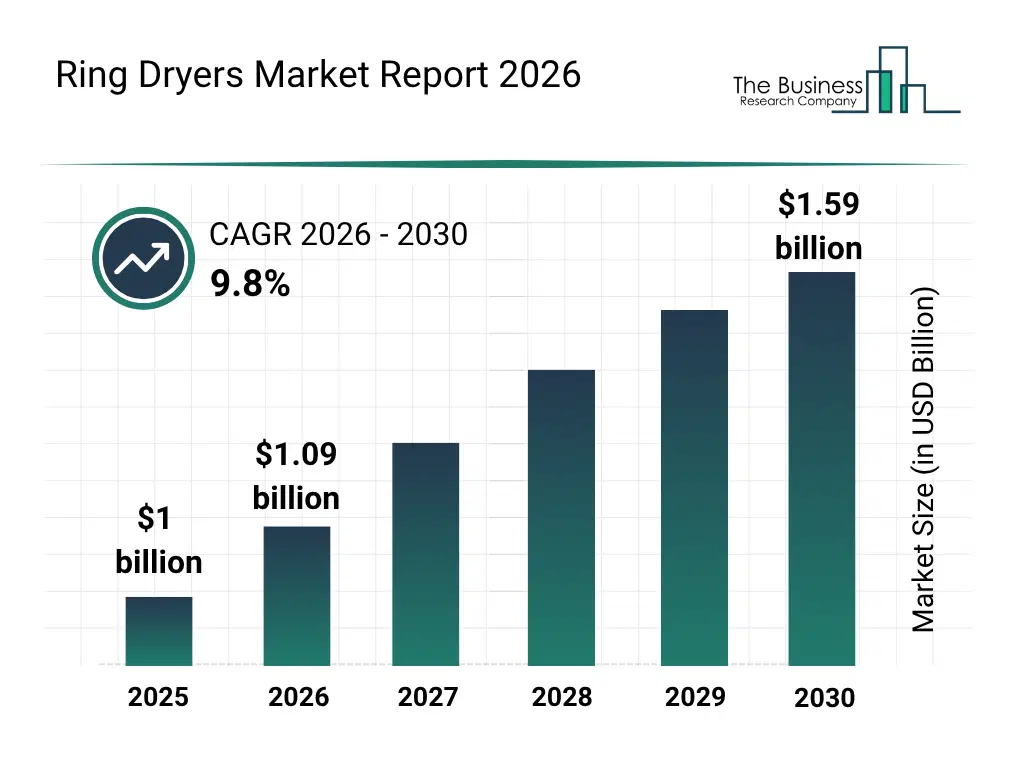
What Is The Ring Dryers Market Size and Share 2026?
The ring dryers market size has grown strongly in recent years. It will grow from $1 billion in 2025 to $1.09 billion in 2026 at a compound annual growth rate (CAGR) of 9.6%. The growth in the historic period can be attributed to expansion of chemical and pharmaceutical manufacturing industries, reliance on conventional batch drying systems, limited adoption of energy efficient drying technologies, growth in agricultural processing and food drying needs, increasing industrialization of powder processing operations.What Is The Ring Dryers Market Growth Forecast?
The ring dryers market size is expected to see strong growth in the next few years. It will grow to $1.59 billion in 2030 at a compound annual growth rate (CAGR) of 9.8%. The growth in the forecast period can be attributed to rising demand for energy efficient and low emission drying systems, expansion of pharmaceutical and specialty chemical production, growth in automation of industrial processing lines, increasing focus on sustainable manufacturing practices, adoption of smart monitoring in drying equipment. Major trends in the forecast period include increasing adoption of energy efficient industrial drying systems, rising demand for continuous ring drying processes in bulk manufacturing, integration of advanced heat recovery systems in drying equipment, growth in closed loop pneumatic drying technologies, expansion of automated process control in industrial drying operations.
Global Ring Dryers Market Segmentation
1) By Type: Batch Operation Ring Dryers, Continuous Operation Ring Dryers 2) By Technology: Convection Ring Dryers, Conduction Ring Dryers, Radiant Ring Dryers, Hybrid Ring Dryers 3) By Capacity: Small Capacity Ring Dryers (Up To 100 Kilograms Per Hour), Medium Capacity Ring Dryers (100 Kilograms Per Hour To 500 Kilograms Per Hour), Large Capacity Ring Dryers (Above 500 Kilograms Per Hour) 4) By Distribution Channel: Direct Sales, Industrial Distributors, Online Industrial Marketplaces, Engineering Procurement And Construction Contracts, Other Distribution Channels 5) By End-User Industry: Food And Beverage, Pharmaceuticals, Chemicals, Agriculture Subsegments: 1) By Batch Operation Ring Dryers: Manual Batch Ring Dryers, Semi Automatic Batch Ring Dryers, Automatic Batch Ring Dryers, Electric Heated Batch Ring Dryers, Steam Heated Batch Ring Dryers, Gas Fired Batch Ring Dryers, Laboratory Scale Batch Ring Dryers, Industrial Scale Batch Ring Dryers 2) By Continuous Operation Ring Dryers: Single Stage Continuous Ring Dryers, Multi Stage Continuous Ring Dryers, Direct Heated Continuous Ring Dryers, Indirect Heated Continuous Ring Dryers, High Capacity Continuous Ring Dryers, Low Temperature Continuous Ring Dryers, Pneumatic Continuous Ring Dryers, Energy Efficient Continuous Ring DryersWhat Are The Drivers Of The Ring Dryers Market?
The expansion of pharmaceutical and chemical manufacturing is expected to propel the growth of the ring dryers market going forward. Pharmaceutical and chemical manufacturing is the large-scale industrial production of medicines and chemicals by processing raw materials into safe, regulated, and usable products for healthcare and various industries. Pharmaceutical and chemical manufacturing is increasing due to rising healthcare needs and expanding industrial demand, which are driving higher production of medicines and essential chemicals. Ring dryers support pharmaceutical and chemical manufacturing by efficiently drying heat-sensitive powders and intermediates into stable, uniform particles, which improves product purity, consistency, and downstream processing performance. For instance, in April 2025, according to Eurostat, a Luxembourg-based government agency, in 2024, EU exports of medicinal and pharmaceutical products increased by 13.5% compared with 2023, reaching $316.38 billion (€313.4 billion). At the same time, imports only recorded a modest increase of 0.5%, amounting to $112.7 billion (€119.7 billion). Therefore, the expansion of pharmaceutical and chemical manufacturing is driving the growth of the ring dryers industry. The expansion of the food processing industry is expected to propel the growth of the ring dryers market going forward. The food processing industry is the sector that converts raw agricultural materials into safe, edible, and value-added food products for consumption and storage. The food processing industry is increasing due to rising demand for convenient and packaged foods, as changing lifestyles and urbanization are driving consumers to prefer ready-to-eat and easy-to-prepare food products. Ring dryers help the food processing industry by efficiently drying liquid or slurry food materials into stable powders, improving shelf life, reducing moisture content, and enabling convenient storage, transportation, and formulation of products like milk powder, starch, and flavoring ingredients. For instance, in July 2025, according to Agriculture and Agri-Food Canada (AAFC), a Canada-based government department for agriculture and food-related products, in 2024, exports of processed food and beverage products from Canada reached $59.8 billion, representing a 3.8% increase compared to 2023. Therefore, the expansion of the food processing industry is driving the growth of the ring dryers industry. The growing adoption of industrial automation is expected to propel the growth of the ring dryers market going forward. Industrial automation is the application of control systems and technologies such as robotics and computers to run industrial operations automatically with minimal human involvement. Industrial automation is increasing mainly due to rising labor cost pressures, as companies are adopting automated systems to reduce dependency on manual labor and maintain cost-efficient, uninterrupted production. Ring dryers support industrial automation by enabling continuous, controlled, and programmable drying of materials, which allows automated systems to maintain consistent product quality with minimal manual intervention and real-time process monitoring. For instance, in November 2024, according to the International Federation of Robotics (IFR), a Germany-based non-profit organization representing the global robotics industry, the robot density in the United States increased from 285 units per 10,000 employees in 2022 to 295 units per 10,000 employees in 2023, reflecting a consistent rise in industrial automation adoption across manufacturing and logistics sectors. Therefore, the growing adoption of industrial automation is driving the growth of the ring dryers industry.Key Players In The Global Ring Dryers Market
Major companies operating in the ring dryers market report are ANDRITZ AG, GEA Group AG, MKS Industrial Solutions, Invex Group, VetterTec GmbH, Advanced Drying Systems, New AVM Systech Private Limited, Microtec Engineering Group, Saka Engineering Systems Private Limited, Mitchell Dryers Ltd, Shrishti Process Equipment, Raygm Engineered Systems, Bühler Group, Hosokawa Micron, SPX FLOW, Mavitec B.V., Heinen Drying GmbH
This chart is for illustrative purposes; the full report includes a detailed competitor analysis and comprehensive overview of the top 10 companies in the market.
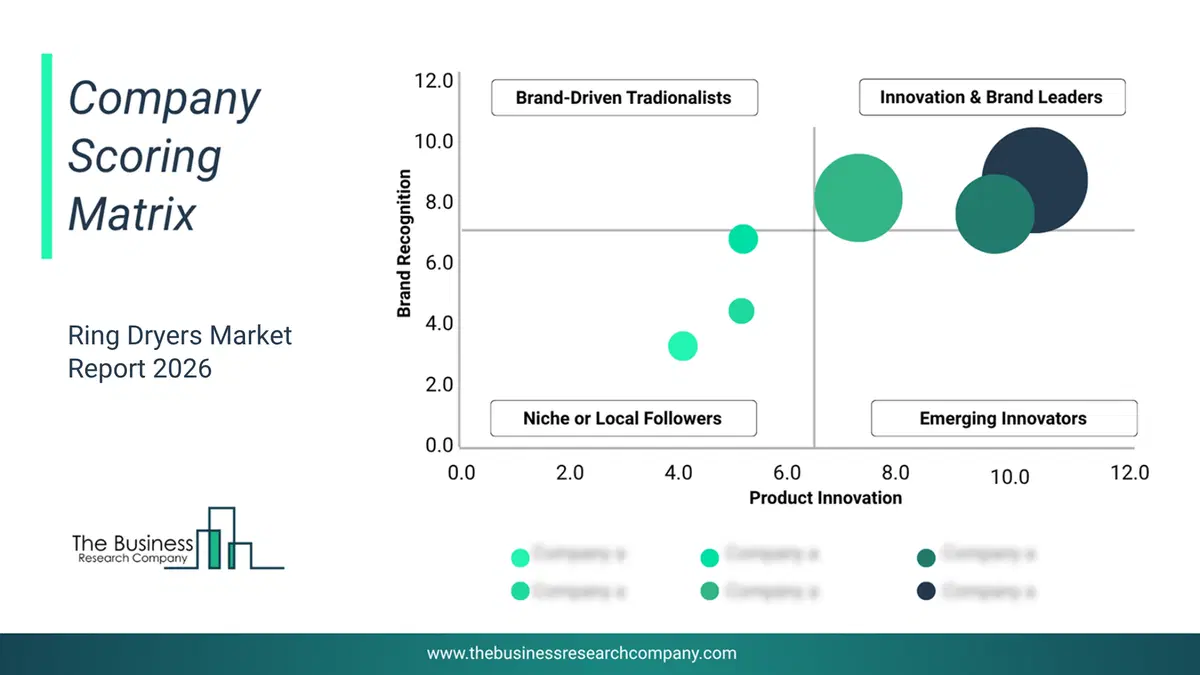
This chart maps companies by product innovation and brand strength, with bubble size indicating relative revenue, helping identify market leaders, challengers, and niche players. This is an illustrative chart; the full report provides a complete and accurate competitive analysis.
Regional Outlook
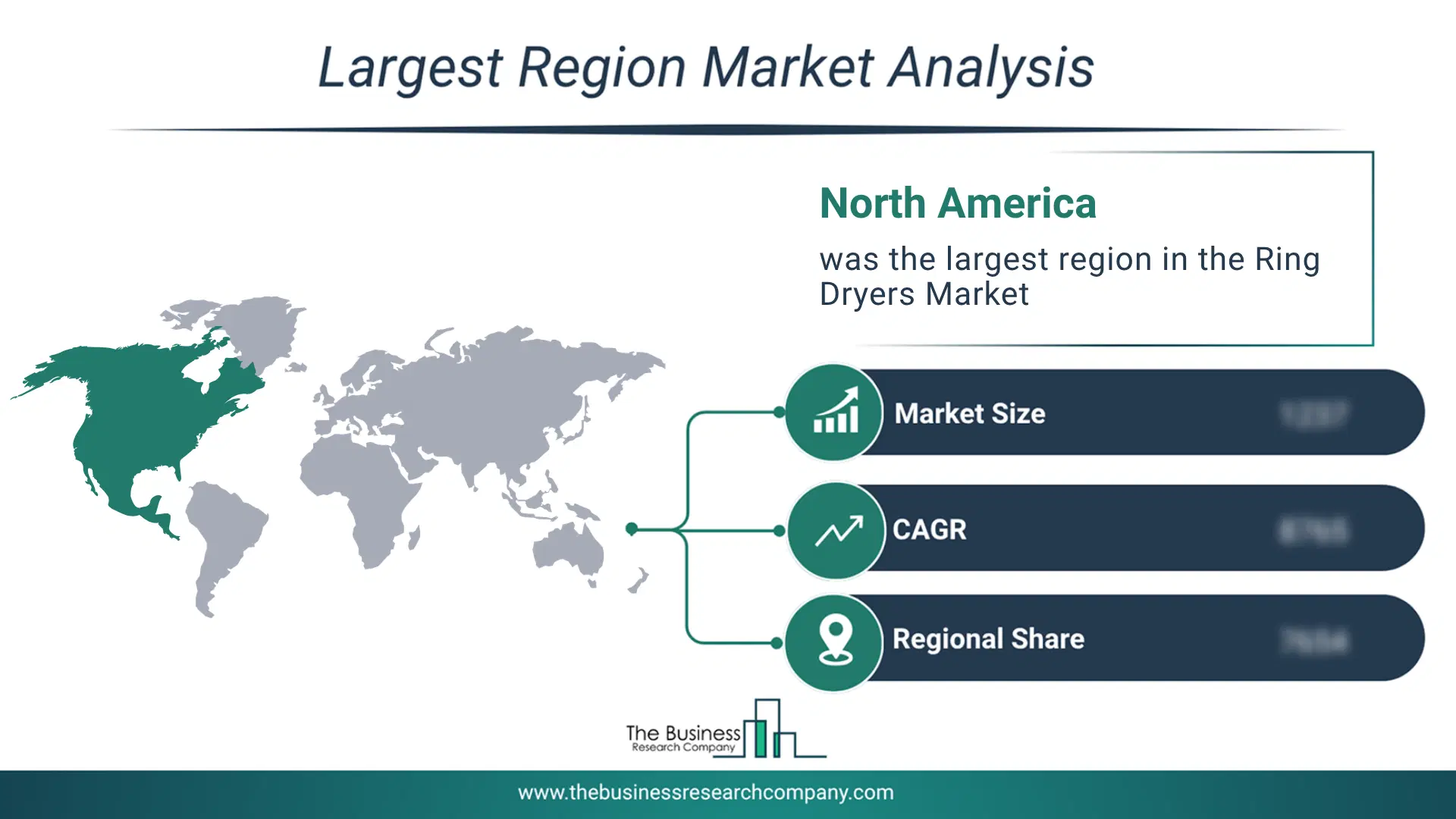
North America was the largest region in the ring dryers market in 2025. Asia-Pacific is expected to be the fastest-growing region in the forecast period. The regions covered in this market report are Asia-Pacific, South East Asia, Western Europe, Eastern Europe, North America, South America, Middle East, Africa. The countries covered in this market report are Australia, Brazil, China, France, Germany, India, Indonesia, Japan, Taiwan, Russia, South Korea, UK, USA, Canada, Italy, Spain.What Defines the Ring Dryers Market?
The ring dryers market consists of sales of spray dryers, flash dryers, fluidized bed dryers, and rotary dryers. Values in this market are ‘factory gate’ values, that is, the value of goods sold by the manufacturers or creators of the goods, whether to other entities (including downstream manufacturers, wholesalers, distributors, and retailers) or directly to end customers. The value of goods in this market includes related services sold by the creators of the goods.How is Market Value Defined and Measured?
The market value is defined as the revenues that enterprises gain from the sale of goods and/or services within the specified market and geography through sales, grants, or donations in terms of the currency (in USD unless otherwise specified). The revenues for a specified geography are consumption values that are revenues generated by organizations in the specified geography within the market, irrespective of where they are produced. It does not include revenues from resales along the supply chain, either further along the supply chain or as part of other products.
This chart presents market attractiveness based on a quantitative evaluation of growth, competition, strategic alignment, and risk, offering a clear view of opportunity areas for decision-making. This chart is for illustrative purposes; the full report contains the complete analysis.

This chart highlights the Total Addressable Market (TAM) by estimating the maximum revenue opportunity using an assumption-driven approach, supporting strategic planning and opportunity sizing across markets. The chart is illustrative; the full report provides a more comprehensive analysis.
What Key Data and Analysis Are Included in the Ring Dryers Market Report 2026?
The ring dryers market research report is one of a series of new reports from The Business Research Company that provides market statistics, including industry global market size, regional shares, competitors with the market share, detailed market segments, market trends and opportunities, and any further data you may need to thrive in the ring dryers industry. The market research report delivers a complete perspective of everything you need, with an in-depth analysis of the current and future state of the industry.Ring Dryers Market Report Forecast Analysis
| Report Attribute | Details |
|---|---|
| Market Size Value In 2026 | $1.09 billion |
| Revenue Forecast In 2030 | $1.59 billion |
| Growth Rate | CAGR of 9.8% from 2026 to 2030 |
| Base Year For Estimation | 2025 |
| Actual Estimates/Historical Data | 2020-2025 |
| Forecast Period | 2026 - 2030 |
| Market Representation | Revenue in USD Billion and CAGR from 2026 to 2030 |
| Segments Covered | Type, Technology, Capacity, Distribution Channel, End-User Industry |
| Regional Scope | Asia-Pacific, Western Europe, Eastern Europe, North America, South America, Middle East, Africa |
| Country Scope | The countries covered in the report are Australia, Brazil, China, France, Germany, India, Indonesia, Japan, Taiwan, Russia, South Korea, UK, USA, Canada, Italy, Spain. |
| Key Companies Profiled | ANDRITZ AG, GEA Group AG, MKS Industrial Solutions, Invex Group, VetterTec GmbH, Advanced Drying Systems, New AVM Systech Private Limited, Microtec Engineering Group, Saka Engineering Systems Private Limited, Mitchell Dryers Ltd, Shrishti Process Equipment, Raygm Engineered Systems, Bühler Group, Hosokawa Micron, SPX FLOW, Mavitec B.V., Heinen Drying GmbH |
| Customization Scope | Request for Customization |
| Pricing And Purchase Options | Explore Purchase Options |