

River Turbine Market Report 2026
Global Outlook – By Product Type (Horizontal Axis River Turbines, Vertical Axis River Turbines, Floating River Turbines, Fixed River Turbines ), By Capacity (Up To 10 kW, 10–100 kW, Above 100 kW ), By Water Flow Condition (Low Flow Rivers, Medium Flow Rivers, High Flow Rivers, Canal-Based Installations, Tidal River Installations ), By Application (Power Generation, Irrigation, Water Pumping, Other Applications ), By End User (Utilities, Independent Power Producers, Industrial Users, Municipal Bodies, Rural Communities, Government Agencies ) – Market Size, Trends, Strategies, and Forecast to 2030
River Turbine Market Overview
• River Turbine market size has reached to $1.11 billion in 2025 • Expected to grow to $1.81 billion in 2030 at a compound annual growth rate (CAGR) of 10.2% • Growth Driver: The Increasing Demand For Renewable Energy Generation Driving The Growth Of The Market Due To Rising Greenhouse Gas Emissions • Market Trend: Advancements In High-Efficiency In-Stream Turbine Technology Enable Sustainable Power Generation From Flowing Water Resources • Asia-Pacific was the largest region and fastest growing region.What Is Covered Under River Turbine Market?
A river turbine is a renewable energy device that converts the kinetic energy of flowing river water into mechanical energy, which is then transformed into electricity. It is typically installed in rivers or streams where continuous water flow rotates turbine blades connected to a generator. These turbines provide a clean and sustainable power generation solution without requiring large dams or significant disruption to aquatic ecosystems. The main product types of river turbines include horizontal axis river turbines, vertical axis river turbines, floating river turbines, and fixed river turbines. Horizontal axis river turbines refer to hydrokinetic devices with turbine blades rotating around an axis positioned parallel to the direction of flowing river water to convert the kinetic energy of the current into electrical energy. These turbines are available in capacities of up to 10 kW, 10–100 kW, and above 100 kW and are designed for low flow rivers, medium flow rivers, high flow rivers, canal-based installations, and tidal river installations. The key applications include power generation, irrigation, water pumping, and others, while the end users include utilities, independent power producers, industrial users, municipal bodies, rural communities, and government agencies.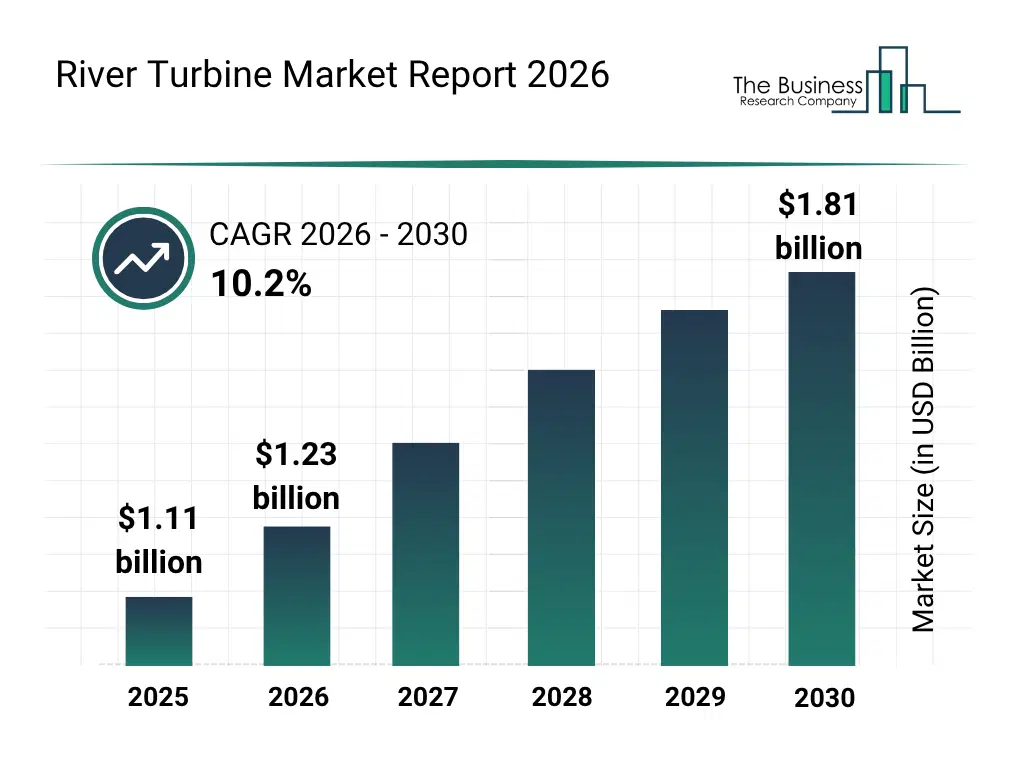
What Is The River Turbine Market Size and Share 2026?
The river turbine market size has grown rapidly in recent years. It will grow from $1.11 billion in 2025 to $1.23 billion in 2026 at a compound annual growth rate (CAGR) of 10.6%. The growth in the historic period can be attributed to increasing demand for renewable electricity generation, rising concerns over greenhouse gas emissions, growing adoption of decentralized power generation, increasing demand for clean energy from remote communities, rising need for sustainable alternatives to conventional power generation.What Is The River Turbine Market Growth Forecast?
The river turbine market size is expected to see rapid growth in the next few years. It will grow to $1.81 billion in 2030 at a compound annual growth rate (CAGR) of 10.2%. The growth in the forecast period can be attributed to growing demand for small-scale hydropower generation, increasing focus on low-impact renewable energy projects, rising demand for reliable electricity in remote areas, expanding deployment of distributed renewable energy systems, increasing need for continuous clean power generation. Major trends in the forecast period include increasing adoption of low-impact river turbine installations, rising demand for modular river turbine systems, growing preference for turbines suitable for variable water flow conditions, increasing demand for durable turbine components for continuous operation, rising focus on minimizing maintenance requirements for river-based power generation.
Global River Turbine Market Segmentation
1) By Product Type: Horizontal Axis River Turbines, Vertical Axis River Turbines, Floating River Turbines, Fixed River Turbines 2) By Capacity: Up To 10 kW, 10–100 kW, Above 100 kW 3) By Water Flow Condition: Low Flow Rivers, Medium Flow Rivers, High Flow Rivers, Canal-Based Installations, Tidal River Installations 4) By Application: Power Generation, Irrigation, Water Pumping, Other Applications 5) By End User: Utilities, Independent Power Producers, Industrial Users, Municipal Bodies, Rural Communities, Government Agencies Subsegments: 1) By Horizontal Axis River Turbines: Single Rotor Horizontal Axis River Turbines, Multi Rotor Horizontal Axis River Turbines, Ducted Horizontal Axis River Turbines, Open Flow Horizontal Axis River Turbines 2) By Vertical Axis River Turbines: Darrieus Vertical Axis River Turbines, Savonius Vertical Axis River Turbines, Helical Vertical Axis River Turbines, Cross Flow Vertical Axis River Turbines 3) By Floating River Turbines: Surface Floating River Turbines, Submerged Floating River Turbines, Modular Floating River Turbines, Platform Mounted Floating River Turbines 4) By Fixed River Turbines: Bottom Mounted River Turbines, Pile Mounted River Turbines, Anchored River Turbines, Channel Mounted River TurbinesWhat Is The Driver Of The River Turbine Market?
The increasing demand for renewable energy generation is expected to propel the growth of the river turbine market going forward. Renewable energy generation refers to the process of producing electricity or usable energy from naturally replenishing sources such as sunlight, wind, water, biomass, and geothermal heat, which have minimal environmental impact and can be continuously renewed. Increasing demand for renewable energy generation is due to rising greenhouse gas emissions, as the need to reduce carbon pollution and combat climate change encourages the adoption of clean and sustainable energy sources. A river turbine enables renewable energy generation by converting the kinetic energy of flowing rivers and water currents into clean electricity, facilitating sustainable power production without relying on fossil fuels. For instance, in December 2024, according to Eurostat, a Luxembourg-based government agency, in 2023, renewable energy accounted for 24.5% of the energy consumed in the EU, an increase from 23.0% in 2022. Therefore, the increasing demand for renewable energy generation is driving the growth of the river turbine industry.Key Players In The Global River Turbine Market
Major companies operating in the river turbine market are GE Vernova Inc, Voith GmbH & Co. KGaA, ANDRITZ AG, Dongfang Electric Corporation Limited, Toshiba Energy Systems & Solutions Corporation, Harbin Electric Corporation Co. Ltd., Hitachi Mitsubishi Hydro Corporation, Zhefu Holding Group Co. Ltd., Power Machines Public Joint Stock Company, Fuji Electric Co. Ltd., Tyazhmash Public Joint Stock Company, FLOVEL Energy Private Limited, Gilbert Gilkes & Gordon Ltd, Litostroj Power d.o.o., Canyon Industries Inc, Natel Energy Inc, Verdant Power Inc, Ocean Renewable Power Company Inc, Turbulent BV, Instream Energy Systems Corporation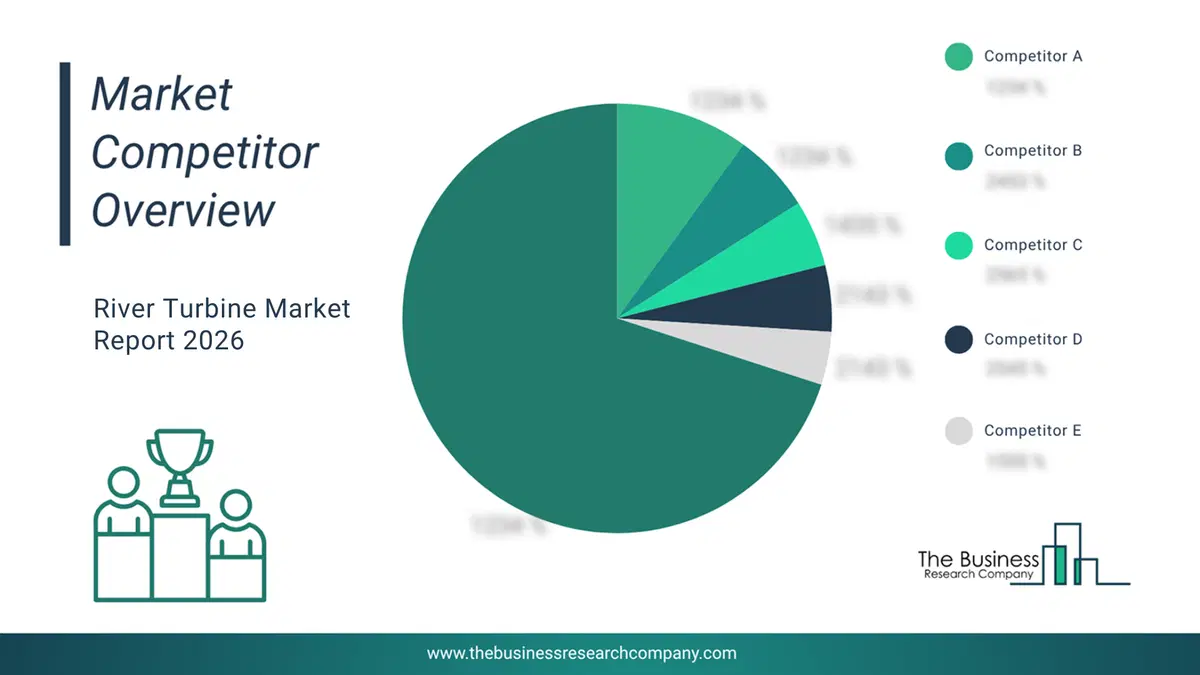
This chart is for illustrative purposes; the full report includes a detailed competitor analysis and comprehensive overview of the top 10 companies in the market.
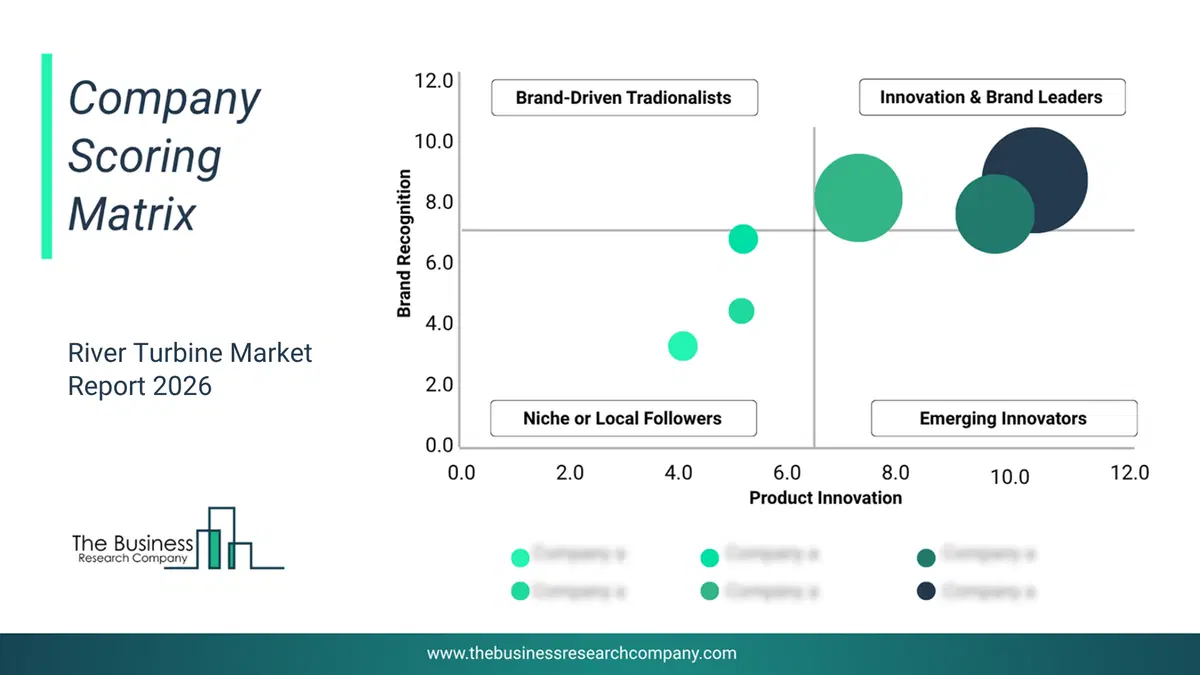
This chart maps companies by product innovation and brand strength, with bubble size indicating relative revenue, helping identify market leaders, challengers, and niche players. This is an illustrative chart; the full report provides a complete and accurate competitive analysis.
Global River Turbine Market Trends and Insights
Major companies operating in the river turbine market are focusing on developing technologically advanced solutions, such as high-efficiency in-stream turbines, to improve electricity output and enable cost-effective renewable energy generation from flowing water resources. High-efficiency in-stream turbines are advanced river turbine systems designed to maximize electricity generation by efficiently converting the kinetic energy of flowing water currents into renewable power with improved turbine performance, durability, and lower operational requirements. For instance, in November 2024, the Central Electricity Authority, an India-based statutory power-sector body, launched surface hydrokinetic turbine (SHKT) technology, an innovative river turbine solution designed for sustainable power generation from running water sources. The technology uses the kinetic energy of flowing rivers and canals to generate electricity without requiring dams, barrages, or major civil construction. It is designed as a modular and scalable system that can be deployed across different water environments, including rivers, irrigation canals, and renewable energy projects. The turbine technology supports decentralized electricity generation by enabling clean power production in remote and off-grid locations. It offers advantages such as lower environmental disruption, reduced infrastructure requirements, and continuous renewable energy generation compared with conventional hydropower systems.What Are Latest Mergers And Acquisitions In The River Turbine Market?
In December 2025, EnergyVision NV, a Belgium-based green energy company, acquired Turbulent for an undisclosed amount. With this acquisition, EnergyVision aims to diversify and strengthen its renewable energy generation portfolio by adding stable hydropower capacity, enhancing its clean energy mix, and expanding its ability to provide reliable renewable electricity solutions. Turbulent NV is a Belgium-based company that provides highly efficient, fish-friendly vortex river and canal turbines.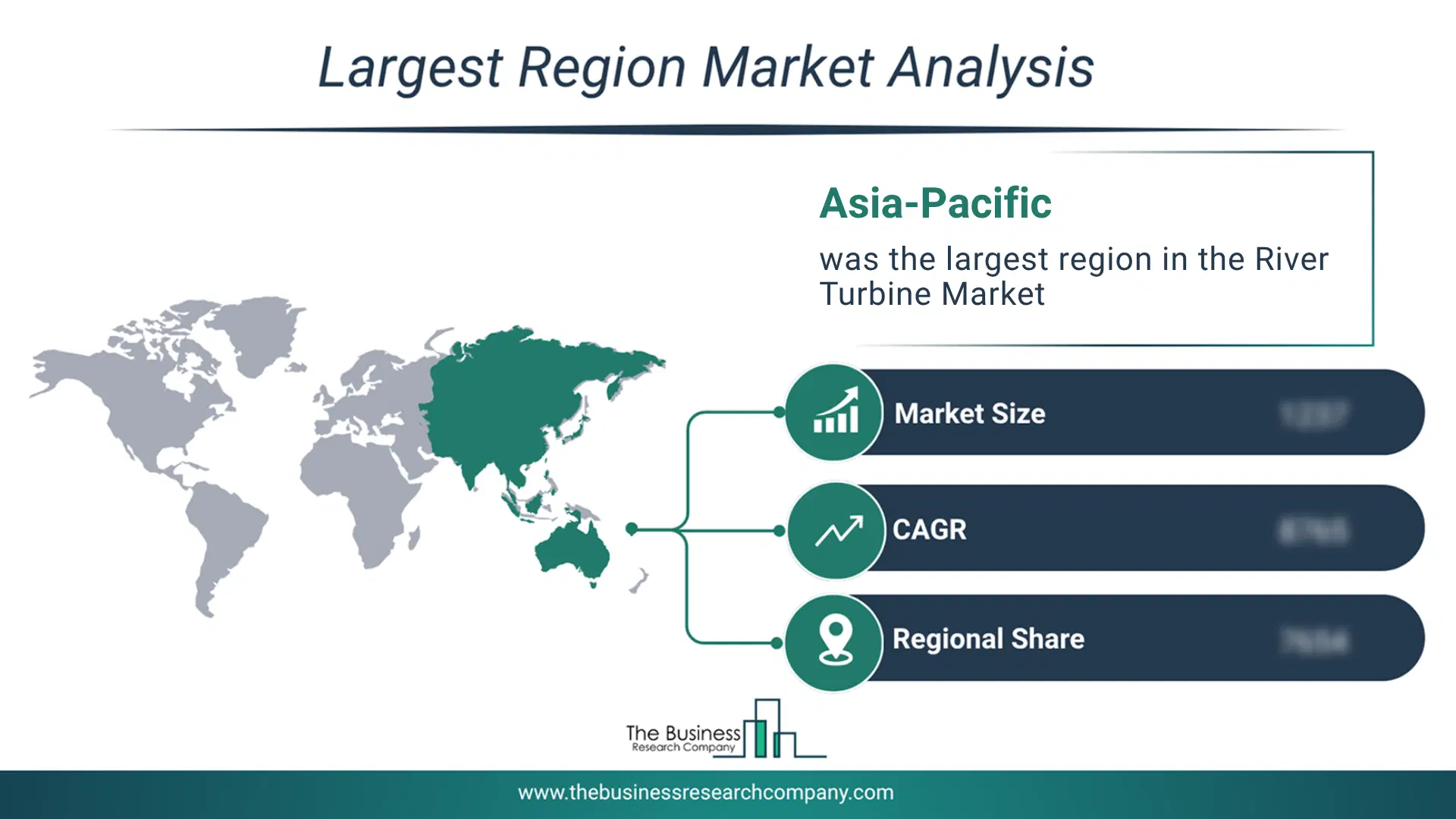
Regional Outlook
Asia-Pacific was the largest region in the river turbine market in 2025. Asia-Pacific is expected to be the fastest-growing region in the forecast period. The regions covered in this market report are Asia-Pacific, South East Asia, Western Europe, Eastern Europe, North America, South America, Middle East, Africa. The countries covered in this market report are Australia, Brazil, China, France, Germany, India, Indonesia, Japan, Taiwan, Russia, South Korea, UK, USA, Canada, Italy, Spain.What Defines the River Turbine Market?
The river turbine market consists of sales of crossflow turbines, kaplan turbines, francis turbines, pelton turbines, bulb turbines, propeller turbines, and hydro generators. Values in this market are ‘factory gate’ values, that is, the value of goods sold by the manufacturers or creators of the goods, whether to other entities (including downstream manufacturers, wholesalers, distributors, and retailers) or directly to end customers. The value of goods in this market includes related services sold by the creators of the goods.How is Market Value Defined and Measured?
The market value is defined as the revenues that enterprises gain from the sale of goods and/or services within the specified market and geography through sales, grants, or donations in terms of the currency (in USD unless otherwise specified). The revenues for a specified geography are consumption values that are revenues generated by organizations in the specified geography within the market, irrespective of where they are produced. It does not include revenues from resales along the supply chain, either further along the supply chain or as part of other products.
This chart presents market attractiveness based on a quantitative evaluation of growth, competition, strategic alignment, and risk, offering a clear view of opportunity areas for decision-making. This chart is for illustrative purposes; the full report contains the complete analysis.

This chart highlights the Total Addressable Market (TAM) by estimating the maximum revenue opportunity using an assumption-driven approach, supporting strategic planning and opportunity sizing across markets. The chart is illustrative; the full report provides a more comprehensive analysis.
What Key Data and Analysis Are Included in the River Turbine Market Report 2026?
The river turbine market research report is one of a series of new reports from The Business Research Company that provides market statistics, including industry global market size, regional shares, competitors with the market share, detailed market segments, market trends and opportunities, and any further data you may need to thrive in the river turbine industry. The market research report delivers a complete perspective of everything you need, with an in-depth analysis of the current and future state of the industry.River Turbine Market Report Forecast Analysis
| Report Attribute | Details |
|---|---|
| Market Size Value In 2026 | $1.23 billion |
| Revenue Forecast In 2030 | $1.81 billion |
| Growth Rate | CAGR of 10.2% from 2026 to 2030 |
| Base Year For Estimation | 2025 |
| Actual Estimates/Historical Data | 2020-2025 |
| Forecast Period | 2026 - 2030 |
| Market Representation | Revenue in USD Billion and CAGR from 2026 to 2030 |
| Segments Covered | Product Type, Capacity, Water Flow Condition, Application, End User |
| Regional Scope | Asia-Pacific, Western Europe, Eastern Europe, North America, South America, Middle East, Africa |
| Country Scope | The countries covered in the report are Australia, Brazil, China, France, Germany, India, Indonesia, Japan, Taiwan, Russia, South Korea, UK, USA, Canada, Italy, Spain. |
| Key Companies Profiled | GE Vernova Inc, Voith GmbH & Co. KGaA, ANDRITZ AG, Dongfang Electric Corporation Limited, Toshiba Energy Systems & Solutions Corporation, Harbin Electric Corporation Co. Ltd., Hitachi Mitsubishi Hydro Corporation, Zhefu Holding Group Co. Ltd., Power Machines Public Joint Stock Company, Fuji Electric Co. Ltd., Tyazhmash Public Joint Stock Company, FLOVEL Energy Private Limited, Gilbert Gilkes & Gordon Ltd, Litostroj Power d.o.o., Canyon Industries Inc, Natel Energy Inc, Verdant Power Inc, Ocean Renewable Power Company Inc, Turbulent BV, Instream Energy Systems Corporation |
| Customization Scope | Request for Customization |
| Pricing And Purchase Options | Explore Purchase Options |