
Roadside Windbreak Systems Market Report 2026
Global Outlook – By Product Type ( Living Windbreaks, Artificial Windbreaks, Modular Windbreak Panels, Other Product Types), By Installation Type ( Permanent, Temporary), By Material ( Wood, Metal, Synthetic Materials, Other Materials), By Application ( Highways, Railways, Urban Roads, Rural Roads, Other Applications), By End User ( Government, Private, Commercial, Other End Users) – Market Size, Trends, Strategies, and Forecast to 2030
Roadside Windbreak Systems Market Overview
• Roadside Windbreak Systems market size has reached to $2.21 billion in 2025 • Expected to grow to $3.16 billion in 2030 at a compound annual growth rate (CAGR) of 7.4% • Growth Driver: Rising Investments In Transportation Infrastructure Projects Are Fueling The Growth Of The Market Due To Enhancing Road Safety, Reducing Wind-Related Disruptions, And Improving The Resilience Of Transport Networks • North America was the largest region in 2025 and Asia-Pacific is the fastest growing region.What Is Covered Under Roadside Windbreak Systems Market?
Roadside windbreak systems are engineered barrier structures installed along highways and roads to reduce the impact of strong winds and control snow drifting. These systems help improve road safety, visibility, and driving conditions in areas exposed to harsh weather. Roadside windbreak systems are typically made from durable materials and are designed based on environmental and geographical conditions. The main product types of roadside windbreak systems include living windbreaks, artificial windbreaks, modular windbreak panels, and other product types. Living windbreaks refer to vegetation-based systems designed to reduce wind speed and improve safety and environmental protection along roadsides. They are categorized by installation type including permanent and temporary and are made using materials such as wood, metal, synthetic materials, and other materials. The key applications of highways, railways, urban roads, rural roads, and others, while the end-user includes government, private, commercial, and others.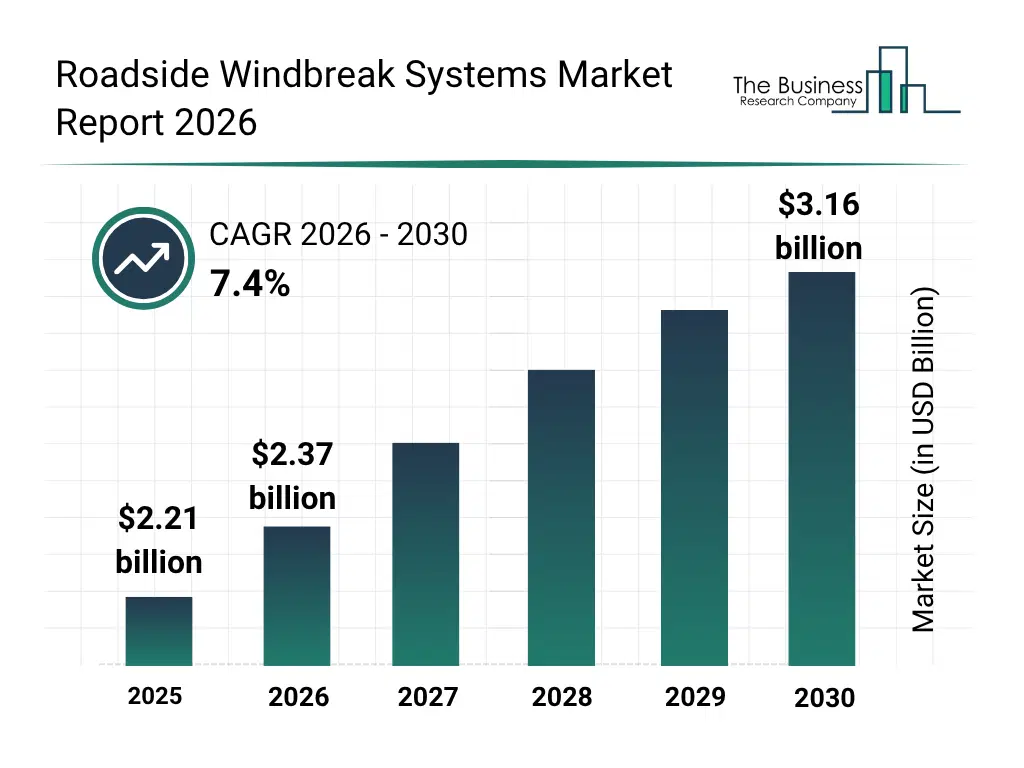
What Is The Roadside Windbreak Systems Market Size and Share 2026?
The roadside windbreak systems market size has grown strongly in recent years. It will grow from $2.21 billion in 2025 to $2.37 billion in 2026 at a compound annual growth rate (CAGR) of 7.2%. The growth in the historic period can be attributed to lack of structured roadside wind protection systems, increasing road accidents due to low visibility in snow-prone regions, limited infrastructure investment in rural highways, dependence on natural vegetation for wind control, minimal use of engineered barrier systems in transport infrastructure.What Is The Roadside Windbreak Systems Market Growth Forecast?
The roadside windbreak systems market size is expected to see strong growth in the next few years. It will grow to $3.16 billion in 2030 at a compound annual growth rate (CAGR) of 7.4%. The growth in the forecast period can be attributed to growth in smart highway and intelligent transportation systems, rising climate variability and extreme weather events, expansion of road infrastructure in cold and high-wind regions, increasing focus on road safety and accident reduction policies, adoption of sustainable and recyclable infrastructure materials. Major trends in the forecast period include increasing deployment of modular and prefabricated windbreak barrier systems for highways, growing adoption of hybrid living and artificial windbreak solutions for environmental stability, rising demand for recyclable and sustainable materials in roadside infrastructure, expansion of temporary windbreak systems for construction and seasonal deployment, integration of advanced aerodynamic design for improved snow and wind control efficiency.
Global Roadside Windbreak Systems Market Segmentation
1) By Product Type: Living Windbreaks, Artificial Windbreaks, Modular Windbreak Panels, Other Product Types 2) By Installation Type: Permanent, Temporary 3) By Material: Wood, Metal, Synthetic Materials, Other Materials 4) By Application: Highways, Railways, Urban Roads, Rural Roads, Other Applications 5) By End User: Government, Private, Commercial, Other End Users Subsegments: 1) By Living Windbreaks: Tree Based Windbreaks, Shrub Based Windbreaks, Mixed Vegetation Windbreaks, Native Species Windbreaks, Multi Row Shelterbelts 2) By Artificial Windbreaks: Fabric Windbreak Systems, Plastic Barrier Windbreaks, Metal Barrier Windbreaks, Concrete Windbreak Structures, Composite Material Windbreaks 3) By Modular Windbreak Panels: Interlocking Panel Systems, Pre Engineered Panel Systems, Portable Panel Systems, Adjustable Height Panel Systems, Transparent Panel Systems 4) By Other Product Types: Hybrid Windbreak Systems, Temporary Netting Windbreaks, Inflatable Windbreak Structures, Recycled Material Windbreaks, Custom Designed Windbreak SystemsWhat Are The Drivers Of The Roadside Windbreak Systems Market?
The rising investments in transportation infrastructure projects are expected to propel the growth of the roadside windbreak system market going forward. Transportation infrastructure projects refer to the planning, design, construction, and maintenance of physical systems that enable the movement of people and goods from one location to another. Rising investment in transportation infrastructure is driven by rapid urbanization and population growth, increasing pressure on existing systems, prompting governments to expand capacity, reduce congestion, and ensure efficient movement of people and goods to sustain economic productivity. Roadside windbreak systems support transportation infrastructure projects by enhancing road safety, minimizing wind-related disruptions such as dust and snow drift, and protecting infrastructure assets, thereby ensuring more efficient and resilient transport networks. For instance, in October 2025, according to the Federal Highway Administration, a US-based government agency, funding for the National Highway Performance Program (NHPP) increased steadily, rising from about $28.4 billion in fiscal year 2022 to $29.0 billion in fiscal year 2023 and reaching $29.6 billion in fiscal year 2024, highlighting growing federal investment in transportation asset management. Therefore, the rising investments in transportation infrastructure projects are driving the growth of the roadside windbreak system industry. The rising frequency and economic impact of extreme weather events are expected to propel the growth of the roadside windbreak systems market going forward. The frequency and economic impact of extreme weather events describe how often severe climate events occur and the scale of financial damage they inflict on infrastructure and economies. The growing frequency and economic impact of extreme weather events are largely driven by climate change, as rising global temperatures intensify weather patterns and increase the likelihood of high-impact events occurring across multiple regions simultaneously. As extreme weather causes widespread damage to roadside infrastructure and transportation corridors, the need for protective systems such as windbreaks becomes increasingly critical to reduce wind-driven hazards, prevent road closures, and maintain safe passage under adverse conditions. For instance, in January 2024, according to the National Centers for Environmental Information (NCEI), a US-based government agency, in 2022, the U.S. faced 18 weather and climate disasters, each causing over $1 billion in damages, whereas in 2023, this number surged to 28, marking a significant rise in both frequency and financial impact of such events. Therefore, the rising frequency and economic impact of extreme weather events are driving the growth of the roadside windbreak systems industry. The rising road safety regulations and awareness are expected to propel the growth of the roadside windbreak systems market going forward. Rising road safety regulations and awareness refer to the growing implementation of government-mandated traffic safety laws, infrastructure standards, and public education campaigns aimed at reducing road accidents, injuries, and fatalities. These road safety regulations and awareness are rising primarily due to the persistently high number of road traffic deaths globally, which has compelled governments in developed nations to introduce stricter safety legislation, enforce infrastructure improvement mandates, and allocate increased funding toward protective roadside measures. The strengthening of road safety regulations and awareness directly increases the adoption of physical roadside protective structures that shield drivers and infrastructure from wind-related hazards, poor visibility, and adverse weather conditions on highways and expressways. For instance, in December 2025, according to the National Conference of State Legislatures, a US-based nonpartisan public officials' association, state legislatures remain highly active in advancing traffic safety laws, with 44 states enacting nearly 270 related bills in 2024. Key areas of focus included aggressive driving, automated enforcement, driver licensing, and impaired driving, as well as bicyclist and school bus safety. Therefore, rising road safety regulations and awareness are driving the growth of the roadside windbreak systems industry.Key Players In The Global Roadside Windbreak Systems Market
Major companies operating in the roadside windbreak systems market are Nippon Steel Metal Products Co. Ltd., JFE Metal Products Corporation, Officine Maccaferri S.p.A., Geobrugg AG, Groupe Lebel inc., Tenax Corporation, Green (Tianjin) Technology Development Company Ltd., WeatherSolve Structures Inc., Walcoom Corp.Regional Outlook
North America was the largest region in the roadside windbreak systems market in 2025. Asia-Pacific is expected to be the fastest-growing region in the forecast period.The regions covered in this market report are Asia-Pacific, South East Asia, Western Europe, Eastern Europe, North America, South America, Middle East, Africa. The countries covered in this market report are Australia, Brazil, China, France, Germany, India, Indonesia, Japan, Taiwan, Russia, South Korea, UK, USA, Canada, Italy, Spain.What Defines the Roadside Windbreak Systems Market?
The roadside windbreak systems market consists of sales of snow fencing systems, drift control barriers, roadside snow retention structures, and wind flow deflection systems. Values in this market are ‘factory gate’ values, that is, the value of goods sold by the manufacturers or creators of the goods, whether to other entities (including downstream manufacturers, wholesalers, distributors, and retailers) or directly to end customers. The value of goods in this market includes related services sold by the creators of the goods.How is Market Value Defined and Measured?
The market value is defined as the revenues that enterprises gain from the sale of goods and/or services within the specified market and geography through sales, grants, or donations in terms of the currency (in USD unless otherwise specified). The revenues for a specified geography are consumption values that are revenues generated by organizations in the specified geography within the market, irrespective of where they are produced. It does not include revenues from resales along the supply chain, either further along the supply chain or as part of other products.What Key Data and Analysis Are Included in the Roadside Windbreak Systems Market Report 2026?
The roadside windbreak systems market research report is one of a series of new reports from The Business Research Company that provides roadside windbreak systems market statistics, including roadside windbreak systems industry global market size, regional shares, competitors with a roadside windbreak systems market share, detailed roadside windbreak systems market segments, market trends and opportunities, and any further data you may need to thrive in the roadside windbreak systems industry. This roadside windbreak systems market research report delivers a complete perspective of everything you need, with an in-depth analysis of the current and future scenario of the industry.Roadside Windbreak Systems Market Report Forecast Analysis
| Report Attribute | Details |
|---|---|
| Market Size Value In 2026 | $2.37 billion |
| Revenue Forecast In 2030 | $3.16 billion |
| Growth Rate | CAGR of 7.4% from 2026 to 2030 |
| Base Year For Estimation | 2025 |
| Actual Estimates/Historical Data | 2020-2025 |
| Forecast Period | 2026 - 2030 |
| Market Representation | Revenue in USD Billion and CAGR from 2026 to 2030 |
| Segments Covered | Product Type, Installation Type, Material, Application, End User |
| Regional Scope | Asia-Pacific, Western Europe, Eastern Europe, North America, South America, Middle East, Africa |
| Country Scope | The countries covered in the roadside windbreak systems market report are Australia, Brazil, China, France, Germany, India, Indonesia, Japan, Taiwan, Russia, South Korea, UK, USA, Canada, Italy, Spain. |
| Key Companies Profiled | Nippon Steel Metal Products Co. Ltd., JFE Metal Products Corporation, Officine Maccaferri S.p.A., Geobrugg AG, Groupe Lebel inc., Tenax Corporation, Green (Tianjin) Technology Development Company Ltd., WeatherSolve Structures Inc., Walcoom Corp. |
| Customization Scope | Request for Customization |
| Pricing And Purchase Options | Explore Purchase Options |