

Robo Advisory Market 2026
By Service Type (Direct Plan Based/Goal Based, Comprehensive Wealth Advisory), By Business Model (Pure Robo Advisors, Hybrid Robo Advisors), By End-User (Retail Investors, High Net Worth Individuals, Other End Users), By Provider (Fintech Robo Advisors, Banks, Traditional Wealth Managers, Other Providers), And By Region, Opportunities And Strategies – Global Forecast To 2035
Robo Advisory Market Definition
Robo advisory is a digital platform service that provides automated, algorithm-driven financial planning and investment services, with little to no human supervision. It uses computer algorithms to build and manage investment portfolios based on your goals and risk tolerance. The robo advisory market consists of sales of robo advisory services by entities (organizations, sole traders and partnerships), also known as robo advisors, that provide financial guidance and advisory services. Robo advisors specialize in the use of computer algorithms and technology to offer personalized investment advice, portfolio management and financial planning, based on user inputs such as financial goals, risk tolerance, investment horizon and financial situation.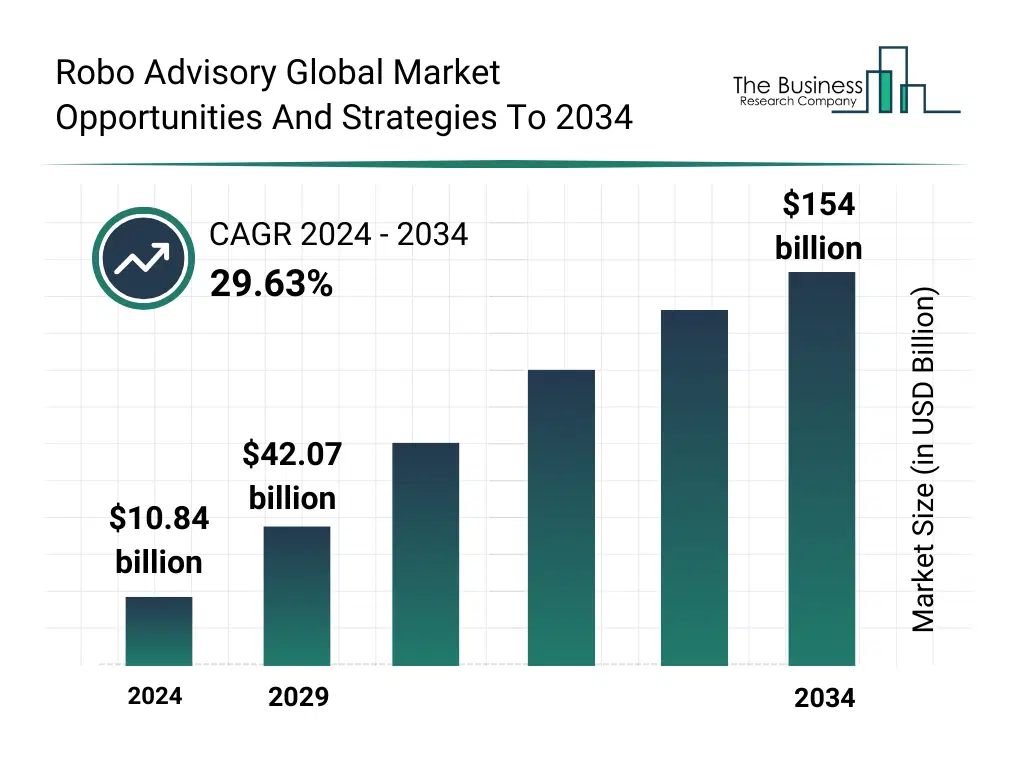
Robo Advisory Market Size
The global robo advisory market reached a value of nearly $10,842.03 million in 2024, having grown at a compound annual growth rate (CAGR) of 32.51% since 2019. The market is expected to grow from $10,842.03 million in 2024 to $42,065.37 million in 2029 at a rate of 31.15%. The market is then expected to grow at a CAGR of 29.63% from 2029 and reach $154,002.23 million in 2034. Growth in the historic period resulted from advancements in artificial intelligence and machine learning, rising adoption of digital financial platforms, expansion of the financial services sector and growing awareness of investment and financial planning. Factors that negatively affected growth in the historic period was data security and privacy concerns and limited product scope and customization. Going forward, increasing penetration of smartphones, increasing demand for personalized and goal-based investment strategies, surge in demand for ESG (environmental, social, governance) and sustainable investing options and growing demand for cost-effective investment solutions will drive the growth. Factors that could hinder the growth of the robo advisory market in the future include lack of human interaction and trust issues, regulatory and compliance challenges and trade war and tariffs.Robo Advisory Market Drivers
The key drivers of the robo advisory market include: Increasing Penetration Of Smartphones During forecast period, the increasing penetration of smartphones is expected to propel the growth of the robo advisory market. As smartphones become more affordable and accessible, a larger share of the global population can engage with digital financial services. Robo-advisory platforms benefit from this trend by offering seamless mobile access, user-friendly interfaces, and real-time portfolio management through dedicated apps. Increased smartphone adoption also supports greater financial inclusion, particularly among younger, tech-savvy investors who prefer digital solutions over traditional advisory services. This shift toward mobile-based investment management is expected to enhance customer engagement and accelerate market growth. The increasing penetration of smartphones growth contribution during the forecast period in 2024 is 1.50%.Robo Advisory Market Restraints
The key restraints on the robo advisory market include: Lack Of Human Interaction And Trust Issues Lack of human interaction and trust issues is expected to hinder the growth of the robo advisory market in forecast period. Many investors still prefer personalized guidance from human advisors, especially for complex financial decisions that require empathy and nuanced judgment. The fully digital nature of robo-advisors can make some users skeptical about data security, algorithmic transparency, and the reliability of automated recommendations. This trust deficit is more pronounced among older or less tech-savvy investors who value direct communication and reassurance. Consequently, these concerns may slow adoption rates and limit the market’s expansion despite the technological advantages of robo-advisory platforms. Growth affected by lack of human interaction and trust issues across regions during the forecast period in 2024 is -2.50%.Robo Advisory Market Trends
Major trends shaping the robo advisory market include: Expanding Access To Personalized Wealth Management Through AI-Driven Hybrid Models Major companies operating in the robo advisory market are focusing on advancing hybrid wealth management models that combine artificial intelligence (AI) with human expertise to enhance personalization, automate portfolio optimization, and expand accessibility for mass affluent investors. For instance, in June 2025, Kristal, a Singapore-based investment management company, has launched a $30 million Series B funding round to accelerate expansion and advance its robo-advisory and agentic artificial intelligence (AI) technology. The platform leverages AI to deliver personalized portfolio management, 24/7 monitoring, and automatic rebalancing for clients with $100K–$5M in assets bringing private banking-level insights to mass affluent investors. For relationship managers, Kristal’s AI tools enhance productivity by automating client engagement and investment analysis. The funds support growth across India, the Middle East, and Southeast Asia, solidifying Kristal’s position as a leading innovator in hybrid, AI-powered wealth management. Integrating AI And Premium Services To Build Comprehensive Digital Wealth Ecosystems Major companies operating in the robo advisory market are focusing on expanding their service ecosystems through integrated digital wealth platforms that combine automated portfolio management, AI-driven insights, and premium financial services such as private banking, estate planning, and tax optimization to attract and retain high-value clients. For instance, in March 2025, Robinhood Markets Inc., a US-based financial services company, has launched Robinhood Strategies, a new robo-advisor platform offering automated, actively managed portfolios of stocks and ETFs (exchange-traded funds) with low, capped fees, free for gold members with over $100,000 invested. The service tailors allocations based on risk tolerance and time horizon, using quantitative and qualitative analysis for portfolio construction. Robinhood also announced Robinhood Banking, a private banking service for gold members featuring high-yield cash accounts, estate planning, and tax advice, alongside luxury lifestyle perks. Additionally, Robinhood Cortex, an AI-powered investment assistant, will offer real-time market insights and trade ideas. Together, these launches expand Robinhood’s ecosystem into full-service digital wealth and private banking.Opportunities And Recommendations In The Robo Advisory Market
Opportunities – The top opportunities in the circular economy market segmented by type will arise in the electronic waste segment, which will gain $107,628.32 million of global annual sales by 2029. The top opportunities in the circular economy market segmented by enterprise size will arise in the large enterprises segment, which will gain $195,525.77 million of global annual sales by 2029. The top opportunities in the circular economy market segmented by industry vertical will arise in the waste management and recycling segment, which will gain $87,894.85 million of global annual sales by 2029. The circular economy market size will gain the most in the USA at $65,699.87 million. Recommendations- To take advantage of the opportunities, The Business Research Company recommends the robo advisory companies to focus on advancing hybrid advisory models to expand personalized wealth management, focus on building integrated digital wealth ecosystems to attract high-value clients, focus on expanding inclusive ai-driven wealth platforms to broaden market reach, focus on expanding comprehensive wealth advisory to capture the fastest-growing segment, focus on scaling hybrid robo advisory models to capture the largest and fastest-growing segment, focus on expanding omnichannel distribution to increase platform reach, focus on expanding omnichannel distribution to increase platform reach, focus on capturing growth in the traditional wealth managers segment, expand in emerging markets, continue to focus on developed markets, provide competitively priced offerings, continue to use b2b promotions, focus on strengthening people strategies for high net worth clients.
Robo Advisory Market Segmentation
The robo advisory market is segmented by service type, by provider, by business model and by end user.By Service Type –
The Robo Advisory market is segmented by service type into:
- a) Direct Plan Based/Goal Based
- b) Comprehensive Wealth Advisory
By Business Model –
The Robo Advisory market is segmented by business model into:
- a) Pure Robo Advisors
- b) Hybrid Robo Advisors
By End User –
The Robo Advisory market is segmented by end user into:
- a) Retail Investors
- b) High Net Worth Individuals
- c) Other End Users
By Provider –
The Robo Advisory market is segmented by provider into:
- a) Fintech Robo Advisors
- b) Banks
- c) Traditional Wealth Managers
- d) Other Providers
- e) Automotive And Transportation
By Geography - The robo advisory market is segmented by geography into:
- • China
- • India
- • Japan
- • Australia
- • Indonesia
- • South Korea
- • USA
- • Canada
- • Brazil
- • France
- • Germany
- • UK
- • Italy
- • Spain
- • Russia
-
o Asia Pacific
o Africa