Contact Us
  Search
The Business Research Company Logo
Robo Taxis Market 2025
Published :May 2025
Pages :330
Format :PDF
Delivery Time :2-3 Business Days
Why 2-3 days? We update the report with the latest data and news before delivery. Let us know if you need us to expedite.
Report Price :$4,490.00

Robo Taxis Market 2025

By Type (L4 Robo-Taxi, L5 Robo-Taxi), By Vehicle Type (Car, Shuttle/Van), By Service (Rental-Based, Station-Based), By Propulsion (Electric Vehicle, Fuel Cell Vehicle, Hybrid Electric Vehicle), By Application (Goods Transportation, Passenger Transportation), And By Region, Opportunities And Strategies – Global Forecast To 2035

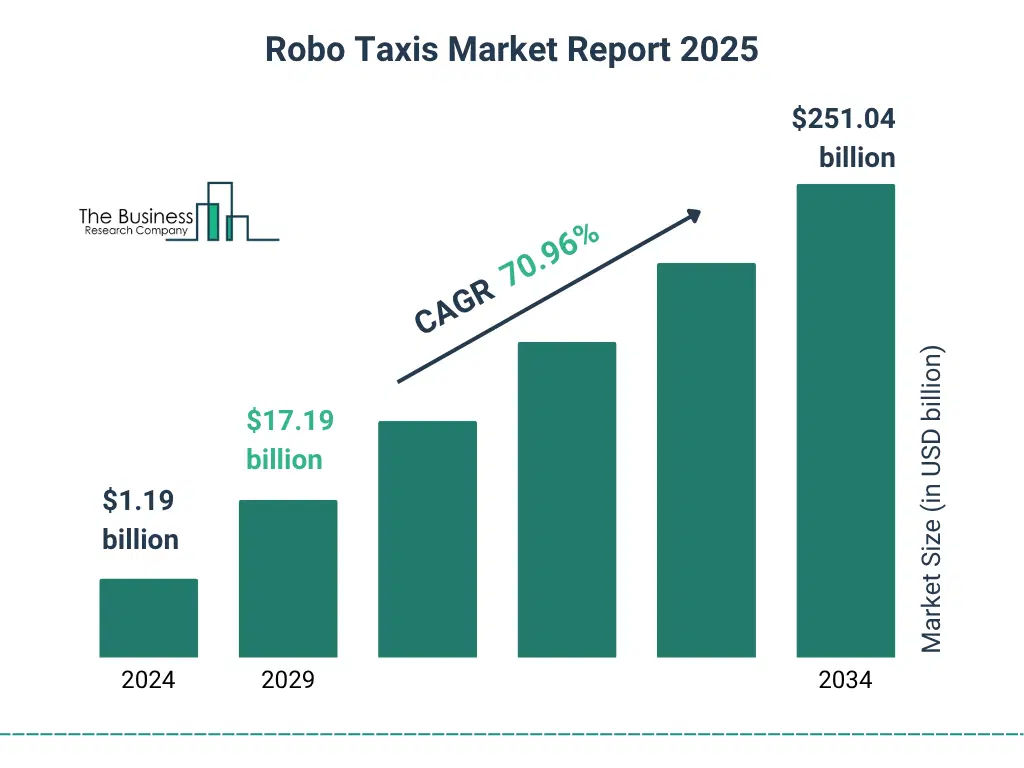
Robo Taxis Market Size and growth rate 2025 to 2029: Graph

Robo Taxis Market Definition

Robo taxis also known as autonomous taxis or self-driving taxis, are vehicles that provide transportation services without a human driver. These vehicles leverage advanced artificial intelligence (AI), sensors and connectivity technologies to navigate roads and transport passengers or goods safely and efficiently. The robo taxis market consists of sales by entities (organizations, sole traders and partnerships) of robo taxis product and services that are designed to operate in urban environments, suburban areas and designated autonomous vehicle zones, offering an alternative to traditional ride-hailing and taxi services. They are primarily used by commuters, travelers, logistics companies and businesses looking for efficient and cost-effective transportation solutions.
Research Expert

Book your 30 minutes free consultation with our research experts

> Robo Taxis Market Size

The global robo taxis market reached a value of nearly $1,188.03 million in 2024. The market is expected to grow from $1,188.03 million in 2024 to $17,188.12 million in 2029 at a rate of 70.64%. The market is then expected to grow at a CAGR of 70.96% from 2029 and reach $2,51,035.85 million in 2034. Growth in the historic period resulted from the rise in adoption of electric vehicles, expansion of charging infrastructure, favorable government regulations and incentives and increasing consumer preference for shared mobility. Factors that negatively affected growth in the historic period were high initial investment and development costs and safety concerns and public skepticism about self-driving technology. Going forward, the rising number of connected vehicles, rising demand for ride-hailing services, rising traffic congestion in urban areas and rising adoption of automation in fleet management will drive the growth. Factor that could hinder the growth of the robo taxis market in the future include cybersecurity risks and data privacy issues and lack of infrastructure for autonomous vehicle operations.

Robo Taxis Market Drivers

The key drivers of the robo taxis market include: Rising Number Of Connected Vehicles The rising number of connected vehicles is expected to propel the robo taxis market going forward. Connected vehicles are automobiles equipped with internet access and advanced communication technologies that enable real-time data exchange with other vehicles, infrastructure and networks for enhanced safety, efficiency and convenience. The rising number of connected vehicles is driven by factors such as advancements in the Internet of Things (IoT), increasing consumer demand for smart mobility and regulatory support for vehicle-to-everything (V2X) communication, with IoT advancements playing a crucial role by enabling seamless data transmission and integration across automotive ecosystems. Robo-taxis contribute to this surge by leveraging autonomous driving technology and connectivity to offer efficient, driverless transportation solutions, further accelerating the adoption of connected vehicle networks. For instance, in October 2023, according to the Department for Science, Innovation and Technology (DSIT) UK-based ministerial department, the UK’s connected and automated mobility (CAM) sector, including self-driving vehicles, could reach a value of £42 billion ($54 billion) and create up to 38,000 jobs by 2035, with 40% of cars expected to have autonomous capabilities. Therefore, the rising number of connected vehicles is propelling the robo taxis market.

Robo Taxis Market Restraints

The key restraints on the robo taxis market include: Cybersecurity Risks And Data Privacy Issues The cybersecurity risks and data privacy issues are expected to hamper the robo taxis market going forward. Robo-taxis are hampered by cybersecurity risks and data privacy issues, as vulnerabilities in autonomous vehicle systems can lead to hacking threats, unauthorized data access and potential breaches compromising passenger safety and personal information. Consequently, cybersecurity risks and data privacy issues limit consumer trust, regulatory approvals and widespread adoption of self-driving technology. This challenge restrains market growth, as increased security concerns necessitate stricter regulations, higher compliance costs and continuous technological advancements to ensure robust protection against cyber threats. For example, in February 2024, according to Tata Elxsi, an India-based design and technology services company, autonomous vehicles remain highly connected through the internet and cellular networks, making them vulnerable to cyber threats such as hacking, data breaches and unauthorized access to real-time location data. A cyberattack on a robo-taxi could lead to system malfunctions, remote control takeover, tampering with sensor data, or even crashes, posing significant risks to passenger safety and public security. Therefore, cybersecurity risks and data privacy issues could hamper the robo taxis market's growth.

Need data on a specific region in this market?

Opportunities And Recommendations In The Robo Taxis Market

Opportunities – The top opportunities in the robo taxis market segmented by type will arise in the L4 robo-taxi segment, which will gain $15,151.08 millions of global annual sales by 2029. The top opportunities in the robo taxis market segmented by vehicle type will arise in the car segment, which will gain $13,605.93 millions of global annual sales by 2029. The top opportunities in the robo taxis market segmented by service will arise in the rental-based segment, which will gain $15,295.38 millions of global annual sales by 2029. The top opportunities in the robo taxis market segmented by propulsion will arise in the electric vehicle segment, which will gain $14,873.19 millions of global annual sales by 2029. The top opportunities in the robo taxis market segmented by application will arise in the passenger transportation segment, which will gain $13,822.42 millions of global annual sales by 2029. The robo taxis market size will gain the most in the USA at $6,188.40 million. Recommendations- To take advantage of the opportunities, The Business Research Company recommends the robo taxis focus on developing next-generation autonomous technology to enhance urban mobility, focus on expanding access and enhancing public trust, focus on developing fully autonomous robotaxis, focus on expanding fully autonomous ride-hailing services, expand in emerging markets, continue to focus on developed markets, focus on expanding strategic collaborations to enhance distribution channels, focus on optimizing pricing strategies for robo-taxi companies, focus on targeting early adopters and tech-savvy consumers, focus on collaboration with transportation and urban mobility stakeholders, focus on targeting urban commuters and tech-savvy individuals.
Chat with us