
Robot-Assisted Rehabilitation Treadmills Market Report 2026
Global Outlook – By Product Type (End-Effector Based Treadmills, Exoskeleton Based Treadmills, Gait Training Treadmills, Other Product Types), By Technology (Semi-Automated, Fully Automated), By Application (Neurological Rehabilitation, Orthopedic Rehabilitation, Geriatric Rehabilitation, Other Applications), By End-User (Hospitals, Rehabilitation Centers, Clinics, Home Care Settings, Other End-Users) – Market Size, Trends, Strategies, and Forecast to 2030
Robot-Assisted Rehabilitation Treadmills Market Overview
• Robot-Assisted Rehabilitation Treadmills market size has reached to $0.97 billion in 2025 • Expected to grow to $1.72 billion in 2030 at a compound annual growth rate (CAGR) of 12.1% • Growth Driver: Rising Prevalence Of Neurological Disorders Fueling The Growth Of The Market Due To The Need For Targeted Rehabilitation And Improved Motor Function Recovery • Market Trend: Empowering Rehabilitation With Advanced Anti-Gravity Support, Enhanced Gait Analysis, And Adaptive Mobility Assistance • North America was the largest region in 2025 and Asia-Pacific is the fastest growing region.What Is Covered Under Robot-Assisted Rehabilitation Treadmills Market?
Robot-assisted rehabilitation treadmills are advanced therapy systems that combine robotic support, sensors, and software to assist patients during gait training. They provide controlled, repetitive walking movements while adjusting support based on patient capability. These help patients recover mobility, strength, and coordination after neurological or orthopedic injuries. These systems improve rehabilitation outcomes, therapy consistency, and clinical efficiency. The main product types of robot-assisted rehabilitation treadmills are end-effector based treadmills, exoskeleton based treadmills, gait training treadmills, and others. End-effector based treadmills are robotic rehabilitation systems that guide patient foot movement to support repetitive gait training and neurological recovery. These systems operate using semi-automated and fully automated technologies, used in neurological rehabilitation, orthopedic rehabilitation, geriatric rehabilitation, and others, among end users including hospitals, rehabilitation centers, clinics, home care settings, and others.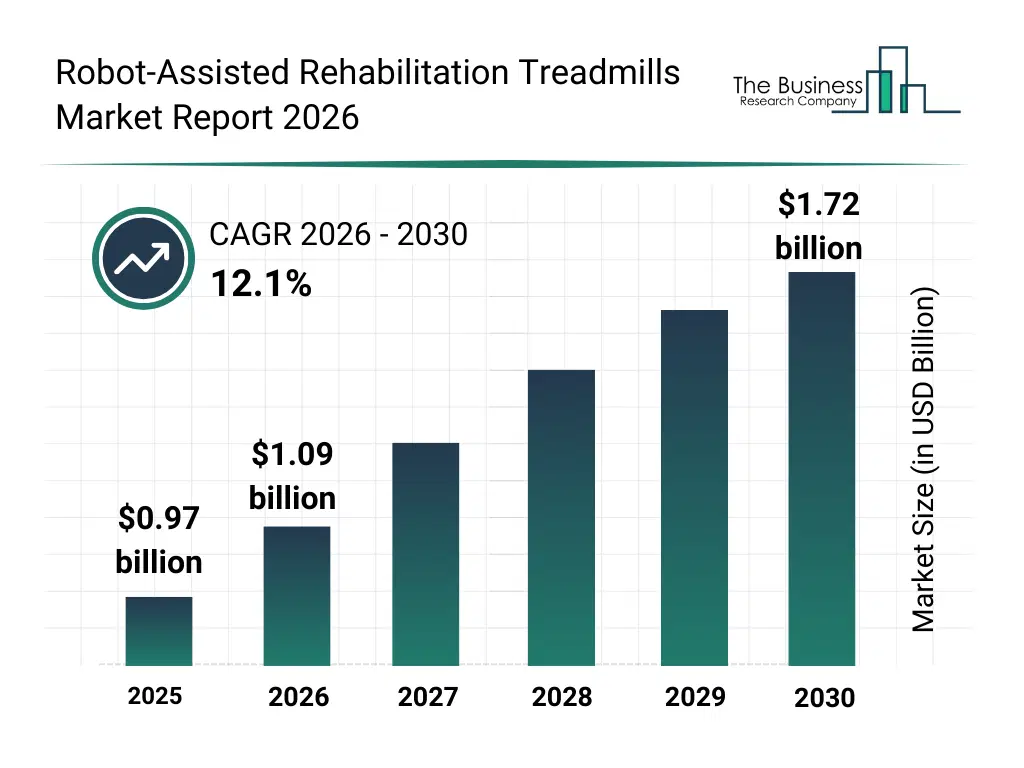
What Is The Robot-Assisted Rehabilitation Treadmills Market Size and Share 2026?
The robot-assisted rehabilitation treadmills market size has grown rapidly in recent years. It will grow from $0.97 billion in 2025 to $1.09 billion in 2026 at a compound annual growth rate (CAGR) of 12.4%. The growth in the historic period can be attributed to increasing adoption of robotic rehabilitation devices, growing prevalence of neurological disorders, rising demand for advanced physiotherapy solutions, expansion of rehabilitation centers, increasing focus on patient mobility restoration.What Is The Robot-Assisted Rehabilitation Treadmills Market Growth Forecast?
The robot-assisted rehabilitation treadmills market size is expected to see rapid growth in the next few years. It will grow to $1.72 billion in 2030 at a compound annual growth rate (CAGR) of 12.1%. The growth in the forecast period can be attributed to growing investment in medical robotics, increasing demand for technology-assisted rehabilitation, rising focus on personalized therapy solutions, expansion of outpatient rehabilitation services, growing elderly population requiring mobility support and Major trends in the forecast period include technology advancements in robotic gait training systems, innovations in sensor-integrated rehabilitation treadmills, developments in artificial intelligence-assisted rehabilitation, research and development in neurorehabilitation robotics, advancements in immersive rehabilitation technologies.

Global Robot-Assisted Rehabilitation Treadmills Market Segmentation
1) By Product Type: End-Effector Based Treadmills, Exoskeleton Based Treadmills, Gait Training Treadmills, Other Product Types 2) By Technology: Semi-Automated, Fully Automated 3) By Application: Neurological Rehabilitation, Orthopedic Rehabilitation, Geriatric Rehabilitation, Other Applications 4) By End-User: Hospitals, Rehabilitation Centers, Clinics, Home Care Settings, Other End-Users Subsegments: 1) By End-Effector Based Treadmills: Footplate Based Gait Systems, Distal Joint Guidance Systems, Force Feedback Assisted Platforms, Balance And Stability Training Platforms 2) By Exoskeleton Based Treadmills: Lower Limb Robotic Exoskeletons, Hip And Knee Joint Assisted Exoskeletons, Full Leg Support Robotic Frames, Wearable Motorized Gait Support Systems 3) By Gait Training Treadmills: Body Weight Support Treadmills, Robotic Assisted Speed Regulated Treadmills, Dynamic Gait And Posture Training Systems, Multidirectional Gait Correction Treadmills 4) By Other Product Types: Hybrid Gait Rehabilitation Systems, Robotic Balance Training Platforms, Neuromuscular Reeducation Devices, Specialized Rehabilitation Motion PlatformsWhat Is The Driver Of The Robot-Assisted Rehabilitation Treadmills Market?
The increasing prevalence of neurological disorders is expected to propel the growth of therobot-assisted rehabilitation treadmills market going forward. Neurological disorders are medical conditions that affect the brain, spinal cord, and nerves, disrupting normal nervous system function and leading to impairments in movement, cognition, sensation, behavior, or overall bodily control. The increasing prevalence of neurological disorders is due to unhealthy lifestyle habits, including poor diet, physical inactivity, smoking, excessive alcohol consumption, and chronic stress. Robot-assisted rehabilitation treadmills help in neurological disorder management by providing guided, repetitive gait training with real-time feedback and support. They improve patient outcomes by enhancing mobility, muscle strength, balance, and functional recovery during rehabilitation. For instance, in June 2025, according to Brain Research UK, a United Kingdom-based neurological charity, the prevalence of neurological conditions increased from 10.5?million people in 2024 to an estimated 11?million in 2025, marking a 4.8?% rise year over year. Therefore, the rising demand for targeted CNS drug delivery is driving the growth of the robot-assisted rehabilitation treadmills industry.Key Players In The Global Robot-Assisted Rehabilitation Treadmills Market
Major companies operating in the robot-assisted rehabilitation treadmills market are HIWIN Corp., Biodex Medical Systems Inc., Reha Technology AG, Guangzhou Longest Science & Technology Co. Ltd., Hocoma AG, Motek Medical B.V., Ekso Bionics Holdings Inc., Tyromotion GmbH, ReWalk Robotics Ltd., Meditouch Ltd., Woodway USA Inc., Restorative Therapies Inc., BAMA Teknoloji A.Ş., Aretech LLC, Bionik Laboratories Corp., Techno Concept Inc., Rex Bionics Plc, Rehab‑Robotics Company Limited, LokoHelp Group GmbH, ZARYA
This chart is for illustrative purposes; the full report includes a detailed competitor analysis and comprehensive overview of the top 10 companies in the market.

This chart maps companies by product innovation and brand strength, with bubble size indicating relative revenue, helping identify market leaders, challengers, and niche players. This is an illustrative chart; the full report provides a complete and accurate competitive analysis.
Global Robot-Assisted Rehabilitation Treadmills Market Trends and Insights
Major companies operating in the robot-assisted rehabilitation treadmills market are focusing on developing advanced products, such as anti-gravity body weight support systems, to improve patient mobility outcomes, accelerate recovery timelines, and enhance clinical rehabilitation protocols. Anti-gravity body weight support systems refer to integrated mechanisms that reduce the patient’s effective body weight during treadmill walking, allowing individuals with mobility impairments to engage in gait training with reduced risk of falls and less physical strain. For instance, in June 2024, ReWalk Robotics Ltd., an Israel-based provider of rehabilitation technology solutions, the AlterG NEO Anti-Gravity Treadmill. It is a cost-effective, user-friendly treadmill featuring the company's patented Differential Air Pressure (DAP) technology. This core technology provides precise and consistent unweighting, enabling safe rehabilitation and athletic training by reducing stress on injured joints and muscles. Its updated design and accessible price point are specifically intended to make the benefits of anti-gravity therapy available to a broader range of physical rehabilitation clinics and athletic training facilities.What Are Latest Mergers And Acquisitions In The Robot-Assisted Rehabilitation Treadmills Market?
In August 2023, ReWalk Robotics Ltd., an Israel-based provider of robotic mobility and neurorehabilitation solutions, acquired AlterG Inc. for approximately $19 million. With this acquisition, ReWalk aims to expand its rehabilitation technology portfolio by integrating AlterG’s anti-gravity treadmill systems, used in physical and neurological rehabilitation settings globally, thereby strengthening its capabilities in robot-assisted rehabilitation treadmills and broadening its market reach into clinic and home-based gait training solutions. AlterG Inc. is a US-based developer and manufacturer of anti-gravity treadmill systems that employ patented Differential Air Pressure technology to support mobility recovery and reduce the effects of gravity through robot‑assisted rehabilitation treadmills.
Regional Insights
North America was the largest region in the robot-assisted rehabilitation treadmills market in 2025. Asia-Pacific is expected to be the fastest-growing region in the forecast period. The regions covered in this market report are Asia-Pacific, South East Asia, Western Europe, Eastern Europe, North America, South America, Middle East, Africa. The countries covered in this market report are Australia, Brazil, China, France, Germany, India, Indonesia, Japan, Taiwan, Russia, South Korea, UK, USA, Canada, Italy, Spain.What Defines the Robot-Assisted Rehabilitation Treadmills Market?
The robot-assisted rehabilitation treadmills market consists of revenues earned by entities by providing services such as robot-assisted gait training services, robotic treadmill therapy sessions, neurorehabilitation support services, post-stroke mobility training services, and assisted physiotherapy rehabilitation services. The market value includes the value of related goods sold by the service provider or included within the service offering. The robot-assisted rehabilitation treadmills market also includes sales of robot-assisted rehabilitation treadmills, robotic gait training treadmills, body-weight support treadmill systems, robotic exoskeleton-integrated treadmills, and sensor-equipped rehabilitation treadmill units. Values in this market are ‘factory gate’ values, that is, the value of goods sold by the manufacturers or creators of the goods, whether to other entities (including downstream manufacturers, wholesalers, distributors, and retailers) or directly to end customers. The value of goods in this market includes related services sold by the creators of the goods.How is Market Value Defined and Measured?
The market value is defined as the revenues that enterprises gain from the sale of goods and/or services within the specified market and geography through sales, grants, or donations in terms of the currency (in USD unless otherwise specified). The revenues for a specified geography are consumption values that are revenues generated by organizations in the specified geography within the market, irrespective of where they are produced. It does not include revenues from resales along the supply chain, either further along the supply chain or as part of other products.
This chart presents market attractiveness based on a quantitative evaluation of growth, competition, strategic alignment, and risk, offering a clear view of opportunity areas for decision-making. This chart is for illustrative purposes; the full report contains the complete analysis.

This chart highlights the Total Addressable Market (TAM) by estimating the maximum revenue opportunity using an assumption-driven approach, supporting strategic planning and opportunity sizing across markets. The chart is illustrative; the full report provides a more comprehensive analysis.
What Key Data and Analysis Are Included in the Robot-Assisted Rehabilitation Treadmills Market Report 2026?
The robot-assisted rehabilitation treadmills market research report is one of a series of new reports from The Business Research Company that provides market statistics, including industry global market size, regional shares, competitors with the market share, detailed market segments, market trends and opportunities, and any further data you may need to thrive in the robot-assisted rehabilitation treadmills industry. The market research report delivers a complete perspective of everything you need, with an in-depth analysis of the current and future state of the industry.Robot-Assisted Rehabilitation Treadmills Market Report Forecast Analysis
| Report Attribute | Details |
|---|---|
| Market Size Value In 2026 | $1.09 billion |
| Revenue Forecast In 2030 | $1.72 billion |
| Growth Rate | CAGR of 12.1% from 2026 to 2030 |
| Base Year For Estimation | 2025 |
| Actual Estimates/Historical Data | 2020-2025 |
| Forecast Period | 2026 - 2030 |
| Market Representation | Revenue in USD Billion and CAGR from 2026 to 2030 |
| Segments Covered | Product Type, Technology, Application, End-User |
| Regional Scope | Asia-Pacific, Western Europe, Eastern Europe, North America, South America, Middle East, Africa |
| Country Scope | The countries covered in the report are Australia, Brazil, China, France, Germany, India, Indonesia, Japan, Taiwan, Russia, South Korea, UK, USA, Canada, Italy, Spain. |
| Key Companies Profiled | HIWIN Corp., Biodex Medical Systems Inc., Reha Technology AG, Guangzhou Longest Science & Technology Co. Ltd., Hocoma AG, Motek Medical B.V., Ekso Bionics Holdings Inc., Tyromotion GmbH, ReWalk Robotics Ltd., Meditouch Ltd., Woodway USA Inc., Restorative Therapies Inc., BAMA Teknoloji A.Ş., Aretech LLC, Bionik Laboratories Corp., Techno Concept Inc., Rex Bionics Plc, Rehab‑Robotics Company Limited, LokoHelp Group GmbH, ZARYA |
| Customization Scope | Request for Customization |
| Pricing And Purchase Options | Explore Purchase Options |