
Robot Charging Station Market Report 2026
Global Outlook – By Type (Fixed, Mobile), By Charging Type (Wired Charging, Wireless Charging, Fast Charging), By Connectivity (Wireless Fidelity (Wi-Fi), Bluetooth, Ethernet), By Application (Household Robots, Industrial Robots, Commercial Robots, Autonomous Delivery Robots), By End Use (Residential, Industrial, Commercial) – Market Size, Trends, Strategies, and Forecast to 2030
Robot Charging Station Market Overview
• Robot Charging Station market size has reached to $8.05 billion in 2025 • Expected to grow to $15.08 billion in 2030 at a compound annual growth rate (CAGR) of 13.4% • Growth Driver: Increasing Adoption Of Automation Fueling The Growth Of The Market Due To Rising Demand For Continuous Operation • Market Trend: Naas Launches First Automatic Charging Robot Driving Innovation In The Robot Charging Station • Asia-Pacific was the largest region in 2025.What Is Covered Under Robot Charging Station Market?
A robot charging station is a designated area or device where robots automatically recharge their batteries. These stations provide power through wired connections, wireless charging, or battery-swapping mechanisms, ensuring uninterrupted operation for autonomous robots, such as vacuum cleaners, drones, or industrial robots. The main types of robots charging stations are fixed and mobile. Fixed robot charging stations are stationary units permanently installed at specific locations where robots return to recharge. These stations support various charging types, including wired charging, wireless charging, and fast charging, utilizing different connectivity options, including wireless fidelity (Wi-Fi), bluetooth, and ethernet. They serve a range of applications, including household robots, industrial robots, commercial robots, and autonomous delivery robots, with end users spanning residential, industrial, and commercial.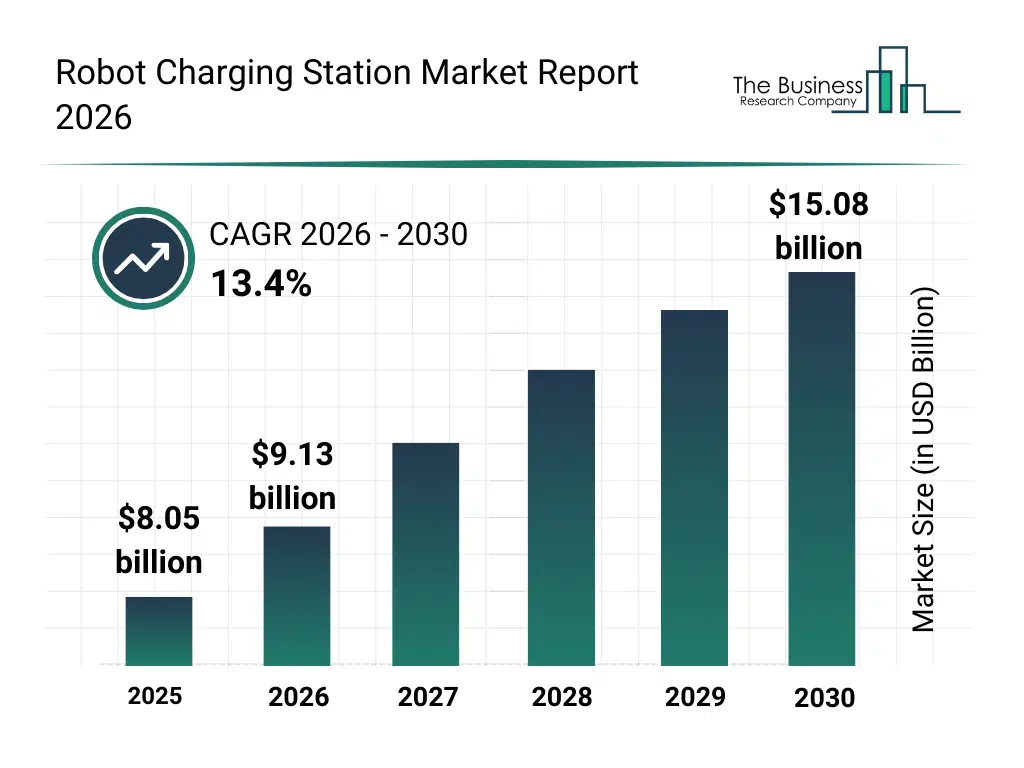
What Is The Robot Charging Station Market Size and Share 2026?
The robot charging station market size has grown rapidly in recent years. It will grow from $8.05 billion in 2025 to $9.13 billion in 2026 at a compound annual growth rate (CAGR) of 13.4%. The growth in the historic period can be attributed to growth of industrial automation, adoption of robotic vacuum cleaners, expansion of warehouse robotics, increasing use of agvs and amrs, need for continuous robot uptime.What Is The Robot Charging Station Market Growth Forecast?
The robot charging station market size is expected to see rapid growth in the next few years. It will grow to $15.08 billion in 2030 at a compound annual growth rate (CAGR) of 13.4%. The growth in the forecast period can be attributed to scaling of autonomous delivery robots, growth in smart factories, increasing deployment of service robots, demand for battery swapping solutions, investments in smart charging infrastructure. Major trends in the forecast period include rising adoption of autonomous robot fleets, growing demand for wireless and contactless charging, expansion of fast charging infrastructure for robots, integration of smart energy management systems, standardization of modular charging interfaces.Tariff Impact On Robot Charging Station Market
Tariffs have affected the robot charging station market by increasing the cost of imported power electronics, wireless charging modules, batteries, and control components used in advanced charging systems. These impacts are most significant in industrial and commercial robotics applications, particularly across asia-pacific and europe where component sourcing is globally distributed. Higher tariffs have raised system integration costs and slowed large-scale deployment of charging infrastructure. At the same time, tariffs have encouraged local manufacturing, regional supply chain development, and innovation in cost-efficient and standardized robot charging solutions.
Global Robot Charging Station Market Segmentation
1) By Type: Fixed, Mobile 2) By Charging Type: Wired Charging, Wireless Charging, Fast Charging 3) By Connectivity: Wireless Fidelity (Wi-Fi), Bluetooth, Ethernet 4) By Application: Household Robots, Industrial Robots, Commercial Robots, Autonomous Delivery Robots 5) By End Use: Residential, Industrial, Commercial Subsegments: 1) By Fixed Robot Charging Station: Wired Charging Station, Inductive (Wireless) Charging Station 2) By Mobile Robot Charging Station: Autonomous Mobile Charging Station, Docking-Based Charging StationWhat Is The Driver Of The Robot Charging Station Market?
The increasing adoption of automation across various industries is expected to drive the growth of the robot charging station market going forward. Industrial automation involves the integration of control systems, robotics, and advanced technologies to enhance productivity and efficiency in sectors such as manufacturing, logistics, and warehousing. The adoption of automation is increasing due to its ability to enhance efficiency, reduce operational costs, and boost productivity while allowing businesses to scale and maintain high-quality standards. Robot charging stations are useful for automation as they ensure continuous operation by autonomously recharging robots, minimizing downtime, and optimizing productivity without manual intervention. For instance, in September 2023, according to the International Federation of Robotics, a Germany-based professional non-profit organization, global industrial robot installations in factories reached 553,052 in 2023, marking a 5% year-on-year increase from 2022. Therefore, the increasing adoption of automation across various industries is driving the growth of the robot charging station industry.Key Players In The Global Robot Charging Station Market
Major companies operating in the robot charging station market are ABB Ltd, Hangzhou Hikrobot Technology Co. Ltd., Hai Robotics Co. Ltd., NaaS Technology Inc., Powermat Technologies Ltd., Clearpath Robotics Inc., EV Safe Charge Inc., SMP Robotics Systems Corp., ROCSYS B.V., WiBotic Inc., DF Automation and Robotics Sdn Bhd, EVS TECH CO. LTD, HEISHA Technology Co. Ltd., Mob-Energy S.A.S, Trossen Robotics LLC, Tusk Robots Inc., Wiferion GmbH, RobotLAB Inc., VOLTERIO GmbH, Autev AG
This chart is for illustrative purposes; the full report includes a detailed competitor analysis and comprehensive overview of the top 10 companies in the market.
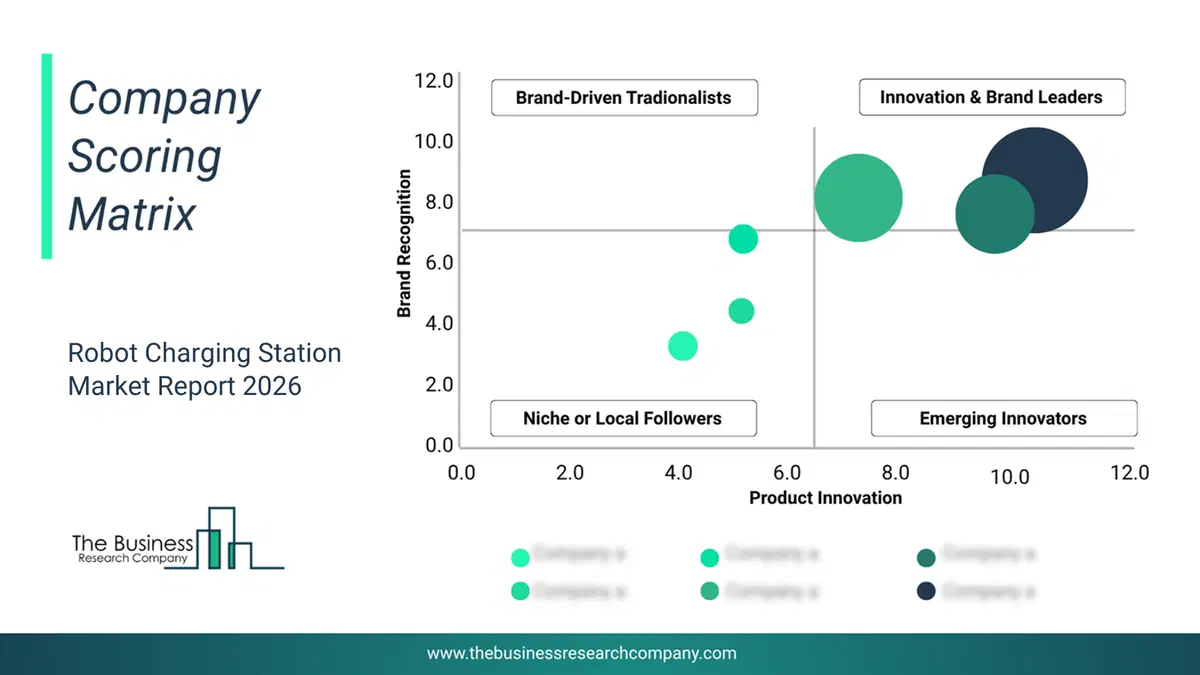
This chart maps companies by product innovation and brand strength, with bubble size indicating relative revenue, helping identify market leaders, challengers, and niche players. This is an illustrative chart; the full report provides a complete and accurate competitive analysis.
Global Robot Charging Station Market Trends and Insights
Major companies operating in the robot charging station market are focusing on developing advanced solutions such as automatic robotic arms to enhance efficiency and user experience. Automatic robotic arms are designed to autonomously locate electric vehicles, dock with charging ports, perform charging, and complete payment settlement without human intervention. For instance, in March 2023, NaaS Technology Inc., a China-based electric vehicle (EV) charging solutions company, launched its first self-developed automatic charging robot featuring active vehicle locating, smart charging, and automatic payment settlement. The robot employs deep learning, 5G, V2X, and simultaneous localization and mapping technologies, enabling precise self-parking, automatic docking and undocking, one-click ordering, and automatic return for recharging. It is waterproof, shockproof, and compatible with major EV OEMs through an open API, supporting various charging power and battery capacity configurations. The robot autonomously detects charging ports, plugs and unplugs charging guns, and facilitates fully unmanned operations. It also integrates with charging piles to provide value-added services like shopping, dining, and relaxation around charging stations.What Are Latest Mergers And Acquisitions In The Robot Charging Station Market?
In March 2024, Rocsys B.V., a Netherlands-based manufacturer of hands-free and robotic charging station solutions for electric autonomous vehicles, partnered with Autocar to pilot hands-free charging for electric terminal tractors. This collaboration aims to enhance fleet productivity and sustainability by automating the charging process, eliminating the need for manual intervention. Autocar is a US-based company specializing in the manufacture of severe-duty vocational trucks.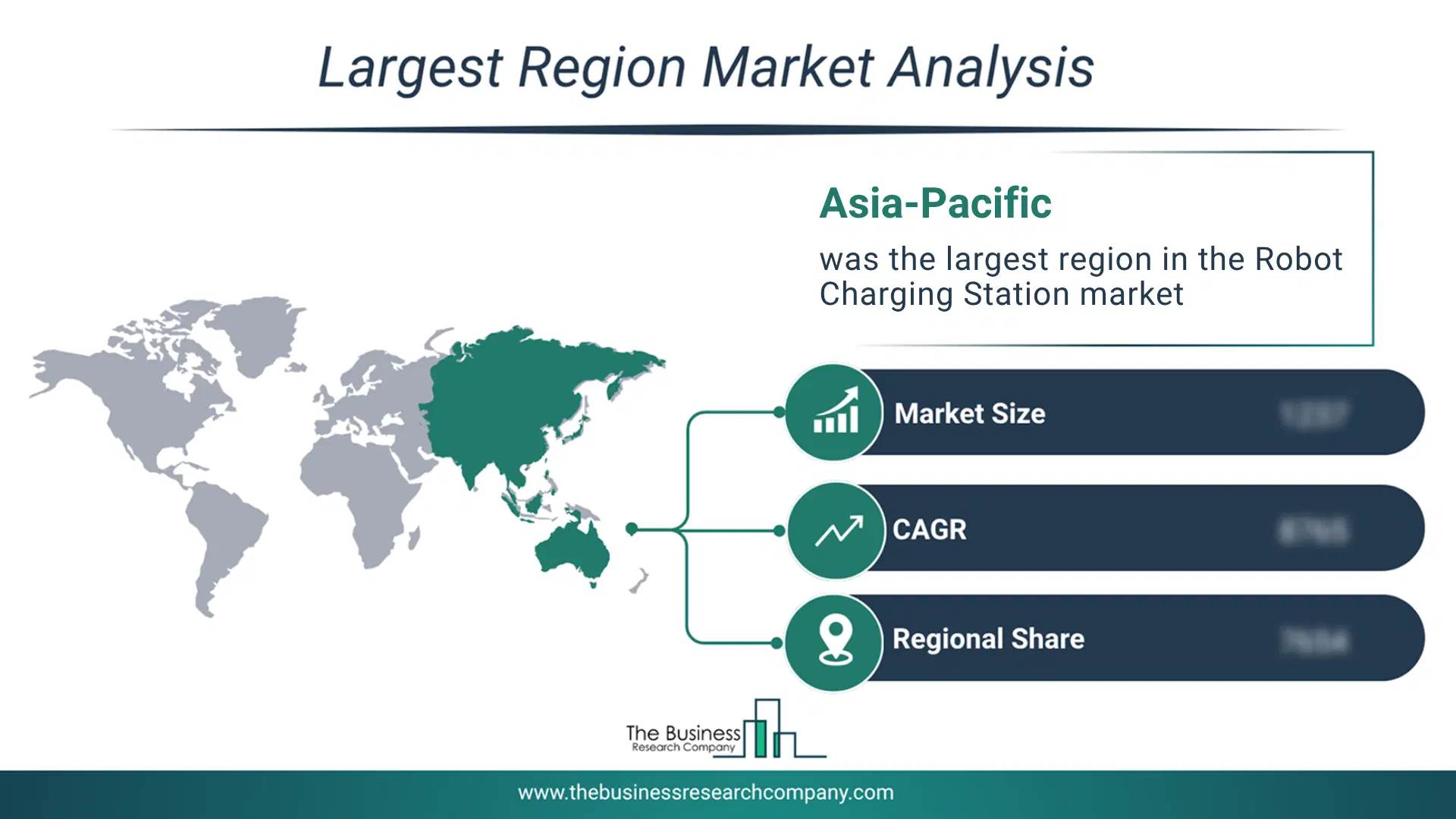
Regional Outlook
Asia-Pacific was the largest region in the robot charging station market in 2025. The regions covered in this market report are Asia-Pacific, South East Asia, Western Europe, Eastern Europe, North America, South America, Middle East, Africa The countries covered in this market report are Australia, Brazil, China, France, Germany, India, Indonesia, Japan, Taiwan, Russia, South Korea, UK, USA, Canada, Italy, Spain.What Defines the Robot Charging Station Market?
The robot charging station market consists of sales of charging docks, wireless or contact-based charging systems, robotic arm charging units, mobile robot charging carts, and portable charging stations. Values in this market are ‘factory gate’ values, that is, the value of goods sold by the manufacturers or creators of the goods, whether to other entities (including downstream manufacturers, wholesalers, distributors, and retailers) or directly to end customers. The value of goods in this market includes related services sold by the creators of the goods.How is Market Value Defined and Measured?
The market value is defined as the revenues that enterprises gain from the sale of goods and/or services within the specified market and geography through sales, grants, or donations in terms of the currency (in USD unless otherwise specified). The revenues for a specified geography are consumption values that are revenues generated by organizations in the specified geography within the market, irrespective of where they are produced. It does not include revenues from resales along the supply chain, either further along the supply chain or as part of other products.
This chart presents market attractiveness based on a quantitative evaluation of growth, competition, strategic alignment, and risk, offering a clear view of opportunity areas for decision-making. This chart is for illustrative purposes; the full report contains the complete analysis.

This chart highlights the Total Addressable Market (TAM) by estimating the maximum revenue opportunity using an assumption-driven approach, supporting strategic planning and opportunity sizing across markets. The chart is illustrative; the full report provides a more comprehensive analysis.
What Key Data and Analysis Are Included in the Robot Charging Station Market Report 2026?
The robot charging station market research report is one of a series of new reports from The Business Research Company that provides market statistics, including industry global market size, regional shares, competitors with the market share, detailed market segments, market trends and opportunities, and any further data you may need to thrive in the robot charging station industry. The market research report delivers a complete perspective of everything you need, with an in-depth analysis of the current and future state of the industry.Robot Charging Station Market Report Forecast Analysis
| Report Attribute | Details |
|---|---|
| Market Size Value In 2026 | $9.13 billion |
| Revenue Forecast In 2030 | $15.08 billion |
| Growth Rate | CAGR of 13.4% from 2026 to 2030 |
| Base Year For Estimation | 2025 |
| Actual Estimates/Historical Data | 2020-2025 |
| Forecast Period | 2026 - 2030 |
| Market Representation | Revenue in USD Billion and CAGR from 2026 to 2030 |
| Segments Covered | Type, Charging Type, Connectivity, Application, End Use |
| Regional Scope | Asia-Pacific, Western Europe, Eastern Europe, North America, South America, Middle East, Africa |
| Key Companies Profiled | ABB Ltd, Hangzhou Hikrobot Technology Co. Ltd., Hai Robotics Co. Ltd., NaaS Technology Inc., Powermat Technologies Ltd., Clearpath Robotics Inc., EV Safe Charge Inc., SMP Robotics Systems Corp., ROCSYS B.V., WiBotic Inc., DF Automation and Robotics Sdn Bhd, EVS TECH CO. LTD, HEISHA Technology Co. Ltd., Mob-Energy S.A.S, Trossen Robotics LLC, Tusk Robots Inc., Wiferion GmbH, RobotLAB Inc., VOLTERIO GmbH, Autev AG |
| Customization Scope | Request for Customization |
| Pricing And Purchase Options | Explore Purchase Options |