

Robot End-Effector Market Report 2026
Global Outlook – By Type (Grippers, Welding Guns, Clamps, Suction Cups, Tool Changers, Other Types ), By Robot Type (Traditional Industrial Robots, Collaborative Robots ), By Application (Handling, Welding, Assembly, Processing, Dispensing, Other Applications ), By Industry (Automotive, Electrical And Electronics, Metals And Machinery, Food And Beverages, Other Industries) – Market Size, Trends, Strategies, and Forecast to 2030
Robot End-Effector Market Overview
• Robot End-Effector market size has reached to $5.78 billion in 2025 • Expected to grow to $11.03 billion in 2030 at a compound annual growth rate (CAGR) of 13.8% • Growth Driver: Collaborative Robots Fueling Surge In Robotics End-Effector Market • Market Trend: Increasing Focus On Product Innovations To Provide Reliable Services To Their Customers • Asia-Pacific was the largest region and fastest growing region.Market Gains By 2030 – Top Opportunities By Segment
Market Gain identifies the most promising market opportunities by highlighting the segments or products expected to generate the highest incremental revenue growth over the next five years.
What Is Covered Under Robot End-Effector Market?
A robot end-effector is a device attached to a robot's wrist that allows the robot to engage with its task. The end effector is the component of the robot that interacts with its surroundings. These tools are essential in various industries for tasks like gripping, welding, cutting, painting, and assembling. The main types of robot end-effectors are grippers, welding guns, clamps, suction cups, tool changers and others. Welding guns refer to portable devices for semiautomatic welding parts of various articles. The robots types are traditional industrial robots and collaborative robots. The various applications involved handling, welding, assembly, processing, dispensing and others and it is used in automotive, electrical and electronics, metals and machinery, food and beverages and others.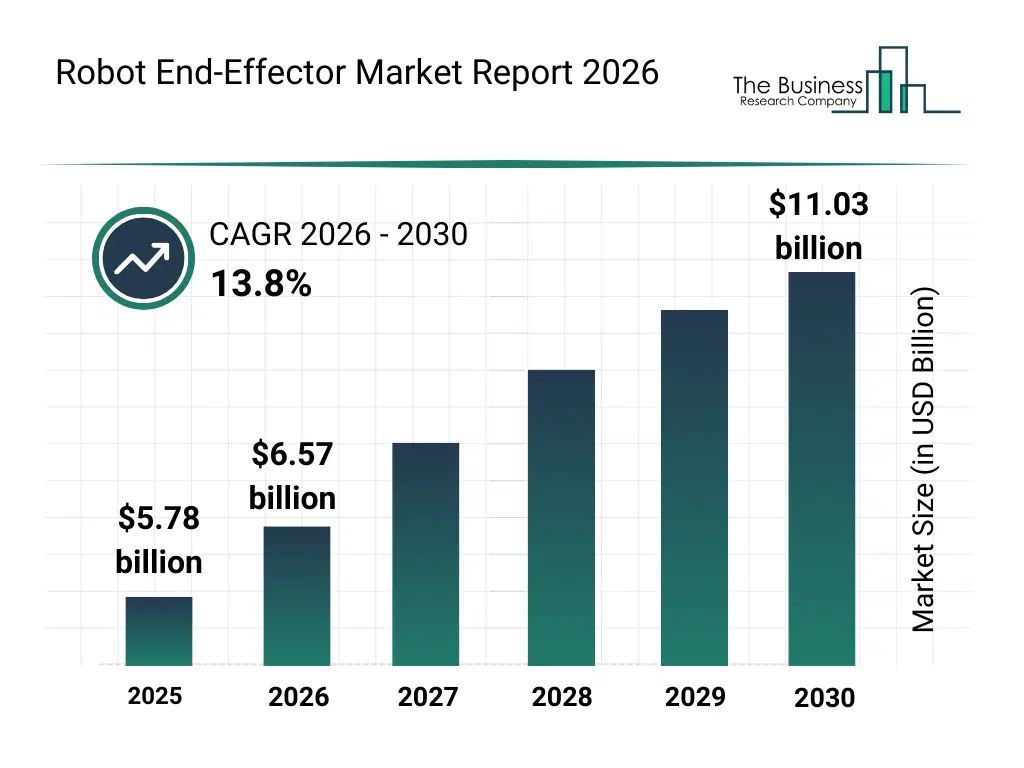
What Is The Robot End-Effector Market Size and Share 2026?
The robot end-effector market size has grown rapidly in recent years. It will grow from $5.78 billion in 2025 to $6.57 billion in 2026 at a compound annual growth rate (CAGR) of 13.8%. The growth in the historic period can be attributed to industrial automation adoption, growth in automotive manufacturing, rising use of industrial robots, demand for high volume production, improvements in robotic accuracy.What Is The Robot End-Effector Market Growth Forecast?
The robot end-effector market size is expected to see rapid growth in the next few years. It will grow to $11.03 billion in 2030 at a compound annual growth rate (CAGR) of 13.8%. The growth in the forecast period can be attributed to collaborative robot deployment growth, expansion of smart factories, rising demand for flexible manufacturing, increasing electronics assembly automation, growth in electric vehicle production. Major trends in the forecast period include rising adoption of modular end effectors, growing demand for application specific grippers, increased use of lightweight end effector materials, higher focus on precision and repeatability, expansion of quick change tooling systems.
Global Robot End-Effector Market Segmentation
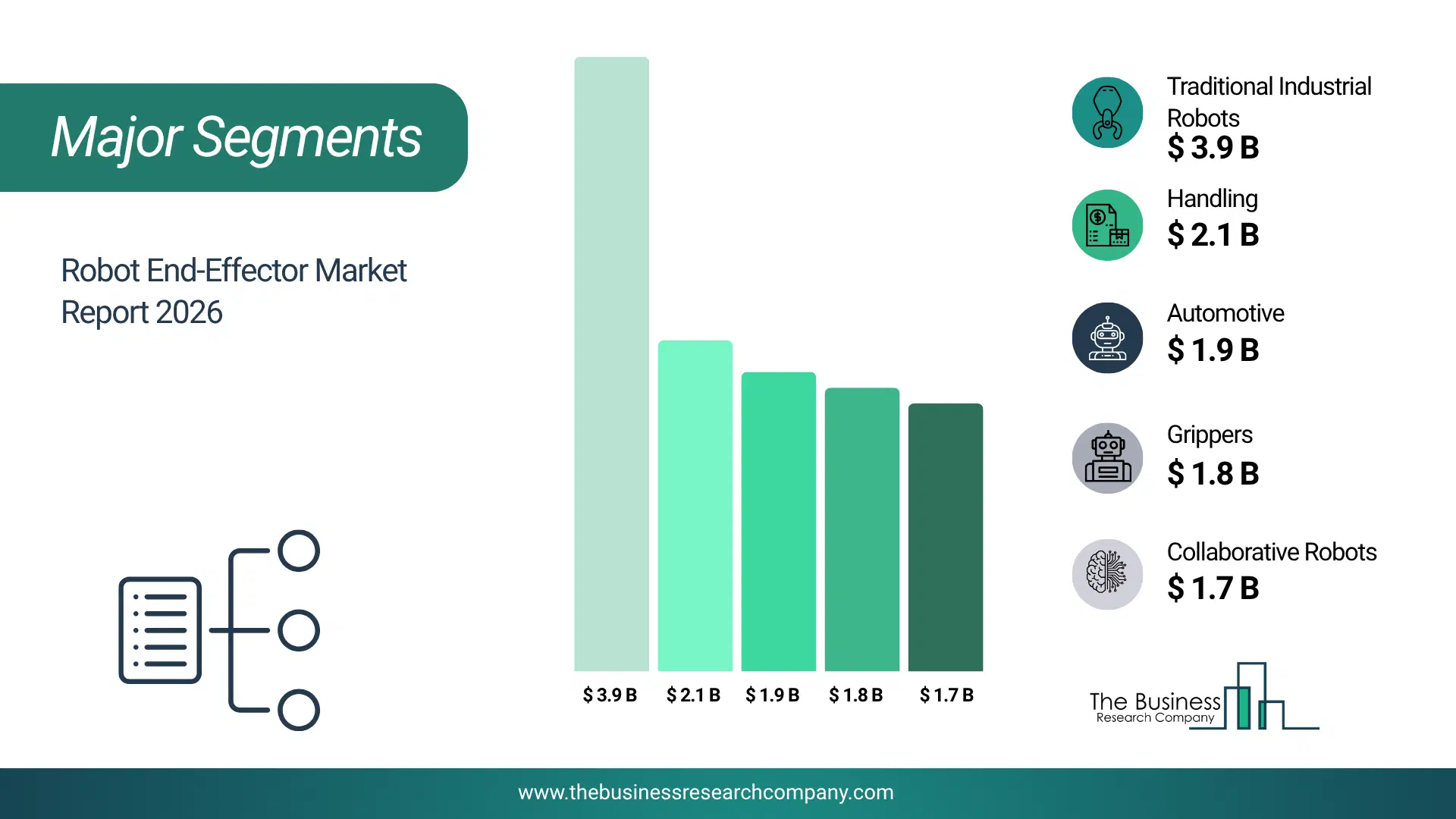
1) By Type: Grippers, Welding Guns, Clamps, Suction Cups, Tool Changers, Other Types 2) By Robot Type: Traditional Industrial Robots, Collaborative Robots 3) By Application: Handling, Welding, Assembly, Processing, Dispensing, Other Applications 4) By Industry: Automotive, Electrical And Electronics, Metals And Machinery, Food And Beverages, Other Industries Subsegments: 1) By Grippers: Mechanical Grippers, Soft Grippers, Magnetic Grippers 2) By Welding Guns: MIG Welding Guns, TIG Welding Guns, Laser Welding Guns 3) By Clamps: Pneumatic Clamps, Hydraulic Clamps 4) By Suction Cups: Vacuum Cups, Bellows Cups 5) By Tool Changers: Automatic Tool Changers, Manual Tool Changers 6) By Other Types: Cutting Tools, Painting Guns, Assembly Tools The top segments in the robot end-effector market will be: • Traditional Industrial Robots will reach $3978.19 Million by 2025. • Handling will reach $2134.71 Million by 2025. • Automotive will reach $1936.81 Million by 2025. • Grippers will reach $1810.07 Million by 2025. • Collaborative Robots will reach $1796.87 Million by 2025.What Is The Driver Of The Robot End-Effector Market?
The rising demand for collaborative robots is expected to propel the growth of the robotics end-effector market going forward. Collaborative robots refer to a form of robotic automation built to work safely alongside human workers in a shared, collaborative workspace. The demand for collaborative robots is growing because the consumer industry has a high need for robots. For instance, in September 2024, according to the International Federation of Robotics, a Germany-based non-profit organization, global industrial robot adoption continued to accelerate in 2023, with annual installations surpassing 541,000 units for the third consecutive year and driving the worldwide operational stock to 4.3 million robots, marking a 10% increase and bringing the total number of robots in use to well over four million globally. Therefore, the rising demand for collaborative robots is driving the growth of the robotics end-effector market.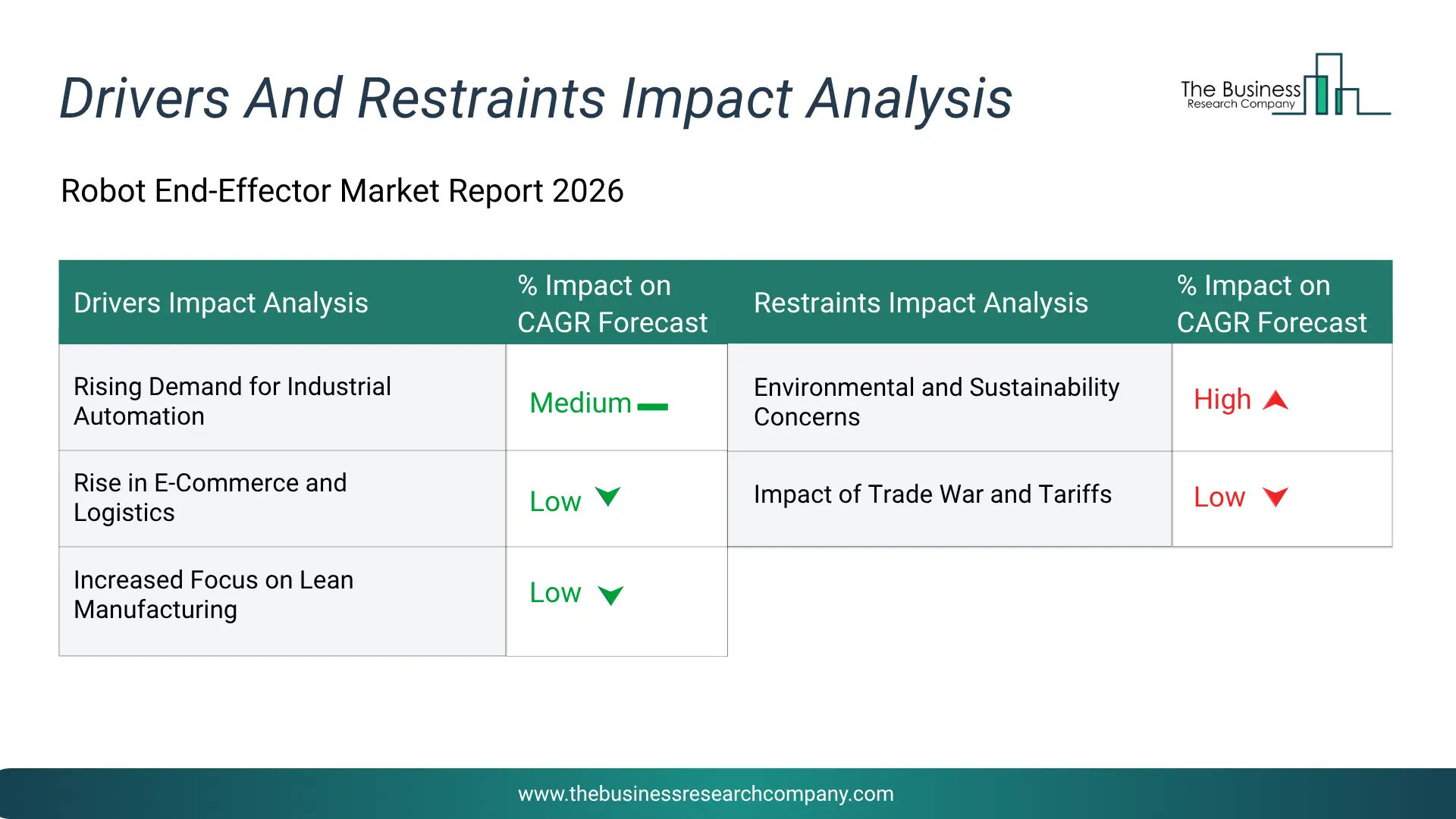
Infographic Chart Showing Key Market Drivers Analysis And Restraints For Robot End-Effector Market
The chart presents an impact analysis of key drivers and restraints, quantifying their relative influence on the market's growth rate and helping assess the balance between growth enablers and limiting factors. This chart offers a high-level perspective; the full report contains more detailed insights.
How Will The Drivers Impact Growth In The Global Robot End-Effector Market?
• Rising Demand for Industrial Automation (Medium) – The rising demand for industrial automation will become a key driver of growth in the robot end-effector market by 2030. Industrial automation relies heavily on robots equipped with end-effectors to perform a variety of tasks such as material handling, assembly, welding and packaging with precision and efficiency. As sectors like automotive, electronics, food and beverage and logistics adopt automation to meet increasing consumer expectations and address labor shortages, the need for versatile, high-performance end-effectors continues to grow. These tools enable robots to adapt to different tasks, product types and environments, making them essential to flexible manufacturing systems. Furthermore, the integration of AI and smart sensors into end-effectors is expanding their capabilities, allowing for real-time decision-making and advanced object recognition, further fueling their demand in automated industrial setups. As a result, the rising demand for industrial automation is anticipated to contributing to a 1% annual growth in the market. • Rise in E-Commerce and Logistics (Low) – The rise in e-commerce and logistics will emerge as a major factor driving the expansion of the robot end-effector market by 2030. With the exponential growth of online shopping, especially post-pandemic, companies are under immense pressure to process, pick, pack and ship goods rapidly and accurately. Robot end-effectors—such as adaptive grippers, suction cups and smart picking tools, are essential for automating these repetitive tasks, enabling robots to handle a wide variety of items with different shapes, sizes and fragility. These tools improve productivity, reduce errors and operate efficiently even in 24/7 environments. Additionally, the push for same-day or next-day delivery has intensified the need for robotic solutions in last-mile and warehouse operations, making robot end-effectors a critical component of modern logistics and driving strong market growth in this sector. Consequently, the rise in e-commerce and logistics is projected to contributing to a 0.8% annual growth in the market. • Increased Focus on Lean Manufacturing (Low) – The increased focus on lean manufacturing practices will serve as a key growth catalyst for the robot end-effector market by 2030, lean manufacturing emphasizes minimizing non-value-added activities, optimizing resource utilization and maintaining consistent product quality, all goals that robotic systems with advanced end-effectors are well-suited to achieve. Robot end-effectors, such as precise grippers, welding tools and automated assembly attachments, enable high-speed, repeatable operations with minimal errors and downtime. They support just-in-time production by allowing quick reconfiguration and handling of varied tasks, which is essential for manufacturers operating in high-mix, low-volume environments. As companies increasingly adopt lean strategies to stay competitive and respond to fluctuating market demands, the integration of robot end-effectors becomes a key enabler of streamlined, efficient and scalable manufacturing processes, thereby accelerating market growth. Therefore, this increased focus on lean manufacturing practices is projected to supporting to a 0.8% annual growth in the market. • Increasing Focus on Workplace Safety (Low) – The increasing focus on workplace safety will become a significant driver contributing to the growth of the robot end-effector market by 2030. In industries such as automotive, manufacturing, chemical processing and logistics, tasks involving heavy lifting, sharp tools, extreme temperatures, or repetitive motion pose significant risks to workers. Robot end-effectors, such as grippers, welding torches and cutting tools enable robots to safely perform these high-risk operations with precision and consistency, thereby minimizing workplace injuries and improving compliance with occupational safety regulations. Additionally, the rise of collaborative robots (cobots) equipped with safety-certified end-effectors allows for safe human-robot interaction on shared workspaces, making automation accessible even in small-scale operations. As companies prioritize employee well-being and regulatory compliance, the demand for robotic end-effectors that enhance safety while maintaining productivity is expected to grow steadily, driving market expansion. Consequently, the increasing focus on workplace safety is projected to contributing to a 0.3% annual growth in the market.How Will The Restraints Impact Growth In The Global Robot End-Effector Market?
• Changed Integration Challenges (Low) – Changed Integration Challenges will restrict the growth of the Robot End-Effector market during the forecast period. Robot end-effector integration with robotic systems presents technical challenges including compatibility and programming issues. Integration complexity can lead to implementation delays and increased costs. The need for customization and specialized expertise for integration limits adoption and market growth. • Environmental and Sustainability Concerns (Low) – Environmental and Sustainability Concerns will restrict the growth of the Robot End-Effector market during the forecast period. Growing environmental concerns about materials and energy consumption in robotics affect end-effector design and selection. Sustainability considerations may limit the use of certain materials and drive demand for eco-friendly solutions. Environmental awareness among customers can affect product preferences and market dynamics. • Impact of Trade War and Tariffs (Low) – Impact of Trade War and Tariffs will restrict the growth of the Robot End-Effector market during the forecast period. Robot end-effectors rely on imported components, sensors, and specialized materials. Trade tariffs and restrictions can increase production costs and affect product availability. Trade barriers may also impact automation investment and manufacturing activity, affecting end-effector demand.Key Players In The Global Robot End-Effector Market
Major companies operating in the robot end-effector market are ABB Ltd, DESTACO, KUKA Aktiengesellschaft, Piab AB, Robotiq Inc., Zimmer Group Holding GmbH, SCHUNK GmbH & Co. KG, J. Schmalz GmbH, Millibar Inc., Festo SE & Co. KG, Weiss Robotics GmbH & Co. KG, TÜNKERS Maschinenbau GmbH, Soft Robotics Inc., ATI Industrial Automation Inc., Applied Robotics Inc., FIPA GmbH, Grabit Inc., Intelligente Peripherien für Roboter GmbH, OnRobot A/S, PHD Inc., Robot System Products AB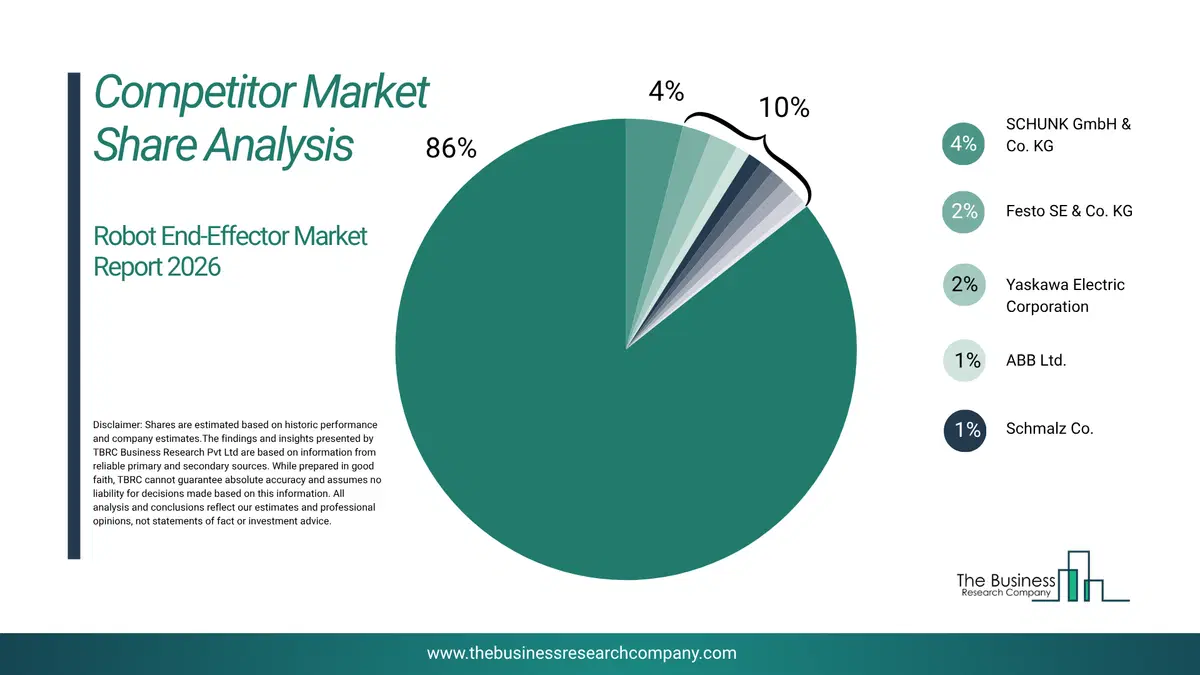
This chart is for illustrative purposes; the full report includes a detailed competitor analysis and comprehensive overview of the top 10 companies in the market.
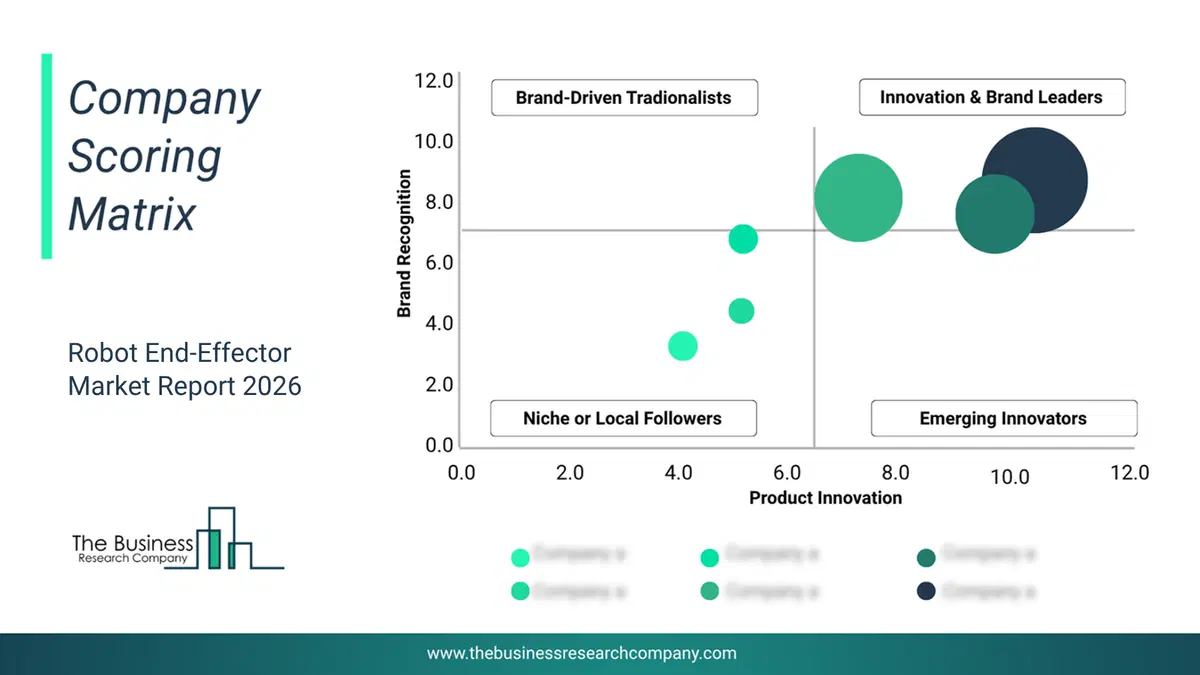
This chart maps companies by product innovation and brand strength, with bubble size indicating relative revenue, helping identify market leaders, challengers, and niche players. This is an illustrative chart; the full report provides a complete and accurate competitive analysis.
Global Robot End-Effector Market Trends and Insights
Major companies operating in the robotics end-effector market are focusing on innovative products such as vacuum gripper to drive revenues in their market. A vacuum gripper is a type of end effector that uses suction to pick up and manipulate objects. It is a versatile and widely used tool in automation and robotics, as it can handle a wide variety of materials without the need for physical contact. For instance, in January 2023, Robotiq Inc. a Canada-based company specializing in robotic grippers launched powerpick and multipack. Powerpick is a vacuum gripper that was created for palletizing applications. It has the adaptability to manage a variety of box sizes, shapes, weights, and packing materials. With 46 handling options and the ability to lift hefty cases up to 11.5 kg (25 lbs), it eliminates the need for specialized grippers when handling different kinds of boxes. Powerpick facilitates picking a greater variety of palletizing patterns with greater flexibility and enables label orientation. Multipick is a software function that allows a UR cobot to pick up numerous boxes at once, hence unlocking faster throughput at the end of the line and increasing throughput and payload capabilities.What Are Latest Mergers And Acquisitions In The Robot End-Effector Market?
In October 2023, Stabilus SE a Germany-based company, acquired DESTACO Co Ltd for $680 million. With this acquisition, Stabilus aims to expand its portfolio by incorporating DESTACO's expertise in providing robotics end-effectors. DESTACO Co Ltd is a US-based company that offers robotics end-effectors.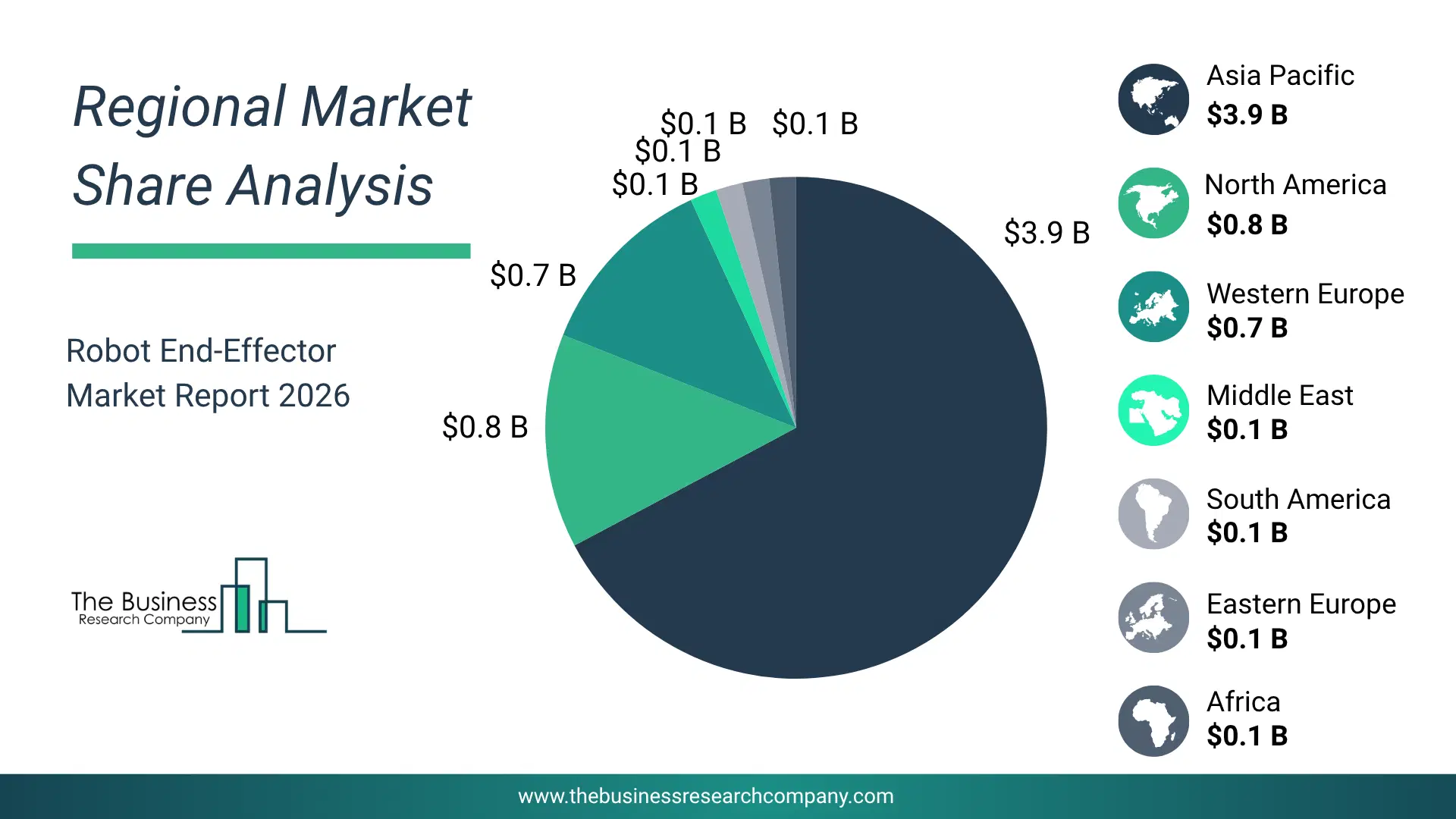
Regional Outlook
Asia-Pacific was the largest region in the robotics end-effector market in 2025. Asia-Pacific is expected to be the fastest-growing region in the forecast period. The regions covered in this market report are Asia-Pacific, South East Asia, Western Europe, Eastern Europe, North America, South America, Middle East, Africa The countries covered in this market report are Australia, Brazil, China, France, Germany, India, Indonesia, Japan, Taiwan, Russia, South Korea, UK, USA, Canada, Italy, Spain.What Defines the Robot End-Effector Market?
The robot end-effector market consists of sales of two-fingered grippers, sensors, process tools. Values in this market are ‘factory gate’ values, that is the value of goods sold by the manufacturers or creators of the goods, whether to other entities (including downstream manufacturers, wholesalers, distributors, and retailers) or directly to end customers. The value of goods in this market includes related services sold by the creators of the goods.How is Market Value Defined and Measured?
The market value is defined as the revenues that enterprises gain from the sale of goods and/or services within the specified market and geography through sales, grants, or donations in terms of the currency (in USD unless otherwise specified). The revenues for a specified geography are consumption values that are revenues generated by organizations in the specified geography within the market, irrespective of where they are produced. It does not include revenues from resales along the supply chain, either further along the supply chain or as part of other products.
This chart presents market attractiveness based on a quantitative evaluation of growth, competition, strategic alignment, and risk, offering a clear view of opportunity areas for decision-making. This chart is for illustrative purposes; the full report contains the complete analysis.

This chart highlights the Total Addressable Market (TAM) by estimating the maximum revenue opportunity using an assumption-driven approach, supporting strategic planning and opportunity sizing across markets. The chart is illustrative; the full report provides a more comprehensive analysis.
What Key Data and Analysis Are Included in the Robot End-Effector Market Report 2026?
The robot end-effector market research report is one of a series of new reports from The Business Research Company that provides market statistics, including industry global market size, regional shares, competitors with the market share, detailed market segments, market trends and opportunities, and any further data you may need to thrive in the robot end-effector industry. The market research report delivers a complete perspective of everything you need, with an in-depth analysis of the current and future state of the industry.Robot End Effector Market Report Forecast Analysis
| Report Attribute | Details |
|---|---|
| Market Size Value In 2026 | $6.57 billion |
| Revenue Forecast In 2030 | $11.03 billion |
| Growth Rate | CAGR of 13.8% from 2026 to 2030 |
| Base Year For Estimation | 2025 |
| Actual Estimates/Historical Data | 2020-2025 |
| Forecast Period | 2026 - 2030 |
| Market Representation | Revenue in USD Billion and CAGR from 2026 to 2030 |
| Segments Covered | Type, Robot Type, Application, Industry |
| Regional Scope | Asia-Pacific, Western Europe, Eastern Europe, North America, South America, Middle East, Africa |
| Country Scope | The countries covered in the report are Australia, Brazil, China, France, Germany, India, Indonesia, Japan, Taiwan, Russia, South Korea, UK, USA, Canada, Italy, Spain. |
| Key Companies Profiled | ABB Ltd, DESTACO, KUKA Aktiengesellschaft, Piab AB, Robotiq Inc., Zimmer Group Holding GmbH, SCHUNK GmbH & Co. KG, J. Schmalz GmbH, Millibar Inc., Festo SE & Co. KG, Weiss Robotics GmbH & Co. KG, TÜNKERS Maschinenbau GmbH, Soft Robotics Inc., ATI Industrial Automation Inc., Applied Robotics Inc., FIPA GmbH, Grabit Inc., Intelligente Peripherien für Roboter GmbH, OnRobot A/S, PHD Inc., Robot System Products AB |
| Customization Scope | Request for Customization |
| Pricing And Purchase Options | Explore Purchase Options |