
Robot Heat Stake Welding Cells Market Report 2026
Global Outlook – By Component (Robots, Welding Equipment, Control Systems, Safety Systems, Other Components), By Type (Standard Cells, Customized Cells), By Automation Level (Semi-Automatic, Fully Automatic), By Application (Automotive, Electronics, Medical Devices, Consumer Goods, Other Applications), By End-User (Original Equipment Manufacturer (OEMs), Tier 1 Suppliers, Contract Manufacturers, Other End-Users) – Market Size, Trends, Strategies, and Forecast to 2030
Robot Heat Stake Welding Cells Market Overview
• Robot Heat Stake Welding Cells market size has reached to $1.47 billion in 2025 • Expected to grow to $2.53 billion in 2030 at a compound annual growth rate (CAGR) of 11.5% • Growth Driver: Rising Demand For Industrial Automation Fueling The Growth Of The Market Due To The Need For Higher Operational Efficiency • Market Trend: • Asia-Pacific was the largest region in 2025 and North America is the fastest growing region.What Is Covered Under Robot Heat Stake Welding Cells Market?
Robot heat stake welding cells are automated workstations where robots use controlled heat and pressure to join thermoplastic components by melting and reforming material at precise points. These cells are used to enable high-speed, consistent, and repeatable assembly of plastic parts without adhesives or mechanical fasteners, improving production efficiency and product quality. The main components of robot heat stake welding cells include robots, welding equipment, control systems, and safety systems. Robots refer to automated mechanical arms designed to perform precise heat stake welding tasks with high accuracy, speed, and repeatability, minimizing manual labor and improving production efficiency. There are types such as standard cells and customized cells. The organization sizes include small and medium enterprises and large enterprises, and they are used by several end-users such as original equipment manufacturers (OEMs), tier 1 suppliers, contract manufacturers, and others.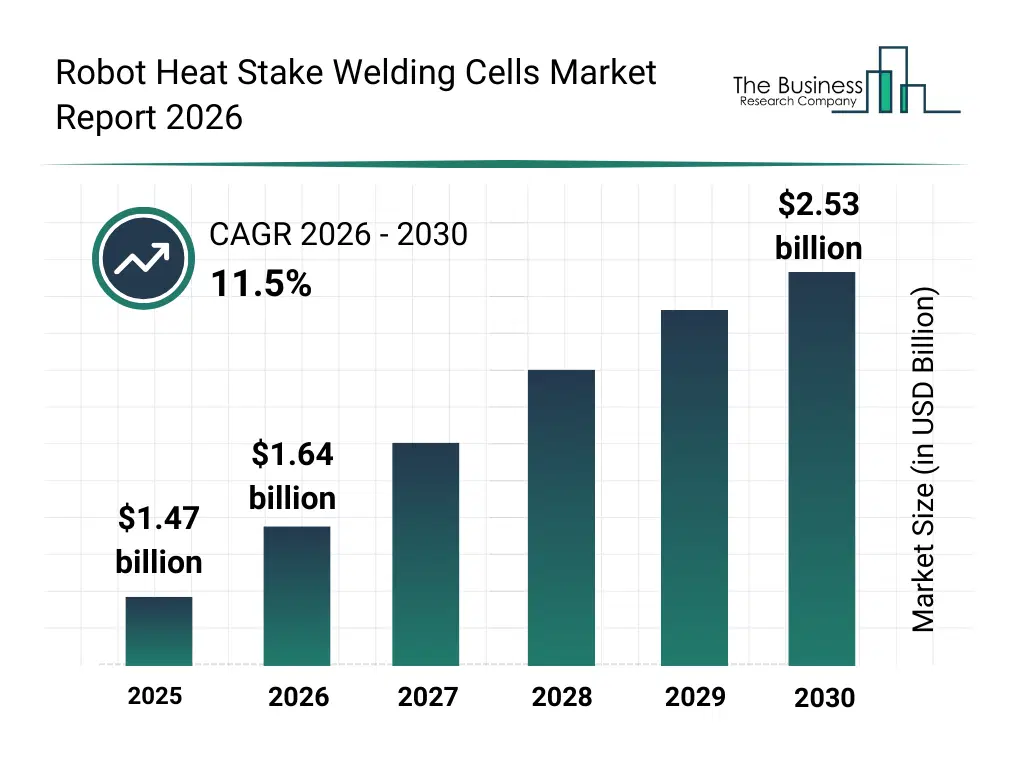
What Is The Robot Heat Stake Welding Cells Market Size and Share 2026?
The robot heat stake welding cells market size has grown rapidly in recent years. It will grow from $1.47 billion in 2025 to $1.64 billion in 2026 at a compound annual growth rate (CAGR) of 11.7%. The growth in the historic period can be attributed to growing adoption of industrial automation, increasing use of thermoplastics in automotive interiors, rising demand for precision welding in electronics manufacturing, expanding production of consumer goods requiring plastic joining, and increasing shift from manual to robotic welding operations.What Is The Robot Heat Stake Welding Cells Market Growth Forecast?
The robot heat stake welding cells market size is expected to see rapid growth in the next few years. It will grow to $2.53 billion in 2030 at a compound annual growth rate (CAGR) of 11.5%. The growth in the forecast period can be attributed to rising integration of robotics in manufacturing lines, growing demand for high-quality plastic welding in Medical Devices, increasing adoption of electric vehicles boosting plastic component production, expanding investments in automated assembly solutions, and increasing need for faster and more consistent plastic joining processes. Major trends in the forecast period include widespread adoption of advancements in robotic heat staking technologies, growth in modular and flexible welding cell designs, innovations in thermal control and welding precision systems, increasing research and development in automated plastic joining methods, and development of artificial intelligence (AI)-driven monitoring and quality assurance tools.
Global Robot Heat Stake Welding Cells Market Segmentation
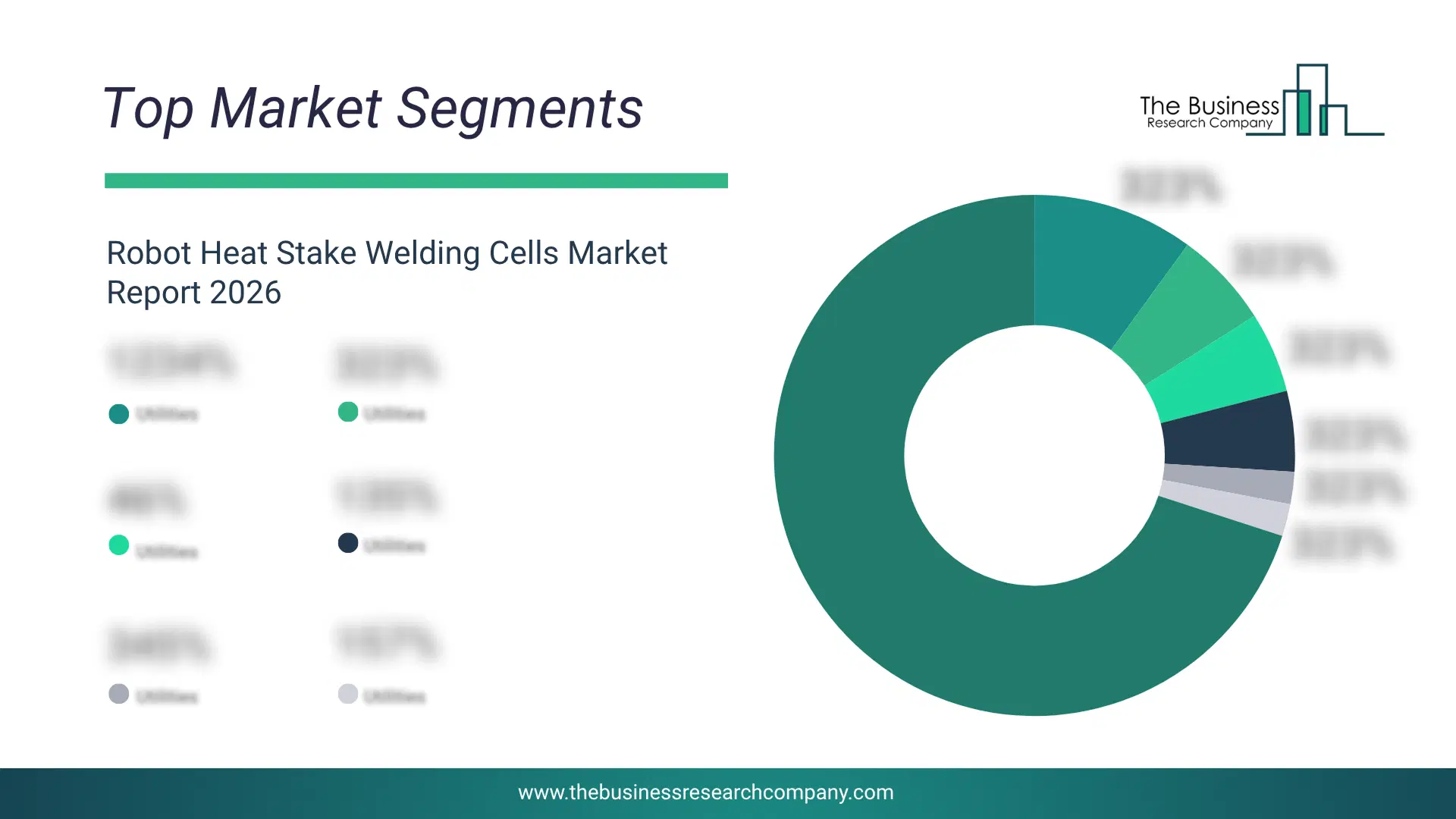
1) By Component: Robots, Welding Equipment, Control Systems, Safety Systems, Other Components 2) By Type: Standard Cells, Customized Cells 3) By Automation Level: Semi-Automatic, Fully Automatic 4) By Application: Automotive, Electronics, Medical Devices, Consumer Goods, Other Applications 5) By End-User: Original Equipment Manufacturer (OEMs), Tier 1 Suppliers, Contract Manufacturers, Other End-Users Subsegments: 1) By Robots: Articulated Robots, Cartesian Robots, Delta Robots, Gantry Robots, Parallel Robots, Collaborative Robots 2) By Welding Equipment: Thermal Staking Heads, Ultrasonic Staking Heads, Hot Air Staking Modules, Resistance Staking Units, Induction Staking Units, Fixture Mounted Staking Tools 3) By Control Systems: Programmable Controllers, Motion Control Units, Temperature Control Modules, Process Monitoring Systems, Human Machine Interfaces, Network Communication Modules 4) By Safety Systems: Safety Fencing And Enclosures, Light Curtains And Beam Sensors, Emergency Stop Systems, Safety Interlock Switches, Presence Sensing Mats, Two Hand Control Systems 5) By Other Components: Fixtures And Jigs, End Effectors And Tooling, Conveyors And Feeders, Material Handling Modules, Vision Inspection Sensors, Tool Change SystemsWhat Are The Drivers Of The Robot Heat Stake Welding Cells Market?
The rising demand for industrial automation is expected to propel the growth of the robot heat stake welding cells market going forward. Industrial automation refers to the use of control systems, machinery, software, and robotics to operate and monitor industrial processes with minimal human intervention. The demand for industrial automation is rising due to the need for increased operational efficiency as businesses aim to reduce costs, minimize errors, and boost productivity. Robot heat stake welding cells enhance industrial automation by delivering precise, repeatable welding operations, making them ideal for high-volume production environments. They reduce manual labor by automating complex heat-staking tasks, improving manufacturing efficiency, consistency, and overall operational productivity. For instance, in September 2025, according to the International Federation of Robotics, a Germany-based non-profit organization, there were 4,664,000 robotic units operating in factories globally in 2024, marking a 9% increase from 4,281,585 units in 2023. Therefore, the rising demand for industrial automation is driving the growth of the robot heat stake welding cells industry. The growing demand for lightweight vehicles is expected to propel the growth of the robot heat stake welding cells market going forward. Lightweight vehicles refer to automobiles that are built using lighter materials such as aluminum, high-strength steel, carbon fiber, and composites to reduce overall vehicle weight. The growing demand for lightweight vehicles is due to the increasing need for fuel efficiency and reduced emissions. Robot heat stake welding cells enhance lightweight vehicles by enabling precise and reliable joining of lightweight materials such as plastics and composites, making them ideal for modern automotive manufacturing. They improve production efficiency by delivering consistent, high-quality welds, supporting the creation of durable, weight-optimized vehicle components. For instance, in December 2024, according to the American Chemistry Council, a US-based trade association, an average automobile contains 429 pounds of plastics and polymer composites, accounting for 9.7% of the vehicle’s total weight, with polypropylene per vehicle rising from 97 pounds in 2022 to 100 pounds in 2023. Therefore, the growing demand for lightweight vehicles is driving the growth of the robot heat stake welding cells industry. The rising infrastructure development is expected to propel the growth of the robot heat stake welding cells market going forward. Infrastructure development refers to the planning, construction, and maintenance of essential physical systems such as transport, energy, water, and communication networks. The rise in infrastructure development activities is driven by economic growth and urbanization, as they boost demand for improved transportation, energy, and public utility networks. Rising infrastructure development enhances robot heat stake welding cells by increasing demand for fast, precise, and automated manufacturing processes needed for large-scale projects. For instance, in July 2024, according to the Office for National Statistics, a UK-based government department, total general government investment in infrastructure reached $17.25 billion (£13.8 billion) in 2023, marking a 3.9% increase from 2022. Therefore, the rising infrastructure development is driving the growth of the robot heat stake welding cells industry.Key Players In The Global Robot Heat Stake Welding Cells Market
Major companies operating in the robot heat stake welding cells market are ABB Ltd., Emerson Electric Co., Kawasaki Heavy Industries Ltd., Hyundai Robotics Co. Ltd., FANUC Corporation, KUKA AG, Yaskawa Electric Corporation, NACHI-FUJIKOSHI CORP., Comau S.p.A., Universal Robots A/S, Dukane Corporation, TELSONIC Ultrasonics AG, Bielomatik Leuze GmbH + Co. KG, Sonics & Materials Inc., Sonitek Corporation, Thermal Press International Inc., MECASONIC Group, OTC DAIHEN Inc., Mecasonic Corporation, Tianjin Hanex Technology Co. Ltd., Hyusonic Co. Ltd., Vimal Nourishment Technologies Pvt. Ltd., Robotuner Automation Pvt. Ltd.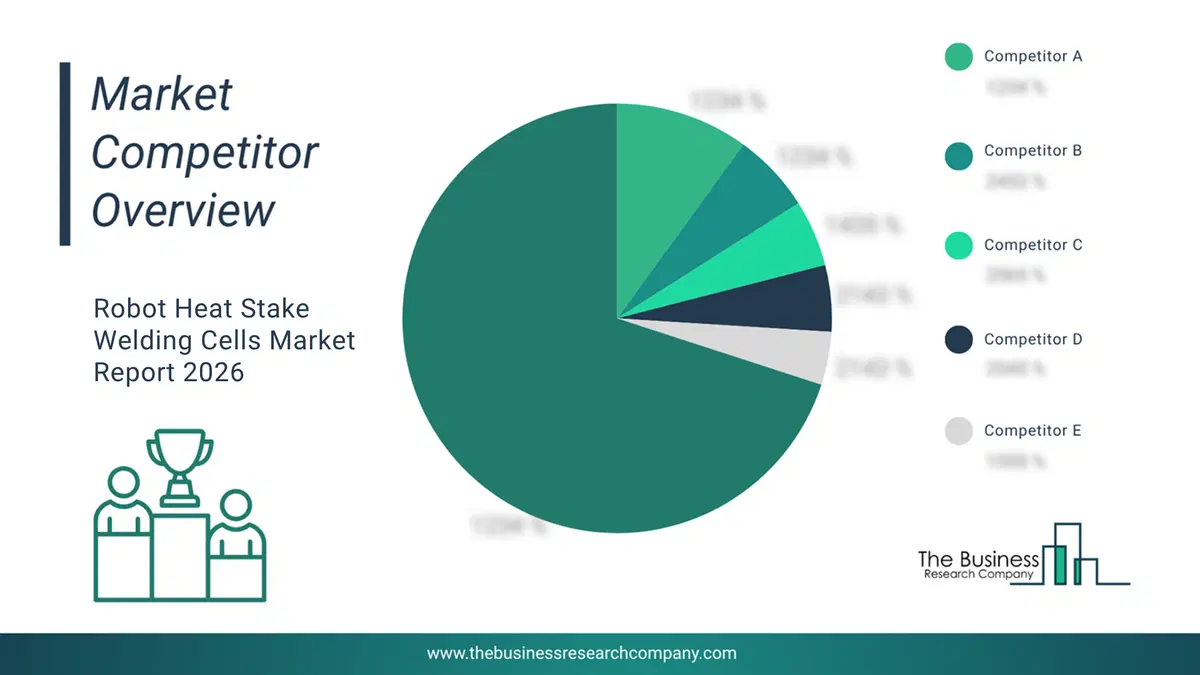
This chart is for illustrative purposes; the full report includes a detailed competitor analysis and comprehensive overview of the top 10 companies in the market.
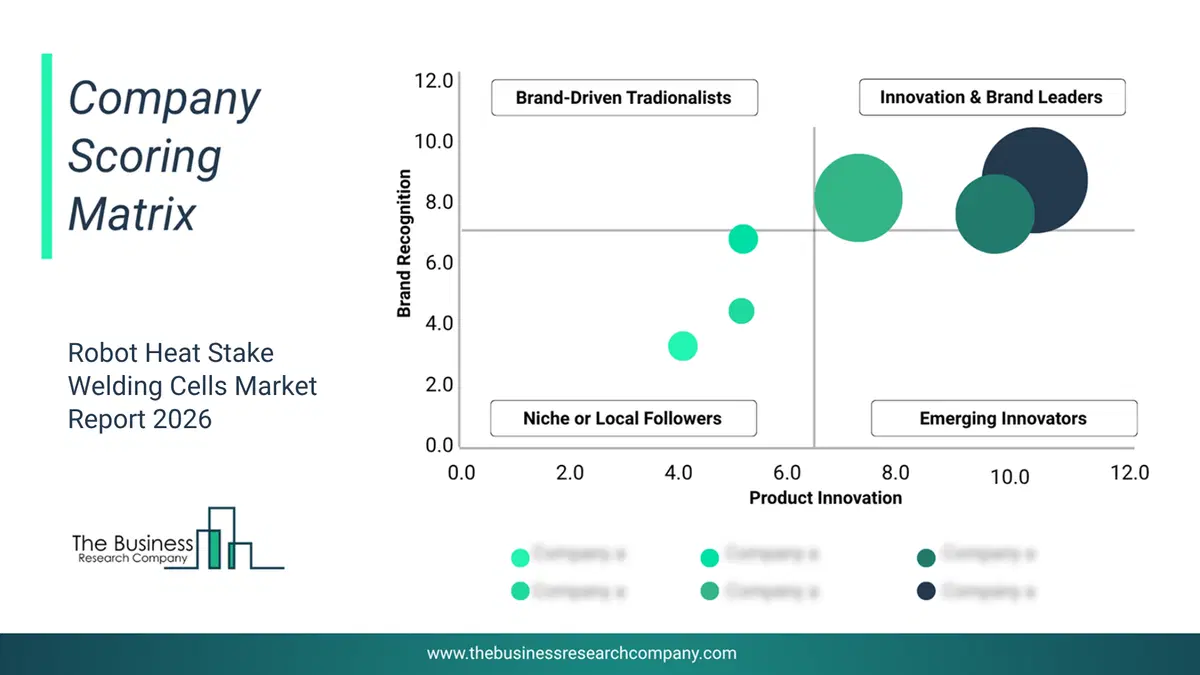
This chart maps companies by product innovation and brand strength, with bubble size indicating relative revenue, helping identify market leaders, challengers, and niche players. This is an illustrative chart; the full report provides a complete and accurate competitive analysis.
Regional Insights
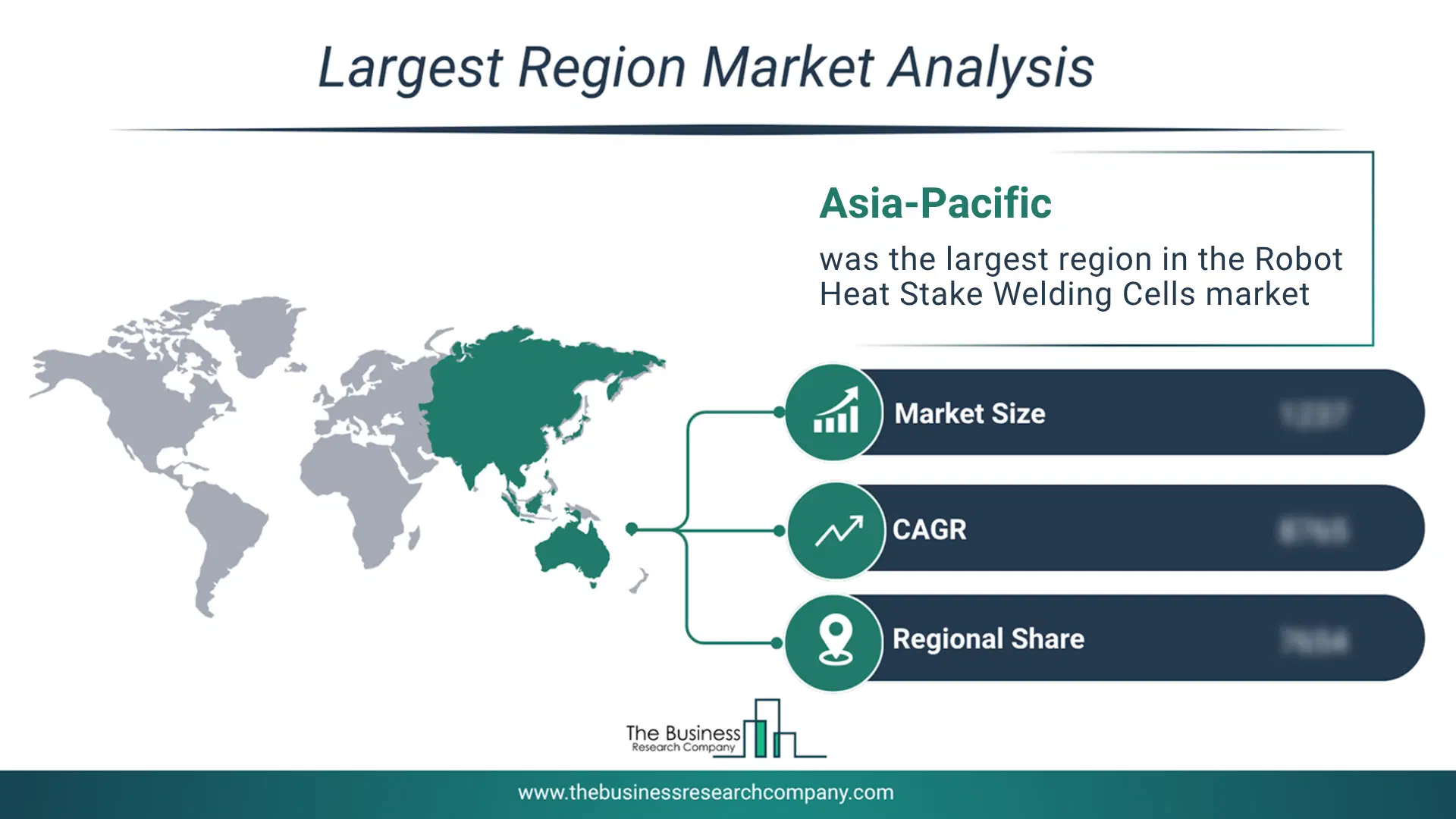
Asia-Pacific was the largest region in the Robot Heat Stake Welding Cells market in 2025. North America is expected to be the fastest-growing region in the forecast period. The regions covered in this market report are Asia-Pacific, South East Asia, Western Europe, Eastern Europe, North America, South America, Middle East, Africa. The countries covered in this market report are Australia, Brazil, China, France, Germany, India, Indonesia, Japan, Taiwan, Russia, South Korea, UK, USA, Canada, Italy, Spain.What Defines the Robot Heat Stake Welding Cells Market?
The robot heat stake welding cells market consists of sales of robot-based heat staking machines, modular robotic welding cells, integrated heat stake automation systems, and customized robotic staking solutions. Values in this market are ‘factory gate’ values, that is, the value of goods sold by the manufacturers or creators of the goods, whether to other entities (including downstream manufacturers, wholesalers, distributors, and retailers) or directly to end customers. The value of goods in this market includes related services sold by the creators of the goods.How is Market Value Defined and Measured?
The market value is defined as the revenues that enterprises gain from the sale of goods and/or services within the specified market and geography through sales, grants, or donations in terms of the currency (in USD unless otherwise specified). The revenues for a specified geography are consumption values that are revenues generated by organizations in the specified geography within the market, irrespective of where they are produced. It does not include revenues from resales along the supply chain, either further along the supply chain or as part of other products.
This chart presents market attractiveness based on a quantitative evaluation of growth, competition, strategic alignment, and risk, offering a clear view of opportunity areas for decision-making. This chart is for illustrative purposes; the full report contains the complete analysis.

This chart highlights the Total Addressable Market (TAM) by estimating the maximum revenue opportunity using an assumption-driven approach, supporting strategic planning and opportunity sizing across markets. The chart is illustrative; the full report provides a more comprehensive analysis.
What Key Data and Analysis Are Included in the Robot Heat Stake Welding Cells Market Report 2026?
The robot heat stake welding cells market research report is one of a series of new reports from The Business Research Company that provides market statistics, including industry global market size, regional shares, competitors with the market share, detailed market segments, market trends and opportunities, and any further data you may need to thrive in the robot heat stake welding cells industry. The market research report delivers a complete perspective of everything you need, with an in-depth analysis of the current and future state of the industry.Robot Heat Stake Welding Cells Market Report Forecast Analysis
| Report Attribute | Details |
|---|---|
| Market Size Value In 2026 | $1.64 billion |
| Revenue Forecast In 2030 | $2.53 billion |
| Growth Rate | CAGR of 11.5% from 2026 to 2030 |
| Base Year For Estimation | 2025 |
| Actual Estimates/Historical Data | 2020-2025 |
| Forecast Period | 2026 - 2030 |
| Market Representation | Revenue in USD Billion and CAGR from 2026 to 2030 |
| Segments Covered | Component, Type, Automation Level, Application, End-User |
| Regional Scope | Asia-Pacific, Western Europe, Eastern Europe, North America, South America, Middle East, Africa |
| Key Companies Profiled | ABB Ltd., Emerson Electric Co., Kawasaki Heavy Industries Ltd., Hyundai Robotics Co. Ltd., FANUC Corporation, KUKA AG, Yaskawa Electric Corporation, NACHI-FUJIKOSHI CORP., Comau S.p.A., Universal Robots A/S, Dukane Corporation, TELSONIC Ultrasonics AG, Bielomatik Leuze GmbH + Co. KG, Sonics & Materials Inc., Sonitek Corporation, Thermal Press International Inc., MECASONIC Group, OTC DAIHEN Inc., Mecasonic Corporation, Tianjin Hanex Technology Co. Ltd., Hyusonic Co. Ltd., Vimal Nourishment Technologies Pvt. Ltd., Robotuner Automation Pvt. Ltd. |
| Customization Scope | Request for Customization |
| Pricing And Purchase Options | Explore Purchase Options |