

Robot Self-Piercing Rivet Cells Market Report 2026
Global Outlook – By Component (Robots, Riveting Tools, Control Systems, Safety Systems, Other Components), By Cell Type (Standalone Cells, Integrated Cells), By Application (Automotive, Aerospace, Other Applications), By End-User (Original Equipment Manufacturer (OEMs), Tier 1 Suppliers, Contract Manufacturers, Other End-Users) – Market Size, Trends, Strategies, and Forecast to 2030
Robot Self-Piercing Rivet Cells Market Overview
• Robot Self-Piercing Rivet Cells market size has reached to $1.56 billion in 2025 • Expected to grow to $2.66 billion in 2030 at a compound annual growth rate (CAGR) of 11.2% • Growth Driver: Growing Demand For Electric Vehicles Driving The Growth Of The Market Due To Increasing Need For Lightweight And High-precision Assembly Solutions • Market Trend: Advancements In Automatic Riveting Cell Technology Enhance Manufacturing Precision And Efficiency • North America was the largest region in 2025 and Asia-Pacific is the fastest growing region.What Is Covered Under Robot Self-Piercing Rivet Cells Market?
Robot self-piercing rivet (SPR) cells are automated systems that use robotic arms and self-piercing rivet technology to join multiple layers of materials without pre-drilling holes. These cells ensure high-speed, precise, and durable fastening of metals and lightweight materials through controlled force and accurate alignment. They enhance production efficiency, consistency, and structural integrity in advanced manufacturing environments. The main components of robot self-piercing rivet cells are robots, riveting tools, control systems, safety systems, and others. Robots refer to automated machines equipped with advanced riveting tools and control systems that perform high-precision self-piercing riveting operations for joining materials without pre-drilling. The key cell types include standalone cells and integrated cells. Major applications include automotive, aerospace, electronics, construction, and others, with primary end users being original equipment manufacturers (OEMs), tier 1 suppliers, contract manufacturers, and others.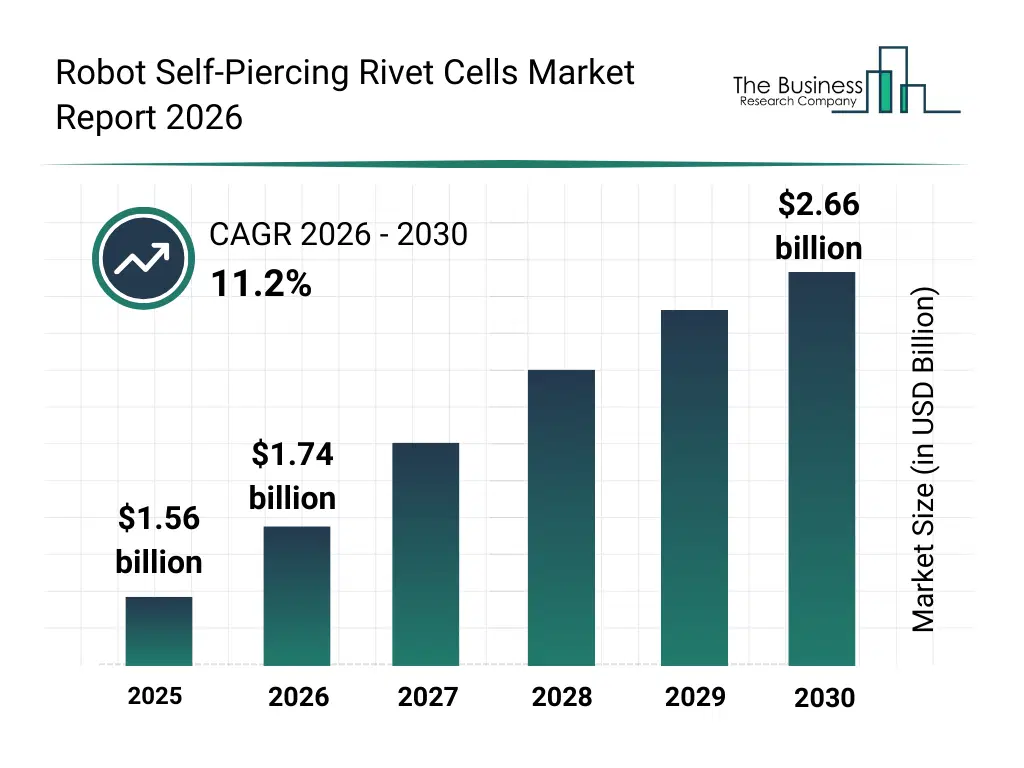
What Is The Robot Self-Piercing Rivet Cells Market Size and Share 2026?
The robot self-piercing rivet cells market size has grown rapidly in recent years. It will grow from $1.56 billion in 2025 to $1.74 billion in 2026 at a compound annual growth rate (CAGR) of 11.5%. The growth in the historic period can be attributed to expansion of automotive lightweighting initiatives, growth in robotic assembly lines, increasing use of aluminum and mixed materials, availability of high-precision robotic systems, rising demand for repeatable fastening processes.What Is The Robot Self-Piercing Rivet Cells Market Growth Forecast?
The robot self-piercing rivet cells market size is expected to see rapid growth in the next few years. It will grow to $2.66 billion in 2030 at a compound annual growth rate (CAGR) of 11.2%. The growth in the forecast period can be attributed to increasing adoption in EV body manufacturing, expansion of aerospace structural assembly, rising automation across tier suppliers, growing focus on defect-free joining, integration of smart factory technologies. Major trends in the forecast period include increasing adoption of automated riveting cells, rising use in lightweight vehicle structures, growing integration of vision and sensor systems, expansion of high-speed riveting applications, enhanced focus on joint strength consistency.Tariff Impact On Robot Self-Piercing Rivet Cells Market
Tariffs are influencing the robot self-piercing rivet cells market by increasing costs of imported robots, servo-driven riveting tools, control systems, and safety components. Automotive and aerospace manufacturing hubs in Europe and Asia-Pacific are most affected due to reliance on advanced robotic imports. These tariffs are raising capital investment requirements and extending deployment timelines. However, they are also accelerating localization of robotic cell integration, development of modular riveting solutions, and increased collaboration with regional automation suppliers.
Global Robot Self-Piercing Rivet Cells Market Segmentation
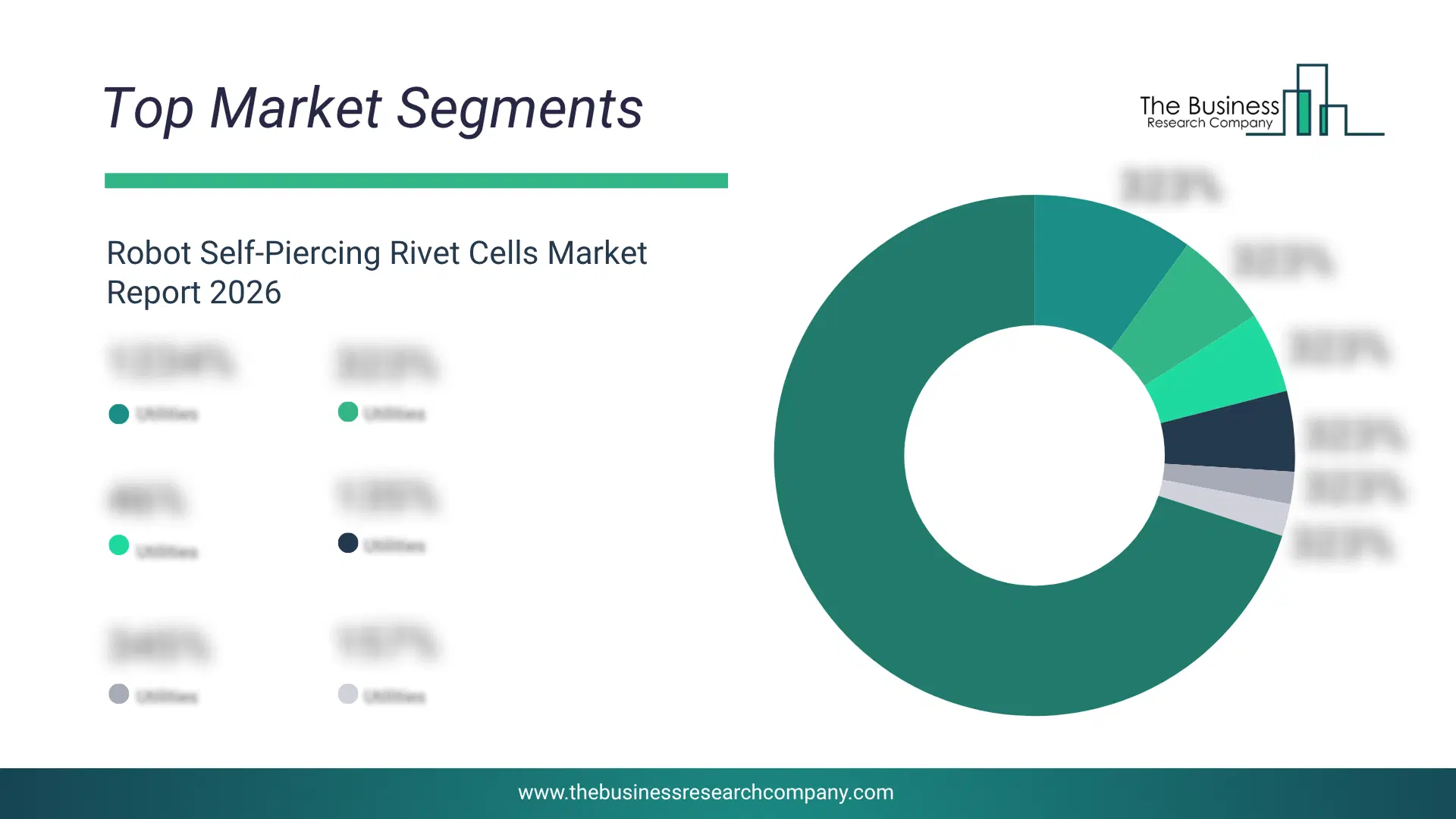
1) By Component: Robots, Riveting Tools, Control Systems, Safety Systems, Other Components 2) By Cell Type: Standalone Cells, Integrated Cells 3) By Application: Automotive, Aerospace, Other Applications 4) By End-User: Original Equipment Manufacturer (OEMs), Tier 1 Suppliers, Contract Manufacturers, Other End-Users Subsegments: 1) By Robots: Articulated Robots, Gantry Robots 2) By Riveting Tools: Hydraulic Riveting Tools, Pneumatic Riveting Tools, Electric Riveting Tools, Servo-Driven Riveting Tools 3) By Control Systems: Programmable Logic Controllers (PLC), Human Machine Interface (HMI), Motion Control Systems, Vision Systems, Feedback and Sensor Modules 4) By Safety Systems: Safety Light Curtains, Emergency Stop Systems, Safety Mats And Barriers, Interlock Switches, Safety Controllers 5) By Other Components: Tool Changers, End Effectors, Fixtures And Positioners, Conveyors And Material Handling Units, Power Supply And Cabling AssembliesWhat Is The Driver Of The Robot Self-Piercing Rivet Cells Market?
The growing demand for electric vehicles (EVs) is expected to propel the growth of the robot self-piercing rivet cells market going forward. The growing demand for electric vehicles (EVs) is driven by governments implementing stricter fleet emission targets and offering purchase incentives, both of which are accelerating the adoption and market penetration of EVs. Robot self-piercing rivet cells provide automakers high-speed, repeatable, and precise joining for multilayer and mixed-material assemblies, which helps manufacturers scale electric vehicle (EV) body production and meet lightweighting targets. For instance, in 2024, according to the International Energy Agency, an intergovernmental energy agency, electric cars accounted for around 18% of all cars sold in 2023, up from 14% in 2022. Therefore, the growing demand for electric vehicles (EVs) is driving the growth of the robot self-piercing rivet cells industry.Key Players In The Global Robot Self-Piercing Rivet Cells Market
Major companies operating in the robot self-piercing rivet cells market are ABB Ltd., Atlas Copco AB, Autoriv GmbH, FANUC Corporation, Yaskawa Electric Corporation, Böllhoff GmbH & Co. KG, ECKOLD GmbH & Co. KG, Rivetmach Machinery Industries Co. Ltd., ERSM Machinery Co. Ltd., Wuhan Herorivet Machinery Manufacturing Co. Ltd., EXO Automation Technology Co. Ltd., Tokai-MMC Co. Ltd., Oro Robotics & Automation Pvt. Ltd., Vario Engineering Solutions Pvt. Ltd., Flexible Automation Inc., KUKA AG, Dürr AG, Lincoln Electric Company, Stanley Black & Decker, Inc., RSM Machinery, Gesipa (Gesipa Blindniettechnik GmbH), RENMAKCH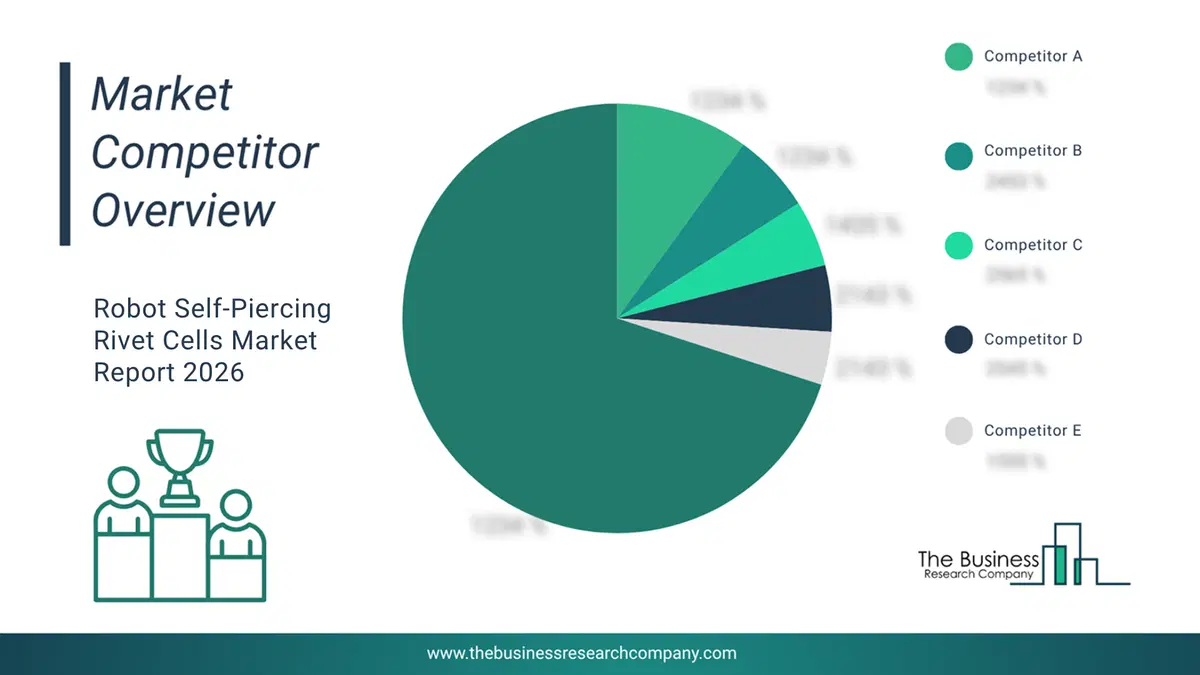
This chart is for illustrative purposes; the full report includes a detailed competitor analysis and comprehensive overview of the top 10 companies in the market.
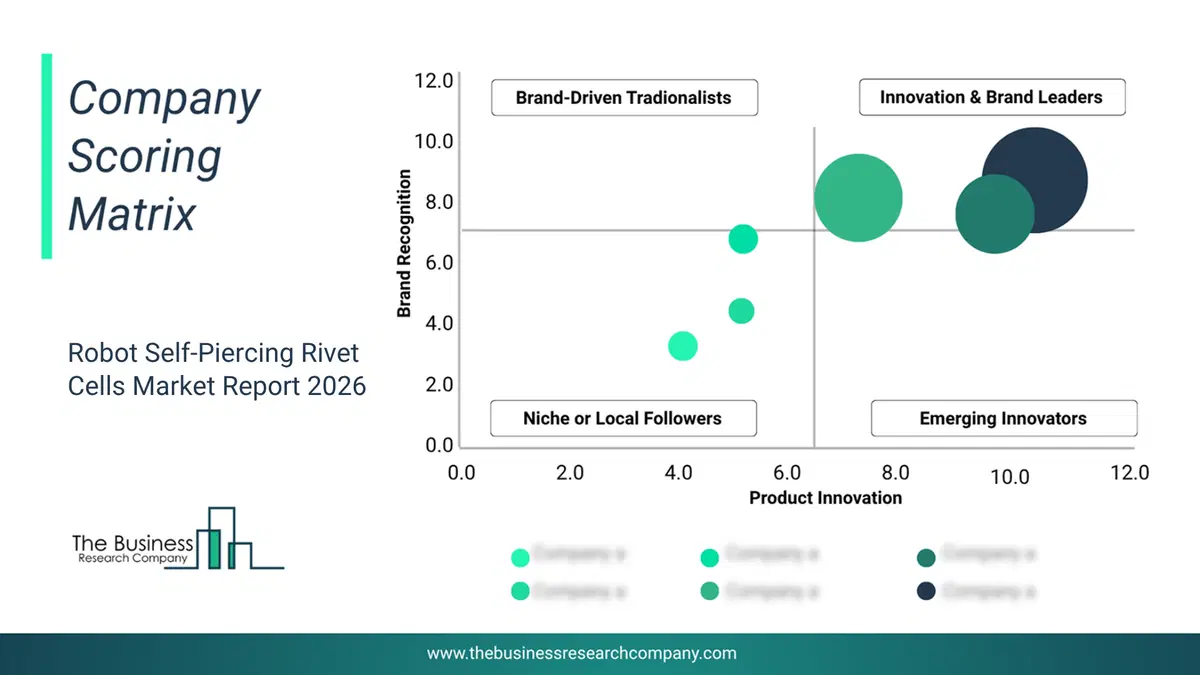
This chart maps companies by product innovation and brand strength, with bubble size indicating relative revenue, helping identify market leaders, challengers, and niche players. This is an illustrative chart; the full report provides a complete and accurate competitive analysis.
Global Robot Self-Piercing Rivet Cells Market Trends and Insights
Major companies operating in the robot self-piercing rivet cells market are focusing on technological advancements, such as automatic riveting cells equipped with integrated robotic systems and intelligent control platforms, to improve fastening precision, production flexibility, and operational efficiency. Automatic riveting cells refer to fully automated robotic systems designed to apply self-piercing rivets or inserts to composite or metallic components without manual intervention. These systems combine advanced motion control, adaptive force monitoring, and automated feeding mechanisms to ensure consistent and high-speed joining performance across complex geometries. For instance, in January 2025, Belotti SpA, an Italy-based industrial automation company, unveiled the Automatic Riveting Cell (ARC) at JEC World 2025, a leading international composites event. The Belotti ARC features a robotic riveting platform capable of machining and joining composite frames and components for automotive and aerospace applications, offering enhanced precision, reduced cycle times, and live operational demonstrations of its state-of-the-art robotic performance.What Are Latest Mergers And Acquisitions In The Robot Self-Piercing Rivet Cells Market?
In June 2024, Heron Corporation, a China-based intelligent equipment manufacturer, acquired the assets of AKH Inc.’s Flush Self-Pierce Riveting (FSPR) business for an undisclosed amount. With this acquisition, Heron Corporation aims to strengthen its position in advanced joining technologies by integrating AKH’s proprietary flush self-pierce riveting technology into its automated and robotic riveting solutions portfolio. The acquisition enhances Heron’s capabilities in providing high-precision robotic self-piercing rivet cells for lightweight vehicle structures and multi-material assemblies. AKH Inc. is a US-based manufacturer specializing in flush self-pierce riveting systems used in automotive and industrial applications.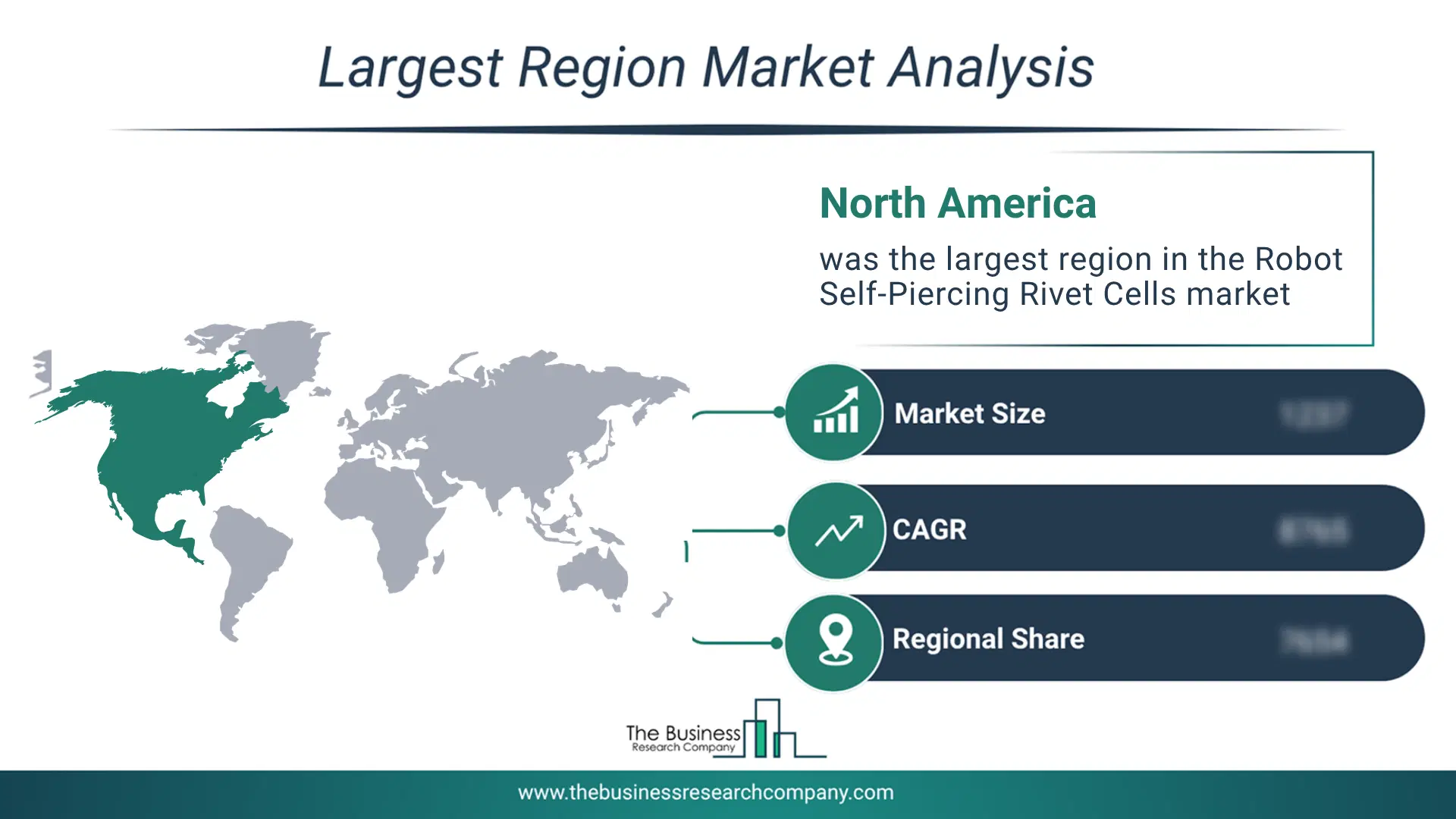
Regional Outlook
North America was the largest region in the robot self-piercing rivet cells market in 2025. Asia-Pacific is expected to be the fastest-growing region in the forecast period. The regions covered in this market report are Asia-Pacific, South East Asia, Western Europe, Eastern Europe, North America, South America, Middle East, Africa The countries covered in this market report are Australia, Brazil, China, France, Germany, India, Indonesia, Japan, Taiwan, Russia, South Korea, UK, USA, Canada, Italy, Spain.What Defines the Robot Self-Piercing Rivet Cells Market?
The robot self-piercing rivet cells market consists of sales of robotic riveting cells, self-piercing rivet guns, rivet feeders, robotic arms, and control panels. Values in this market are ‘factory gate’ values, that is, the value of goods sold by the manufacturers or creators of the goods, whether to other entities (including downstream manufacturers, wholesalers, distributors, and retailers) or directly to end customers. The value of goods in this market includes related services sold by the creators of the goods.How is Market Value Defined and Measured?
The market value is defined as the revenues that enterprises gain from the sale of goods and/or services within the specified market and geography through sales, grants, or donations in terms of the currency (in USD unless otherwise specified). The revenues for a specified geography are consumption values that are revenues generated by organizations in the specified geography within the market, irrespective of where they are produced. It does not include revenues from resales along the supply chain, either further along the supply chain or as part of other products.
This chart presents market attractiveness based on a quantitative evaluation of growth, competition, strategic alignment, and risk, offering a clear view of opportunity areas for decision-making. This chart is for illustrative purposes; the full report contains the complete analysis.

This chart highlights the Total Addressable Market (TAM) by estimating the maximum revenue opportunity using an assumption-driven approach, supporting strategic planning and opportunity sizing across markets. The chart is illustrative; the full report provides a more comprehensive analysis.
What Key Data and Analysis Are Included in the Robot Self-Piercing Rivet Cells Market Report 2026?
The robot self-piercing rivet cells market research report is one of a series of new reports from The Business Research Company that provides market statistics, including industry global market size, regional shares, competitors with the market share, detailed market segments, market trends and opportunities, and any further data you may need to thrive in the robot self-piercing rivet cells industry. The market research report delivers a complete perspective of everything you need, with an in-depth analysis of the current and future state of the industry.Robot Self Piercing Rivet Cells Market Report Forecast Analysis
| Report Attribute | Details |
|---|---|
| Market Size Value In 2026 | $1.74 billion |
| Revenue Forecast In 2030 | $2.66 billion |
| Base Year For Estimation | 2025 |
| Actual Estimates/Historical Data | 2020-2025 |
| Forecast Period | 2026 - 2030 |
| Market Representation | Revenue in USD Billion and CAGR from 2026 to 2030 |
| Segments Covered | Component, Cell Type, Application, End-User |
| Regional Scope | Asia-Pacific, Western Europe, Eastern Europe, North America, South America, Middle East, Africa |
| Key Companies Profiled | ABB Ltd., Atlas Copco AB, Autoriv GmbH, FANUC Corporation, Yaskawa Electric Corporation, Böllhoff GmbH & Co. KG, ECKOLD GmbH & Co. KG, Rivetmach Machinery Industries Co. Ltd., ERSM Machinery Co. Ltd., Wuhan Herorivet Machinery Manufacturing Co. Ltd., EXO Automation Technology Co. Ltd., Tokai-MMC Co. Ltd., Oro Robotics & Automation Pvt. Ltd., Vario Engineering Solutions Pvt. Ltd., Flexible Automation Inc., KUKA AG, Dürr AG, Lincoln Electric Company, Stanley Black & Decker, Inc., RSM Machinery, Gesipa (Gesipa Blindniettechnik GmbH), RENMAKCH |
| Customization Scope | Request for Customization |
| Pricing And Purchase Options | Explore Purchase Options |